
EUR/USD Price Action: Reading the 1.1430 Trap
The EUR/USD pair holds firm at the 1.1430 support level, defying immediate bearish pressure according to July 2026 data.
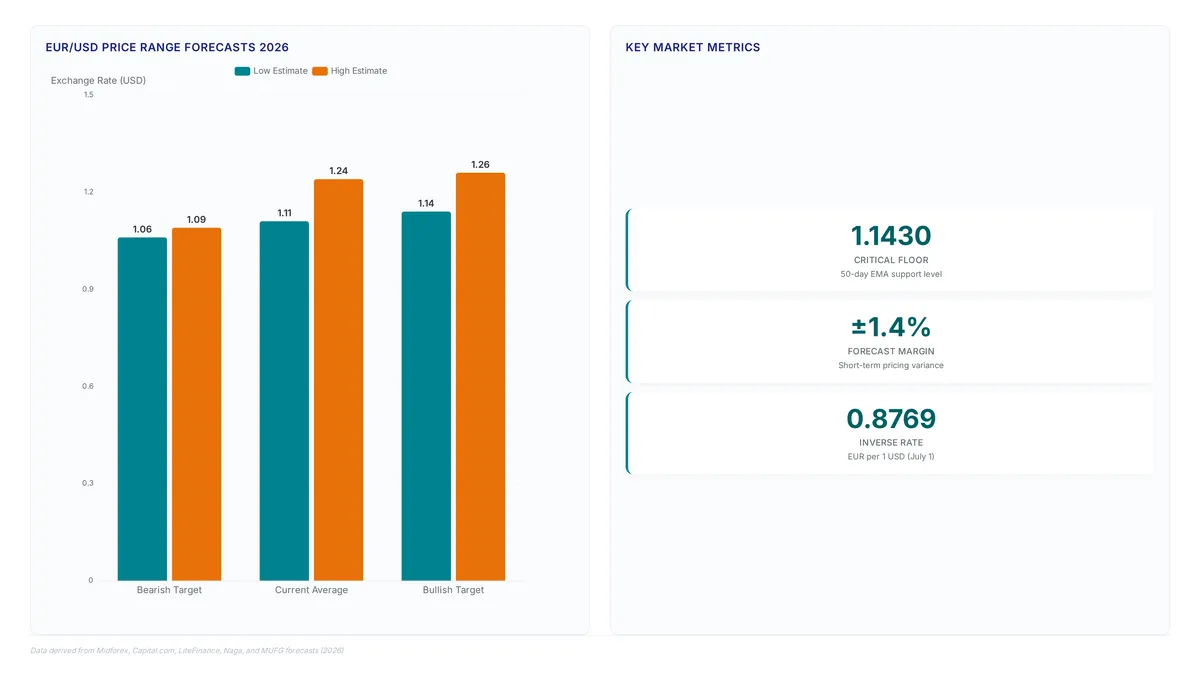
Call it what you want, consolidation, pause, breath, but do not call it a reversal yet. The price action screams patience, not conviction. While the pair recently posted a weekly appreciation of +0.53% driven by Federal Reserve easing expectations, intraday charts reveal a struggle to sustain gains above the EMA50 flexible support.economies.com reports that the exchange rate settled near 1.1438 on July 17, highlighting the critical nature of this technical battleground.
This is where noise drowns out signal. Traders often mistake a lack of selling for the start of buying. They are different animals. The guide below dissects how technical analysis defines the current market structure by pinpointing exactly where momentum dies despite bullish macro narratives. We focus on executing intraday trades using live support levels, specifically how stability at 1.1430 dictates short-term entry and exit strategies. Navigating the volatility of the world's most traded currency pair requires respecting these constraints, especially given that the pair accounts for an estimated a significant share of all global transactions.
The Role of Technical Analysis in Defining EURUSD Market Structure
Defining EUR/USD Support and Resistance Levels
Buyers step in at support levels; sellers dominate at resistance. It is that simple until the lines blur. In the current EUR/USD structure, the zone near 1.1390 acts as a static barrier preventing further decline. Above, resistance defines the ceiling. Recent market data highlights 1.1430 as a critical resistance threshold that has repeatedly capped bullish attempts, forcing traders to watch for breakouts or rejections. At the time of the last recorded update on 2026-07-17 23:05 UTC, the EUR/USD price was listed as 1.1438. Failure to breach this level resulted in slight intraday losses and a testing of the 50-day Exponential Moving Average (EMA50), exactly as observed when the pair failed to sustain gains above this mark during mid-July sessions.
Look at the inverse. As of July 1, 2026, the inverse USD/EUR exchange rate stood at a specific rate per 1 USD, implying a EUR/USD parity of approximately a corresponding value. Here lies the friction: some frameworks prioritize these static numbers, whereas others focus on flexible barriers like the 1.1499 level, which represents former support turned resistance. This methodological split forces a choice. You must distinguish between hard price floors and moving average constraints, or the market will punish the ambiguity.
| Barrier Type | Price Level | Function |
|---|---|---|
| Static Support | 1.1390 | Halts bearish momentum |
| Static Resistance | 1.1430 | Caps intraday rallies |
| Structural Ceiling | 1.1499 | Validates trend reversal |
Identifying these zones manages capital exposure. The 1.1390 level serves as a critical "cost basis" where buying interest has recently emerged to limit further declines. We integrate these technical definitions into our proprietary charting tools to help clients visualize these boundaries in real-time. A drop to the 1.1390 support level serves as a potential target in morning market assessments, signaling a deeper corrective phase if the level fails to hold.
Applying Momentum Signals to EUR/USD Trends
Bearish momentum screams when price action remains significantly weaker than the established trend. Operators respect the path of least resistance. A composite of moving averages from MA5 to MA200 generated a "Strong Sell" signal as of late June 2026. This configuration indicates that recent price action remains under pressure relative to the established trend. While some market participants might seek early entries during temporary bounces, technical indicators on June 30, 2026, signaled a "Strong Sell" recommendation based on these moving averages ranging from MA5 to MA200. Relying solely on these signals invites disaster during sudden reversals driven by macroeconomic shocks; the lag is real and costly.
Bullish momentum demands price sustain trading above key exponential moving averages. That condition remains unmet in the prevailing market structure where the pair faced negative pressure due to trading below the EMA50. The EUR/USD pair recorded a weekly appreciation of +0.53%, settling at an exchange rate of 1.1772, driven by expectations of Federal Reserve monetary easing. Do not let the weekly gain fool you. The technical backdrop remains dominated by selling pressure until specific resistance levels break. Operators must distinguish between corrective rallies and genuine trend changes to avoid premature position building.
| Signal Type | MA Configuration | Implication |
|---|---|---|
| Strong Sell | MA5 < MA200 | Downside pressure dominant |
Our platform provides advanced charting tools to monitor these moving average crosses in real-time. A sustained move above the EMA50 is required to reinforce stability and validate a shift away from the current bearish thesis, warranting an immediate reassessment of open positions.
Risks of Divergent Eurozone Economic Indicators
Inflation data indicated easing price pressures in Germany, France, and Italy during June 2026, while Spain's rates remained near two-year highs, influencing the Euro's monthly performance. When core nations experience easing price pressures while Spain's rates remain elevated, the resulting false breakout traps momentum traders relying on chart patterns alone. This internal divergence creates a fragmented macroeconomic baseline that technical indicators like RSI or moving averages cannot quantify.
Fundamental dissonance drives corrective declines that override intraday support levels. Downgraded growth forecasts combined with safe-haven demand for the US Dollar suppress the Euro's value despite bullish chart formations. Technical analysis defines the market structure, yet it fails to price in regional disparities until the price breaches key thresholds. A bearish breakdown scenario suggests potential drops to the 1.06, 1.09 range before any recovery, defining the lower bound of current cost expectations for our clients.
| Indicator Type | Limitation in Divergence |
|---|---|
| Moving Averages | Lag during sudden fundamental shifts |
| Support Levels | Break under asymmetric inflation data |
| RSI Signals | Generate false oversold readings |
Prioritize fundamental alignment over technical triggers when regional data conflicts. The cost of ignoring this divergence is evident in the volatility driven by conflicting economic reports. If core Eurozone inflation converges with Spanish highs, the market flexible may shift, requiring a re-evaluation of the current bearish thesis.
Mechanics of Momentum Loss and RSI Signals in Currency Pairs
Defining RSI Momentum Loss and Bearish Divergence Mechanics
Price makes higher highs while the relative strength indicator prints lower highs. This is bearish divergence, a mechanical failure. This specific configuration signals that buying pressure is exhausting even as the EURUSD pair attempts to extend gains. Such attempts to offload overbought status often precede a sharp reversal when momentum cannot sustain the upward trajectory. The cost of ignoring this signal is measurable; technical indicators collectively show a "Sell" outlook as moving averages reinforce the bearish trend technical indicators.
Distinguish between temporary consolidation and genuine momentum loss.
- Price action breaches prior support levels with increasing volume.
- The RSI fails to reclaim the 50.00 midline after a dip.
- Regional disparities in inflation data further fragment the single currency's external value regional disparities.
False signals remain a risk if the pair stabilizes above the EMA50 flexible support. The euro remains on track for significant monthly losses, compounding the pressure on any recovery attempt monthly losses. A breakdown scenario suggests pricing could drop to the 1.06, 1.09 range before any sustainable recovery occurs pricing range.
ForexCFD.top analysts note that divergence without volume confirmation often leads to whipsaws rather than trends. Timeframe selection matters; lower timeframes generate frequent but less reliable divergence signals compared to daily charts. Traders relying solely on RSI peaks without confirming price structure invite premature entries. Only a decisive close below key intraday support validates the momentum shift. Data from June indicates easing price pressures in substantial economies, yet Spain's rates near two-year highs create internal tension that fuels volatility easing price pressures. This macroeconomic divergence ensures that technical breakdowns may accelerate rapidly once critical thresholds breach.
Applying EMA50 Support and Higher Low Strategies to EURUSD
The EUR/USD pair currently relies on the EMA50 to establish a defensive base against persistent selling pressure. Price action recently failed to breach the key resistance at 1.1430, triggering a retest of flexible support levels. This specific technical configuration validates the necessity for traders to identify a higher low formation before committing capital to long positions. The market requires this structural shift to transition from mere stabilization to genuine bullish momentum.
- Monitor price interaction with the EMA50 for signs of accumulation rather than immediate breakout.
- Wait for a confirmed higher low to form above the 1.1350 threshold to validate trend reversal.
- Observe whether the pair can sustain trading above the moving average to offload overbought conditions.
Recent intraday sessions illustrate how the stability of the 1.1430 level acts as a critical pivot point for near-term direction. Attempts to gain bullish traction often falter without this core support holding firm. A notable case study shows that failure to clear resistance led to a retest of the EMA50, confirming the barrier's efficacy in limiting upward attempts technical resistance.
However, the formation of a higher low does not guarantee sustained growth if macroeconomic divergence persists. Regional inflation disparities can undermine technical setups regardless of pattern completion. For instance, easing price pressures in substantial Eurozone economies contrast with sticky inflation elsewhere, creating internal friction that caps the single currency's upside potential inflation divergence.
Traders at ForexCFD.top interpret these signals through a strict framework where the chart sets the entry only after the data sets the bias. The current strategy demands patience; entering before the higher low confirms exposes capital to false breakouts. A decisive close below the EMA50 invalidates the bullish thesis entirely, reopening the path toward deeper support zones. Only a verified breakout above 1.1380 accompanied by soft inflation data would flip this conservative view to aggressive accumulation.
Risks of Fluctuating Intraday Moves and False Momentum Signals
Fluctuating intraday levels frequently generate false momentum signals that trap traders expecting sustained directional moves. The EUR/USD pair recently demonstrated this risk by posting a modest rise even while suffering a monthly decline of a significant amount, creating a deceptive visual of recovery. Such price action often occurs when the market attempts to offload overbought status without establishing a genuine higher low, leading to sharp reversals. Traders misinterpreting these fluctuations as trend confirmations face significant losses when the broader bearish bias reasserts control.
The mechanism of this failure involves price breaching short-term resistance only to fail at key structural barriers like 1.1430. Historical data shows the pair witnessing slight intraday losses immediately after failing to breach such levels, validating the trap scenario technical resistance. This specific behavior highlights the danger of relying solely on immediate percentage changes without confirming volume or structural support. A strong strategy requires distinguishing between corrective bounces and genuine trend reversals to avoid entering short positions at temporary lows or long positions at false highs.
ForexCFD.top advises clients to wait for confirmed closes above resistance rather than reacting to intraday spikes. The cost of premature entry is often a complete loss of capital if the EMA50 fails to hold as flexible support. Traders must recognize that fluctuating moves often signal indecision rather than opportunity.
| Signal Type | Reliability | Action Required |
|---|---|---|
| Intraday Spike | Low | Wait for close |
| Structural Break | High | Confirm with volume |
| RSI Divergence | Medium | Check timeframe |
The view flips only if price sustains a close above the 1.1433 resistance level with increasing volume.
Executing Intraday Trades Based on Live Support Levels
Defining Intraday Fluctuation Dynamics Below EMA50

Fluctuated trading on latest intraday levels stems directly from the stability of the key support at 1.1430 alongside the support provided by the EMA50. Negative pressure grips the EUR/USD pair whenever price action settles below the EMA50, a constraint clearly visible when the market failed to breach the key resistance at 1.1430. Data indicates repeated attempts to gain bullish momentum and resume gains while leaning on the EMA50 as a flexible support base. Declined intraday trading sessions have occurred, yet the pair has also settled on strong gains supported by trading above the EMA50, which reinforces stability. ForexCFD.top analytical tools highlight these divergences so clients differentiate between noise and actionable signal within live charts. Premature long entries that contradict the primary trend represent the cost of ignoring this flexible. Observation confirms the short-term corrective bullish trend remains dominant while leaning on the EMA50.
Executing Entries on Higher Lows Near 1.1390 Support
Attempts to look for a higher low to use as a base help the pair gain the required momentum. Technical analysis indicates the pair achieved limited gains while leaning on a critical support level at 1.1390, which served as a potential target in morning market assessments. Traders identifying this higher low formation should wait for price action to reclaim lost ground before committing capital. The short-term corrective bullish trend remains dominant only while leaning on the EMA50 flexible average. A breach below this threshold could expose the pair to deeper declines. Market participants often mistake minor intraday fluctuations for genuine breakouts, leading to premature entries. Capital.
Identifying False Breakouts During Profit-Taking Truces
Resistance rejection at 1.1430 has led to negative pressure, with the pair failing to breach this key resistance level. This specific move was characterized as a truce to catch breath and gather its profits, creating a deceptive calm before potential downside continuation. Traders tracking intraday price movements must distinguish between these profit-gathering lulls and actual structural breaks. Immediate exposure to renewed selling pressure below the EMA50 is the cost of misinterpreting this signal. ForexCFD.top emphasizes that valid reversals require sustained closes above flexible averages, not wick formations. Relying on real-time percentage changes without confirming volume or candle closure leads to premature entries during these truces. Momentum oscillators often remain neutral during consolidation, offering no clear directional bias until the break occurs. Market participants should treat any rally failing to clear the 1.1430 ceiling as a selling opportunity within the broader downtrend.
Strategic Decision Making Amidst Forecast Uncertainty and Recovery Risks
Risks: Defining Forecast Error Risks in Divergent Eurozone Data
Conflicting regional inflation data creates immediate analytical blind spots that distort standard forecasting models. Market performance in mid-2026 was heavily influenced by conflicting inflation data across the Eurozone. This internal divergence fuels a corrective decline where localized price spikes mask broader economic weakness. The resulting 'double hit' scenario combines downgraded growth forecasts with surging safe-haven demand for the US Dollar. Such conditions render simple trend extrapolation unreliable for predicting EURUSD recovery paths.
- High inflation in Spain contrasts sharply with easing pressures in Germany and France.
- Aggregated Eurozone metrics fail to capture these critical national disparities.
- Forecast error margins expand significantly when regional data diverges without clear direction.
This fragmentation complicates the interpretation of technical signals near key levels. While some models suggest a potential bounce, the fundamental backdrop supports a deeper correction before any sustainable recovery occurs. Relying on uniform Eurozone data ignores the specific drag of weaker member states on the single currency. The primary risk remains that bullish technical patterns form solely on temporary liquidity gaps rather than genuine structural strength. Investors must prioritize regional inflation differentials over headline numbers to avoid false breakouts. Until then, volatility remains elevated as markets digest mixed economic signals.
Applying EMA50 Stability Tests to EUR/USD Entry Decisions
Traders asking if they should buy EURUSD at current levels must first verify whether the price holds above the 1.1430 floor while interacting with the 50-day Exponential Moving Average. On 2026-07-17 at 16:18 UTC, an evening update noted that the EURUSD pair witnessed fluctuated trading on its latest intraday levels. Recent sessions show the pair fluctuating specifically due to the stability of this key support, suggesting that the pair is attempting to build a higher low to use as a base for required momentum. The failure to breach the 1.1430 barrier previously resulted in slight losses, as the pair faced negative pressure due to trading below the EMA50.
- The pair has declined in recent intraday trading while leaning on EMA50 support.
- Trading above the EMA50 provides a flexible support base that reinforces stability.
- Fluctuating moves occur as the pair attempts to gain bullish momentum to recover recent losses.
Fixing incorrect forex analysis demands rejecting premature entries when the technical picture shows the pair failing to breach key resistance. While some models suggest a potential rebound, the cost of ignoring the EMA50 rejection is a retest of lower liquidity zones. The market view may shift if the pair successfully uses the higher low as a base, otherwise, the pair continues to face negative pressure when trading below the EMA50.
Risks of Signal Discrepancies Between Moving Average Composites
Aggregates data from MA5 to MA200 to produce this bearish technical signal, creating a sharp divergence from frameworks prioritizing the stability of the 1.1430 support level. Analytical approaches vary significantly between platforms, creating a split in trader sentiment. This discrepancy forces traders to choose between momentum indicators and structural support, often resulting in premature exits before a confirmed trend reversal. Analytics highlight that relying on a single platform's algorithmic output ignores the nuance of intraday consolidation.
- Momentum oscillators frequently conflict with long-term trend filters during transition phases.
The primary danger lies in treating an aggregated moving average rating as an absolute truth rather than a lagging derivative of past prices. While the broader moving average suite suggests further decline, the pair may be building energy for a rebound off established floors. The cost of ignoring this split is entering short positions exactly when the market is exhausting its downward momentum.
About
Marcus Halloran, Chief Market Strategist at ForexCFD.top, leads our daily coverage of G10 currency pairs with a specific focus on the EUR/USD. His background as a former interbank FX strategist in London provides the precise institutional perspective required to dissect the complex macro drivers influencing the Euro Dollar. In this analysis, Marcus applies his expertise in monetary policy and interest-rate differentials to interpret how ECB and Fed decisions directly impact price action. His daily work involves translating high-level central bank communications into actionable technical levels for retail traders, ensuring that complex market movements are explained with clarity and precision. At ForexCFD.top, an independent publication dedicated to regulation-aware forex and CFD news, Marcus ensures that every EUR/USD forecast is grounded in rigorous fundamental research rather than speculation. This approach aligns perfectly with our mission to provide global retail traders with vendor-neutral, education-first market intelligence.
Conclusion
The EUR/USD pair currently faces a structural conflict where aggregated moving average composites signal decline while price action respects the 1.1430 floor. This divergence creates a specific operational risk: traders who treat lagging algorithmic ratings as absolute truth often enter short positions precisely when downward momentum exhausts. The market is not merely fluctuating; it is forcing a choice between momentum oscillators and hard structural support. Ignoring this split leads to premature exits before a confirmed trend reversal, costing capital in both directions.
Adopt a conditional stance that prioritizes price reaction over composite ratings. Do not commit to a directional bias until the pair either firmly reclaims the 50day Exponential Moving Average or breaks the 1.1390 region with volume. The "double hit" of downgraded growth forecasts and safe-haven USD demand requires patience rather than prediction. Wait for the market to prove its intent rather than assuming the trend based on lagging derivatives.
Start this week by setting alerts at the 1.1390 support and 1.1430 resistance levels to notify you when price approaches these zones. This ensures your reaction is timely and based on actual liquidity tests rather than theoretical models. Focus your analysis on how the EUR/USD behaves at these specific boundaries to validate any potential reversal.
Frequently Asked Questions
This massive liquidity ensures tight spreads but demands strict risk management during volatile intraday sessions.
Traders should watch this gap closely as breaking below could trigger deeper corrective phases.
A weekly rise of 0.53% offers hope but fails to erase larger monthly losses entirely. Operators must distinguish between temporary bounces and genuine trend reversals before entering.
This static resistance caps rallies and forces sellers to defend the ceiling repeatedly. Failure to breach this zone often results in immediate testing of lower support floors.
Conflicting signals between static floors and dynamic averages create market tension. Traders must verify if momentum loss is temporary or signals a broader shift in structure.
References