
Geopolitical deescalation: Why oil's $4.50 drop matters
WTI crude's sudden $4.50 plunge confirms the market's brutal pricing of de-escalation risks.
Geopolitical calm triggers immediate supply shock reversals, forcing a rapid revaluation of assets previously hedged against Strait of Hormuz closures. InvestingLive data highlights how quickly inflationary pressure evaporates when refinery throughputs stabilize, shifting the narrative from scarcity to surplus. Investors aren't just celebrating peace; they are aggressively unwinding positions built on the fear of a significant supply deficit.
This analysis dissects the mechanical transmission of oil price volatility into sector-specific winners, explaining why airline stocks and cruise lines outperform during geopolitical de-escalation. We track how JETS ETF movements correlate with jet fuel spikes and why Carnival remains resilient despite broader energy exposure. We also examine the euro's reaction to reduced LNG dependency and the counter-intuitive surge in gold miners as emerging markets resume reserve building.
This is a calculated rotation away from war premiums. As refinery crude throughputs recover from projected lows of a substantial volume, the window for inflation hedging narrows significantly. The following sections define exactly which assets survive the transition from conflict pricing back to demand-driven fundamentals.
The Mechanics of the Peace Trade in Global Markets
Defining the Peace Trade via Strait of Hormuz De-escalation
When WTI crude drops $4.50 to $80.38, the peace trade mechanism triggers immediate asset repricing, erasing war risk premiums instantly. This de-escalation signal strips the geopolitical premium embedded in energy futures, directly linking headlines about Iran to tangible price action across global markets. Supply disruption fears subside as traders react to the news. Bearish analyses suggest prices could fall toward per-barrel levels near $50 if renewable adoption accelerates alongside conflict resolution. Optimistic scenarios forecast a rebound to the $91.72, $91.87 range, highlighting the binary nature of geopolitical risk pricing. Removing the war premium does not guarantee stable demand. Global oil supply faces a projected decline of several million barrels per day in 2026 regardless of geopolitical status.
Distinguishing temporary panic from structural deficits matters. Fuel costs decrease for airlines and cruise lines while underlying volume constraints remain intact due to earlier infrastructure damage. Equity valuations rise on margin expansion hopes even as physical throughput remains capped. Markets price the absence of war rather than the return of full capacity. This price floor caps input costs for generators and refineries, altering how inflation reacts to lower oil. The primary driver for this drop remains the removal of war risk premiums rather than a fundamental oversupply. Current headline inflation sits at +4%, a level described as squeezing consumers now through reduced discretionary income. Stabilizing energy prices prevents further erosion of purchasing power, allowing the peace trade to translate into tangible consumer relief.
Transitioning to stable pricing faces headwinds from inelastic demand sectors. Record travel volume conflicts with soaring energy expenses, creating a use play on stability for operators like Carnival. Booking levels remain strong despite high fuel costs. Such durability suggests that lifestyle travel demand absorbs price shocks better than utility consumption. The shift from revenge travel to sustained lifestyle travel indicates that consumer prioritization has fundamentally altered. Infrastructure cost inflation driven by tariffs further complicates the pass-through of wholesale savings. Operators must monitor whether the energy stability holds long enough to reset long-term contracts.
A concurrent significant demand contraction driven by price sensitivity contrasts sharply with this projected shortfall. Market stability hinges entirely on the assumption that obstructed routes clear by mid-year. Anticipated price relief evaporates instantly should the closure persist beyond June. The EIA assumes oil flows will slowly start to resume in the Third Quarter 2026, a timeline that leaves little margin for error. Analysts warn that oil prices reaching $126 per barrel Booking levels remain inelastic for specific luxury demographics despite this threat. These patterns mask underlying systemic stress. The peace trade narrative fails completely if physical barrels do not move.
Data center energy consumption approaching 1,050 TWh by 2027 further tightens the global energy balance sheet. This industrial load competes directly with transportation fuel needs, amplifying the impact of any supply shock. Demand destruction is not linear when necessary services compete for limited hydrocarbons. The window for a soft landing remains open but is narrowing rapidly.
Sector-Specific Transmission Channels for Oil Price Volatility
Jet Fuel Spikes and Airline Fare Durability Mechanics
Jet fuel price spikes driven by Middle Eastern refining losses forced airlines to implement +20% fare increases while demand remained resilient. This pricing power contrasts sharply with the cruise sector, where Carnival stock rose 6% despite lacking similar hedging protections against volatile spot markets.
The operational divergence stems from distinct cost structures and risk management strategies. Aviation accounts for roughly a small fraction of global energy-related CO2 emissions, a factor pressuring carriers to maintain margins for future decarbonization investments. Conversely, cruise lines use slower steaming and routing optimization to offset fuel exposure without relying on financial derivatives. While Carnival absorbed significant adverse fuel costs, the operator achieved $650 million in savings through fleet efficiency upgrades rather than hedging instruments.
| Feature | Airline Sector | Cruise Sector |
|---|---|---|
| Primary Hedge | Fare Increases | Operational Efficiency |
| Fuel Strategy | Pass-Through Pricing | Slower Steaming |
| Demand Signal | Inelastic Travel Need | Record Booking Levels |
| Risk Profile | Immediate Spot Exposure | Delayed Margin Impact |
A critical tension exists between immediate revenue protection and long-term volume growth. Airlines prioritize margin preservation through aggressive pricing, betting that underlying demand for flying remains strong enough to withstand hikes. Cruise operators like Carnival focus on capacity management and fuel burn reduction to navigate volatility. This split strategy reveals that asset values inflate based on perceived adaptability to supply shocks rather than raw fuel cost exposure alone. The market rewards visible operational adjustments over static financial hedges when geopolitical risks recede. This operational pivot substitutes financial hedging instruments with physical fuel burn reductions, distinguishing the carrier from airlines that rely on derivative contracts.
The limitation remains that competitors with active hedging programs may report smoother profit dynamics during sharp price rallies. Carnival's model demands continuous execution perfection, whereas a swap contract guarantees a price regardless of operational performance. This tension defines the risk profile for investors analyzing cruise stocks against airline peers in a post-conflict environment. Conversely, Carnival traditionally avoids hedging instruments, leaving the balance sheet vulnerable to spot market volatility while competitors hedge. The initial equal battering of both sectors reflected broad travel panic rather than identical cost structures.
Record booking levels at premium prices indicate that demand remains inelastic for specific luxury and mass-market demographics. This flexible creates a tension where Carnival functions less as a recovery play and more as a direct bet on energy price stabilization. Operators must recognize that cruise equity valuations now track oil stability more tightly than historical fuel burn ratios suggest. The market prices cruise stocks on sustained low-energy scenarios rather than transient demand spikes.
Comparative Asset Performance During Geopolitical De-escalation
Defining the Peace Trade: Gold Reserves vs Euro Energy Exposure
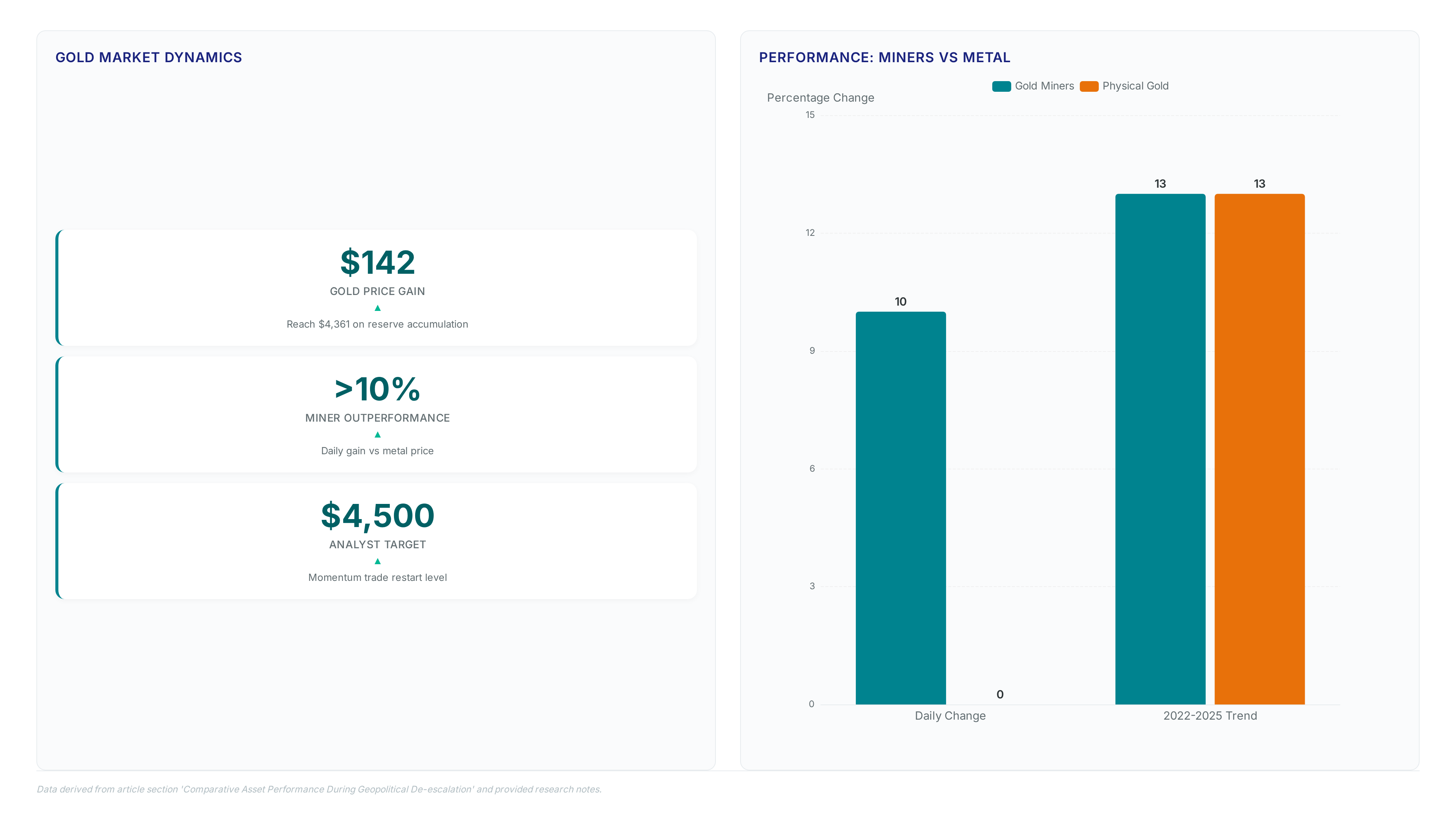
Gold gains $142 to reach $4361 as emerging markets resume reserve accumulation previously halted by oil shocks. This reserve rebuilding mechanic treats bullion as a balance sheet stabilizer rather than a fear gauge. Analysts target a return above $4500 to restart the momentum trade, signaling that central bank demand now outweighs technical resistance. The driver is distinct from speculative flows; it is a structural repair of sovereign wealth degraded by energy costs. Many gold miners are up by more than 10% today, outperforming the metal itself due to operational.
Conversely, the euro advances 48 pips primarily because the eurozone economy remains heavily exposed to energy flows via oil and LNG. A retreat in crude acts as a direct catalyst for the currency by easing terms of trade. Market participants note that European stocks could return to being the flavour-of-the-week com) if oil stability persists, though capital rotation remains slower than equity reactions. The tension lies in the fact that while cheap energy helps the euro, it often signals weaker global growth, creating a ceiling for sustained appreciation. Operators must watch for the point where falling oil prices transition from a relief rally into a demand destruction signal, which would reverse both trades.
The euro is up 48 pips today because the eurozone economy remains heavily exposed to energy flows via oil and LNG. However, market participants note that European stocks have been slow to react, suggesting renewable energy adoption rates may dictate long-term stability more than temporary peace dividends. In global travel hubs away from Western markets. Buying gold now addresses sovereign liquidity risks, whereas euro exposure hedges against energy import costs.
Meanwhile, the peace trade narrative favors the euro as crude oil retreats, but this currency gain relies entirely on sustained energy de-escalation. A retreat in crude oil prices acts as a strong catalyst for the euro, though market participants remain slow to buy the peace fully. Speculation persists that European stocks could return to being the flavour-of-the-week, driven by the region's heavy exposure to energy flows via oil and.
Conversely, gold miners offer use that spot prices lack, with many names up double-digits today. This sector functions as a hedge against the very energy instability that threatens travel demand. Investors chasing the Euro recovery ignore the structural risk that emerging markets will resume building gold reserves regardless of short-term peace. The limitation is clear: peace benefits both assets differently, but only gold offers a floor if geopolitical tensions resurface. This scenario contrasts with optimistic projections capping near a high threshold, leaving a wide volatility band for operators to navigate. Below this level, the inflationary shock dissipates, allowing consumer spending to recover from utility costs that rose 13% recently.
Demand durability remains the critical variable for trade execution. Despite fare hikes, air travel volume persists, yet leisure budgets face pressure from elevated power bills. Budget-conscious travelers now seek offseason pricing under $100 per night to offset other expenses, shifting yield dynamics for carriers. This behavior confirms that while headline inflation squeezes liquidity, specific demand pockets remain inelastic. Failure to hold this line invalidates the peace rebound thesis, forcing a retreat to defensive positions until supply clarity returns. The cost of misreading this signal is immediate drawdown as algorithmic flows react to the next technical breakdown.
Carriers absorbed fuel volatility by passing costs to consumers without destroying booking velocity. This pricing power contrasts with historical elasticity models where fuel spikes cratered load factors. Operators now face a narrow window to enter before earnings reports cement the recovery narrative. Coverage Pillars recommends scaling positions as crude stabilizes near recent lows. The durability indicates that travel remains a priority even as headline inflation squeezes disposable income elsewhere.
Cruise lines demonstrate similar fortitude, with record 2026 booking levels achieved at premium price points. Carnival Corporation specifically mitigates risk through slower steaming. These operational adjustments preserve margins while competitors struggle with legacy fuel contracts. Entry timing should align with off-season pricing cycles where Mexican Riviera sailings drop to attract volume without sacrificing yield.
The limitation remains regulatory scrutiny over CO2 emissions, which account for a measurable share of global energy output. Investors must monitor whether efficiency gains outpace carbon taxation risks in the coming quarters. Strategic entry requires balancing current momentum against potential policy headwinds that could erode profitability quicker than fuel savings accrue.
Operators should first audit balance sheets for fuel efficiency measures that mirror cruise line strategies, as energy cost management directly correlates to mining margin survival during volatile periods. A second filter requires confirming exposure to emerging market central bank buying, which drives the underlying bid structure independent of technical resistance. This discipline prevents chasing false breakouts driven solely by algorithmic trading rather than fundamental supply constraints.
However, a rapid retreat in crude oil could strengthen the dollar, temporarily suppressing dollar-denominated gold despite strong physical demand. The cost of ignoring this macro correlation is a premature entry before the momentum trade fully resets. Coverage Pillars advises waiting for confirmed volume expansion above the key threshold rather than anticipating the move. Investors must recognize that while inflation remains sticky, the path to higher asset values requires clearing specific technical hurdles that many miners have yet.
About
Aisha Rahman, Gold & Commodities Analyst at ForexCFD. Top, brings critical regional expertise to the analysis of WTI crude volatility. Based in the Gulf, her daily work involves monitoring the precise geopolitical fault lines that drive global energy markets, including the strategic Strait of Hormuz. This proximity allows her to contextualize how supply disruptions and inflationary shocks directly impact oil prices and broader market sentiment. Her specialization in commodity-currency links and safe-haven flows provides the necessary framework to understand why WTI's drop to $80.38 matters for global traders. At ForexCFD. Top, an independent publication dedicated to factual market news and risk-aware trading education, Aisha uses her deep understanding of both fundamental supply dynamics and technical price action. Her analysis connects real-world events in the Middle East to actionable insights for retail traders navigating energy sector fluctuations, ensuring complex macroeconomic data is translated into clear, vendor-neutral guidance.
Conclusion
When crude volatility compresses travel margins, the operational break point shifts from fuel procurement to capital allocation discipline. The binary price swings between $50 and a high threshold create a trap where hedging strategies that worked in stable markets fail to protect liquidity during rapid regime changes. Companies relying solely on spot market exposure will find their balance sheets eroded quicker than efficiency gains can replenish them. The real cost the price per barrel, but the inability to pivot fleet deployment quickly enough to match demand elasticity without sacrificing yield.
Investors must mandate that transportation operators demonstrate a verified fuel-to-revenue hedge ratio exceeding a substantial majority before committing new capital by Q3 2026. This threshold ensures survival if geopolitical premiums vanish overnight, leaving only fundamental supply dynamics. Do not accept vague promises of route optimization; demand concrete proofs of derivative coverage that lock in margins regardless of headline spikes.
Start this week by auditing your portfolio's exposure to carriers with unhedged fuel burn above a majority of operating costs. Divest or demand immediate risk mitigation plans from management teams lacking specific, time-bound hedging schedules. This immediate filter separates solvent operators from those merely gambling on stable geopolrics.
Stabilizing energy prices helps prevent further erosion of purchasing power for households globally.
Frequently Asked Questions
WTI crude dropped $4.50 to $80.38, instantly erasing war risk premiums from the market. This sharp decline confirms the brutal pricing of de-escalation risks as supply shock fears subside quickly.
Bearish analyses suggest WTI crude could fall toward $50 per barrel if renewable adoption accelerates alongside conflict resolution. This contrasts with optimistic scenarios forecasting a rebound to higher price ranges soon.
Airlines implemented +20% fare increases to cover oil prices, yet demand remained remarkably resilient throughout the period. This suggests strong underlying consumer desire for flying despite significant cost pressures on travelers.
Gold miners are surging as emerging markets resume building reserves, with many stocks up more than 10% today. Investors seek assets that benefit from renewed reserve building by global economies now.
Current headline inflation sits at +4%, a level described as squeezing consumers through reduced discretionary income. Stabilizing energy prices helps prevent further erosion of purchasing power for households globally.