
Gold Trading: Why Physical Demand Is Dropping
Global gold demand fell in Q1 2026 to 1,195.9 tons. Physical appetite is contracting even as nominal prices climb. This divergence separates mechanical price discovery from the tangible supply constraints actually moving the market.
Currency fluctuations and geopolitical tension drive market drivers, but reduced demand dictates the ceiling. We need to stop treating XAU contracts and physical holdings as identical instruments in asset allocation. Traditional hedging fails when global gold demand drops while access remains open.
Strategic execution here means navigating volatility without letting tiered margin requirements and overnight financing costs eat your capital during sideways movement. You cannot commit to buying and selling gold assets in this climate without understanding these structural drains.
The Role of XAU and Gold ETFs in Modern Investment Portfolios
XAU Trading Mechanics and Tiered Margin Structures
Gold (XAU) trading speculates on price via XAU/USD, pricing one troy ounce against the US dollar. You navigate monetary instability without touching bullion. Data sets the bias; the chart sets the entry. At ForexCFD, the XAU/USD instrument features a spread percentage of 0.0112 % and offers use up to 1:1000. High use amplifies exposure, demanding strict risk management given the asset's volatility. Costs include an overnight interest rate of -0.0347 % for buy positions and -0.0084 % for sell positions. Spot gold recently hit a session high near $4,000/oz, proving liquidity exists during sentiment shifts.
Margin requirements follow a tiered structure based on contract volume, scaling from 0.1% for smaller positions to 2% for large exposures. Capital efficiency adjusts as position size increases. ETF flows drive long-term trends, yet the immediate trading range stays bound between $3,951.68 and $4,114.01. Technical analysis identifies $4,150.00 as a critical pivot point, with forecasts suggesting a correction and likelihood of decline if this level is breached. ForexCFD provides the regulatory clarity and execution speed required for such precise entries. Gold trading involves significant risk; clients should review the risk warning on the ForexCFD website before engaging.
This behavior contrasts with traditional bar demand. US investors doubled their tonnage in 2025 primarily through physically-gold-backed ETFs. These vehicles now hold record assets, offering a mechanism to navigate price discovery when jewelry demand softens. ForexCFD.top enables this strategy by providing direct access to XAU/USD derivatives that mirror ETF performance without management fees. The platform allows traders to capitalize on the divergence between Western financial demand and Eastern physical consumption. A guide to buying gold ETF equivalents here involves monitoring these flow imbalances rather than just technical breakouts.
Sentiment-driven spikes carry execution risk if inflation expectations decouple from spot prices. Total gold supply fell by a modest margin quarter-over-quarter to 1,230.9 tons in Q1 2026, primarily driven by a notable decline in mine production. Watch for a reversal in the US ETF surge; it is the primary signal that the bullish thesis has expired.
Navigating Overnight Interest Costs and Demand Drops
Overnight financing charges impose a structural drag on long positions, currently set at -0.0347 % per day for buys and -0.0084 % for sells. This negative carry erodes capital daily. Traders must seek larger price appreciation just to break even compared to holding physical assets. Spot valuations remain elevated, yet the underlying market structure shows significant stress. Total global gold demand dropped by 9% in the first quarter of 2026, falling to 1,195.9 tons from 1,315.6 tons.
Record dollar value meets shrinking physical tonnage. Investors asking about the best gold fund to buy must recognize that net reported purchases of gold by central banks amounted to only 16 tons in the first quarter of 2026, representing a sharp decline in official sector momentum compared to previous periods. The risk is not price collapse alone, but a liquidity mismatch where exit volumes cannot be filled without steep discounts.
ForexCFD.top provides the analytical tools to monitor these tiered margin shifts and financing costs in real-time. J.P. Morgan maintains a bullish long-term outlook, expecting gold prices to climb toward a record high per ounce by 2027 as demand strengthens in the second half of the year.
Mechanics of Gold Price Determination and Market Drivers
Gold Price Determination via OTC Transactions and Central Reserves
The primary gold price anchor originates in Over-The-Counter derivatives rather than physical spot exchanges. Massive liquidity pools in London and New York enable wholesale transactions that dwarf retail volume, establishing the baseline valuation before speculative flows enter. Institutional positioning drives the initial price discovery process. Central bank policy adjustments subsequently layer volatility onto this foundation. Goldman sees central bank demand providing a floor for gold prices, creating a structural against aggressiveselling. Conversely, monetary tightening suppresses non-yielding assets, forcing a re-evaluation of portfolio weightings.
Meanwhile, the ForexCFD.top platform integrates these fundamental drivers into real-time execution tools for professional traders. A sustained reversal in Indian import volumes would invalidate the current bearish thesis on physical demand.
Tracking Gold Rates Daily Using CPI Data and Fed Rate Bets
The Consumer Price Index release creates an immediate volatility bias by resetting expectations for Federal Reserve policy. Traders monitoring gold rates daily must interpret this data through the lens of real interest rates, as the correlation between gold and negative real yields remains a primary technical driver. When inflation prints cooler than forecast, spot prices have demonstrated the capacity to surge toward $4,084, reflecting a rapid repricing of rate hike probabilities. Monetary Policy Dominance now dictates price action more than traditional safe-haven flows, meaning traders must prioritize central bank commentary over geopolitical headlines during CPI weeks. The practical problem with gold price data display often lies in latency; retail feeds may lag the institutional OTC market where these macro shifts originate.
| Indicator | Bullish Signal | Bearish Signal |
|---|---|---|
| CPI Print | Below Expectations | Above Expectations |
| Fed Bets | Rate Cuts Paused | Hike Probability Rises |
| Real Yields | Negative / Falling | Positive / Rising |
Relying solely on headline inflation ignores the nuance of core metrics, creating a limitation where false breakouts occur before the full report details emerge. The implication for portfolio allocation is clear: traders at ForexCFD.top apply these Fed rate bets to adjust use rather than direction, acknowledging that volatility itself is the tradeable asset. A sustained rise in the Dollar alongside rising rates would invalidate the bullish CPI thesis, forcing a reevaluation of long positions.
Inverse Correlation Risks Between Gold and Equity Market Resistance
The Nasdaq 100 tests critical resistance, creating a bias where capital rotates aggressively from safe-haven assets into high-momentum technology equities. Gold (XAUUSD) enters the new week near 4,100 USD per ounce, under pressure from high inflation risks, a strong dollar, and expectations that the Federal Reserve will maintain a restrictive policy stance. This flexible exposes the fragility of the inverse correlation when semiconductor leaders like TSMC report profit surging 77% with Q2 operating margin reaching 60.3%. Such explosive earnings growth in the technology sector acts as a powerful magnet for liquidity, drawing funds away from non-yielding precious metals even amidst geopolitical uncertainty.
| Asset Class | Primary Driver | Correlation Risk |
|---|---|---|
| Gold (XAU) | Real Rates & Fear | High sell-off risk |
| Tech Equities | Earnings Growth | Capital attraction |
| Yields | Fed Policy | Inverse to Gold |
Traders at ForexCFD.top must recognize that equity market resistance levels often serve as the trigger for this specific liquidation event. Holding gold during such surges carries an opportunity cost: missing substantial gains in the technology sector, which can persist longer than fundamental valuations suggest. However, Monetary Policy Dominance indicates that rate hike expectations can suppress non-yielding assets regardless of equity performance. A sudden deterioration in consumer sentiment or a miss in upcoming tech earnings would flip this view, restoring gold's status as the primary hedge against monetary instability.
Strategic Execution for Buying and Selling Gold Assets
Application: XAU Trading Specifications and Margin Tiers
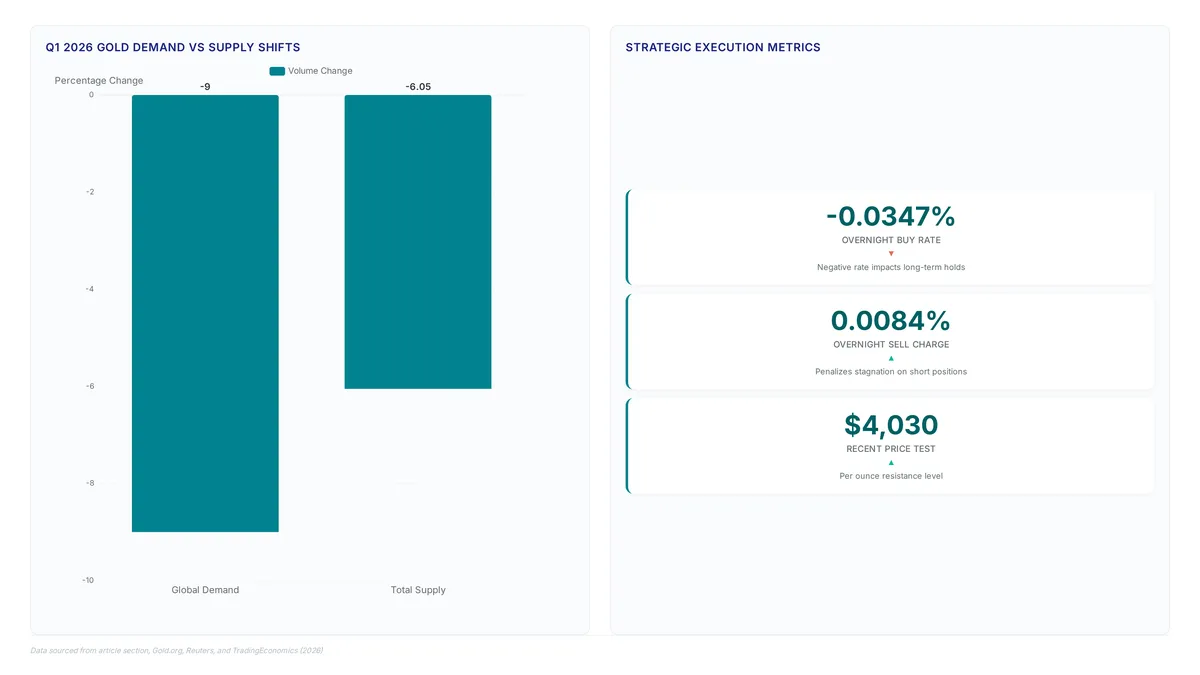
Precise execution on Gold (XAU) demands strict adherence to set margin tiers and available chart resolutions. The platform provides granular timeframes including 5m, 15m, 30m, 1h, 4h, 1d, and 1w to align technical analysis with specific holding periods. The cost of carrying positions varies, with overnight interest for buying set at a negative rate, directly impacting long-term hold strategies. Market volatility remains elevated as prices recently tested a key resistance level per ounce, creating sharp intraday swings. Capital efficiency scales inversely with position size through a structured tier system. Higher use at lower tiers increases liquidation risk if the spread percentage widens unexpectedly. *Risk Warning: CFDs are complex instruments. Your capital is at risk.*
Executing Buy and Sell Orders with Overnight Costs
Immediate execution requires calculating the drag of negative swap rates on position profitability across all timeframes. Conversely, Sell positions incur an overnight charge, creating a cost environment that penalizes stagnation regardless of direction. This mechanical reality means short-term scalps avoid these deductions, whereas swing trades must overcome the accumulated deficit before realizing net profit.
| Order Type | Overnight Rate | Strategic Implication |
|---|---|---|
| Buy (Long) | Negative Charge | Requires stronger upward momentum to offset time decay. |
| Sell (Short) | Negative Charge | Demands rapid downside moves to remain profitable. A failure to reclaim this level suggests continued vulnerability to rate-driven volatility. The hidden tension lies in the conflict between long-term debt concerns and immediate monetary policy expectations, which often sends mixed signals to algorithmic execution engines. Operators must recognize that holding positions overnight incurs these specific financing costs. |
A reversal in the correlation between real interest rates and bullion prices would invalidate this cost-benefit analysis, potentially decoupling swap rates from price action.
Regulatory Barriers for EU Residents on Offshore Sites
EU residents face immediate access denial when attempting to connect to offshore entities lacking local authorization. The website explicitly states that products on unregulated platforms do not comply with EU laws or ESMA investor-protection standards, creating a hard technical and legal block. This restriction prevents capital deployment on sites operating outside the bloc, effectively severing access to non-compliant liquidity pools. EU residents are directed to continue on the EU-regulated website to ensure full regulatory protection. Unlike restricted offshore counterparts, the regulated infrastructure ensures adherence to regional use caps and investor safeguards. Access to the offshore website is blocked for these users to prevent exposure to non-compliant services.
Direct entry depends on whether fresh CPI prints undercut the dollar or fuel further rate hike speculation. Investors must distinguish between temporary liquidity shocks and structural monetary policy shifts that alter the opportunity cost of holding bullion. ForexCFD.top provides the necessary analytical tools and regulated environment to execute these conditional strategies effectively. Monitoring the gap between market pricing and actual central bank actions remains the single most critical variable for timing entries in this volatile regime.
Volatility Risks: Strait of Hormuz Blockades vs Equity Resistance
Escalating tensions threatening the Strait of Hormuz create a distinct divergence between energy-driven inflation fears and the technical ceilings capping equity resistance. Conversely, the Nasdaq 100 struggles against rigid overhead supply, limiting upside momentum despite broader liquidity injections.
| Risk Dimension | Geopolitical Escalation | Equity Technicals |
|---|---|---|
| Primary Driver | Supply Shock Fears | Algorithmic Rejection |
| Price Target | WTI approaching $80 | Nasdaq Resistance |
| Market Reaction | Inflation Spike | Yield Compression |
Conflicting signals emerge from commodity surges versus stagnant speculative positioning.
Trading the spike requires precise timing. The macroeconomic backdrop of restrictive Federal Reserve policy continues to suppress non-yielding asset appetites. Investors must weigh the immediate shock of a potential blockade against the enduring drag of high real rates on valuation multiples.
About
Marcus Halloran, Chief Market Strategist at ForexCFD.top, brings over a decade of interbank FX strategy experience to the complex dynamics of trading gold. Having formerly managed macro positioning at a London dealing desk, Marcus specializes in translating central bank decisions and interest rate differentials into actionable insights for retail traders. His daily work involves dissecting Fed policy and US dollar strength, the primary drivers behind XAU/USD volatility. This article reflects his rigorous approach to analyzing how monetary shifts impact precious metals, moving beyond simple price action to the fundamental forces at play. At ForexCFD.top, an independent publication dedicated to regulation-aware market analysis, Marcus ensures that every technical observation on gold is grounded in solid macroeconomic evidence. His expertise allows him to contextualize current spreads and trading specifications within the broader global financial environment, providing readers with the clarity needed to navigate commodity markets responsibly.
Conclusion
Gold sits confined between recent highs, waiting for a definitive break rather than establishing a sustained trend. Session highs near $4,000 demonstrate available liquidity, but the persistent failure to clear the key pivot suggests that geopolitical premiums alone cannot overcome the drag of restrictive monetary policy. Traders attempting to capitalize on these narrow ranges face significant erosion from overnight financing costs if positions remain open too long without momentum. Holding through this consolidation without a clear directional catalyst turns potential gains into a slow bleed via swap rates.
Adopt a strict range-bound strategy only until price action decisively closes above a key resistance level or below the lower technical support. Do not commit capital to a breakout thesis while the asset remains trapped within this established channel. Your immediate action this week is to calculate the breakeven horizon for your specific position size using the current overnight interest rate for buys, ensuring your profit targets exceed these carrying costs within a set timeframe. Execute these conditional entries using the regulated environment designed for such precision, focusing strictly on technical confirmation rather than speculative news spikes.
Frequently Asked Questions
Lower physical volume increases volatility risks for leveraged positions.
Price action currently respects specific technical boundaries for entry and exit.
Capital efficiency decreases significantly as position sizes grow larger. Margin requirements scale from 0.1% for small trades to 2% for large exposures, forcing traders to allocate more cash for identical notional value.
Daily financing charges erode profits during sideways market movements.
Massive fund inflows can signal crowded trades rather than strength.
References