
SpaceX CFDs: Trade Post-IPO Volatility Safely
SpaceX raised a record US$86 billion after underwriters exercised the overallotment greenshoe option, per FP Markets data.
The addition of SpaceX share CFDs allows traders to speculate on post-IPO volatility without owning the underlying asset. FP Markets clients can now access institutional-grade tools to navigate the sharp price swings seen since the June 12 debut. While the stock opened at US$150 and briefly eclipsed US$200, it has since collapsed to test pre-IPO levels near the initial US$135 pricing. This introduction details how Share CFDs provide critical access to these erratic market movements following the largest IPO in history.
Readers will learn the specific mechanics of trading SPCX on MetaTrader 5 and cTrader platforms as outlined by FP Markets. The article examines how to execute both long and short positions to capitalize on the depreciation patterns often seen in large IPOs during their first year. Historical precedents like Meta Platforms suggest such volatility is standard, making the ability to trade both directions necessary for risk management.
Understanding these trading mechanics is vital given the unprecedented demand for high-growth technology companies. The guide explains how flexible use on these platforms enables exposure to SpaceX price action regardless of market direction. Traders can now engage with this landmark listing using the same professional infrastructure applied to other substantial global indices.
The Role of Share CFDs in Accessing Post-IPO SpaceX Volatility
Share CFDs and the SpaceX Greenshoe Option Mechanism
A share CFD grants price exposure without equity ownership. FP Markets lists this instrument for Space Exploration Technologies Corp. On MetaTrader 5 and cTrader interfaces. Directional access to post-IPO volatility flows through these institutional-grade trading tools. The greenshoe option allowed underwriters to expand the capital raise notably. SpaceX initially secured US$75 billion before the overallotment increased the total to US$86 billion. The IPO resulted in a staggering valuation for SpaceX of an immense amount. Rapid repricing creates wide spreads that elevate transaction costs for derivative traders. Liquidity arrives alongside a demand for precise entry timing during the initial discovery phase. Early depreciation risks haunt large technology debuts according to historical patterns. Use increases both upside potential and downside exposure equally.
- Definition: Derivatives tracking asset price without ownership rights.
- Platforms: Execution available via MT5 and cTrader systems.
- Pricing: Initial share price set at US$135.
- Mechanism: Greenshoe provisions expanded the total offering size.
- Risk: Capital is at risk due to high use.
Structural tension exists between immediate liquidity access and the cost of carrying used positions overnight. Large IPOs tend to experience depreciation in their first year of trading. Companies like Meta Platforms dropped initially before surging. Equity bulls may step in later to match historical norms.
Risk Warning: Share CFDs are complex instruments with high use risk. Capital is at risk.
Trading Post-IPO Volatility with Long and Short CFD Positions
Post-IPO volatility defines the SPCX trading environment where prices fluctuate wildly before stabilizing. Demand initially drove the share price to US$150 at the open, and it eclipsed US$200 shortly after on 16 June before collapsing to test pre-IPO levels. Historical data suggests large IPOs tend to experience depreciation in their first year of trading. This trend creates a natural bearish bias for early entries. Traders apply long positions to capture rebounds from oversold conditions. Short positions profit from the anticipated downward drift.
Technical architecture supports both directional bets. Speculation on upward surges and downward corrections becomes possible. Flexibility matters because trading SPCX CFDs provides exposure to post-IPO volatility. Spreads widen notably during high-volume periods. Effective cost of entry and exit increases materially. A contrarian might buy the dip if the price stabilizes near the initial offering range. Speed of reversal constitutes the specific risk here. Large IPOs often see sharp, non-linear moves. Used positions face liquidation before the broader trend resumes.
Financing costs and margin calls confront the CFD trader. Long-term shareholders avoid these constraints. Success depends on precise timing rather than fundamental conviction alone. The market will eventually price the asset based on earnings. The interim path remains highly unpredictable. Liquidity conditions require close monitoring as the initial frenzy subsides. Alternative reporting indicates the IPO raised $85 billion through the sale of more than 555 million shares. A massive float can suppress early price action. Companies like Meta Platforms (META) dropped in their first year before surging. SPCX may face similar headwinds despite its technological promise. A share CFD allows traders to speculate on these downward moves without owning the underlying equity.
Sheer scale of the offering means minor sentiment shifts trigger disproportionate price declines. Early rallies often fade as institutional holders rebalance portfolios. Holding used long positions through this correction phase invites danger. The long-term thesis for Space Exploration Technologies Corp. Remains strong. Short-term technical structure favors caution. Volume profiles warrant close monitoring for signs of distribution. Data sets the bias; the chart sets the entry.
Mechanics of Trading SPCX on MetaTrader 5 and cTrader Platforms
MT5 and cTrader Architecture for SPCX CFD Execution
FP Markets, a global, multi-regulated, award-winning broker established in Sydney, Australia in 2005, expanded its equity offering to include share CFDs for Space Exploration Technologies Corp. (SPCX) roughly two weeks after the stock's market debut. The broker targeted users by offering access to the instrument on both MetaTrader 5 (MT5) and cTrader platforms simultaneously. This dual-platform strategy ensures that clients can trade the new offering on established institutional interfaces immediately upon release. Other brokers prioritized speed. FP Markets focused on providing the instrument across distinct execution environments, including MetaTrader 4, TradingView, and cTrader, as part of its selection of over 10,000 CFD instruments.
Technical access allows clients to reach the SPCX CFD through these specific platforms, which support the broker's multi-regulated global presence. Both platforms provide real-time data feeds connected to the underlying Nasdaq market. Traders accessing the MT5 platform or cTrader can apply flexible use parameters available on the broker's Standard and Professional accounts. The cost structure involves spreads, which are intrinsic to CFD trading and linked to the volatility of the underlying asset. Traders should recognize that use applies to the exposure taken on these platforms. Slippage becomes a tangible threat if market liquidity thins during rapid price movements. Any disruption in the upstream Nasdaq feed would affect price availability on both platforms.
*Risk Warning: CFDs are complex instruments with a high risk of losing money rapidly due to use. FP Markets is regulated by ASIC, CySEC, FSA, FSCA, and CMA. This content is for educational purposes only and does not constitute financial advice.*
Platform Divergence: StarTrader's Speed vs FP Markets' Dual-Access Strategy
Operational agility drove STARTRADER to list SPCX CFDs on MetaTrader 5 just three days post-debut, capturing early volatility. This speed-first approach contrasts with the strategy employed by FP Markets, which announced its listing on June 26, 2026, offering access on both MetaTrader 5 and cTrader. By launching on multiple platforms simultaneously, the broker provides clients with a choice of industry-leading interfaces rather than restricting access to a single venue.
| Feature | Speed-Focused Deployment | Dual-Platform Strategy |
|---|---|---|
| Primary Goal | Capture initial liquidity spike | Serve diverse platform preferences |
| Platform Scope | Single interface (MT5) | MT5 and cTrader simultaneous |
| Target User | Retail momentum traders | Traders requiring platform choice |
| Latency Trade-off | Minimal setup delay | Thorough tool integration |
Consequences of this divergence appear in the range of tools available to traders at launch. Rapid deployers offer quick entry. FP Markets emphasizes a broad selection of world-class trading platforms, including MetaTrader 4, MetaTrader 5, TradingView, and cTrader. Traders using MetaTrader 5 alongside cTrader gain access to different charting and automation capabilities. The dual availability ensures that clients can select the environment that best suits their trading style, whether they require specific algorithmic features or manual execution tools. Traders using flexible use on MetaTrader 5 or cTrader face widened spreads as pricing engines adjust to the underlying exchange data feeds. Order books can gap. Market executions fill notably away from the requested price level. This risk increases for short positions attempting to enter during sudden upward surges or long positions exiting during crashes, as seen in the stock's first week of trading.
| Risk Factor | Technical Consequence | Mitigation Strategy |
|---|---|---|
| Liquidity Gaps | Execution at degraded prices | Use limit orders only |
| Latency Spikes | Delayed order transmission | Monitor market depth |
| Margin Calls | Automatic position liquidation | Reduce use ratios |
No software interface can manufacture liquidity where none exists physically within the matching engine. Established brokers like FP Markets cannot guarantee fill prices when volatility exceeds normal statistical distribution models, such as during the record-breaking IPO events. Exchange circuit breakers halt trading entirely. All pending orders become inactive regardless of platform sophistication.
*Trading CFDs involves significant risk of loss to your capital. ForexCFD.top is an educational resource operated by ForexCFD.*
Executing Long and Short Positions on the SpaceX Share CFD
SPCX CFD Long and Short Position Mechanics on FP Markets
Opening a position on Space Exploration Technologies Corp. requires selecting a directional bias without owning the underlying equity. Traders access post-IPO volatility through MetaTrader 5 or cTrader interfaces provided by FP Markets. The mechanism separates price speculation from share registration, allowing immediate participation in both upward and downward moves.
- Select the SPCX instrument from the market watch list on your preferred terminal. 2.3. Choose "Sell" to open a short position if expecting a reversion toward pre-listing valuation levels.
- Define lot size and apply flexible use to determine total exposure relative to margin.
The technical architecture supports both long and short positions, enabling speculation on either side of the price action. A critical limitation exists: widening spreads during high-volume periods can increase the effective cost of entry and exit significantly. This friction means that while use amplifies gains, it also accelerates losses if the market moves against the chosen direction before liquidity stabilizes. ForexCFD.top is an educational resource. Affiliate relationships exist.*
Executing SPCX Trades via MetaTrader 5 and cTrader Platforms
Immediate instrument availability on MetaTrader 5 and cTrader defines the current execution window. Traders must bypass equity ownership mechanics to access pure price exposure through CFD contracts. The workflow separates account activation from order entry, demanding precise configuration of the market watch list before capital deployment.
- Navigate to the Market Watch panel and search for the SPCX ticker symbol.
- Right-click the instrument to open the Order window for immediate ticket access.
- Input volume size and select Buy for long exposure or Sell for short bias.
- Set stop-loss levels below entry to manage the inherent volatility of new listings.
Platform selection dictates the precision of this order execution. A critical tension exists between speed and verification; rushing the use setting without confirming margin requirements can trigger immediate liquidation during sharp reversals. Unlike direct stock purchasing, these derivatives never confer voting rights or dividend entitlements, isolating the trade strictly to price movement. Failure to adjust default lot sizes on high-volatility assets like Space Exploration Technologies Corp. Remains a primary cause of early account drawdown. The view flips if regulatory bodies restrict use ratios for technology IPOs, forcing a migration to unleveraged equity markets.
Managing Use Risks During SpaceX Post-IPO Price Swings.
Extreme price variance defines the immediate trading environment following the debut. Space Exploration Technologies Corp. The catalyst is this explosive volatility, which generates a bias toward capital preservation over aggressive position sizing. Traders must recognize that flexible use amplifies both gains and losses during such swings.
- Calculate margin requirements based on the full notional value, not the deposit.
- Set stop-loss orders immediately upon entry to define maximum loss tolerance.
- Avoid maximum use ratios during the first week of price discovery.
The technical trigger occurs when price breaches the previous session high or low with volume. However, the limitation is that liquidity often vanishes during sharp reversals, widening spreads significantly. This means a trader holding a large position may face execution at unfavorable prices. A view flip occurs if the stock stabilizes above the IPO reference for five consecutive sessions. You should consider whether you understand how CFDs work and whether you can afford to take the high risk of losing your money. Legal status varies by jurisdiction; local restrictions may apply. Affiliate relationships may exist.
Strategic Entry Points and Risk Factors for High-Growth Tech IPOs
Defining Post-IPO Depreciation Patterns in Mega-Cap Tech
Massive public debuts frequently lose value during year one, creating a structural bias for delayed entry. This volatility pattern mirrors Meta Platforms, which dropped in its first year before surging later. Historical data suggests large IPOs tend to experience depreciation in their first year of trading, establishing a critical timeframe for risk assessment.
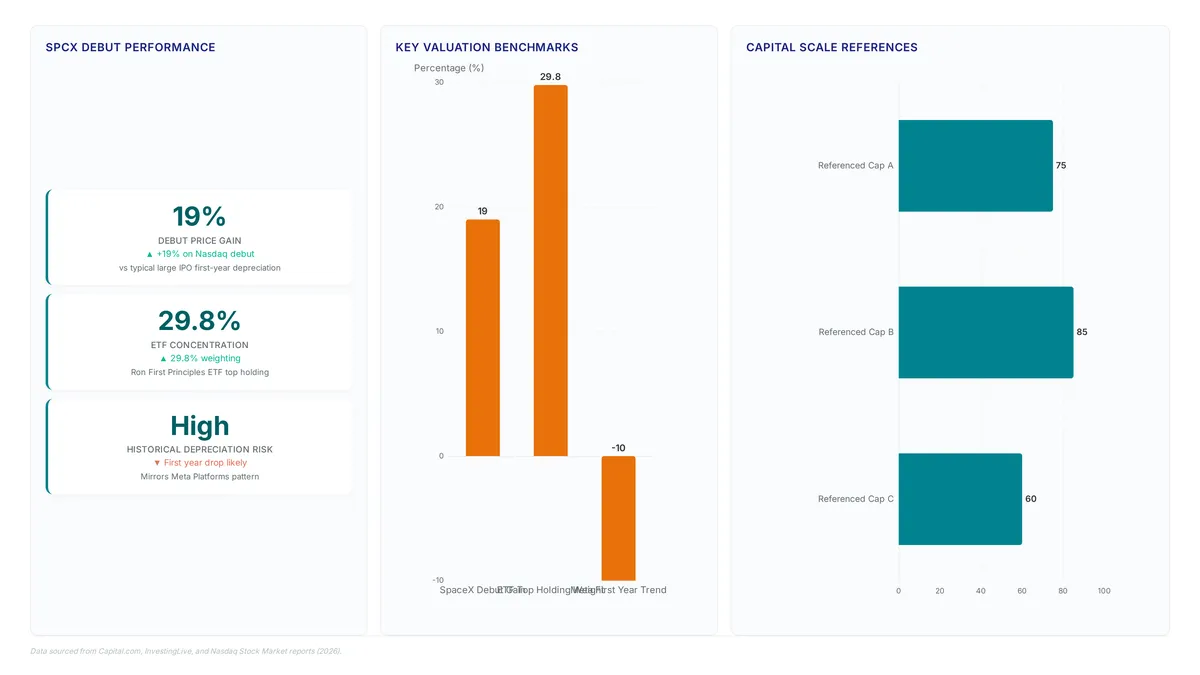
Early profit-taking mixed with inflated valuations drives this decline. Yet the cost of early entry is measurable through widened spreads during high-volume periods. Trading SPCX CFDs provides exposure to post-IPO volatility, which can notably widen spreads and increase the effective cost of entry and exit during high-volume periods. Operators must distinguish between temporary liquidity gaps and fundamental valuation resets.
Strategy demands clarity: large IPOs often navigate beyond their IPO level as equity bulls step in, matching historical norms.
A key distinction lies in execution; trading via CFDs introduces post-IPO volatility that notably widens spreads, increasing the effective cost of entry during high-volume periods. Unlike spot equity, CFD traders face funding costs that erode capital during sideways consolidation. While immediate rebounds are possible, historical norms for large IPOs suggest a period of depreciation in the first year. Traders asking should I trade SPCX CFD must recognize that flexible use increases drawdowns when volatility widens spreads during rapid price declines. Unlike spot equities, CFD positions on MT5 and cTrader platforms face daily financing costs that erode capital during extended consolidation.
The limitation is that historical depreciation patterns in mega-cap tech often test investor conviction prior to recovery. Institutional concentration remains high, with funds like the Baron First Principles ETF holding a significant share of assets in this single name, magnifying systemic pressure during exits. Data sets the bias; the chart sets the entry.
About
Marcus Halloran, Chief Market Strategist at ForexCFD.top, brings over a decade of interbank experience to analyzing landmark equity events like the SpaceX (SPCX) listing. His background as a former London-based FX strategist specializing in G10 macro and intermarket analysis uniquely positions him to dissect how substantial IPOs influence broader risk sentiment and capital flows. While his daily work focuses on central bank decisions and currency majors, Halloran applies the same rigorous framework to share CFDs, evaluating how post-IPO volatility impacts retail trading strategies. At ForexCFD.top, an independent publication dedicated to regulated broker news and market analysis, he ensures that complex listings are contextualized within the global economic calendar. This approach allows him to connect high-profile debuts, such as SpaceX's record-breaking market entry, to actionable insights for traders navigating CFD use and risk management across emerging and developed markets.
Conclusion
The structural tension in SpaceX (SPCX) shares as a CFD arises from the collision between massive institutional concentration and the mechanical drag of daily financing costs. While early price action suggests momentum, the reality of holding used positions through a potential year-long depreciation cycle creates a silent erosion of capital that spot equity holders avoid. Liquidity gaps during high-volume exits will likely widen spreads further, punishing traders who mistake temporary volatility for a sustained trend reversal. The presence of single-asset ETFs holding nearly a third of their portfolio in this name magnifies systemic pressure, meaning any coordinated exit could trigger cascading liquidations below key support levels.
Traders must adopt a defensive posture by limiting position size specifically to account for funding decay during sideways consolidation. Do not assume immediate recovery; instead, wait for confirmed stabilization above the initial open before committing significant capital. The most effective immediate step is to calculate the exact break-even point on your specific platform including overnight fees, then set hard stops that respect widened spread conditions rather than tight technical levels. Success in this environment requires treating every rally as a potential liquidity event rather than a guaranteed breakout. Focus on preserving capital while the market digests the staggering valuation, ensuring you remain solvent long enough to capitalize on genuine trend clarity rather than noise.
Frequently Asked Questions
The initial raise was $75 billion before greenshoe expansion. The final total reached $86 billion, creating massive liquidity for traders to exploit volatility without holding underlying equity assets directly.
Shares opened at $150 and briefly eclipsed $200 before falling. This extreme range forces CFD traders to utilize tight stop losses when speculating on such erratic post-IPO price movements effectively.
This figure represents the initial offering price where the stock recently collapsed to test. Traders watch this level closely as a potential support zone or breakdown point for new short positions.
Large IPOs often see depreciation in their first year, similar to Meta Platforms. This pattern encourages traders to consider short positions or wait for stabilization before entering long CFD trades.
Such a staggering valuation creates wide spreads that elevate transaction costs significantly. Derivative traders must account for these higher costs when calculating potential profits on every single trade executed.
References