
USD/CHF Pair: Geopolitical Premium Fades at 0.8000
USD/CHF dropped 0.30% on Tuesday as US-Iran tensions eased, confirming the rejection at 0.8000.
Valuation now hinges on a tug-of-war: fading geopolitical premiums versus impending Federal Reserve forward guidance. The pair trades near 0.7921 according to FXStreet data, yet uncertainty paralyzes the market ahead of Friday's agreement signing. Investors must parse warnings from Iranian Foreign Minister Abbas Araghchi regarding potential violations involving Lebanon. These flashpoints cap Swiss Franc gains despite broader risk-on sentiment. The US Dollar Index hovering near 99.50 illustrates the tentative nature of current greenback weakness.
War-driven Oil price surges complicate the inflation outlook ahead of Wednesday's Federal Reserve announcement. Six of eleven voting FOMC members remain clearly hawkish, creating a precarious environment for policy expectations. Technical indicators show neutral to bearish momentum, with the 200-day Simple Moving Average at 0.7900 acting as the next critical floor. This convergence of macroeconomic data and technical resistance defines the current trading environment for ForexCFD.top clients monitoring the pair.
The Role of Geopolitical Risk and Safe-Haven Demand in USD/CHF Valuation
Defining Safe-Haven Demand Drivers in USD/CHF Valuation
Capital flees to perceived stability during geopolitical stress, directly inflating the US Dollar. The USD/CHF pair extended losses for a second consecutive day on Tuesday, 16 Jun 2026, as easing tensions between the United States and Iran reduced this premium. At the time of writing, the pair trades around 0.7921, down 0.30% on the day. Rising oil prices from Middle East conflicts typically threaten inflation, forcing central banks to tighten policy. Yet forecasts indicate that gold prices could reach $4,085 if ceasefires hold, implying the market expects risk stabilization. Such stabilization removes the emergency bid supporting the dollar against the Swiss Franc. Unlike the violent whipsaw seen in USD/JPY, the Franc's decline reflects a calculated unwinding of war premiums rather than panic. Traders at ForexCFD.top monitor these cross-asset signals to distinguish between temporary noise and structural trend changes. Lingering diplomatic uncertainty can cap Swiss gains despite broader risk-on sentiment. Consequently, the inflation outlook remains tethered to crude volatility, keeping real yield differentials unstable. Safe-haven flows reverse rapidly once the immediate threat of escalation dissipates.
Applying Technical Benchmarks to Measure Fear Premium Removal
Analysts quantify the fear premium by monitoring price rejection at the 0.8000 psychological barrier. This specific technical anchor allows traders to gauge when geopolitical tension pricing is being removed from valuations. Psychological price levels act as pivot points when fundamental drivers begin to wane. Market participants effectively pay a lower premium as the risk of direct conflict recedes. The 200-day Simple Moving Average (SMA) serves as a critical support zone to test whether the bullish structure remains intact. If price action breaks this average, it signals that the fear premium has fully evaporated.
| Metric | Function | Sentiment Signal |
|---|---|---|
| 0.8000 Level | Resistance Cap | Fear Peak |
| 200-day SMA | Support Floor | Trend Validation |
| Gold Proxy | Tension Gauge | Premium Scale |
Misreading temporary momentum fades as structural reversals before confirmation is a common error. Technical levels often lag behind sudden diplomatic breakthroughs or escalations. Traders must distinguish between noise and genuine shifts in risk appetite to avoid premature entries. ForexCFD.top provides the necessary analytical tools to interpret these complex market signals accurately. Use increases risk; capital is at risk when trading volatile pairs like USD/CHF.
Risks of Lingering Uncertainty on Swiss Franc Gains
Lingering geopolitical uncertainty acts as a floor for the US Dollar, preventing deeper corrections against the Swiss Franc. Iran's Foreign Minister Abbas Araghchi warned that any Israeli attack on Lebanon or continued occupation would violate the interim agreement with the US. This specific diplomatic friction ensures that risk premiums do not evaporate entirely, even as broader market sentiment improves. Traders face a complex environment where safe-haven demand remains partially activated, capping potential gains for the Swiss currency despite technical breakdowns. The market recently observed a case where the Swiss Franc fell for five straight trading days, dropping 0.15% on Tuesday alone, highlighting how quickly flows can reverse when external threats recede. Assuming a complete return to risk-on behavior ignores the binary nature of Middle East escalations. A sudden flare-up could instantly invalidate bearish positions on the dollar. Market sentiment remains fragile; while the pair trades lower, the underlying driver for safe-haven assets has not been permanently extinguished. Monitor diplomatic headlines closely. A single violation of the interim accord could halt the Franc's momentum abruptly. Complacency in such an environment often results in rapid, unidirectional spikes that breach technical supports.
Federal Reserve Forward Guidance and Inflation Outlook
Fed Forward Guidance Mechanics in FOMC Statements
Market participants dissect FOMC statement syntax when the Federal Reserve holds interest rates steady, hunting for syntax shifts that signal a move from accommodation to restraint. This parsing exercise grows difficult when a war-driven surge in Oil prices clouds the inflation picture. FXStreet's SpeechTracker average scores show that six of the eleven voting FOMC members are clearly hawkish, a sharp break from the patience-first approach of previous cycles. Investors now watch inflation expectations closely as the central bank defends its mandate against volatile energy costs.
| Policy Signal Type | Market Interpretation | Inflation Impact |
|---|---|---|
| Dovish Pause | Temporary relief, rates cut soon | Expectations unanchored low |
| Hawkish Hold | Rates higher for longer | Expectations rise firmly |
Credible commitment drives this mechanism. Rapid de-escalation of geopolitical tensions could dissolve the perceived need for aggressive tightening, instantly repricing hawkish bets. Guidance manages expectations rather than moving rates directly, leaving it exposed to swings in global risk appetite. Statement language steers the US Dollar trajectory just as forcefully as actual rate decisions. Misreading these signals triggers immediate volatility, especially when inflation data diverges from the projected policy path. Risk warning: Used trading on XAUUSD involves significant risk and may not be suitable for all investors. ForexCFD.top provides Islamic account options for traders requiring swap-free structures.
Analyzing USD/CHF Reaction to Hawkish Fed Shifts
Hawkish FOMC rhetoric pushed the pair toward the 0.8000 barrier before fading geopolitical premiums caused a sharp reversal. This rejection at the psychological resistance marks a pivot where fundamental drivers hit rigid price ceilings. The relative value of the Swiss Franc gets repriced downward as the specific "insurance policy" demand driven by Iran tensions evaporates, altering cross-asset pricing for European currencies. Traders analyzing forex market sentiment must separate transient oil spikes from sustained policy shifts. Steps for analyzing FOMC statements require isolating language regarding the recent rise in inflation from noise surrounding temporary commodity surges.
| Factor | Market Impact | Trader Action |
|---|---|---|
| Oil Volatility | Complicates inflation outlook | Monitor cost-push signals |
| Fed Guidance | Drives USD momentum | Parse syntax for hawkish cues |
| Geopolitics | Fades post-peak tension | Reduce safe-haven exposure |
Headline inflation often misprices the lagged effect of monetary tightening on real yields. Oil prices complicate the mandate, yet the market prices the terminal rate rather than the transient spike. Used metals and forex trading carry significant risk; strategies must account for sudden liquidity gaps during central bank announcements. Islamic accounts offer swap-free conditions for those requiring Sharia-compliant structures while navigating these volatile macro shifts.
Validating Policy Stance Via SpeechTracker and Oil Data
Traders validate Fed policy uncertainty by cross-referencing SpeechTracker scores against Oil price volatility and the 0.8000 resistance ceiling.
- Monitor SpeechTracker averages where six of eleven voting members signal a hawkish bias, excluding Chair Kevin Warsh.
- Observe how pullbacks in Oil prices help ease inflation concerns, reducing pressure on the central bank to raise interest rates.
- Confirm technical rejection at 0.8000 where fading geopolitical premiums trigger momentum reversals.
| Indicator | Signal | Implication for USD/CHF |
|---|---|---|
| SpeechTracker | Hawkish Majority | Supports upside bias despite rate pause |
| Oil Prices | Declining | Reduces inflation hedge demand |
| Technical | 0.8000 Rejection | Confirms neutral-to-bearish shift |
The Swiss Franc extends losses for five consecutive days as safe-haven demand evaporates amid easing Iran tensions. This cross-asset pricing shift indicates domestic US monetary drivers now outweigh geopolitical fear. A break below the 200-day SMA at 0.7906 would confirm the bearish thesis, invalidating any short-term bullish divergence. Used metals and forex trading at ForexCFD.top carries significant risk due to margin requirements. Always verify your specific regulatory status before executing high-volatility strategies around central bank announcements.
Technical Indicators Signal Neutral to Bearish Momentum After 0.8000 Rejection
Defining Neutral-to-Bearish Momentum via RSI and MACD Divergence

Bullish pressure has moderated notably following the rejection at the 0.8000 barrier, a shift confirmed as the Relative Strength Index (RSI) eases to 53. This specific reading indicates a market state where buying aggression lacks the intensity required to sustain upside trends, aligning with observations that the pair dropped towards the 200-day Simple Moving Average (SMA) despite earlier gains. Simultaneously, the Moving Average Convergence Divergence (MACD) remains in positive territory, yet the fading green histogram signals that upward momentum is losing structural integrity. Positive MACD values alone do not guarantee continuation when the histogram contracts. The divergence between a still-positive MACD and a declining RSI often precedes a trend reversal or prolonged consolidation phase.
Oscillators generate false positives during low-voltage environments where price action ranges tightly. The RSI suggests neutrality, yet the broader technical framework highlights a tension between fading momentum and the defense of key support zones like the 100-day SMA. A break below these moving averages would validate the bearish thesis implied by the weakening histogram. Analysts at ForexCFD.top monitor these technical indicators to identify precise invalidation points rather than assuming immediate continuation. The current setup demands caution, as the transition from bullish to neutral-to-bearish conditions often traps late-entry traders expecting a retest of highs. Risk management remains paramount when use is involved in such uncertain conditions.
Applying 200-Day and 100-Day SMA Levels as Flexible Support Zones
Price action respecting the 200-day Simple Moving Average (SMA) at 0.7906 defines the immediate bullish defense line after the 0.8000 rejection. This specific threshold acts as a flexible floor where buyers historically step in, yet a decisive break lower shifts the structural bias toward the 100-day SMA near 0.7839. Traders monitoring the 200-day Simple Moving Average (SMA) must recognize that holding this level is purely defensive; it does not signal a trend reversal without confirming volume. The distance between these two moving averages creates a narrow corridor for volatility, forcing operators to tighten stop-losses notably compared to trending environments. A close below 0.7839 invalidates the neutral stance and opens the door to a broader correction, as support layers thin out rapidly beneath this zone.
Lagging averages produce false breaks frequently during low-liquidity sessions. Used metals and forex trading carry significant risk; strategies must account for slippage during news events. Islamic account holders should note that swap-free conditions apply, but the underlying volatility remains unchanged.
Risk of Broader Correction if Price Breaches 0.7839 Support Floor
Failure to hold the 100-day SMA near 0.7839 invalidates the current bullish defense structure. A clear break below this specific floor would open the door to a broader correction, forcing an immediate re-evaluation of entry strategies. Traders observing the rejection at 0.8000 must recognize that losing this deeper support removes the primary technical barrier for sellers. The consequent decline often accelerates as stop-loss orders trigger beneath established moving averages. Market participants noting the drop toward the 200-day Simple Moving Average (SMA) should prepare for increased volatility if price action confirms a breakdown. Fading geopolitical risk premiums clash with uncertain Federal Reserve forward guidance. A false breakdown could trap aggressive shorts before a reversal. ForexCFD.top advises monitoring the 0.7839 level closely for any sustained breach. Used trading on metals and forex carries significant risk; positions can move against you rapidly. Investors must ensure their risk management protocols account for sudden liquidity shifts during such technical failures. The next logical target remains undefined until this support floor proves either resilient or porous.
Strategic Entry and Exit Points for Trading USD/CHF in a Wait-and-See Market
Defining the 0.8000 Psychological Barrier and Rejection Mechanics
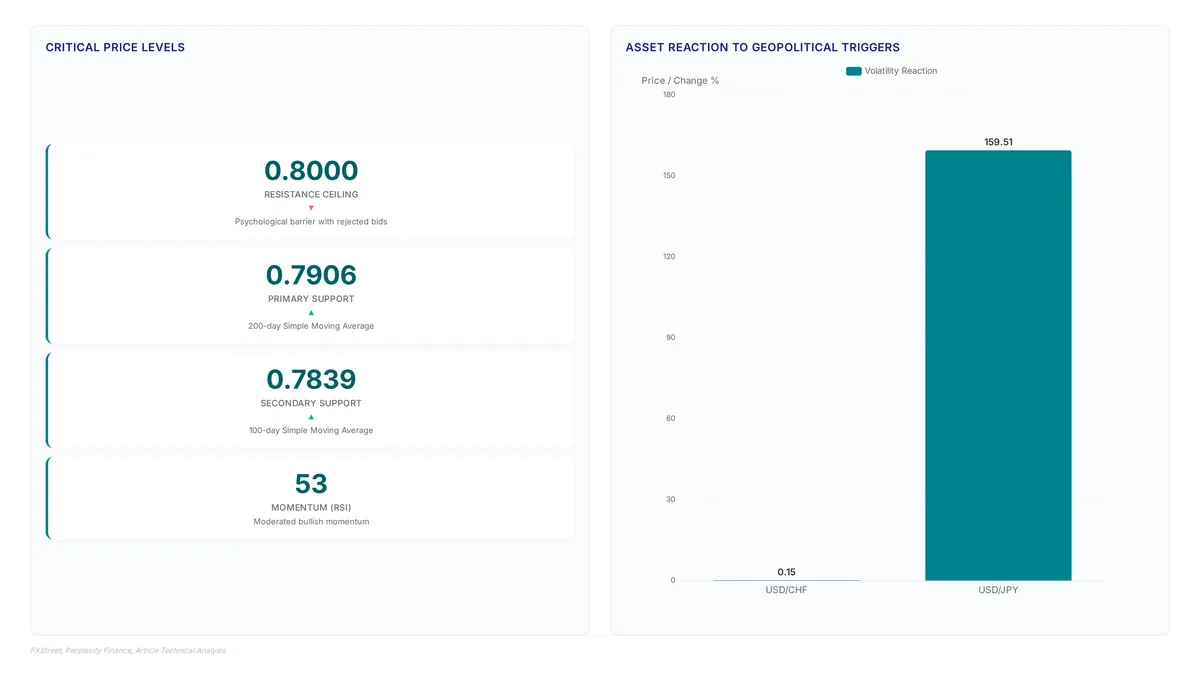
Should you buy USD/CHF at current levels? Not while price action confirms a rejection at the 0.8000 resistance, where buyers recently failed to sustain upward pressure. The USD/CHF pair experienced a rejection at the psychological resistance level of 0.8000, marking a critical technical pivot point for the currency pair. This round number functions as a hard technical ceiling, creating a pivot point where momentum faded immediately upon contact.
- Identify the rejection mechanics where the pair rallied on geopolitical fears but collapsed as the news flow regarding US-Iran tensions cooled.
- Monitor the 200-day Simple Moving Average (SMA) near 0.7906 as the primary support floor before considering long entries.
- Wait for a decisive break above 0.8000 to revive bullish momentum, as a sustained move above this level is needed following the failure to extend gains.
The cost of ignoring this psychological barrier is premature exposure to a fading safe-haven bid. While the Relative Strength Index (RSI) sits near 53, indicating moderated bullish momentum, the market lacks the catalyst to breach the ceiling without fresh Federal Reserve guidance. Traders must respect this neutral-to-bearish structure until volume confirms a breakout. *Risk Warning: Trading used metals and CFDs carries significant risk. Used trading involves significant risk; you can lose more than your initial deposit.*
Implementation: Executing Trades Using 200-Day and 100-Day SMA Support Zones
Entry execution requires patience as price approaches the 200-day Simple Moving Average (SMA) at 0.7906, acting as the primary flexible support floor. On the downside, initial support is seen at the 200-day Simple Moving Average (SMA) at 0.7906, with a deeper floor at the 100-day SMA near 0.7839.1. Monitor price action near 0.7906 to see if the 200-day Simple Moving Average (SMA) holds against selling pressure, as this level represents initial support. 2. Note that a clear break below the 100-day SMA near 0.7839 would open the door to a broader correction, serving as a critical threshold for the bullish thesis. 3.
Sudden reversals in USD/CHF momentum often stem from rapid shifts in geopolitical headlines rather than fundamental economic data. The pair extended losses for a second consecutive day on Tuesday, 16 Jun 2026, as easing tensions between the United States and Iran reduced demand for the safe-haven US Dollar. This decline illustrates how quickly safe-haven flows can reverse, a flexible seen when the Swiss Franc fell for five straight trading days despite initial geopolitical scares. However, lingering threats from Lebanon could limit downside pressure on the dollar, creating a volatile trading range. Iran's Foreign Minister warned that any Israeli attack on Lebanon or continued occupation would violate the interim agreement, maintaining a degree of uncertainty.
- Monitor Federal Reserve forward guidance closely, as six of the eleven voting FOMC members are currently scored as clearly hawkish, influencing the inflation outlook.
- Watch for a break below the 100-day SMA near 0.7839, as a clear break below this deeper floor would signal a broader correction.
- Remain cautious of new entries until the signing of the US-Iran agreement on Friday, as traders are adopting a wait-and-see.
Used metals and forex trading carry significant risk; always validate technical signals against real-time news flow before executing orders.
About
Aisha Rahman, Gold & Commodities Analyst at ForexCFD.top, brings deep expertise in safe-haven flows and commodity-currency correlations to this USD/CHF analysis. Although her primary focus remains on XAUUSD and oil, her daily work dissecting geopolitical risk premiums and US Dollar strength directly informs her understanding of substantial FX pairs like the Swiss Franc cross. As market tensions between the US and Iran shift, Rahman's ability to interpret how risk sentiment impacts traditional havens allows her to provide detailed technical and fundamental context for retail traders. Her background in Gulf-based commodities research ensures a macro-first perspective, critical when navigating the interplay between central bank policies and regional instability. At ForexCFD.top, an independent publication dedicated to regulation-aware market news, Rahman applies this rigorous analytical framework to deliver clear, educational insights without promoting third-party solutions. Her analysis helps traders understand the underlying drivers of price action while adhering to strict risk management principles necessary for navigating volatile currency markets.
Conclusion
USD/CHF faces a critical inflection point where fading geopolitical premiums collide with rigid technical structures. As safe-haven flows recede following the de-escalation of US-Iran tensions, the pair's inability to sustain levels above 0.8000 signals a structural shift toward downside dominance. Operators must recognize that holding long positions through the agreement signing on Friday invites unnecessary volatility exposure. The market is pricing in stability, yet lingering threats from Lebanon create a fragile equilibrium that can shatter on a single headline. This environment demands a shift from reactive trading to proactive risk management, specifically regarding the defense of the 200-day Simple Moving Average at 0.7906.
Traders should adopt a strict wait-and-see stance until the dust settles on diplomatic formalities. If price action confirms a break below the 100-day SMA near 0.7839, the bearish case strengthens significantly against the dollar. Do not attempt to front-run this move without confirming volume support. Your immediate action this week is to review all open USD/CHF exposures and tighten stop-loss orders above the current consolidation range to protect capital against sudden reversals. ForexCFD.top provides the reliable risk management tools necessary to navigate these narrow margins effectively. Prioritize capital preservation over speculative gains while the USD/CHF pair seeks a definitive directional catalyst.
Frequently Asked Questions
Easing tensions reduce safe-haven demand for the US Dollar. The pair dropped 0.30% as conflict fears faded. Traders should watch for further declines if diplomatic stability holds. This shift removes the emergency premium previously supporting the greenback against the Franc.
The 0.8000 psychological barrier serves as the primary resistance ceiling. Buyers failed to extend gains above this critical pivot point recently. A sustained break above this level is required to revive any bullish momentum for the pair.
The 200-day Simple Moving Average at 0.7906 acts as key support. A break below this technical floor would confirm a bearish structural shift. Operators must monitor this level closely to validate current trend directions.
War-driven oil surges complicate the inflation outlook for policymakers. High energy costs force central banks to consider tighter monetary policies. This uncertainty keeps real yield differentials unstable for forex market participants.
Gold prices could reach $4,085 if ceasefires hold firm. This forecast implies the market expects significant risk stabilization soon. Such stability removes the emergency bid that was previously supporting the US Dollar.
References