
Williams %R Oversold? Don't Buy GBP/USD Without This
GBP/USD technical sentiment currently shows 20 bearish indicators against only 6 bullish signals. In this environment, the Williams %R oversold alert demands rigorous confirmation rather than blind optimism. Data from CoinCodex reveals a skewed landscape where bearish short-term sentiment dominates the GBP/USD pair following a sharp selloff to the mid-1.3200s. The Williams %R dropping to -86.35 signals exhausted sellers, but it fails to guarantee a reversal without corroborating evidence from support regions. Traders frequently mistake these oversold signals for immediate buy entries, ignoring historical instances where the oscillator remained suppressed during accelerated downtrends.
Differentiating between genuine reversal patterns and mere pauses in a broader decline requires examining momentum confirmation techniques. We must identify when downside momentum is truly fading versus when it is simply resetting for another leg lower. The following analysis outlines precise trade execution strategies that prioritize capital preservation over speculative bottom-fishing in volatile forex environments.
The Role of Williams %R in Identifying Stretched Momentum
Larry Williams introduced this momentum oscillator in 1973 to quantify where price sits within a set lookback window. The momentum oscillator calculates the current closing price against the highest high of the period, avoiding smoothing algorithms that lag behind real-time data. Readings near -100 suggest the asset is closing near the bottom of its range, signaling intense downward pressure rather than an automatic rebound. The scale spans 0 to -100, with values between 0 and -20 marking overbought conditions while levels below -80 indicate oversold momentum.
Rapid reactions to price changes make the tool highly sensitive to short-term volatility shifts. Traders often hunt for failure swings where the indicator fails to reach extreme levels on a second attempt, a pattern documented as more reliable than simple threshold breaches. Quantitative analysis suggests strict adherence to these specific entry and exit rules can achieve win rates as high as 81%.
Momentum oscillators like Williams %R can remain in oversold territory for extended periods during strong downtrends, warning that an "oversold" reading alone is not a guaranteed buy signal without price action confirmation. This lack of smoothing creates friction between early signal detection and false positive frequency in trending markets. Operators must distinguish between stretched momentum and structural breakdown to avoid premature counter-trend entries.
GBP/USD Oversold Signal: Interpreting the -96.40 Reading
A Williams %R reading of -96.400 on June 18, 2026, placed the GBP/USD close at 1.32925 almost exactly at the 14-period low, signaling extreme momentum exhaustion rather than an automatic buy trigger. Such oversold momentum indicates price has stretched far from its mean, yet historical data warns that oscillators can remain depressed during strong trends without immediate reversal. The market data confirms the depth of this decline, showing sellers drove the session low to 1.32620 before the close. Traders watch the mid-1.32s support zone for stabilization, as previous clusters in this region attracted dip-buying interest. Relying solely on the indicator creates significant risk because the tool lacks smoothing and generates false signals if price action does not confirm a shift.
False Reversal Risks: When Oversold Becomes Bearish Legs
Oversold momentum signals stretched price action but frequently precedes stronger bearish legs rather than immediate reversals. The primary danger lies in the indicator's ability to remain depressed during accelerating trends, trapping traders who anticipate a bounce. A validated signal often requires a specific failure swing pattern where sellers lose control progressively, unlike a simple threshold breach. Acting on unconfirmed readings incurs a hidden financial cost that erodes capital during strong directional moves.
The false reversal trap occurs when price sustains lows while the oscillator refuses to recover above critical levels. Historical divergence cases illustrate how price can extend trends even as momentum appears exhausted, misleading participants expecting a mean reversion. Traders must distinguish between a genuine exhaustion point and the early stage of a deeper decline.
- Price may test support multiple times before breaking.
- Volume often spikes during the initial oversold touch.
- Resistance levels hold firm despite extreme readings.
- Trend context overrides oscillator extremes in strong moves.
- Confirmation requires a close above key moving averages.
Ignoring these structural cues leads to premature entries. The financial risk of misinterpreting these signals demands strict adherence to price action confirmation over raw oscillator data.
Mechanics of Price Action Confirmation and Reversal Patterns
Defining Reversal vs Continuation in Williams %R Context
A genuine reversal requires the indicator to recover above -80 alongside stabilized daily closes, whereas continuation patterns persist with readings below this threshold. Mechanically, the distinction lies in whether price action confirms a shift in momentum or simply pauses within an accelerating trend. A divergence analysis reveals discrepancies between price peaks and indicator troughs that often precede valid turning points. Without this structural break, oversold momentum merely reflects persistent selling pressure rather than exhaustion.
| Feature | Reversal Signal | Continuation Pattern |
|---|---|---|
| Indicator Path | Recovers above -80 quickly | Remains depressed below -80 |
| Price Action | Holds support, forms higher lows | Breaks support, prints lower lows |
| Trend Context | Momentum diverges from price | Price and momentum align downward |
| Risk Profile | Set stop below recent low | High probability of further decline |
Operators must recognize that momentum oscillators can stay in extreme territory for extended periods during strong directional moves. The cost of misidentification is measurable: entering long positions during a continuation phase often results in immediate drawdown as the trend accelerates. Traders relying solely on threshold breaches ignore the reality that Williams %R lacks the smoothing filters found in other tools, making it hypersensitive to rapid price changes. A valid setup demands evidence that sellers have lost control, typically shown by a daily close reclaiming key structure. Ignoring this requirement exposes capital to false reversals where bounces roll over under nearby resistance.
Executing GBP/USD Bullish and Bearish Trade Scenarios
Bullish execution requires GBP/USD holding the 1.3290 reaction zone while reclaiming the 1.3400, 1.3460 resistance cluster. Sellers forcing a daily close below support opens a path toward the 1.3160 major floor. Short-covering accelerates when price stabilizes in the mid-1.32s, creating rapid momentum shifts that divergence mechanics help identify before full reversals occur.
Bearish breakdowns trigger on confirmed breaches of the 1.3290 level, targeting the 1.3160, 1.3180 liquidity pool. This scenario aligns with current bearish short-term sentiment where technical indicators heavily favor continued downward pressure. Traders enter short positions on daily closes below support or rejection candles printing within the 1.3400, 1.3460 supply zone.
| Scenario | Entry Trigger | Stop Level | Profit Target |
|---|---|---|---|
| Bullish Continuation | Close above 1.3460 | Close below 1.3400 | 1.3600, 1.3650 |
| Bearish Breakdown | Close below 1.3290 | Close above 1.3300 | 1.3160, 1.3180 |
False reversals remain the primary risk, as Williams %R can remain depressed during strong trending moves without generating valid bounce signals. The stop loss placement must account for volatility expansion following large daily ranges that distort oscillator readings temporarily. Operators should wait for the indicator to recover above -80 alongside stable closes rather than acting on extreme readings alone.
Execution demands strict adherence to daily close confirmations rather than intraday spikes that often fail under nearby resistance. The take profit zones align with prior swing areas where historical consolidation occurred, providing logical exit points for both directional biases. Risk management requires wider stops during high-volatility sessions to avoid premature exits before directional clarity emerges.
Failure Modes: Identifying Early Stage Bearish Legs
Premature dip-buying in the mid-1.32s often marks the ignition point for a stronger bearish leg rather than a bottom. Momentum oscillators like Williams %R frequently remain stuck in oversold territory during accelerating downtrends, creating a false sense of value for counter-trend traders. Research indicates that acting on an "oversold" reading alone is dangerous without price action confirmation, as the indicator can stay depressed for extended periods.
The distinction between a reversal and continuation hinges on whether price reclaims key levels or rolls over under resistance.
| Pattern Type | Indicator Behavior | Price Action Requirement |
|---|---|---|
| False Reversal | Stays below -80 | Fails at 1.342, 1.345 resistance |
| Valid Reversal | Recovers above -80 | Holds 1.326, 1.333 support |
Traders must verify that a daily close stabilizes above support rather than assuming a bounce is imminent. A common error involves ignoring the trend persistence warning where momentum signals lag behind strong directional moves. Without a confirmed break above the 1.3400 zone, the market structure implies further downside risk toward 1.3160.
Operational discipline demands waiting for the indicator to exit the extreme zone before committing capital. The cost of ignoring this confirmation is measurable: entering short positions too early in a trending market often leads to stop-outs before the actual move occurs. Only when price action aligns with the oscillator does the probability of success improve significantly.
Executing Trades Using Oversold Signals and Stop-Loss Protocols
Defining Valid Entry Triggers via Williams %R Recovery
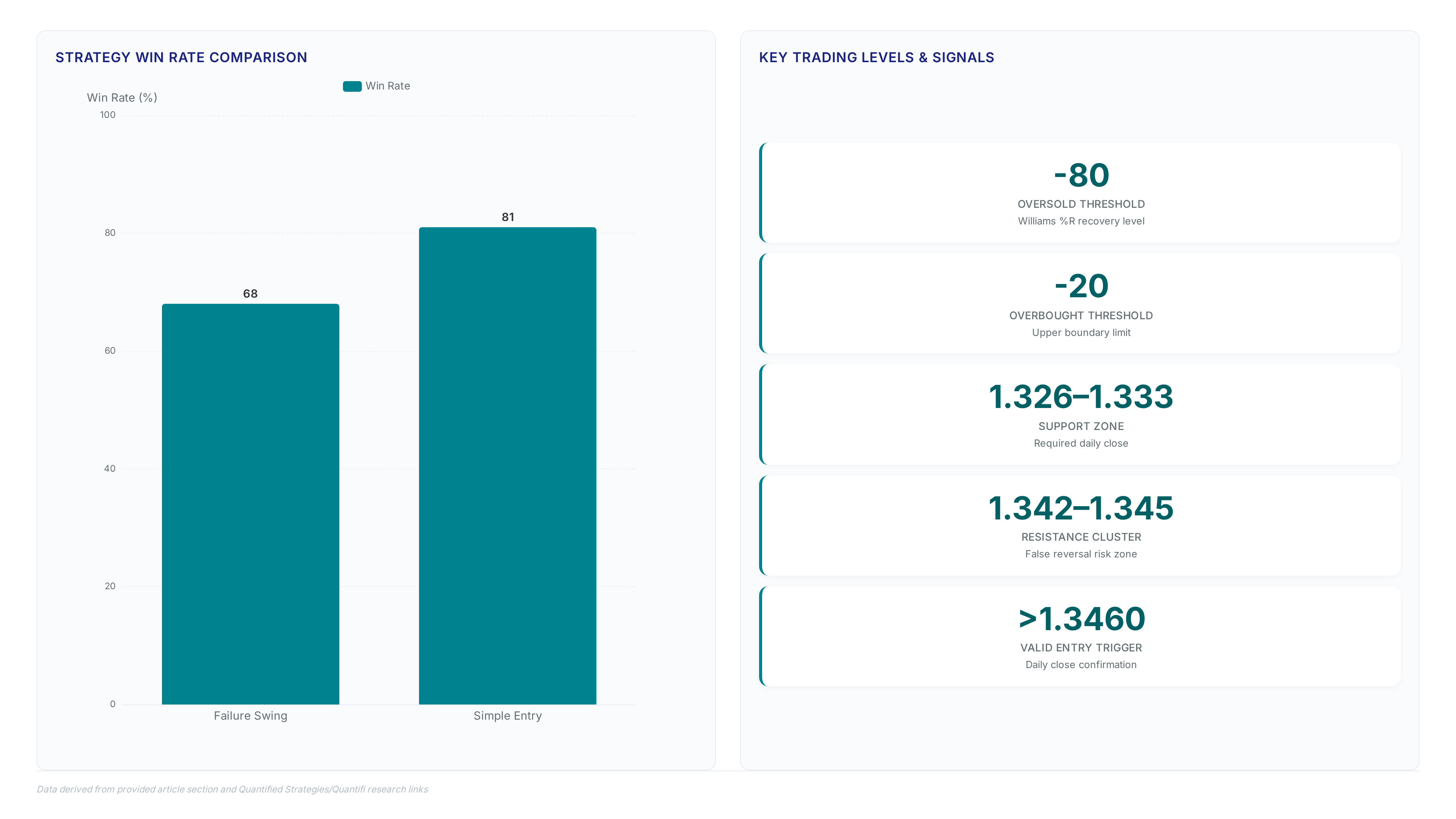
Valid entry requires Williams %R turning up and recovering above -80 rather than merely touching the threshold. This specific recovery filters noise where momentum remains depressed despite price pauses. A simple breach lacks the structural integrity of a failure swing sequence, where the indicator fails to reach previous extremes on a second push lower. Such patterns demonstrate sellers losing control more reliably than static oversold readings.
Confirmation demands a daily close holding above the 1.326, 1.333 support zone to validate demand. Without this price action anchor, the oversold signal invites false reversals common in trending markets. Operators must wait for the 4-Hour or Weekly structure to align with the oscillator's turn. Relying solely on the indicator turning up incurs a hidden cost: premature entries often fail when price rolls over under the 1.342, 1.345 resistance cluster. Most traders fail by assuming an immediate rebound without verifying that sellers have lost control. Patience for a confirmed close above support prevents capital erosion during accelerating downtrends. Only then does the setup transition from a potential trap to a set opportunity.
Application: Executing Bullish and Bearish GBP/USD Trade Scenarios
Long entries require a daily close above 1.3460 or a stabilized pullback into the 1.3290, 1.3300 zone. A bullish setup depends on holding the reaction area while reclaiming resistance, yet the broader long-term decline suggests such moves may only be counter-trend rallies within a secular bear market. Short positions trigger on a confirmed daily close below 1.3290, targeting the 1.3160, 1.3180 liquidity pool. This breakdown scenario aligns with current bearish short-term sentiment.
Stop-loss placement dictates capital preservation during false signals. For breakout entries, place stops on a daily close back below 1.3400. Pullback entries require stops on a daily close below 1.3290. The cost of tight stops is measurable; volatility can expand quickly after large-range candles, widening stop distances unintentionally. Operators must align 4-Hour structure with daily signals to avoid whipsaws. Failure to wait for a reclaim of the 1.342, 1.345 zone often results in premature entries that roll over under supply. Strict adherence to these levels prevents emotional decision-making during rapid price swings.
Pre-Trade Validation Checklist for Structure and Event Risk
Mandatory verification of 4Hour and Weekly structure prevents capital destruction. A valid setup requires more than a deep oversold reading; it demands alignment with higher-timeframe support levels. The June 2026 GBP/USD event demonstrated how extreme readings like -96.400 can coexist with continued downside if structural supports fail to hold. Operators should wait for Williams %R recovery above -80 alongside a stabilized daily close.
Event risk assessment forms the final gate before entry execution. Market participants must verify no imminent central bank communications or inflation releases could override technical signals. This discipline avoids the trap where oscillators remain depressed while price accelerates lower.
- Confirming divergence between price lows and indicator highs.
- Checking for event risk calendars regarding UK or US data.
- Verifying 4-Hour candle closes remain above key support.
- Ensuring no substantial liquidity gaps exist near entry triggers.
- Monitoring volume spikes during the 06 session for added confirmation.
Ignoring these checks exposes accounts to whipsaws common in GBP/USD during high-volatility periods. The strategy succeeds only when technical extremes align with structural and quiet news cycles.
Mitigating Risks of False Breakouts and Premature Entries
Defining False Breakouts and Premature Oscillator Entries
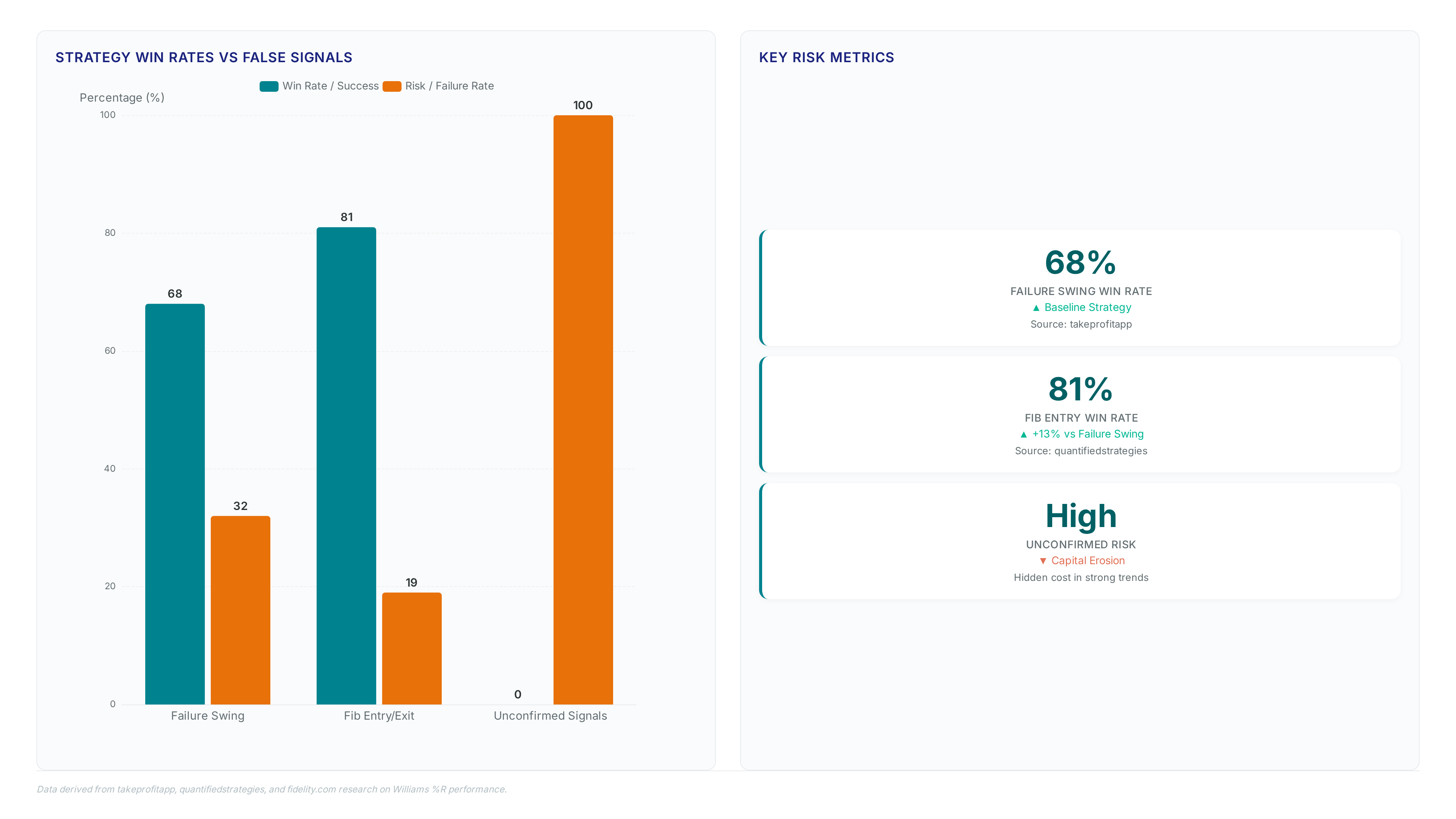
False breakouts happen when Williams %R flashes an oversold signal while price action keeps falling, trapping counter-trend traders in accelerating selloffs. Momentum oscillators often stay stuck in depressed territory during strong directional moves, creating a deceptive appearance of value where none exists. This persistence generates repeated whipsaws for operators who enter positions based solely on threshold breaches without structural confirmation. Acting on these unconfirmed readings represents a significant hidden cost that erodes capital during trending markets.
About
Vikram Nair serves as the Emerging Markets & Asia FX Writer at ForexCFD. Top, where he specializes in the complex dynamics of Tier-2 and Tier-3 currency pairs. Although his primary beat covers Asian and African markets like USD/INR and USD/NGN, his deep expertise in macroeconomic drivers and central bank policy provides a reliable framework for analyzing substantial pairs like GBP/USD. His daily work tracking the RBI and CBN requires rigorous assessment of how inflation data and hawkish federal tones impact liquidity, skills directly transferable to interpreting the Williams %R signals discussed in this article. At ForexCFD. Top, an independent publication dedicated to vendor-neutral analysis, Nair applies this same disciplined approach to global FX majors. By connecting broad macro fundamentals with precise technical indicators, he offers retail traders a factual perspective on whether current oversold conditions represent a genuine reversal opportunity or a continuation of downside momentum.
Conclusion
Williams %R functions as a precise trigger mechanism, yet it fractures when isolated from higher-timeframe context. The operational cost of ignoring this reality is not merely missed entries but the systematic erosion of capital during macro-driven expansions where momentum persists beyond logical extremes. Reliance on raw oscillator depth without structural alignment transforms potential reversals into liquidity traps, particularly when central bank narratives override technical exhaustion. Traders must recognize that volatility expansion demands a shift from reactive signaling to proactive structural verification.
Adopt a conditional protocol immediately: deploy Williams %R only when the 4-Hour and Weekly structures confirm a directional bias that matches your intended trade. Do not execute counter-trend reversals unless price action explicitly reclaims key structural levels, regardless of how deeply oversold the indicator reads. This discipline sacrifices the illusion of perfect bottom-fishing for the reality of sustained profitability. Begin this week by auditing your last ten losses to identify how many occurred against the prevailing higher-timeframe trend despite favorable oscillator readings. Use this data to harden your entry criteria before the next substantial economic release.
Frequently Asked Questions
Strategies face significant whipsaw losses without proper price action filters in accelerating trends. Research estimates failure rates exceeding 30% when traders ignore structural breakdowns and rely solely on oversold momentum readings.
Strict adherence to specific entry and exit rules dramatically improves trading performance outcomes. Quantitative analysis suggests that following these disciplined protocols can achieve win rates as high as 81% for momentum oscillator strategies.
Momentum oscillators can remain depressed while price continues trending lower without immediate reversal. This lack of smoothing creates tension between early signal detection and false positive frequency in strongly trending market environments.
Operators must align the four-hour structure with daily signals to avoid whipsaw losses. Mandatory verification of higher timeframe support levels prevents capital destruction during periods of extreme momentum exhaustion and volatility.
The June 2026 event showed price pushing toward support despite deep oversold conditions. This demonstrated that extreme readings do not guarantee reversals without confirming price action mechanics and strict stop-loss protocols.