
AUD/CAD Range: Why 9950 Resistance Matters Now
AUD/CAD targets a retest of the . 9950 resistance after breaking the mid-range, though long-term forecasts warn of a eventual drop to 0.9877 by 2029.
We are stuck in a range-bound structure. Price oscillates between hard floors and ceilings rather than trending. Sure, a temporary spike to 1.0568 later this year is on the table, but the immediate battle sits at the . 9850 midpoint. Here, the 100 and 200 SMAs have converged. Treat the 9950 level as a critical liquidity zone, not an automatic breakout target.
This analysis dissects the structural dynamics governing these sideways markets. The Australian dollar remains vulnerable to soft data despite the RBA's 25 basis point hike to 4.10%. We will cover executing breakout retest strategies with precision, distinguishing between a genuine trend reversal and a classic range trap before committing capital.
The Structural Dynamics of Range-B Forex Markets
Defining Range-Bound Markets and AUD/CAD Support Zones
AUD/CAD is stuck. Price action bounces between a. 9750 floor and a. 9950 ceiling. The . 9850 mid-range acts as the pivot where momentum flips. In trending environments, flexible moving averages guide us; here, static boundaries define entries. We calculate pivot points using prior high, low, and close data to project these reversal zones. For the range to hold, buying pressure at support must exactly equal selling pressure at resistance.
Most retail traders fail here. Only a small fraction successfully predict movements without mastering these structural definitions. False breakouts near the. 9950 resistance zone cause frequent stop-outs for those ignoring this reality. Research into technical trading rules shows higher predictability under specific conditions, though range boundaries remain the primary filter.
Fundamental catalysts like U. S. -Iran developments can invalidate historical boundaries instantly. A break above the. 9950 zone destroys the range thesis completely. Operators need to distinguish a genuine breakout from a liquidity grab before committing capital. Knowing why . 9850 become key reference points stops traders from mistaking temporary noise for a trend change.
Applying Technical Rules to AUD/CAD Price Oscillation
Watch the breakout from the 0.90500, 0.92500 sideways range observed in early 2026. This structural shift allows traders to apply technical rules to AUD/CAD price oscillation. Validating this shift confirms rule-based systems across developed currency pairs. Studies evaluating 497 technical trading rules from January 2000 to December 2022 confirm these methods notably forecast price movements. Soft data and U. S. -Iran conflict sentiment drive the current mixed performance.
Differentiating between range-bound and trending environments remains the primary operational challenge. The pair recently cleared key resistance, yet the Australian dollar faces headwinds from choppy risk sentiment. Falling crude prices weakened the Canadian dollar as an oil-linked asset. Directional bias relies heavily on fundamental catalysts rather than pure pattern recognition due to this divergence. Historical rule sets lose efficacy during sudden geopolitical shocks. Emerging markets often show higher predictability, yet substantial pairs like AUD/CAD demand strict adherence to evolving pivot point confluence. Operators must weigh the statistical edge of back-tested rules against the immediate noise of peace deal negotiations. False breakout entries occur when traders fail to adjust for these fundamental overrides. Successful navigation requires synthesizing the long-term statistical validity of technical systems with real-time fundamental analysis.
Fundamental Risks Driving AUD/CAD Volatility Breakouts
Structural transitions into trending environments occur when fundamental catalysts invalidate range-bound strategies. Central bank divergence overrides technical support floors, causing rapid shifts in directional biases. The Reserve Bank of Australia executed a hawkish 25 basis point hike, lifting the official cash rate to 4.10%. This policy stance strengthens the Australian dollar against peers lacking similar yield advantages. Collapsing crude oil valuations made the Canadian dollar the weakest substantial currency. Lower energy prices erode the fiscal backing for the oil-linked Loonie, creating asymmetric downside pressure. External volatility events from the Reserve Bank of New Zealand in May 2026 further complicate regional correlation models. Static resistance zones become obsolete within single trading sessions during such fundamental shocks. Immediate liquidation risk faces traders relying solely on pivot point reversals during macro-driven breaks. Ignoring these economic reports guarantees failure when price action decouples from historical oscillation patterns.
Technical Mechanics Driving the.9950 Retest Scenario
SMA Confluence Mechanics at the.9850 Mid-Range Level
The 100 and 200 Simple Moving Averages converge precisely at the . 9850 price point. This creates a dense liquidity cluster that dictates immediate reaction logic. The alignment transforms a static mid-range value into a flexible decision zone where momentum often stalls or reverses. Unlike pivot point calculations which derive static levels from prior daily extremes, moving averages shift continuously with each new candle close. The mechanical significance lies in the self-reinforcing nature of this confluence; as price approaches the aggregate, algorithmic orders trigger simultaneously, amplifying volatility.
Recent price action retreated from a high of 0.9949 directly into this technical decision zone near 0.9765, validating the magnetic pull of these averaged trend lines. The convergence acts as a filter for false breakouts, requiring sustained closes above the bundle to confirm bullish continuation.
| Feature | Static Pivot Points | Flexible Moving Averages |
|---|---|---|
| Calculation Basis | Prior High, Low, Close | Rolling price average |
| Responsiveness | Fixed until next day | Updates every tick |
| Signal Type | Reversion target | Trend confirmation |
Operators identify these key levels by watching for the compression of volatility bands around the 100 and 200 periods. A failure to hold this confluence often signals a deeper retracement toward the . 9750 floor. The breakout from early 2026 9850 cluster determines if that structure remains intact. Traders must distinguish between a temporary wick through the averages and a genuine close, as the latter invalidates the support thesis.
Mapping AUD/CAD Reversal Zones Using R2 Pivots and.9950 Resistance
The. 9950 historical resistance zone acts as the primary inflection point where weekly R2 Pivot calculations at. 9932 converge to create a high-probability reversal cluster. Traders analyzing 4-hour chart patterns must distinguish between flexible momentum indicators and static levels derived from prior daily extremes using standard pivot point calculation methods. This specific confluence forces a binary outcome: a decisive breakout toward the 1.0000 psychological handle or an immediate rejection back to the. 9850 mid-range support.
- Price approaches the. 9932 R2 level, testing seller conviction near the. 9950 ceiling.
- A confirmed close above this zone invalidates the bearish harmonic structure targeting lower lows.
- Confirming a valid retest requires price to hold the. 9750 zone while respecting the 0.9834 Fibonacci pivot point.
Traders must distinguish between flexible momentum shifts and static support derived from prior daily extremes using pivot point calculation methods. The April range floor remains active, yet a break below this level invalidates the bullish structure established in early 2026.1. Verify the 4-hour candle close stays above the. 9750 support cluster.
- Check if price action respects the Fibonacci pivot point at 0.9834 as new support.
- Monitor volume profiles to ensure no liquidity voids exist down to the range floor.
Operators often misinterpret a wick below. 9750 as a breakout, but true breakdowns require sustained pressure below the April low. The cost of premature entry is a stop-loss hunt before the actual trend resumes. Unlike moving averages that lag price, these static levels provide immediate reference points for risk placement. Failure to align the range floor with Fibonacci confluence increases the probability of a false signal. Strict adherence to these validation steps filters noise from genuine structural breaks.
Executing Breakout Retest Strategies with Pivot Point Precision
Defining the.9950 Retest Entry Trigger
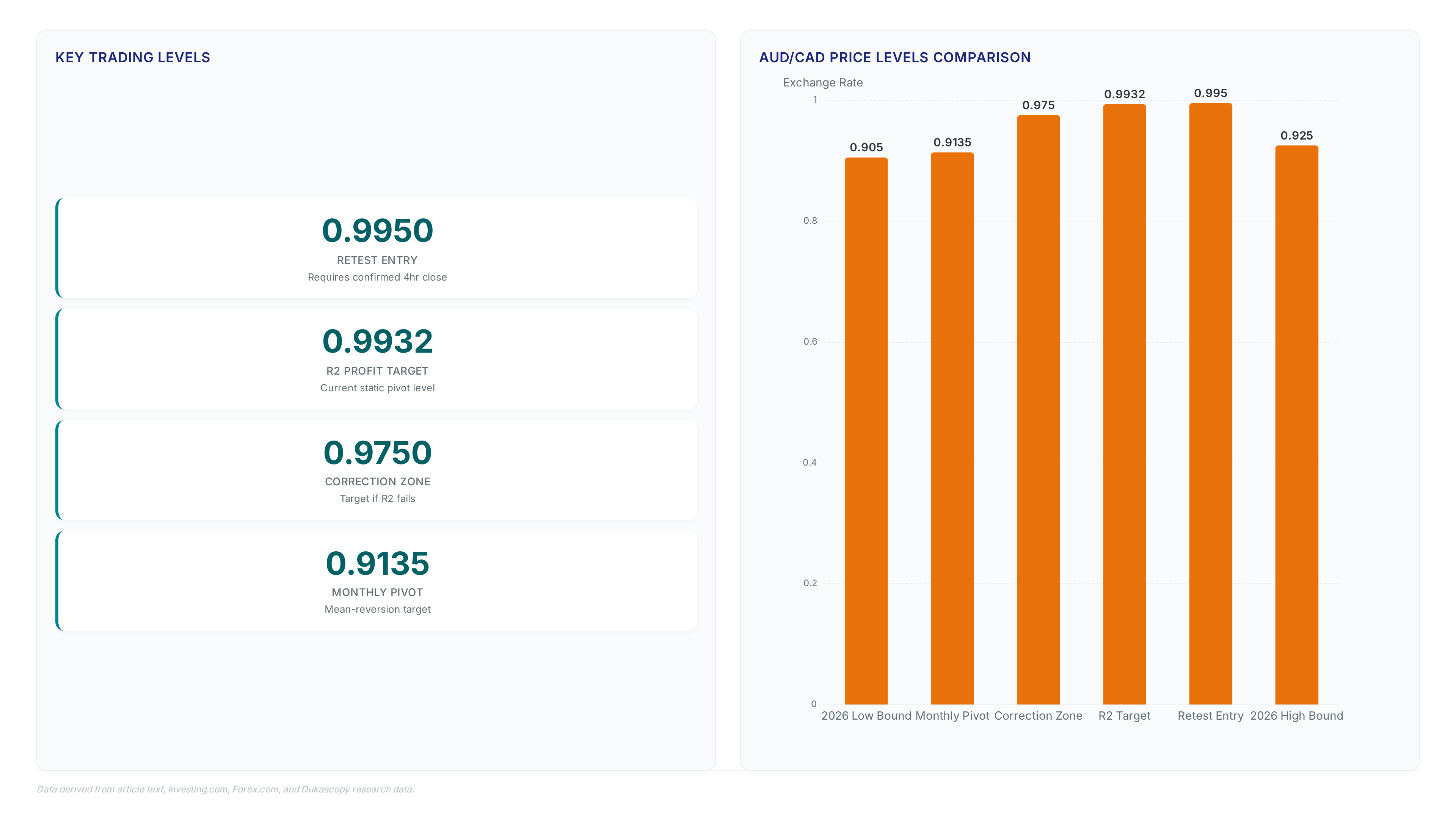
Validating a. 9950 retest entry demands a confirmed 4-hour close above this level followed by a liquidity sweep that respects the prior ceiling as new support. Technical analysis distinguishes this valid breakout from noise by observing how price interacts with static levels derived from pivot point calculation methods. A false breakout typically fails to hold the mid-range area during the pullback, whereas a genuine trend continuation finds buyers stepping in before the 100 and 200 SMAs.
Traders must differentiate between flexible momentum shifts and the rigid constraints of harmonic patterns like the Bearish Cypher completion which often dictates exact reversal coordinates near resistance.
| Condition | Valid Retest Signal | False Breakout Signal |
|---|---|---|
| Price Action | Holds above.9850 support | Wicks below.9850 mid-range |
| Momentum | RSI diverges bullish | RSI remains flat or bearish |
| Volume | Increases on upward push | Declines during approach |
The limitation of this approach lies in the latency of 4-hour candle closures; waiting for confirmation sacrifices entry precision for higher probability success. Operators relying on static pivot calculations miss the nuance that algorithmic flows often trigger stops just below the range floor before reversing. Coverage Pillars advises monitoring the reaction at the R2 Pivot Point closely, as a failure here often cascades into a deeper correction toward the . 9750 zone.
Executing Trades Using R2 Pivot Targets
Meanwhile, the current R2 Pivot Point at. 9932 establishes the precise profit-taking zone for AUD/CAD long positions targeting the. 9950 resistance. Traders calculate this static level by adding the prior day's high-low range to the pivot value, distinguishing it from flexible oscillators that lag behind price action. This mechanical definition creates a rigid ceiling where algorithmic sell orders frequently cluster, contrasting with the fluid nature of moving average support. Operators should scale exits at the R2 Pivot Point rather than waiting for the psychological 1.0000 handle, as historical data shows rejection often occurs before round numbers are tested.
Choppy price action near the. 9950 resistance generates false breakout signals that trap undisciplined retail entries. The distinction between a valid trend shift and noise relies on comparing flexible momentum against fixed pivot point calculation methods derived from prior sessions. Institutional infrastructure minimizes latency by connecting directly to dark pools, a feature absent in most retail platforms that exacerbates slippage during volatility spikes. This architectural gap means retail orders often fill at worse prices than intended when chasing breakouts. The mid-range area at. 9850 frequently acts as a magnet for price after a failed breakout, punishing late entrants.
| Market Condition | Retail Reaction | Institutional Action |
|---|---|---|
| False Breakout | Chases price | Fades the move |
| Range Bound | Overtrades | Waits for edges |
| High Volatility | Panics | Executes via direct links |
Operators must accept that ranging markets invalidate trend-following logic until a confirmed close occurs. Coverage Pillars recommends defining strict entry rules that ignore price wicks extending beyond the. 9950 zone. A failure to distinguish between standard pivot points and Fibonacci variants leads to misplaced stop-loss orders. The cost of overtrading is the rapid erosion of capital in sideways conditions.
Risk Management Protocols for Volatile Currency Pairs
Volatility spikes at the. 9950 ceiling force a choice between momentum chasing and mean-reversion traps. Range-bound markets punish traders who apply trending strategies near static barriers, creating unique exposure profiles where false breaks trigger cascading stops. Unlike directional moves driven by fundamentals, this environment relies on the mechanical relationships between high, low, and closing prices to define pivot point calculation methods. Hidden costs of trading this choppy structure include slippage during liquidity voids between the. 9750 floor and. 9850 mid-range, premature exits when price wicks beyond the R2 Pivot Point at.

Sizing Positions Relative to the.9850 SMA Confluence and Pivot Points
Position sizing must derive from the distance between the. 9850 mid-range support and the R2 resistance at. 9932 to calculate valid risk-reward ratios. Traders often ignore that pivot point calculation methods produce static barriers distinct from flexible moving averages, creating a rigid ceiling for lot size determination. The mechanism requires measuring the pip gap between the entry near the 100 and 200 SMAs and the stop-loss placed below the April range floor. Evidence suggests that relying on flexible oscillators instead of these static levels increases exposure to false breakouts during low-liquidity sessions.
Psychological Pitfalls When Trading the.9765 Decision Zone and False Breakouts
Price action stalling near the 0.9765 decision zone triggers premature entries driven by recency bias rather than confirmed structural breaks. Retail operators often misinterpret this pullback from 0.9949 as an immediate reversal signal, ignoring that directional biases typically require fundamental catalysts to sustain momentum. Data indicates that without such drivers, price frequently oscillates within established ranges, trapping traders who chase the 1.0000 psychological handle too early. The primary failure mode involves entering long positions before price validates support, assuming the April floor will hold without evidence of buyer conviction.
About
Vikram Nair, Emerging Markets & Asia FX Writer at ForexCFD. Top, brings a distinct macroeconomic perspective to the analysis of the AUD/CAD cross. While his daily coverage focuses on emerging-market currencies and central bank policies in Asia and Africa, this background provides a unique lens for evaluating how global risk sentiment impacts commodity-linked majors. The current AUD/CAD volatility, driven by crude oil fluctuations and geopolitical tensions involving U. S. -Iran, directly correlates with the capital flow dynamics Vikram monitors in developing economies. His expertise in tracking how external shocks alter currency valuations allows him to identify critical inflection points, such as the . 9950 retest, with precision. At ForexCFD. Top, an independent publication dedicated to factual market news and technical analysis, Vikram applies his deep understanding of regional funding rails and macro catalysts to deliver clear, vendor-neutral insights for global retail traders navigating complex forex pairs.
Conclusion
Scaling this strategy reveals that liquidity fragmentation at the. 9950 retest often triggers slippage far exceeding standard stop-loss buffers, turning theoretical profits into net losses. The ongoing operational cost of monitoring asynchronous RBA and BoC releases demands automated alert systems, as manual tracking fails to capture the millisecond volatility spikes that invalidate 4-hour patterns. While long-term models project a peak near 1.0568 by 2027, relying on macro forecasts without intraday confirmation exposes capital to unnecessary drawdown during the intervening consolidation phases.
Traders must abandon binary bias immediately. Adopt a conditional approach: only execute long entries if the 4-hour candle closes decisively above. 9950 with confirmed volume, and strictly limit exposure until the 2026 cycle matures. Do not anticipate the breakout; react to the confirmed close. This discipline separates sustainable profitability from the overwhelming failure rate observed in retail speculation.
Start by auditing your current open positions against the. 9750 support level before Friday's close. If price action remains below this threshold without a fundamental catalyst, liquidate immediately to preserve capital for higher-probability setups. This specific risk management step ensures you remain operational for the next market cycle rather than becoming a statistic in the current noise.
Frequently Asked Questions
Most traders fail because they cannot predict movements without mastering structural definitions. Only 2% of retail traders successfully predict these specific market shifts without understanding the defined floors and ceilings.
The Reserve Bank executed a hawkish hike to strengthen the currency against soft data. This action lifted the official cash rate to 4.10%, creating a specific fundamental catalyst for the pair.
Traders can use a specific code to receive a significant discount on their first purchase. The available offer provides a 20% reduction on the initial cost of the AI-powered trade journaling service.
This global prop firm offers a specific reward percentage during the challenge phase. Traders can earn a 15% performance reward while trading simulated funds in the evaluation period.
Global CFD and futures traders can earn a high percentage of their profits. The firm allows participants to earn up to 95% performance rewards when trading with simulated funds.