
AUD/USD Bearish Phase: Rate Pause Fails at 0.6890
AUD/USD has slid to three-month lows near 0.6890 despite the RBA holding rates at 4.35%. The Reserve Bank of Australia maintained its cash rate target at 4.35% in June 2026, pausing after three consecutive increases to monitor tightening financial conditions (https://www.rba.gov.au/media-releases/2026/mr-26-15.html). While this rate represents the highest level in the G10, the market reaction was muted because traders had already priced in the decision. Consequently, the currency failed to generate bullish momentum as renewed Federal Reserve hike expectations strengthened the greenback. The ongoing Middle East conflict further suppressed risk sentiment, creating an unfavorable environment for the Australian dollar.
Central bank divergence between the RBA and Fed drives current price action. High rate differentials are failing to attract capital flows in this specific climate. A break below the critical support zone between 0.6880 and 0.6850 exposes the pair to deeper losses toward the 0.6700 region. Holding this level remains necessary for any potential recovery.
Defining the Bearish Phase Drivers in AUD/USD Dynamics
Defining Bearish AUD/USD Drivers and Risk Sentiment
Selling pressure has overwhelmed buying interest, driving the AUD/USD exchange rate into a distinct bearish phase. The pair has slid toward almost three-month lows near 0.6890 as US dollar strength dominates market pricing across substantial currency pairs. Currency momentum yields entirely to safety demands. Risk sentiment measures the willingness of investors to hold volatile assets; when geopolitical tensions rise, capital flees growth-linked currencies like the Australian dollar. The ongoing Middle East conflict acts as a primary catalyst, triggering a flight to safety that disadvantages commodity exporters.
The mechanism relies on the absence of further tightening rather than the absolute level of rates. Investors increasingly view the pause as a signal that the tightening cycle has peaked, reducing the incentive to hold long AUD positions despite the yield advantage.
Failure to post a bullish impulse reveals a constraint in rate-centric models during periods of geopolitical stress. The ongoing conflict in the Middle East continues to suppress global risk appetite, acting as a headwind that outweighs domestic yield differentials. Safety demands override interest rate parity calculations as the pair slides toward support levels.
Holding rates steady does not equate to currency stability when external fear indices rise. The divergence between a static RBA and a hawkish Federal Reserve creates a structural deficit for the Australian dollar. Without a catalyst to shift risk sentiment, the high cash rate becomes a ceiling rather than a floor for valuation.
Why Elevated Rate Differentials Failed to Boost AUD
Elevated rate differentials failed to lift AUD/USD because markets had fully priced in the outcome. Investors seek surprise in central bank actions, not confirmation of existing expectations. The RBA's inflation target remains fixed at an average of 2-3 per cent, a mandate that anchors long-term policy but offers no immediate trading edge when rates pause. Market expectations priced into the RBA Rate Indicator on the ASX reflect a consensus that the cost of capital will remain high. This consensus creates a static environment where yield advantages cannot overcome negative risk sentiment. Input costs are being passed through at a "supersonic pace," yet this inflationary pressure does not translate to currency strength without hawkish surprises. A priced-in hold acts as a vacuum for momentum, draining the pair of buying interest despite high nominal yields. Consequently, the Australian dollar remains vulnerable to external shocks rather than supported by domestic yield. High rates alone do not drive appreciation when the trajectory offers no further tightening. The absence of surprise is the primary driver of this stagnation.
Mechanics of Central Bank Policy Divergence Between RBA and Fed
RBA Vigilant Stance vs Fed Expectations Mechanics
Priced-in expectations rather than raw rate differentials drive AUD/USD bearishness through mechanical divergence between the Reserve Bank of Australia and the Federal Reserve. The board acknowledged that financial conditions have tightened and the economy is showing early signs of slowing, opting to monitor the lagged effects of recent hikes. This vigilant stance contrasts with expanding Federal Reserve rate hike expectations that sustain dollar strength. The ASX RBA Rate Tracker illustrates this mechanic by deriving implied probabilities from futures, showing that any surprise hike to 4.85% by outliers is currently disconnected from the consensus view of a peak.
Technical Framework for Identifying Support and Resistance Levels
Defining the 0.6880, 0.6850 Support Zone and 0.7000 Resistance
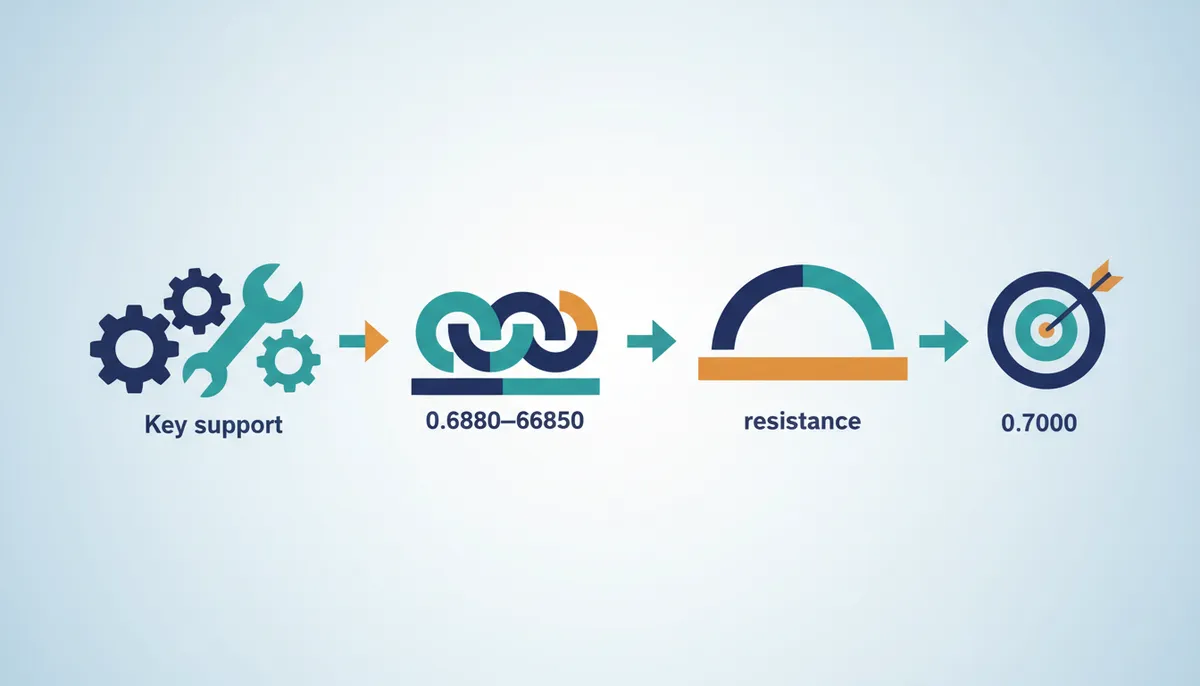
The AUD/USD pair is the most representative benchmark for the Australian dollar's momentum, currently respecting the 0.6880, 0.6850 support zone as a critical technical barrier. This specific price range represents the convergence of recent lows and the lower boundary of current consolidation. Technical analysis suggests a potential downside for the currency pair, with forecasts pointing to a fall toward the next support level of 0.6850 if current bearish trends continue. A sustained recovery would require testing the resistance between 0.6980 and 0.7000, a threshold described as decisive for the next directional move.
| Scenario | Trigger Condition | Target Zone |
|---|---|---|
| Bullish scenario | Hold above 0.6880, 0.6850 | 0.6980, 0.7000 |
| Bearish scenario | Break below 0.6850 | 0.6700, 0.6600 |
Holding the 0.6850 floor is necessary to restore some of the strength lost in recent weeks. Technical bounces face challenges when risk sentiment remains capped by geopolitical tensions, limiting the Australian dollar's upside potential regardless of local RBA policy stances. Reclaiming 0.7000 would represent a significant test of momentum.
Executing trades on the AUD/USD requires precise triggers around the descending trendline and key thresholds. The pair seems to have already shifted its path following prolonged greenback strength. A Bullish scenario could develop if the pair holds the 0.6880, 0.6850 support area and tests the resistance between 0.6980 and 0.7000. Traders should watch for a confirmed move toward this range, noting that any sustained recovery would likely require a more relaxed geopolitical backdrop to negate risk-off flows.
Conversely, the Bearish scenario activates upon rejection of the trendline or a breakdown below the 0.6880, 0.6850 support area. If support fails or the pair rejects the descending trendline in play, AUD/USD could revisit levels from the start of the year. Such a failure opens a path toward start-of-year lows, with technical barriers near 0.6850 representing the next significant downside target if bearish trends persist.
Used metals and forex trading involve significant risk; losses can exceed deposits. ForexCFD.top provides this education-first analysis; we are an affiliate partner and may receive compensation.
Failure Modes: When the 0.6850 Floor Collapses to Start-of-Year Lows
A decisive break below the 0.6880, 0.6850 support zone invalidates the current consolidation structure and exposes the pair to accelerated selling pressure. Should price action reject the descending trendline, the AUD/USD could revisit levels from the start of the year, targeting the 0.6700, 0.6600 area as the next significant zone of interest. This downside risk aligns with technical forecasts pointing to a fall toward 0.6850 if bearish trends persist.
| Scenario | Trigger Event | Downside Target |
|---|---|---|
| Bearish Break | Close below 0.6850 | 0.6700, 0.6600 |
| Trend Rejection | Failure at descending line | Start-of-year lows |
Liquidity conditions can change rapidly during these breakdowns, potentially affecting spreads and slippage for used positions. Note that trading used metals and currencies involves significant risk to your capital.
Strategic Risk Management for Volatile Currency Pairs
Defining Geopolitical Risk Premium in AUD/USD Pricing
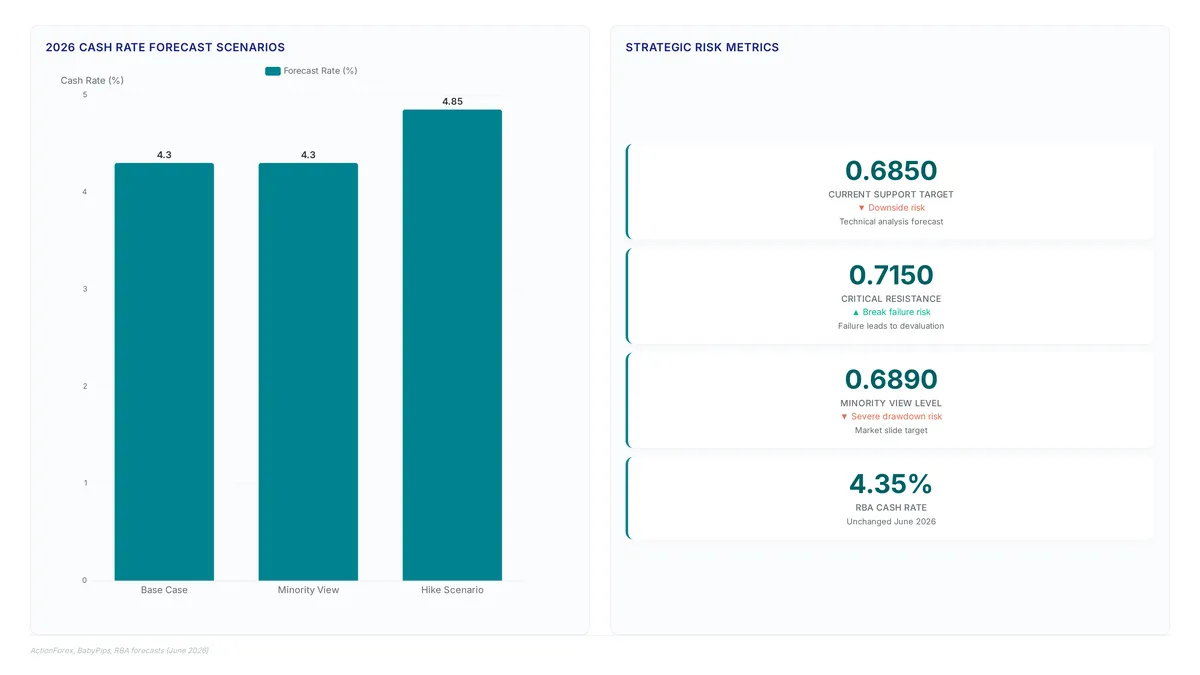
Geopolitical friction installs a risk premium that drags the Australian dollar beneath fair value even as yields climb. Ongoing conflict in the Middle East suppresses global appetite for risk, driving capital toward the safe-haven US dollar rather than chasing yield advantages. Attempts to fix incorrect forex positions by buying dips often fail when fear dictates pricing models. Ignoring this premium invites specific penalties:
- Extended drawdowns as liquidity vanishes during escalations.
- Widening spreads that erode margin on used trades.
- Correlation breakdowns where traditional hedges lose effectiveness.
- Accelerated margin calls due to sudden volatility spikes.
High interest rates theoretically attract capital to offset political fear. Preservation instincts during crises typically outweigh return-seeking behavior in the short-term. The supersonic pace of input cost pass-through threatens future growth, reinforcing a bearish bias. Geopolitical risk acts as a ceiling on AUD/USD recovery until tensions ease. No amount of yield compensation neutralizes a flight-to-safety event. Used metals and currencies carry significant risk; losses can exceed deposits. Islamic accounts avoid swaps but remain exposed to price volatility. Relying on a minority view while the market slides toward 0.6890 exposes capital to severe drawdown risk. The fundamental error lies in betting on a rate hike scenario that current US dollar strength actively contradicts. Investors attempting to fix incorrect forex positions often double down on divergent predictions, ignoring the immediate liquidity drain caused by persistent risk sentiment headwinds.
Maintaining this stance incurs operational costs:
- Accelerated margin erosion as the pair tests lower support zones.
- Opportunity costs from trapped capital during a confirmed bearish trend.
- Increased volatility exposure without corresponding bullish momentum.
- Heightened stress levels affecting decision-making capacity.
- Potential for forced liquidation at unfavorable prices.
Tension exists between holding for a policy shift and respecting the prevailing market structure. Some analysts anticipate further tightening. Price action suggests the economy cannot sustain such pressure without significant pain. Traders should reduce position size or exit entirely until the Australian dollar demonstrates a confirmed reversal above resistance. Ignoring the dominant technical trend in favor of an unproven macro thesis is a fatal flaw in volatile currency markets. Markets often misinterpret a pause as a bullish catalyst. The AUD/USD slide toward recent lows demonstrates how quickly sentiment shifts when surprise is absent. This flexible creates a specific trap for traders attempting to fix incorrect forex positions by averaging down on the belief that yield differentials will eventually force a reversal.
Specific pitfalls include:
- Delayed recognition of risk sentiment overrides from geopolitical tension.
- Capital erosion while waiting for a rate hike cycle that pricing already discounts.
- Exposure to sharp moves if the pair breaks key technical floors.
- Misalignment with central bank forward guidance.
Economic models suggest living standards may fall further under current scenarios, weakening the fundamental case for currency strength living standards. The inability to clear resistance levels increases the probability of a break and retest pattern that devalues the currency against the USD break and retest. Holding long positions based on outlier forecasts ignores the immediate liquidity drain caused by dollar dominance. ForexCFD.top advises that correcting a position requires acknowledging the trend rather than hoping for a divergence that fundamental headwinds suppress.
About
Aisha Rahman serves as the Gold & Commodities Analyst at ForexCFD.top, where she specializes in the complex links between commodity markets and substantial currency pairs. Although her primary focus remains on XAUUSD and oil, her deep expertise in safe-haven flows and macroeconomic drivers makes her uniquely qualified to analyze the AUD/USD pair. The Australian dollar is heavily influenced by global risk sentiment and commodity prices, areas central to Rahman's daily research on how geopolitical tension impacts asset valuations.
At ForexCFD.top, an independent publication dedicated to regulation-aware analysis for global retail traders, Rahman applies her structured approach to dissect how US dollar strength and RBA policy intersect. Her work connects complex fundamental data, such as Federal Reserve rate expectations, to practical trading scenarios. This divergence creates a dangerous trap where traders average down on yield theories while ignoring the immediate liquidity drain caused by the prevailing technical trend. The operational cost of maintaining long positions against this structural weakness is rapid capital erosion, particularly as the pair demonstrates an inability to clear key resistance levels. You must prioritize the confirmed technical breakdown over unproven macro theses that rely on surprise policy shifts which pricing mechanisms have already dismissed.
Stop attempting to fix incorrect forex positions by hoping for a divergence that fundamental headwinds actively suppress. The only viable path forward is to align with the dominant downward structure rather than betting on a reversal that requires an unsustainable economic shock. Start by reducing your position size or exiting entirely this week before the next potential break and retest pattern devalues the currency further against the USD. Acknowledge the trend immediately to prevent forced liquidation at unfavorable prices later.
Frequently Asked Questions
The currency dropped because markets fully priced in the rate decision. With the cash rate holding at 4.35%, traders sold on the news as geopolitical risks outweighed the yield advantage.
Buyers must defend the critical support zone between 0.6880 and 0.6850 to prevent further losses. If this area fails, the pair could slide toward the 0.6700 region as bearish momentum accelerates.
Rising Middle East tensions trigger a flight to safety that hurts risk-sensitive currencies. This fear overrides the appeal of the 4.35% rate, causing capital to flee the Australian dollar for safety.
A sustained break below the 0.6850 threshold confirms the downtrend and opens path to lower zones. Until then, the market remains in a fragile state where high rates fail to attract capital flows.
No, the fixed 2-3 per cent target anchors policy but offers no trading surprise. Without a shift in global risk sentiment or unexpected Fed moves, the currency lacks a catalyst for recovery.
References