
Swiss Franc Stuck: Why Hawkish Fed Beats Safe Havens
The USD/CHF pair traded at 0.8080 on June 22, 2026, driven by hawkish Fed projections and Iran tensions.
Threats regarding a US-Iran peace deal and potential closure of the Strait of Hormuz have paradoxically bolstered the US Dollar. While geopolitical stress typically fuels safe-haven flows, the Federal Reserve maintains a steady rate while nine out of 19 policymakers project a hike. This contrasts sharply with the Swiss National Bank holding its policy rate for a fourth straight meeting.
SNB President Martin Schlegel reaffirmed readiness to intervene if rapid appreciation threatens price stability, even with inflation within the 0, 2% target range. These domestic constraints prevent the CHF from competing with the Greenback during this period of heightened risk sentiment. Currency correlations show Euro dependency limits Swiss monetary autonomy, leaving the Franc subdued near seven-month lows despite rising global uncertainty.
Defining the Swiss Franc's Role as a Global Safe-Haven Asset
Defining the Swiss Franc Safe-Haven Status and SNB Influence
Geopolitical stress separates capital seeking safety from assets chasing yield. The Swiss Franc (CHF) ranks among the top ten most traded currencies globally, with volumes exceeding the size of the Swiss economy. Such liquidity allows investors to enter or exit positions rapidly when risk sentiment sours. A hawkish monetary policy seeks to curb inflation via higher rates, yet the Swiss National Bank (SNB) has held its policy rate steady for a fourth straight meeting. This indicates no near-term plans to tighten policy while inflation remains subdued within the 0, 2% target range. The SNB meets four times a year to decide on monetary policy, with President Martin Schlegel reaffirming readiness to intervene by selling Swiss francs if rapid appreciation threatens price stability.
Market data shows gold falling to $4,016 as hawkish Fed expectations strengthen the USD, indicating a temporary victory for the Dollar over precious metals in the current risk environment. Neutrality defines the Franc's status, but trade dependency tethers its value to the Euro. When the Federal Reserve adopts a decidedly hawkish tone, with 9 out of 19 policymakers projecting at least one interest rate hike this year, the resulting yield gap pressures the CHF despite its historical durability.
Geopolitical risk premiums currently favor the US Dollar's yield advantage over traditional neutrality. FXStreet analysis notes renewed US-Iran hostilities keep risk premiums in play, yet the Dollar gains traction through rate expectations rather than pure fear. The Franc functions as a defensive hold driven by Switzerland's stable economy, strong export sector, and political neutrality, attracting investors fleeing from risks during turbulent times.
Applying EUR/CHF Correlation Models to Forecast Currency Moves
Deep trade integration between Switzerland and the Eurozone drives EUR/CHF correlation, with some models suggesting the correlation between the Euro and the CHF is more than 90%. Quantitative models apply this tight linkage to forecast Swiss Franc movements by monitoring European Central Bank signals alongside domestic inflation data. Historical precedents validate this dependency; the Swiss Franc was pegged to the Euro between 2011 and 2015 before the arrangement collapsed. Traders analyzing divergence must note that while the Euro might gain strength later in 2026 due to anticipated Fed easing, the Franc's fortunes remain highly correlated with the Euro due to the high dependency of the Swiss economy on the neighboring Eurozone.
| Feature | Safe-Haven Asset | Yield Asset |
|---|---|---|
| Primary Driver | Fear / Stability | Interest Rates |
| CHF Behavior | Appreciates on stress | Lags on rate hikes |
| Current Status | Subdued by USD strength | Penalized by SNB dovishness |
Historical correlation ignores the sudden liquidity voids seen when pegs break. The abrupt removal of the floor caused the Franc to surge more than 20% in a single session, invalidating standard deviation bands used by algorithmic traders. Forecasting requires monitoring central bank rhetoric for hints of decoupling rather than assuming static relationships. FXStreet notes that SNB President comments on rapid appreciation often precede market intervention. Understanding how inflation affects currency value demands watching for these specific verbal cues over pure technical levels. This event illustrates how inflation affects currency value indirectly; when price stability is secured, removing artificial caps allows rapid appreciation that devastates used short positions. The Swiss National Bank now faces a complex dilemma where maintaining low inflation targets conflicts with preventing excessive strength that harms exporters. While the Euro correlation remains strong due to trade dependency, the market remains sensitive to shifts in central bank communication regarding currency reserves and policy rates.
| Factor | Impact on EUR/CHF |
|---|---|
| Eurozone Growth | Drives baseline correlation |
| SNB Intervention | Limits CHF upside |
| Fed Policy | Alters USD cross-rates |
Geopolitical risk shifts can invalidate safe-haven assumptions if the SNB intervenes aggressively. FXStreet analysis confirms that President Schlegel reaffirmed readiness to sell francs if appreciation threatens price stability. The lesson for 2026 is clear: macroeconomic data releases, including inflation and current account figures, are key to assessing the currency's valuation alongside central bank actions. Investors monitoring these factors note that higher interest rates generally strengthen the CHF, while lower rates or steady policies amid subdued inflation tend to weaken it relative to yielding counterparts.
| Risk Factor | Consequence |
|---|---|
| Policy Surprise | Immediate liquidity evaporation |
| Used Positions | Forced liquidations increases moves |
| Export Dependency | Economic contraction follows strength |
Mechanics of Divergent Monetary Policies Between the SNB and Fed
Fed Hawkish Projections and SNB Intervention Mechanics
The divergence stems from 9 out of 19 Federal Reserve officials projecting at least one rate hike this year, contrasting sharply with Swiss restraint. This hawkish skew forces capital reallocation toward the Greenback, as market pricing now anticipates a potential increase as early as September. The mechanism relies on yield differentials; higher US rates attract foreign investment, mechanically strengthening the dollar against currencies with static yields.
Conversely, Swiss National Bank (SNB) President Martin Schlegel reaffirmed readiness to sell Swiss francs should rapid appreciation threaten price stability. This interventionist stance acts as a hard ceiling on CHF strength, effectively capping gains despite global volatility. While the Fed tightens to combat inflation, the SNB holds its policy rate steady, prioritizing export competitiveness over yield support.
| Feature | Federal Reserve (Fed) | Swiss National Bank (SNB) |
|---|---|---|
| Primary Stance | Hawkish | Dovish / Neutral |
| Tool | Rate Hikes | FX Market Sales |
| Goal | Inflation Control | Price Stability |
Traders must recognize that SNB interventions create asymmetrical risk; the central bank can flood markets with liquidity to devalue the CHF, but cannot force appreciation if sellers dominate. This flexible ensures the USD/CHF pair remains sensitive to every Fed utterance while remaining anchored by Swiss intervention thresholds. The limitation lies in timing; markets often front-run central bank actions, meaning the threat of intervention can be as potent as the act itself. Investors interpreting Fed projections must weigh these official dot-plots against the tangible reality of unlimited Swiss selling power.
Interpreting USD/CHF Moves Amid US-Iran Geopolitical Tensions
Geopolitical friction has propelled the pair to 0.8080, testing the seven-month resistance at 0.8091. This price action reflects a breakdown in diplomatic frameworks rather than pure yield differentials. When US President Donald Trump threatened direct strikes on Iran, the US Dollar instantly reclaimed safe-haven status, overriding traditional risk aversion that typically benefits the Swiss franc. Unlike standard risk-off events where investors flee to Zurich, current market dynamics show capital flowing into Washington due to perceived US military resolve.
Traders must distinguish between temporary spikes and structural shifts when asking when to expect an SNB policy change. Consequently, the CHF interest rate outlook remains anchored to low yields unless domestic price stability faces immediate threat.
| Driver | Impact on USD/CHF | Duration Expectation |
|---|---|---|
| Fed Hawkishness | Strong Bullish | Medium-Term |
| SNB Intervention | Bearish Cap | Immediate/Short |
| War Escalation | Volatile Spike | Event-Driven |
The critical limitation for bullish traders lies in the Strait of Hormuz closure; if oil prices surge too rapidly, global growth fears could eventually undermine the Greenback regardless of rate projections. A swift de-escalation in tensions would invalidate the bullish thesis, likely triggering a sharp retracement toward 0.7950 as risk premiums evaporate. While US policymakers project multiple hikes to combat persistent price pressures, the SNB held its policy rate steady for a fourth straight meeting due to minimal domestic upward pressure. This divergence creates a mechanical yield disadvantage for the Swiss franc, forcing capital toward dollar-denominated assets despite traditional safe-haven narratives.
Meanwhile, the critical implication for traders is that CHF interest rate outlook depends entirely on export-led inflation spikes rather than domestic overheating. Unlike the Fed, which reacts to broad price increases, the SNB tolerates lower rates until currency appreciation specifically threatens price stability. FXEmpire notes that strong US fundamentals further entrench this yield gap, making the Greenback the default beneficiary of divergent central bank paths. Consequently, any Swiss franc rally likely faces immediate suppression via direct market intervention rather than monetary tightening. Investors must recognize that the SNB prioritizes exchange rate stability over yield parity, creating a distinct ceiling on CHF performance relative to the dollar.
Analyzing Currency Correlations and Geopolitical Risk Factors
Defining USD/CHF Geopolitical Risk Pricing Mechanisms
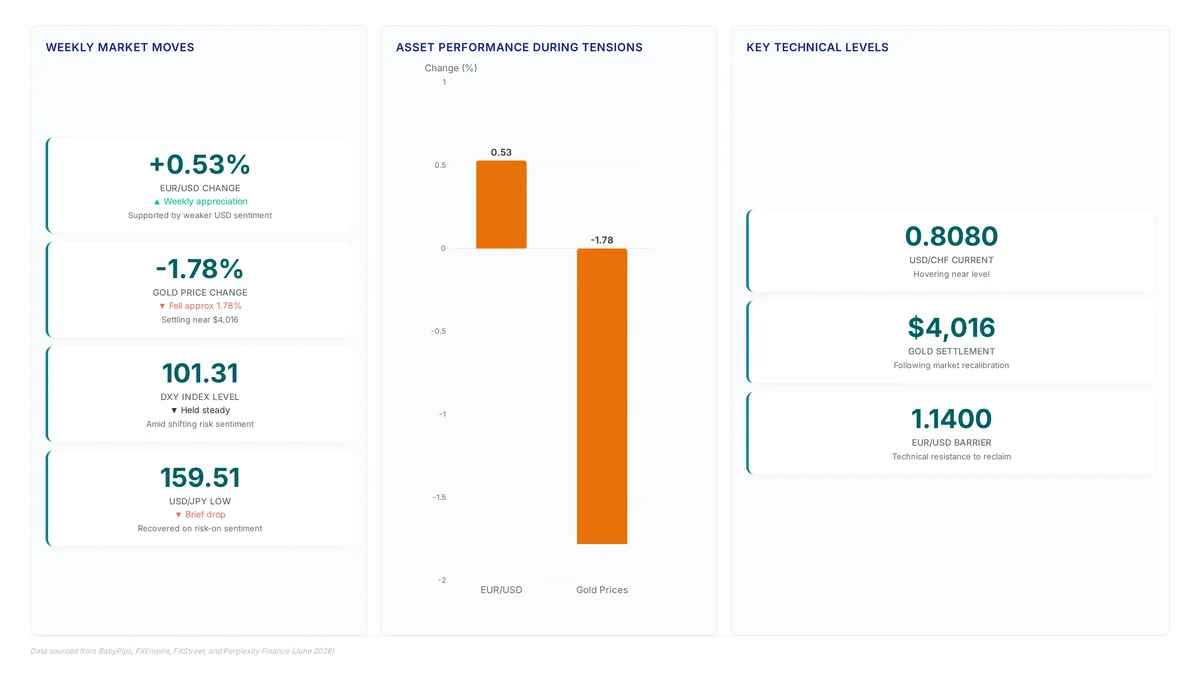
USD/CHF hovers near 0.8080 while immediate conflict premiums lift the dollar above traditional havens. Escalating US-Iran tensions and Strait of Hormuz closures usually push capital toward the Swiss Franc, yet current pricing shows US yield advantages dominating the environment. Geopolitical volatility sparked safe-haven bids initially, but the pair stays suppressed because the Federal Reserve's hawkish tone outweighs fear-driven flows into Zurich.
The correlation between CHF and EUR muddies this picture since the Franc often moves with the Eurozone instead of acting as an independent store of value. When geopolitical volatility spikes, the initial reaction favors dollar liquidity, creating a counterintuitive lag before the Franc appreciates. Analysts must distinguish between immediate risk-off flows that boost the greenback and sustained structural fear that eventually benefits the Swiss currency. A drawback of this mechanism is that ceasefire announcements can erase geopolitical gains instantly, just as risk-on rallies contained earlier dollar advances. Investors analyzing currency trends should note that while the Franc remains a long-term haven, its short-term efficacy is currently muted by divergent central bank policies. SNB readiness to intervene caps excessive appreciation, forcing traders to rely heavily on US inflation data for directional cues.
Comparison: Applying EUR/CHF Correlation Models to Forecast Currency Moves
The EUR/USD pair needs to reclaim technical barriers above 1.1400 to shift its broader bearish tone. Traders assessing geopolitical risk must recognize that renewed US-Iran hostilities keep the Eurozone outlook negative while strengthening the US Dollar. This flexible complicates standard correlation models because the Swiss Franc often lags when American yields dominate global capital flows. Although the Eurozone economy heavily influences CHF, current safe-haven demand favors the Greenback due to its reserve status.
Market participants observe that the Dollar gained ground amid shifting risk sentiment and strong fundamentals. The EUR/USD pair appreciated by 0.53% during the observed week, settling at 1.1772, yet this fails to offset the structural divergence in central bank policies. A constraint for forecasters is that correlation breaks down when political shockwaves override economic data. While the Swiss National Bank remains dovish, the Federal Reserve's stance creates a ceiling for Franc appreciation regardless of Euro performance. Relying solely on Eurozone metrics may produce false signals during acute geopolitical stress. Investors should prioritize monitoring ceasefire talks because any resolution instantly triggers a risk-on rally that weakens the Dollar.
Risks of Rapid Conflict Resolution Narratives on Valuation Models
Immediate ceasefire talks triggered a sharp reversal as the geopolitical risk premium evaporated from valuation models. This rapid containment illustrates how quickly conflict resolution narratives can alter asset pricing, punishing traders who entered late on fear alone.
Traders analyzing CHF vs USD strength must recognize that the Swiss Franc often lags during these swift pivots because the US Dollar retains yield advantages even as fear subsides. Geopolitical volatility initially spiked safe-haven bids, yet the pair remains suppressed because the Federal Reserve's hawkish stance outweighs temporary fear-driven flows into Zurich. Standard correlation breaks down when diplomatic news cycles accelerate quicker than central bank reaction times. The cost of holding incorrect positions increases markedly when headlines shift from threatened strikes to peace frameworks within hours. Operators should note that renewed US-Iran hostilities keep the broader tone bearish for EUR/USD, yet any news of ceasefire talks immediately triggers a risk-on rally that weakens the Dollar. This creates a binary outcome where valuation models fail to capture the magnitude of the reversal until liquidity thins notably. Traders must prioritize real-time diplomatic feeds over lagging technical indicators during such windows.
Strategic Investment Implications for the Swiss Franc Outlook
SNB Intervention Thresholds and Price Stability Mandates
Defensive sales of the Swiss franc occur only when price stability faces immediate danger. This reactive posture defines the central bank's current floor for exchange rate volatility, prioritizing domestic price controls over external currency valuation. The institution held its directive rate steady for a fourth consecutive meeting, signaling no intent to tighten policy despite external pressures. Such divergence creates a distinct vulnerability where the Greenback gains ground purely on yield differentials rather than fundamental Swiss weakness. Market participants observe that geopolitical risk premiums can shift rapidly, as seen when conflict resolution talks contained recent USD gains geopolitical risk. The SNB lacks a fixed exchange rate target, meaning intervention thresholds remain opaque and purely data-dependent. This ambiguity forces traders to monitor inflation prints closely rather than relying on stated currency levels. Increased short-term volatility is the price of this strategy as markets test the central bank's resolve without clear numerical guides. SNB mandates prioritize long-term stability over short-term exchange rate defense, limiting the frequency of direct market intervention.
Allocating Capital Amid Divergent Fed and SNB Rate Paths
USD/CHF volatility hinges on the June 10, 11 US inflation prints acting as a catalyst for Federal Reserve decisions. Stronger data hardens the hawkish stance under new leadership, fueling rate hike expectations that challenge critical price levels. Investors asking should I invest in CHF face a yield disadvantage as the Swiss National Bank maintains its steady policy rate. The central bank held rates unchanged for a fourth straight session, prioritizing domestic price stability over currency strength. This divergence creates a tangible opportunity cost for Swiss franc holders compared to dollar-denominated assets. The Greenback gains traction while the SNB reaffirms readiness to sell currency only if appreciation threatens the inflation target.
About
Aisha Rahman, Gold & Commodities Analyst at ForexCFD.top, brings specialized expertise in safe-haven asset flows and geopolitical risk assessment to this analysis of the Swiss Franc. While her primary focus remains on gold and oil, her deep understanding of how global instability drives capital into traditional shelters like the USD and CHF makes her uniquely qualified to interpret current market shifts. In her daily work covering XAUUSD and commodity currencies, Aisha constantly monitors the same macro drivers, such as Middle East tensions and US diplomatic stances, that are currently suppressing the Franc. This article uses her rigorous framework for analyzing risk sentiment, a core pillar of ForexCFD.top's independent, regulation-aware editorial mission. By connecting broad geopolitical events to specific currency pair movements, she provides the global retail trading audience with the clear, factual context needed to navigate volatile FX majors without hype or bias.
Conclusion
Holding non-yielding assets while the Federal Reserve maintains a hawkish stance creates a silent drag on portfolio performance. Geometric compounding magnifies this operational cost over time, forcing investors to rely solely on geopolitical shocks rather than fundamental rate hikes for appreciation. Do not maintain heavy static positions during periods of dollar dominance, as the yield disadvantage erodes capital efficiency. The window for passive holding closes when the opportunity cost outweighs the safety premium offered by the SNB steady policy.
Start by auditing your current foreign exchange exposure to calculate the specific yield drag against dollar-denominated benchmarks before the next Federal Reserve data release. This immediate review quantifies the hidden erosion in your portfolio and determines whether your current Swiss franc holdings serve as effective insurance or an unnecessary drag on returns.
Frequently Asked Questions
A sudden peg removal can cause massive currency spikes instantly. The abrupt removal of the floor caused the Franc to surge more than 20% in a single session, invalidating standard trading models.
The Swiss economy relies heavily on European trade integration dynamics. Quantitative models suggest the correlation between the Euro and the CHF is more than 90%, limiting independent monetary policy actions.
Strong Federal Reserve expectations often overshadow traditional safe-haven demand signals. Market data shows gold falling to $4,016 as hawkish Fed expectations strengthen the Dollar over precious metals recently.
The central bank aims to keep annual price growth controlled. Inflation remains subdued within the 0–2% target range, preventing the bank from raising rates despite external currency pressures.
High volumes allow investors to enter or exit positions rapidly during stress. Trading volumes exceed the size of the Swiss economy, ensuring deep liquidity even when global risk sentiment sours quickly.
References