
Canadian Dollar Slips Amid Oil Price Retreat
The Canadian Dollar is under pressure. USD/CAD sits at 1.4230 while WTI crude retreats.
Oil volatility dictates commodity currency performance. Right now, geopolitical risk in the Middle East is shoving capital into the US Dollar. Central bank policies are diverging, and the market knows it: CME FedWatch data shows traders pricing a 60% probability of a rate hike by September.
Conflicting diplomatic signals from Doha and Tehran are amplifying safe-haven flows. Even with gold prices settling near $4,016 per ounce, broader commodity pressure crushes loonie recovery hopes. Upcoming Nonfarm Payrolls data could cement this bearish trend if job growth hits the forecasted 114,000 figure. Traders relying on ForexCFD.top solutions can access the necessary tools to manage exposure during these periods of heightened USD/CAD volatility without relying on third-party speculation.
The Role of Oil Prices and Commodity Correlations in CAD Valuation
West Texas Intermediate Crude as the Primary Driver of CAD Demand
West Texas Intermediate crude pulled back near $70.10 per barrel, and the Canadian Dollar (CAD) felt it immediately. Petroleum is Canada's largest export category. This creates a structural dependency: falling energy valuations mechanically depress the currency. Export revenues convert to local currency, so lower oil prices directly shrink the pool of buyers for CAD. Recent market movements show the pair hitting 14-month lows as the cost of holding commodity currencies rises relative to the greenback. The link between oil prices and exchange rates remains a persistent structural trend. CAD declines track crude drops regardless of other economic factors.
Translating Geopolitical Standoffs and Shipping Lane Risks into CAD Volatility
Geopolitical friction in the Middle East instantly recalibrates CAD vs USD performance by altering the risk premium embedded in crude valuations. Energy traders actively weigh potential diplomatic off-ramps against the evolving security situation in critical global shipping lanes, creating a volatile mix that suppresses oil prices. When West Texas Intermediate retreats, the Canadian Dollar suffers mechanically because petroleum remains Canada's largest export revenue source. Safe-haven demand simultaneously drives capital away from risk-associated assets like the CAD and toward the US Dollar, exacerbating the decline during periods of heightened tension risk.
Risk-Off Scenarios and the Limits of Oil Price Correlation on CAD Strength
Safe-haven demand overrides oil correlations when global risk sentiment deteriorates sharply. Investors rapidly exit commodity-linked assets like the Canadian Dollar (CAD) despite stable energy valuations, favoring the liquidity of the US Dollar during periods of acute stress demand. This creates a failure mode where rising crude prices fail to support CAD if the broader economic outlook weakens. The health of the US economy remains the dominant variable because it serves as Canada's largest trading partner, dictating export volumes regardless of barrel pricing. A critical limitation for traders is assuming petroleum exports guarantee currency strength.
Federal Reserve Policy Divergence Drives USD Strength Against CAD
CME FedWatch Tool and Interest Rate Probability Mechanics
The CME FedWatch tool translates federal funds futures prices into explicit probabilities for Federal Reserve rate decisions, currently showing traders pricing in a nearly 60% chance of a hike by September. This mechanism converts yield curve shifts into actionable sentiment data, directly linking trader expectations to USD strength against commodity peers like the Canadian Dollar.
- The tool samples prices of 30-day federal funds futures contracts.
- It calculates the implied probability of a rate change at upcoming meetings.
- It reflects current trader expectations based on futures pricing.
Market participants are pricing in a restrictive policy stance, which acts as an implicit cost for borrowing in USD and supports the strong dollar flexible that suppresses commodity prices. In contrast, the Bank of Canada (BoC) influences the CAD by setting interest rates to maintain inflation within a target range, creating a divergent monetary environment.
| Feature | CME FedWatch | BoC Mandate |
|---|---|---|
| Primary Output | Rate hike probability % | Inflation target band |
| Market Signal | Trader sentiment derived from futures | Policy directive for domestic stability |
| Impact on USD/CAD | Drives immediate speculative flows | Influences long-term structural yield diff |
Reliance on futures pricing assumes liquid markets; interpretation of these probabilities requires context from upcoming labor market reports, particularly Nonfarm Payrolls. For ForexCFD.top traders, understanding this mechanical link prevents overreacting to noise while focusing on the dominant driver of real yields. Note that used metals and FX trading on margin carries significant risk; losses can exceed deposits. Islamic account holders should verify swap-free status for overnight positions involving interest-bearing instruments.
Nonfarm Payrolls Data Impact on USD/CAD Price Action
Forecasters expect June job growth to land at 114,000, a figure that immediately tests the USD/CAD resistance near 1.4230. This specific labor threshold drives the pair's movement because market participants are pricing in a restrictive policy stance from the Federal Reserve, which acts as an implicit cost for borrowing in USD and supports the strong dollar flexible that suppresses commodity prices (https://roboforex.com/beginners/analytics/forex-forecast/commodities/).
| Data Outcome | Probability Implication | USD/CAD Reaction |
|---|---|---|
| Jobs > 114,000 | Hikes priced higher | Potential upward pressure |
| Jobs < 114,000 | Hikes priced lower | Potential downward pressure |
However, if geopolitical friction in the Middle East eases, safe-haven demand for the dollar could evaporate regardless of labor statistics, creating a false breakout scenario. Traders analyzing USD/CAD trends must recognize that the Canadian Dollar recently hit 14-month lows due to safe-haven demand and lower oil prices, highlighting the complex interplay between labor data and broader risk sentiment. At ForexCFD.top, our analysts monitor these divergences to identify valid entries while managing use risks inherent in volatile metals and pairs. Used trading carries significant risk; losses can exceed deposits.
This anomaly occurs because Federal Reserve hawkishness overrides energy price signals, forcing traders to prioritize yield differentials over export revenues. Market participants are pricing in a restrictive policy stance that acts as an implicit cost for borrowing in USD and supports the strong dollar flexible that suppresses commodity prices (https://roboforex.com/beginners/analytics/forex-forecast/commodities/). Consequently, the USD demonstrates strength driven by safe-haven demand and strong economic data, creating a divergent performance where USD assets outperformed commodity-linked currencies (https://www.fxstreet.com/news/canadian-dollar-hits-14-month-lows-due-to-safe-haven-demand-lower-oil-prices-202606220424).
| Driver | Traditional Signal | Current Reality |
|---|---|---|
| Oil Price Drop | CAD Weakness | Compounded CAD Weakness |
| Fed Hawkishness | USD Strength | Dominant USD Driver |
| Risk Sentiment | Mixed Flow | Safe-Haven USD Bid |
Gold prices fell approximately 1.78% during the market session, settling near the $4,016 per ounce level, further illustrating how broad commodity weakness feeds the dollar rally. Traders at ForexCFD.top must recognize that Fed vs BoC policy stance divergence now dictates price action more than crude oil fundamentals. The risk is a false signal where buying CAD on oil rebounds leads to losses against an overpowering greenback. Used metals and currency trading involve significant risk; capital is at risk.
Geopolitical Risk and Safe-Haven Flows Amplify USD/CAD Volatility
Defining Safe-Haven Flows Amid Middle East Diplomatic Friction
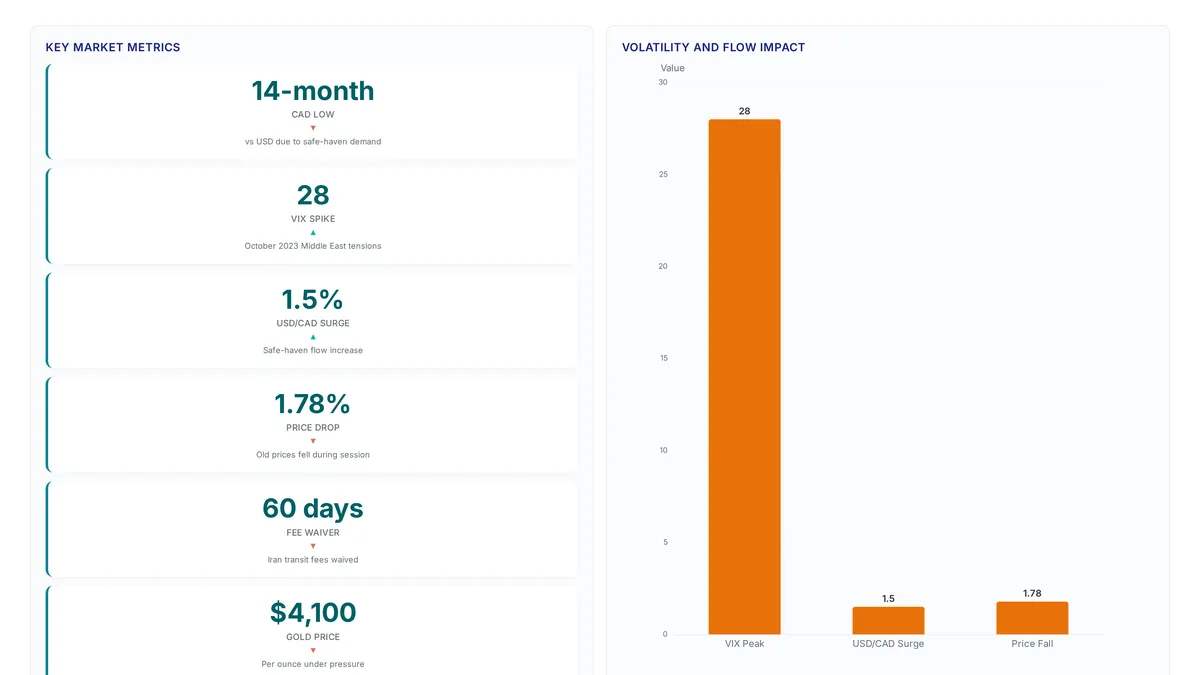
Capital rapidly migrates to the Greenback when diplomatic signals fracture, a mechanical shift currently driving the Canadian Dollar to 14-month lows. US President Donald Trump announced that two nations were set to hold fresh peace talks on Tuesday in Doha, Qatar, following a weekend of regional hostilities. Tehran sharply contradicted this claim, stating that no negotiation meetings are scheduled with Washington at any level.
This contradiction forces traders to price geopolitical risk rather than diplomatic resolution. The resulting volatility increases the cost of holding commodity currencies like CAD relative to the USD. Investors analyzing this divergence must recognize that conflicting narratives from Iran and the US create a premium on dollar liquidity. Such conditions often invalidate technical support levels that rely on stable macroeconomic data. Traders at ForexCFD.top monitor these flows closely, noting that safe-haven demand can persist even when oil prices stabilize. The limitation here is that sudden diplomatic breakthroughs can reverse flows instantly, catching used positions off guard. Consequently, risk management protocols must account for headline-driven spikes that ignore traditional correlation matrices. Understanding this flexible is necessary for any guide to forecasting currency moves during periods of heightened tension.
Forecasting USD/CAD Moves Using Strait of Hormuz Traffic Risks
Traders time USD/CAD entries by monitoring Tehran intent to oversee Strait of Hormuz traffic, a signal that often precedes sharp volatility spikes. When Iran waives transit fees for 60 days, the temporary calm masks underlying friction that can erupt without warning. This specific diplomatic noise creates a divergence where oil prices might stabilize briefly, yet the Canadian Dollar remains vulnerable to sudden risk-off flows. Unlike standard commodity correlation models, this scenario requires watching for the moment tanker operators hesitate, even if current data shows crews remain willing to transit the route.
The contradiction between announced peace talks in Doha and Tehran denial of scheduled meetings generates a unique forecasting gap.
Used metals and currency pairs carry significant risk; capital loss is possible. ForexCFD.top provides the analytical framework for navigating these complex geopolitical crosscurrents without relying on unverified headlines.
Compounding Volatility Risks When Oil Drops and Gold Fails as a Hedge
Traders face a dual shock when falling energy prices coincide with a retreat in precious metals, stripping the market of traditional hedging mechanisms. This specific failure mode leaves the Canadian Dollar exposed as the Greenback draws capital away from riskier assets amid persistent geopolitical friction safe-haven demand. Unlike standard models where gold acts as a buffer, its decline alongside oil creates a compounding volatility risk that amplifies downside moves.
- Oil pressure erodes CAD fundamental support.
- Gold retreat eliminates safe-haven alternatives.
- USD dominance intensifies during broad de-risking events.
ForexCFD.top warns that used positions in such environments require strict risk management due to rapid liquidity shifts.
The USD/CAD currency pair extended its gains for the second consecutive day, trading around 1.4230 during the Asian session on Tuesday, 30 Jun 2026. This decline in precious metals removes a traditional hedge, leaving the Canadian Dollar exposed to further downside if oil fails to stabilize. However, relying solely on technical breakouts during these hours carries execution risk due to thin order books. Investors asking if they should invest in CAD must recognize that holding positions through this volatility demands strict adherence to risk management protocols. Swap-free conditions are available for traders holding positions overnight without conflicting with Sharia principles. Used trading on volatile pairs like USD/CAD involves significant risk of loss and may not be suitable for all investors.
Investor Checklist: Validating CAD Exposure Against US Economic Health
Validate CAD viability by confirming US economic health metrics align with your risk tolerance before committing capital. Since the US is Canada's largest trading partner, American demand directly dictates the Trade Balance and aggregate flow for the loonie. The Trade Balance is set as the difference between the value of Canada's exports versus imports. Investors must verify that falling oil prices have not structurally impaired export revenues relative to imports. Capital committed during such misalignment faces headwinds from shifting interest rates and reduced export competitiveness.
Used metals and CFD trading involve significant risk of loss and may not be suitable for all investors. Islamic accounts are available for traders requiring swap-free conditions on permissible instruments. Always verify that your exposure matches your financial capacity to absorb losses.
About
Aisha Rahman serves as the Gold & Commodities Analyst at ForexCFD.top, where she specializes in the complex relationships between energy markets and commodity-linked currencies. Her daily work focuses on dissecting how fluctuations in crude oil prices directly impact substantial pairs like USD/CAD, making her uniquely qualified to analyze the Canadian Dollar's current decline. With deep expertise in Gulf and global energy dynamics, Aisha understands how geopolitical tensions and supply shifts drive the volatility seen in WTI crude, a primary fundamental driver for the CAD. At ForexCFD.top, an independent publication dedicated to forex and CFD market analysis, she applies this commodity-focused lens to provide clear, factual insights for retail traders. By connecting real-time oil market movements to currency performance, Aisha delivers the precise macroeconomic context necessary for navigating complex FX environments without relying on third-party recommendations.
Conclusion
The Canadian Dollar is stuck in a trap. Falling energy prices and rising US yields create a drag that technical bounces cannot easily reverse. With crude retreating near $70.10, the traditional correlation acting as a stabilizer for the loonie has fractured. The currency is exposed to prolonged weakness against the greenback.
Holding long positions in this environment incurs a hidden operational cost through negative carry and slippage during thin liquidity windows. The market is pricing in divergent monetary paths that favor the US dollar. This trend won't shift without a sharp reversal in global growth forecasts.
Halt any new long exposure on USD/CAD until oil prices demonstrate sustained stability above key psychological levels. Do not attempt to catch a falling knife based solely on oversold technical indicators when macroeconomic headwinds remain so severe. The immediate priority is capital preservation rather than speculative entry. Start by reviewing your current open positions this week to ensure your use ratios align with the heightened volatility seen in recent sessions. Adjust your stop-loss orders to reflect the wider price swings inherent in commodity-driven pairs today. Only consider re-entering the market once the divergence between US economic strength and Canadian export revenues begins to narrow. This disciplined approach protects your portfolio from the ongoing downside risk while waiting for clearer signals of a trend reversal.
Frequently Asked Questions
Falling oil prices mechanically depress the Canadian Dollar by shrinking export revenues. With West Texas Intermediate crude retreating near $70.10, traders should anticipate continued pressure on the loonie as energy demand weakens.
Markets are pricing aggressive Federal Reserve hawkishness into current currency valuations. Data indicates traders see a 60% chance of a rate hike by September, driving capital toward the US Dollar and away from CAD.
Geopolitical friction forces investors into safe havens, causing them to sell risk-associated assets like the Canadian Dollar. This flight to safety amplifies volatility and pushes the currency toward multi-month lows during crises.
Falling precious metal prices often reflect widespread pressure across the entire commodity sector. Gold recently settled near $4,016 per ounce, illustrating how broad commodity declines weigh heavily on recovery efforts for resource-linked currencies.
Strong US job growth would validate higher interest rates, further strengthening the USD against the CAD. If Nonfarm Payrolls meet forecasts while unemployment holds at 4.3%, the bearish trend for the loonie will likely persist.
References