
Gold futures fall: Rate hike fears crush bullion appeal
Gold futures for August 2026 delivery declined on the Multi Commodity Exchange as rate hike fears triggered a sharp selloff. The thesis is simple: rising U.S. Interest expectations and a strengthening dollar have nullified the traditional inflation-hedge status of precious metals. We are seeing a mechanical reevaluation of bullion, divergent performance between domestic and global markets, and a critical need to apply specific support and resistance levels rather than chasing momentum.
The Multi Commodity Exchange saw significant volatility, with spot gold dropping 1% to $4,067.51 per ounce internationally. This downturn occurred even as falling oil prices offered some geopolitical relief following developments near the Strait of Hormuz. Non-yielding assets become liabilities when central banks signal aggressive tightening. Traders are now pricing in multiple rate hikes, a stark contrast to previous expectations, which has strengthened the U.S. Dollar and made bullion more expensive for foreign buyers.
Domestic participants face a similar environment where MCX silver futures for July 2026 delivery fell 1.4% to ₹2,22,578 per kg. Technical analysis suggests critical support zones near $4,040 for international gold, while domestic contracts may test the ₹1,44,000 level. Understanding these support and resistance thresholds is necessary for navigating the heightened volatility ahead of upcoming U.S. GDP data releases.
Macroeconomic Drivers Behind the Precious Metals Selloff
Opportunity Cost of Non-Yielding Assets Amid Rate Hikes
Rising real yields directly erode the value proposition of holding non-yielding assets like gold. Traditional inflation hedges lose appeal when interest rates rise because bullion generates no cash flow to offset financing expenses. Federal Reserve signals regarding tightening increase the opportunity cost of capital immediately. Market sentiment has pivoted sharply following recent central bank communications. This rapid repricing forces a mechanical rotation out of precious metals and into yield-bearing instruments. The inverse relationship between rates and bullion is not merely theoretical; it is the dominant pricing factor currently suppressing demand. As Treasury yields climb, the relative attractiveness of zero-coupon assets diminishes instantly. Higher rates hurt gold prices while simultaneously signaling confidence in economic stability, which can eventually spur industrial demand for silver. Monetary tightening often triggers a liquidity crunch that depresses all commodity prices before any fundamental divergence occurs. Investors must recognize that until the yield curve stabilizes, the cost of carry for holding physical metal remains a persistent drag on total returns. Monitoring real rate spreads rather than nominal price action alone is necessary during these periods.
MCX Price Declines Driven by Dollar Strength and Tariff Hikes
Gold futures on the Multi Commodity Exchange (MCX) for August delivery fell by ₹1,529, a 1.04% decline, to ₹1,45,000 per 10 grams on 24 June 2026, touching an intraday low of ₹1,44,114 amid rising yields. The U.S. Dollar climbed to its highest level in more than a year, making bullion more expensive for buyers holding other currencies. This currency surge mechanically suppresses demand across emerging markets as the stronger dollar acts as a primary headwind that correlates directly with declining commodity valuations. Domestic investors face a compounding double whammy where global price drops converge with local policy shifts. India raised gold import tariffs from 6% to 15%, a move intended to protect foreign exchange reserves but which exacerbated local volatility. This structural cost increase means local price declines appear less severe in percentage terms yet remain painful due to elevated absolute levels. Traders analyzing Federal Reserve impact must monitor how import tariffs interact with currency fluctuations to distort traditional hedging strategies. Unlike pure macro plays, these localized friction costs prevent immediate arbitrage between global spot prices and domestic futures. The result is a fragmented market where global weakness translates unevenly into local losses. Rising real yields erode the value proposition of non-yielding assets when financing costs climb. Strict adherence to support levels rather than momentum chasing is advisable during these policy-driven swings.
Divergent Pressures on Silver Versus Gold Futures
Silver faces a distinct double whammy where monetary tightening converges with industrial demand concerns to accelerate losses. Unlike gold, which primarily reacts to real yield shifts, the white metal suffers from a simultaneous contraction in manufacturing activity. Silver futures for July delivery on the MCX fell by ₹3,255, a 1.44% drop, closing at ₹2,22,579 per kilogram as industrial demand concerns compounded monetary pressures. This divergence is visible in recent MCX data, where silver fell further than gold on the same session. The primary driver for this underperformance is the dual pressure of rising holding costs and subdued factory usage. The steeper decline in silver points to industrial exposure rather than simple currency strength. Industrial demand concerns have compounded monetary pressures, creating a feedback loop that exacerbates price declines. CME Group raising margin requirements for gold and silver contracts directly increased the cost of holding positions. Strategic positioning now requires separating pure monetary hedges from assets with significant industrial exposure.
Divergent Performance Trends in Domestic and Global Markets
Defining Divergent Trends in MCX Futures and International Spot Markets
Domestic MCX silver futures for July 2026 delivery fell Rs 3,256 1.4% to Rs 2,22,578 per kg, underperforming relative to international pressure where spot silver eased 0.9% to $61.44 per ounce. The divergence arises because local contracts price in currency friction alongside raw commodity moves. Multi Commodity Exchange (MCX) participants face a double whammy of falling global benchmarks and a strengthening dollar. Previous sessions saw declines up to 0.25%, indicating accelerating momentum. Used instruments react more aggressively to rate narratives than passive vehicles. Gold ETFs in India tracked the global decline with less day-to-day volatility than futures. This gap creates a specific trap for unhedged buyers. While global prices drop in dollars, the rupee depreciation cushions the fall in absolute terms, yet the percentage loss remains sharp due to import tariffs. Domestic prices drop less severely in percentage terms than global drops but remain painful due to high absolute levels. Domestic gold prices reflect this complex arithmetic rather than pure commodity supply dynamics. Traders must separate currency noise from genuine demand destruction. Risk Warning: Precious metals trading involves significant risk of loss and is not suitable for all investors. ForexCFD.top does not provide investment advice.
Applying Global Spot Price Drops to Domestic Physical Gold Rates
Spot gold dropped 1% to $4,067.51 per ounce, establishing a lower global baseline that immediately recalibrates domestic physical bullion valuations. While futures markets react aggressively to rate narratives, physical buyers face a lagged but absolute reduction in purchasing power parity.
| City | Pure Gold (24k) Rate | Standard Gold (22k) Rate |
| Delhi | Rs 1,15,792 | Rs 1,06,152 |
| Mumbai | Rs 1,15,672 | Rs 1,06,032 |
| Chennai | Rs 1,18,336 | Rs 1,08,472 |
| Hyderabad | Rs 1,15,672 | Rs 1,06,032 |
Delhi pure gold rates stand at Rs 1,15,792 per 8 grams while Chennai pure gold is Rs 1,18,336, illustrating how regional demand sustains higher absolute costs despite the global drop. Investors tracking domestic gold prices must recognize that the local currency friction often cushions the percentage decline seen on international exchanges. Consequently, traders awaiting support levels based solely on COMEX data may misjudge entry points in the physical market. The divergence creates a specific tension where global momentum suggests selling, yet local scarcity maintains elevated rupee valuations. Gold futures to $4,083.90. This divergence highlights how industrial demand buffers silver slightly while monetary tightening pressures gold more aggressively in the contract market. The sharper drop in gold futures reflects used positioning unwinding quicker than physical spot transactions during rate hike speculation.
| Metric | International Spot Reaction | U.S. The limitation for traders is that spot easing masks the latent volatility in delivery contracts. Operators must distinguish between spot stability and futures fragility when sizing positions. The cost of ignoring this spread is premature entry before the contract roll completes its repricing cycle. ForexCFD.top advises monitoring the gap between spot ease and futures falls to gauge true market sentiment. |
|---|
Applying Support and Resistance Levels for Entry and Exit
Defining Gold and Silver Support and Resistance Zones for MCX
Traders must anchor decisions to the specific support bands at $4,089-$4,040 for gold and $60.00-$58.40 for silver identified by Manoj Kumar Jain. These levels define the immediate liquidity zones where selling pressure may pause before a potential rebound or breakdown. Conversely, resistance caps upside momentum between $4,185-$4,220 for gold and $63.60-$65.20 for silver, creating a set range for tactical entries. The strength of the US dollar continues to pressure these precious metals, making the cost of entry volatile for contrarian buyers testing the critical test of current Fibonacci zones. A common error involves treating these bands as single price points rather than flexible zones where order flow thickens. While falling oil prices typically aid bullion, current rate hike fears override this correlation, demanding stricter adherence to these technical boundaries. Ignoring the upper resistance limits while holding long positions exposes capital to unnecessary drawdowns as macro headwinds persist. *Disclaimer: Recommendations, suggestions, views and opinions given by the experts are their own. These do not represent the views of ForexCFD.top. Trading commodities involves significant risk.*
Timing Silver Entries Around U.S. GDP Data Releases
Fresh capital deployment into silver futures should cease immediately prior to U.S. GDP data releases to avoid volatility spikes that invalidate technical setups. Manoj Kumar Jain of Prithvi Finmart explicitly advises against initiating fresh buying positions in gold and silver ahead of these macroeconomic events. The mechanism here involves liquidity evaporation; as traders square positions, the bid-ask spread widens, causing stop-losses to trigger on noise rather than genuine trend breaks. A stronger dollar acts as a primary suppression force, making bullion expensive for holders of other currencies and cating upward momentum. The limitation of waiting for post-data clarity is the potential for gap openings, where price skips your intended entry level entirely. However, the cost of premature entry during high-uncertainty windows often exceeds the opportunity cost of missing a partial move. Traders must prioritize capital preservation over immediate execution when Federal Reserve rate hike expectations are shifting market sentiment. Avoiding the pre-data window allows operators to read the new price action context rather than guessing the outcome.
Risks of Trading Bullion During Dollar Strength and Rate Hike Expectations
Capital preservation requires avoiding fresh entries before U.S. GDP data releases due to unpredictable volatility spikes. Manoj Kumar Jain explicitly warns against initiating new positions ahead of such macroeconomic events because liquidity often evaporates. The primary mechanism of loss involves the opportunity cost inherent in non-yielding assets when central banks tighten policy. Gold, traditionally viewed as a hedge against inflation, tends to lose appeal when interest rates rise because it does not offer any yield. A strengthening dollar increases the effective cost for buyers holding other currencies, compounding downward pressure on spot prices.
| Risk Factor | Impact Mechanism |
|---|---|
| Rising Yields | Increases opportunity cost of holding bullion |
| Strong Dollar | Makes metal expensive for foreign buyers |
| Data Events | Widens spreads and triggers false breakouts |
However, geopolitical de-escalation can trigger sharp reversals; a US-Iran peace framework previously caused prices to surge over 2% before resuming their decline. This volatility trap means technical support levels may fail during headline-driven spikes. Traders must recognize that rate hike expectations fundamentally alter the risk-reward profile, rendering standard momentum strategies ineffective during Fed tightening cycles.
Strategic Risk Management Amidst Volatile Macro Shifts
Defining Volatility Triggers in Federal Reserve Rate Hike Cycles
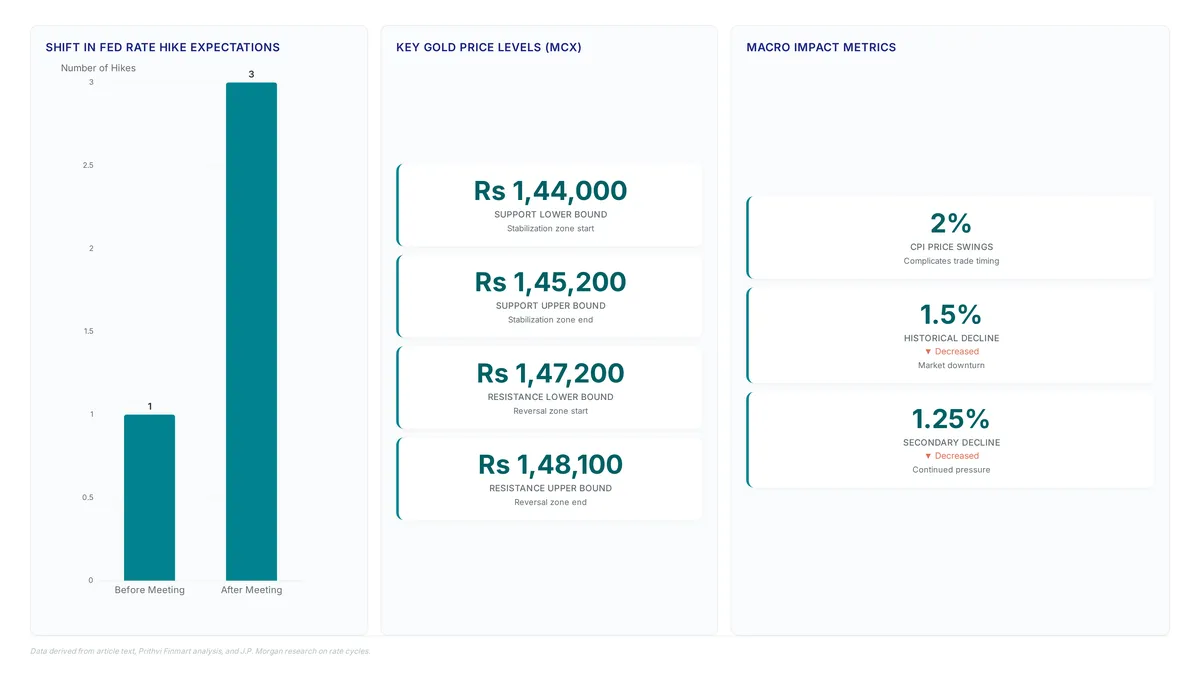
Market expectations shifted sharply following last week's Federal Reserve meeting, instantly recalibrating the opportunity cost for non-yielding bullion. This mechanical repricing forces traders to prioritize strict support boundaries over momentum-based entry signals. Rising Treasury yields directly compete with precious metals, creating a hostile environment for speculative longs holding through policy announcements. Current market models often fail to account for the speed at which CME FedWatch Tool probabilities alter fair value estimates. Traders now price in three interest rate hikes from the U.S. Central bank this year. Expectations stood at just one hike before the meeting. Such rapid changes demand rigid discipline rather than flexible hope.
Risks: Applying Support and Resistance Zones to MCX Gold and Silver Trades
Timing entries during Federal Reserve cycles fails when traders ignore the divergence between global spot pricing and domestic liquidity constraints. GDP releases cause volatility expectations to spike arbitrarily. Strict adherence to these support ranges helps mitigate the risk of false breakouts caused by algorithmic selling. Relying solely on technical levels ignores the macro headwind where rate hike fears outweigh falling oil prices. This divergence creates a chaotic environment where standard inverse correlations break down. Manoj Kumar Jain of Prithvi Finmart identifies specific zones where price action may stabilize or reverse. Gold finds support at Rs 1,45,200-Rs 1,44,000 on MCX. Resistance sits at Rs 1,47,200-Rs 1,48,100. Silver support lies between Rs 2,21,000-Rs 2,16,600. Resistance appears at Rs 2,28,800-Rs 2,31,200. GDP Data
Initiating fresh buying positions before U.S. GDP releases invites sudden reversals that invalidate established technical floors. Investors are advised to avoid initiating fresh buying positions in gold and silver ahead of the release of U.S. GDP data, noting that macroeconomic data often triggers chaotic price action where standard support levels fail to hold. The primary risk lies in the technical failure of key zones; a breach below current thresholds can accelerate selling pressure rather than attract bargain hunters. Traders face hidden costs when timing entries during these high-volatility windows:
- Slippage: Rapid price movements cause execution far worse than expected.
- False Breakouts: Prices dip below support to trigger stops before rebounding.
About
Vikram Nair serves as the Emerging Markets & Asia FX Writer at ForexCFD.top, bringing specialized expertise to the analysis of precious metals within the global macroeconomic environment. His deep focus on how U.S. Federal Reserve policy ripples through Tier-2 and Tier-3 economies makes him uniquely qualified to dissect the recent sharp decline in gold and silver prices. In his daily work, Nair translates complex central bank decisions into actionable insights for retail traders in India and Southeast Asia, where local currency fluctuations against the dollar directly impact bullion affordability. This article connects his routine monitoring of the USD/INR pair and RBI policies to the broader thesis that rising interest rates are currently overpowering traditional inflation hedges. By using ForexCFD.top's commitment to regulation-aware, vendor-neutral analysis, Nair provides a factual breakdown of key technical levels while contextualizing how global rate hike fears specifically affect emerging market participants trading XAUUSD.
Conclusion
The current market structure reveals that liquidity fragmentation becomes the primary breaker of portfolios during macro transitions, not just the direction of price. When import duties shift drastically alongside global spot weakness, the operational cost of holding positions spikes due to widened spreads and erratic slippage. Traders often underestimate how quickly technical support zones lose validity when fundamental drivers like gold policy diverge from local pricing mechanics. This environment demands a shift from aggressive bottom-fishing to defensive capital preservation until volatility compresses.
Market participants should adopt a strict wait-and-see stance until U.S. GDP data releases and the dust settles on domestic tariff adjustments. Do not attempt to time the exact bottom while momentum remains negative and support levels are actively being tested. The risk of a false breakout triggering a cascade of stop-losses outweighs the potential gain of early entry. Patience is the only viable strategy when traditional indicators fail to predict price action accurately.
Start this week by reviewing all open orders near the Rs 1,44,000 support zone and canceling any limit buys that assume a clean rebound. Replace these with alert systems that notify you only after a confirmed daily close above resistance levels. This specific action prevents capital lockup in choppy ranges and ensures you do not incur hidden costs from premature positioning.
Frequently Asked Questions
MCX gold futures for August delivery fell 1.04% on 24 June 2026, to ₹1,45,000 per 10 grams. This decline signals that traders are rapidly pricing out non-yielding assets as central banks signal aggressive tightening policies globally.
India raised import tariffs from 6% to 15% to protect reserves. This policy shift creates a double whammy where global price drops combine with higher local costs to exacerbate volatility for domestic buyers.
Silver faces pressure from both monetary tightening and weak industrial demand. While spot silver eased 0.9% to $61.44, the white metal suffers more than gold because manufacturing activity contractions accelerate its losses.
Critical support zones exist near $4,040 for international contracts. Traders should monitor these thresholds closely because breaking below this level could trigger further mechanical selling as the U.S. dollar continues strengthening.
Rising real yields erode the value of non-yielding assets immediately. When financing costs climb, the opportunity cost of holding bullion increases, forcing a rotation into yield-bearing instruments until the curve stabilizes.
References