
Canadian Pair Breaks Structure on Crude Fall
The loonie sits at 14-month lows. WTI crude just plunged $8 this week per investingLive. The USDCAD pair isn't just dipping; it is breaking structure.
The thesis is simple: structural Canadian weakness meets aggressive Fed tightening. This combination creates momentum that commodity correlations alone cannot explain. While the market digests the post-war oil rout, domestic failures in Canada are accelerating the decline. InvestingLive reports that excluding gasoline and autos, Canadian retail sales contracted by 0.7%. That signals a consumer base crushed by discretionary spending squeezes. Add a population decline of 0.45% in Q1 triggering a technical recession, and USMCA uncertainty looming over trade talks, and the picture darkens.
Federal Reserve policy shifts under Chairman Kevin Warsh are driving a 38 basis point hike expectation, fueling USD strength. We are looking at critical technical levels clearing previous resistance with volume, projecting a path toward the mid-140s. This is a fundamental repricing of North American economic divergence.
Defining the Macro Drivers Behind Canadian Dollar Weakness
Defining Canada's Technical Recession and GDP Contraction
Output shrank for two straight quarters. That is the definition of a technical recession, and Canada is deep in it. The catalyst? A population decline of 0.45% in Q1 as temporary and student visas went unrenewed. Fewer residents mean less labor supply and weaker aggregate demand hitting simultaneously. Static monetary policy clashes violently with this shrinking reality. Fixed rates increase debt servicing costs for households facing reduced income. The Bank of Canada projects GDP growth to remain subdued at 1.2% in 2026. Recovery looks gradual, with forecasts rising to a modest rate in 2027 and a slightly higher rate in 2028.
Marc-André Gosselin was appointed as Deputy Governor on May 25, 2026. His job involves navigating the tension between inflation control and growth stimulation. Network operators and infrastructure investors face reduced capital expenditure budgets during this contraction. Liquidity constraints will likely persist until the projected 2027 upturn materializes.
WTI crude falling $8 weekly drove USD/CAD to 1.4177 as oil correlation tightened. The Canadian dollar weakness directly mirrors the commodity drop to a moderate price per barrel. This price action reflects market expectations that flows will resume through the Strait of Hormuz after the February closure. Arbitrageurs managing transatlantic spreads now face reduced volatility premiums compared to Q1 peaks. Export revenue projections shrink quicker than import costs when crude falls below breakeven thresholds. The loonie must depreciate to restore equilibrium in the current account balance.
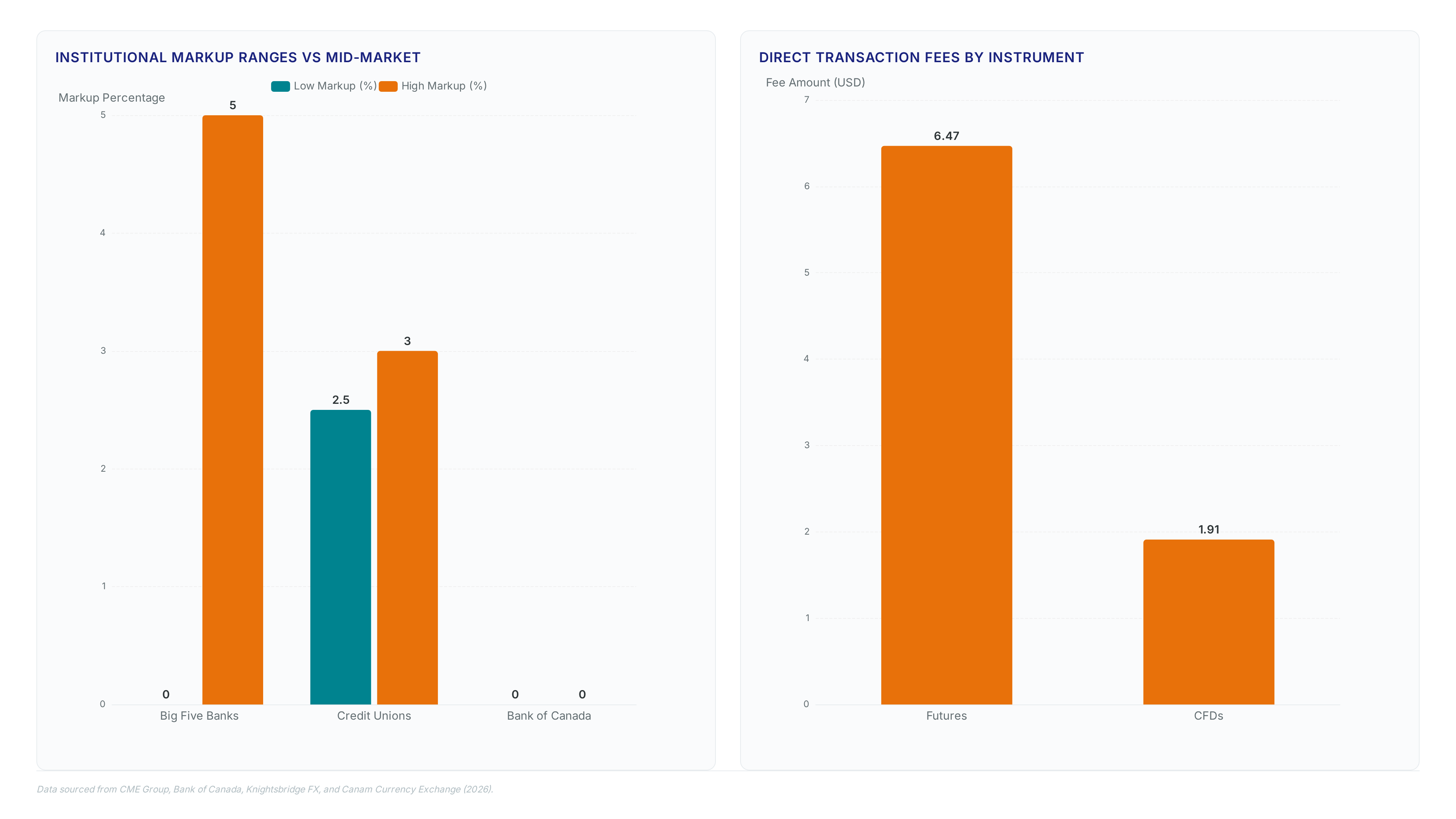
Hedging these exposures incurs specific transaction costs that erode margins. Executing hedges via futures costs a nominal fee per round turn, whereas CFD alternatives charge only $1.91 despite counterparty risk. This cost disparity forces smaller producers to remain unhedged during downturns. Geopolitical volatility creates asymmetric risks for un-hedged cad positions. The rapid price decline suggests the market has already priced in a swift supply normalization. Waiting for explicit confirmation of flow resumption often results in missed entry points for short positions. The window for capturing the full oil correlation move narrows as storage data updates.
Geopolitical friction in the Strait of Hormuz defines the current risk premium, though markets price a swift resolution following the February 28, 2026 military action. Crude valuations have retraced to early-March baselines as traders anticipate flow normalization, capping upside for the petro-currency. This pricing mechanism assumes no further escalation, yet any delay in reopening the chokepoint would sharply diverge from current forward curves. Static positioning introduces a second vector of weakness. Officials confirmed the rate would remain unchanged for a fifth consecutive decision by June, signaling tolerance for prolonged stagnation. This divergence between a holding pattern in Ottawa and hawkish shifts elsewhere widens the yield gap, pressuring capital flows.
Currency traders face a fragile equilibrium. Oil price recovery offers a theoretical buffer, yet the lag in actual export revenue realization leaves the loonie exposed to immediate rate differentials. Monetary easing cannot occur without triggering inflation, while stagnation erodes confidence. Operators must weigh the probability of a geopolitical resolution against the certainty of rate stagnation. April CPI data showed a +2.8% reading, setting a high bar for May. Retail sales rose 0.5% overall but fell 0.7% excluding gasoline and autos. Food and beverage retailers saw a 2.0% decline, indicating squeezed discretionary spenders. The US dollar gained 33 pips against the loonie today. Markets now price 38 bps of hikes this year, up from 21 bps beforehand. Technical breaks suggest a return to the mid-140s remains possible.
Mechanics of USD Strength and Federal Reserve Policy Shifts
How Kevin Warsh's Hawkish Stance Shifts Fed Rate Expectations
Market pricing for federal funds shifted to 38 bps of hikes this year, rising from 21 bps prior to the statement. This repricing mechanism operates through immediate adjustments in short-term yield curves, forcing forex algorithms to recalibrate carry trade valuations. The surge follows a hawkish press conference by Federal Reserve Chairman Kevin Warsh, whose explicit rejection of inflationary transience altered the forward guidance trajectory. Traders now anticipate a steeper tightening cycle, widening the interest rate differential against the loonie.
Liquidity flows respond mechanically to these yield gaps, with the North American foreign exchange market processing approximately a substantial volume in daily gross volume. Such depth ensures that even marginal changes in rate expectations trigger substantial currency moves. The divergence is stark when contrasting US aggression with Canadian inertia, where Tiff Macklem maintains a steady policy course. While the Fed hikes to combat heat, Canadian authorities face a growth slowdown, creating a policy mismatch that drives capital north-to-south.
| Factor | US Stance | Canadian Stance |
|---|---|---|
| Policy Direction | Hawkish Hikes | Static Hold |
| Market Pricing | 38 bps hikes | No change |
| Primary Driver | Inflation Control | Recession Fear |
The cost of this divergence is a rapidly depreciating exchange rate for nations failing to match Federal Reserve tightening. However, the limitation lies in the sustainability of such hikes if growth fractures under pressure. Operators must monitor April data releases closely, as conflicting signals between inflation and GDP could reverse the dollar's momentum abruptly. This liquidity concentration amplifies price discovery when central bank mandates diverge. The mechanism operates through covered interest parity, where traders borrow in low-yield currencies to fund high-yield assets.
- Kevin Warsh signals tighter policy, lifting US short-term yields immediately.
- Market pricing adjusts to reflect 38 bps of expected hikes versus prior 21 bps forecasts.
3.
Trump is attempting to renegotiate the deal to extract further concessions from Canada, creating immediate uncertainty for cross-border investment flows. This political friction compounds the difficulty for capital to find a home in Canada, as investors demand higher risk premiums for assets exposed to potential tariff escalations. The resulting volatility suppresses long-term infrastructure funding, particularly in energy sectors where project timelines exceed election cycles.
Oil price stability remains a conditional anchor for the loonie, yet forecasts diverge sharply based on geopolitical outcomes. Bearish scenarios suggest a fall toward $50 if renewable adoption accelerates, while bullish cases predict spikes above $100 should tensions escalate. This wide dispersion prevents consistent hedging strategies for Canadian exporters, forcing them to absorb greater FX exposure.
| Risk Factor | Immediate Impact | Long-term Consequence |
|---|---|---|
| Trade Policy | Capital flight acceleration | Structural investment deficit |
| Commodity Volatility | Hedging cost increase | Reduced project finance |
| Rate Differential | Yield gap widening | Persistent currency weakness |
A solid reversal in the currency is expected if the situation clears by year end, provided that geopolitical tensions do not reignite supply concerns. However, the window for recovery narrows with each quarter of stagnation. Operators must monitor headline risk closely, as sudden diplomatic breakthroughs could trigger rapid short-covering rallies. The USMCA framework remains the primary variable determining whether current weakness becomes a structural permanent feature or a transient dislocation.
Analyzing USD/CAD Technical Levels and Breakout Momentum
Interpreting the Clean Break of November Highs in USD/CAD
The break of November highs displays clean follow-through, clearing the path toward the mid-140s resistance zone. Technical momentum confirms buyer conviction as price action sustains above the 1.4177 level without immediate retracement. This structure suggests limited friction ahead, particularly as crude valuations face headwinds from record U. S. Output forecasts capping significant rallies production.
| Level Type | Price Zone | Significance |
|---|---|---|
| Support | 1.4000 | Psychological floor |
| Breakout | 1.4177 | Confirmed high |
| Target | Mid-140s | Next liquidity pool |
Traders must account for execution friction when chasing this volatility. The cost disparity materially impacts net profitability during rapid re-pricing events.
However, reliance on technical breakouts ignores the fragility of the underlying driver. Should geopolitical tension ease, the risk premium embedded in the dollar could evaporate quickly. A reversal in oil flows would disproportionately punish the loonie's recent lows, invalidating the breakout signal. Operators should monitor the Monday CPI release closely, as a deviation from the prior 2.8% reading could trigger algorithmic liquidations. The clean chart pattern offers a clear roadmap, yet the macroeconomic foundation remains susceptible to sudden shifts in sentiment.
Strategic Trading Decisions Amidst USMCA and Recession Risks
Comparison: Defining USMCA Renegotiation Brinksmanship and Capital Flight Dynamics
Headline volatility stemming from Trump's renegotiation brinksmanship suppresses capital inflows even as Q2 data shows improvement.
| Use | Threaten deal collapse | Flight to safety |
| Timing | Pre-deadline escalation | Delayed investment |
| Outcome | Extract concessions | Risk premium spike |
Political uncertainty now overrides fundamental valuations, leaving capital with few safe havens in Canada. Traders asking should i trade usd cad now must balance a clean technical breakout against the prospect of deteriorating news cycles before any deal emerges. The Bank of Canada operates under a constrained mandate, having released a Financial Stability Report in May identifying these external shocks as primary domestic risks. Current tactics target specific regulatory concessions rather than broad tariff structures, a shift that extends uncertainty compared to previous trade disputes. Higher yields demanded on loonie-denominated debt raise borrowing costs for Canadian firms, compounding stress on an already weak consumer sector. Positive GDP prints fail to strengthen the currency while USMCA terms remain unresolved. Markets price in prolonged instability, supporting the view that conditions will worsen before any substantive agreement appears.
Comparison: Executing USD/CAD Entries Using the Clean Break of November Highs
Accepting the technical break of November highs as a confirmed signal toward the mid-140s answers whether one should trade usd cad now. Price action holding above 1.4177 validates the breakout, yet execution requires navigating divergent cost structures between venue types. This fee disparity forces a choice between exchange transparency and lower upfront capital outlay. While the Bank of Canada holds rates steady, political friction surrounding USMCA renegotiations introduces headline risk that technical levels alone cannot buffer. The Coverage Pillars framework suggests sizing positions to withstand sudden spread widening if May CPI data diverges from expectations.
About
Aisha Rahman serves as the Gold & Commodities Analyst at ForexCFD. Top, where she specializes in the complex relationships between energy markets and commodity-linked currencies. Her deep expertise in oil market dynamics makes her uniquely qualified to analyze the USDCAD pair, the Canadian dollar's strong historical correlation with WTI crude prices. In her daily work tracking global energy flows and safe-haven assets, Aisha constantly evaluates how shifts in petroleum valuations impact substantial FX crosses. This article's focus on the loonie's downturn amidst falling oil prices directly reflects her core analytical beat. By using ForexCFD. Top's commitment to vendor-neutral macro analysis, she provides retail traders with factual context on how post-war oil routs drive currency volatility. Her background ensures that complex interactions between OPEC decisions, geopolitical tensions, and currency valuations are explained with the precision required for informed trading decisions.
Conclusion
The current uptrend in USD/CAD faces a critical inflection point where traditional hedging costs erode profit margins quicker than price appreciation can replenish them. While oil volatility drives immediate spikes, the structural drag of Canada's shrinking workforce ensures that any rally lacks the fundamental backing for sustained momentum beyond 2027. Relying solely on technical breakouts without accounting for the divergent liquidity models between futures and CFDs exposes traders to hidden execution risks during high-frequency volatility. The impending shift toward AI-intermediated B2B transactions by 2028 will drastically alter FX flow dynamics, rendering manual entry strategies increasingly inefficient against algorithmic counterparts.
Organizations must transition to hybrid execution venues that combine futures-level transparency with CFD capital efficiency before Q4 2026. Do not wait for USMCA clarity to adjust your risk parameters; political resolution will lag market pricing significantly. Start by auditing your current broker's slippage data during the next WTI inventory report release this week. Compare those actual fill prices against your strategy's theoretical backtest to quantify the hidden tax your current venue imposes during stress events. Only firms that validate their execution quality against real-time volatility can survive the narrowing spreads of an AI-dominated environment.
Frequently Asked Questions
Excluding gasoline and autos, retail sales fell 0.7%, indicating severe pressure on discretionary spending. This 0.7% drop in core sectors highlights how rising fuel costs are actively eroding the purchasing power of Canadian households today.
A population decline of 0.45% in Q1 drove the economy into a technical recession by shrinking labor supply. This 0.45% reduction in residents directly reduced aggregate demand, compounding the negative economic outlook for the region.
Executing hedges via futures costs $6.47 per round turn, while CFD alternatives charge only $1.91. This significant $6.47 versus $1.91 disparity forces smaller producers to remain unhedged during periods of intense market volatility.
The pair reached 1.4177 as WTI crude fell $8 weekly, mirroring the commodity drop to $77.27. This correlation shows how the $8 weekly decline in oil prices directly accelerates the weakness of the Canadian dollar.
While overall sales rose 0.5%, this was entirely driven by gasoline, masking a 2.0% decline in food and beverage retailers. The 2.0% drop in essential categories confirms that consumers are severely restricting discretionary spending habits.