
NFP Forecasts: Why 115k Jobs Hide Real Inflation
The US NFP Report arrives Thursday alongside forecasts of a sharp Headline PPI rise, signaling acute inflationary pressure.
Headline job counts lie. To understand the real economy, you must dissect how inflation calculation mechanics and survey methodologies warp the data. We define the specific economic indicators global analysts prioritize when central banks face conflicting signals.
The gap between jobless claims and actual labor market tightness is where the money is made or lost. We break down the mechanics behind ISM Manufacturing PMI releases and how producer price surges drive central bank decisions. Data from InvestingLive shows the US Core PPI Year-over-Year is projected to reach a notable level, a critical threshold for rate deliberations. Consider the Reserve Bank of Australia, which maintained its Cash Rate at 4.35% despite hawkish warnings. This illustrates the complex dance between employment mandates and price stability. Navigating the volatility surrounding the upcoming NFP Report requires understanding these divergences.
Defining Core Economic Indicators for Global Market Analysis
NFP Report Components and Unemployment Rate Forecasts
Gold trades on real yields, fear, and the dollar, but the Non-Farm Payrolls report dictates the immediate violence in price action. Consensus forecasts for June US payrolls sit at 115k, a sharp deceleration from the previous 172k print. The employment rate is expected to remain at 4.3%, aligning with the Federal Reserve's own projections for the year. Average hourly earnings are seen rising 0.3% M/M, a critical input for inflation modeling. Markets have fully priced in a total tightening of 25 basis points by 2027 following recent data releases.
Labor force participation metrics provide the necessary context behind the headline job number. Real-time analysis of these components helps clients navigate FOMC uncertainty. Breaking down private and public sector hiring adds depth to the raw headline figure. *Risk Warning: Trading used metals and CFDs involves substantial risk of loss and is not suitable for all investors.*
Applying EZ Flash CPI and Tankan Index to Market Sentiment
An early read on Eurozone price momentum arrives via the EZ Flash CPI, with May's headline inflation recorded at 3.2% Y/Y. Core measures were described as hotter, driven by energy upside and a jump in services, creating a complex backdrop for the European Central Bank. Traders watch this metric to gauge whether sticky prices force a shift from the current data-dependent stance. Recent Flash PMIs hinted at a potential peaking of the price spike, suggesting the ECB may delay further tightening despite the elevated headline number.
Simultaneously, the Tankan Index serves as a critical proxy for Japanese economic sentiment among thousands of enterprises. A survey of over a dozen research institutes expects the diffusion index for large manufacturers to weaken to 15 from 17. This deterioration reflects rising fuel costs and geopolitical tensions impacting supply chains before the data collection window closed. Mispricing central bank policy shifts carries a heavy cost while Europe grapples with hot services inflation and Japan faces sentiment erosion that could limit yield upside. Risk warnings apply; trading commodities involves significant risk of loss.
ISM Manufacturing PMI Risks: Front-Running Supply Disruptions
Purchasing manager sentiment signals expansion or contraction before official output data arrives through the ISM Manufacturing PMI. S&P Global's June flash manufacturing PMI rose to 55.7, up from 55.1, marking a 49-month high. S&P Global noted the expansion was partly driven by front-running of potential supply disruption. This front-running behavior reflects industry anxiety over potential supply chain fractures rather than genuine consumption strength. Firms accelerate orders to hedge against geopolitical friction in the Middle East, where oil prices have surged toward elevated levels with warnings of spikes to significantly higher prices.
Distinguishing between flash vs final PMI matters here because early estimates capture immediate market reactions before supply realities normalize in final prints.
Acute pressure faces producers as oil pricing has escalated, creating immediate cost pass-through risks for energy-dependent sectors. This forces a recalibration of rate hike expectations as central banks distinguish between temporary supply shocks and entrenched demand inflation. Policymakers face a lagged transmission of these energy costs into final consumer prices. Premature tightening based solely on headline prints risks stifling growth before core inflation genuinely stabilizes. Investors must monitor service sector surveys for confirmation that second-round effects are not taking hold. Market participants are advised to prioritize core divergence over headline noise when positioning for ECB decisions.
Interpreting Survey Timing Bias in June Flash PMI Responses
A blind spot emerges in PMI survey windows where collected data misses late-breaking geopolitical shifts due to structural lag. Most responses arrived around the June 17th MoU signing, capturing sentiment before the full impact of the agreement settled into supply chain expectations. This timing distortion means the Flash PMI output blends pre-signature anxiety with early post-signature relief, as the survey window closes two to three weeks prior to release.
| Factor | Data Capture Window | Market Implication |
|---|---|---|
| Survey Lag | 2, 3 weeks prior | Inherently backward-looking |
| Event Horizon | June 17th MoU | Misses immediate reaction |
| Price Signal | Flash estimate | Hints at potential peaking |
Analysts must adjust their interpretation of inflation data by recognizing that reported price spikes may already be moderating in real-time operations. Technical methodology dictates that data is inherently backward-looking by the time it reaches the market, forcing traders to discount older responses heavily. Flash readings hinted at a potential peaking of the recent price spike, yet the survey window likely missed the sharpest initial price corrections following the diplomatic advance. Investors should prioritize real-time price action over these delayed survey aggregates when sizing positions near key support levels. The divergence between the static survey result and flexible market pricing highlights the importance of understanding the collection timeline. Ignoring this temporal misalignment risks misjudging the true trajectory of manufacturing sentiment.
Front-Running Supply Disruptions Distorting Manufacturing Output Indices
Temporary inventory hoarding creates false strength signals in manufacturing output indices that mislead growth forecasts. S&P Global noted expansion was partly driven by front-running potential supply disruption, creating a divergence between actual demand and reported production. This behavior inflates the manufacturing output index temporarily, as firms order inputs to beat anticipated shortages rather than to satisfy immediate consumer needs. The manufacturing output index reached 57.7, the strongest in 59 months.
Geopolitical tensions in the Middle East exacerbate this distortion by spiking energy costs and prompting precautionary stockpiling. Market participants react to warnings of rising oil prices by accelerating purchase orders, further skewing input buying metrics upward. This surge masks underlying weakness where export demand remains soft and supplier delivery times lengthen notably. Production growth accelerated to its fastest pace since July 2021. The result is a false positive in growth data that complicates central bank calibration of interest rates.
| Distortion Source | Impact on Index | Sustainability |
|---|---|---|
| Front-Running | Inflates output readings | Low |
| Geopolitical Shock | Spikes input costs | Volatile |
| Real Demand | Drives organic growth | High |
Traders monitoring inflation expectations must filter these temporary spikes to avoid mispricing rate hike probabilities. Investors relying on market analytics prioritize separating noise from signal in volatile commodities markets. Used positions on metals carry significant risk when fundamentals are obscured by transient supply fears.
Applying Macro Data to Forecast Central Bank Policy Shifts
RBA Hawkish Language vs SNB Inflation Forecasts
The Reserve Bank of Australia maintains a 4.35% cash rate while explicitly warning of potential further hikes. Unanimous board members demand victory over persistent inflation, a sharp departure from the Swiss National Bank, which sees medium-term pressures unchanged since March. Divergent paths define the environment for traders: the RBA threatens action against oil-driven price spikes, whereas the SNB anticipates holding rates steady despite modestly raised forecasts through 2028.
Reading central bank minutes requires isolating conditional language; the RBA's "if necessary" clause highlights a commitment to act if oil supply disruptions persist. SNB patience suggests the CHF lacks a directional catalyst until fresh data emerges. Markets often price in hawkish rhetoric prematurely, yet the SNB's stance suggests a measured approach to tightening. Investors relying on sticky inflation narratives must recognize that not all central banks react identically to global price shocks. The RBA's willingness to move contrasts with the SNB's static forecast, creating a spread trade opportunity for those monitoring the AUDCHF pair closely. Used positions in these currencies carry significant risk due to sudden policy pivots. Capital allocation here demands precision rather than hope.
Using NFP Breakeven Pace to Predict Fed Holds
A print well above the breakeven pace estimated by the St Louis Fed at 15-18k/month alongside a stable jobless rate supports a Fed hold in July. Following the Non-Farm Payrolls report, markets have fully priced in a total tightening of 25 basis points by the end of 2026. The prevailing trend indicates a definitive move toward neutral or hawkish stances, with investors now scrutinizing sticky inflation data for signs of renewed aggression.
Distinguishing between genuine labor durability and temporary distortions remains the primary challenge for analysts. Event-driven hiring spikes reverse quickly, masking underlying weakness. If headline PPI rises toward a notable rate while core metrics hit an elevated level, the narrative shifts rapidly from "hold" to "hike" regardless of employment figures. This re-evaluation of rate probabilities forces traders to monitor monetary policy pivots where the Fed may drop its easing bias entirely. Unlike the ECB, which faces mixed signals on energy costs, the Fed's dual mandate requires clear evidence of cooling before any rate cuts emerge. A single strong NFP report does not guarantee long-term stability if inflation expectations remain unanchored. The cost of misreading this divergence is immediate volatility in gold and dollar pairs. Used metals trading carries significant risk, and capital is not guaranteed.
Temporary Job Spikes and PPI Upside Risks
A payroll surge driven by the 2026 FIFA World Cup creates a deceptive signal for rate hike expectations. Estimates suggest this event adds 40,000 temporary jobs to US payrolls in June, with effects reversing immediately afterward. This distortion complicates the decision on rate expectations because the labor market strength is transient rather than structural. Traders relying on headline NFP figures without adjusting for this anomaly risk mispricing Federal Reserve policy shifts.
Rising producer prices introduce upside inflation risks that skew long-term forecasts simultaneously. Acceleration suggests underlying cost pressures remain stubborn despite broader cooling narratives. Operators analyzing manufacturing output data to gauge true demand must weigh these input cost spikes carefully. A divergence here indicates stagflationary tendencies rather than pure growth. Analysts warn that used XAUUSD positions face heightened volatility if markets overreact to these distorted prints. Gold often rallies on real yield compression, yet false inflation spikes can temporarily strengthen the dollar. A break below session lows post-data release would signal a shift in momentum. Trading used metals carries significant risk; strategies must account for potential whipsaws during data releases.
Executing a Structured Workflow for Employment and Inflation Reports
Defining the Breakeven Pace and Jobless Rate Thresholds
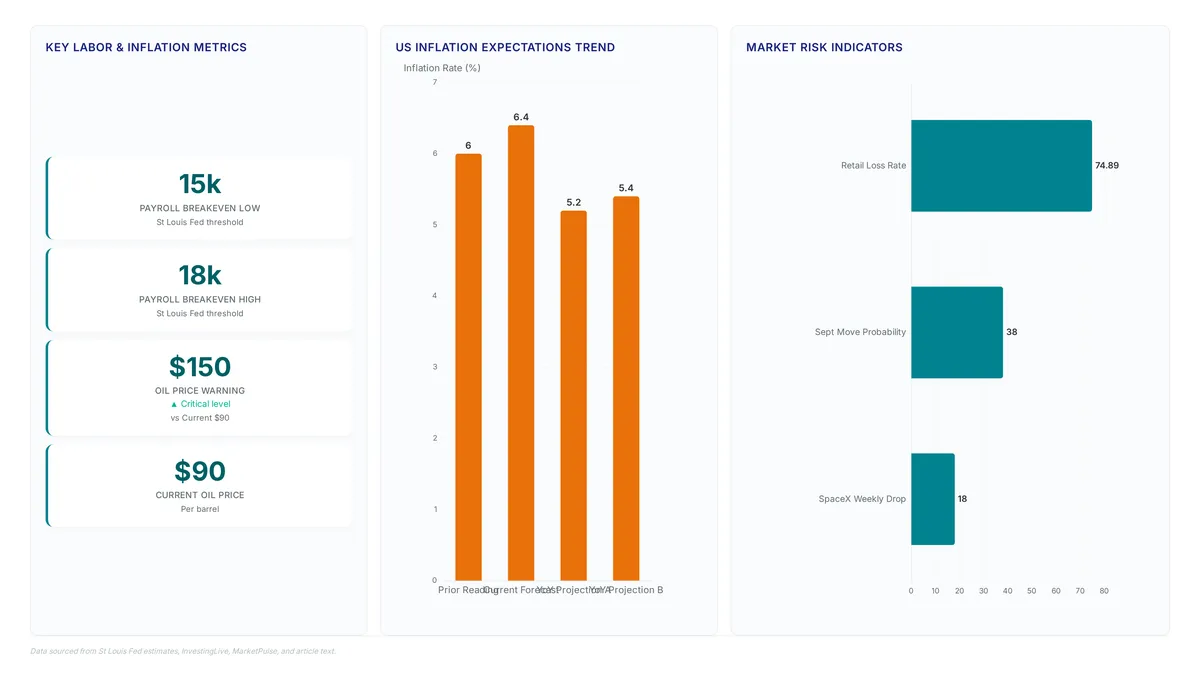
Traders must benchmark monthly payroll gains against the St Louis Fed's estimated breakeven pace of 15-18k to gauge labor market tightness accurately. This narrow margin distinguishes between genuine economic expansion and mere population growth, serving as the primary filter for Fed policy expectations. A print exceeding this threshold alongside a stable unemployment rate typically supports a hold decision, whereas sustained underperformance signals cooling demand. Should unemployment breach this level, the narrative shifts rapidly from sticky inflation to potential recession risks, forcing a recalibration of rate cut pricing.
- Compare the headline payroll result against the 15-18k breakeven range to determine momentum.
- Monitor market pricing, which currently indicates a total tightening of 25 basis points by 2027 following recent reports.
ForexCFD.top analysts note that ignoring the breakeven pace leads to false positives when interpreting headline job growth. Markets often overreact to single-month spikes that fail to sustain the required absorption rate for new entrants. This specific adjustment prevents misinterpreting event-driven hiring as structural labor strength, a common pitfall during substantial global tournaments. Traders should first consult the economic calendar to identify the exact release window, noting that the US Non-Farm Payrolls report is scheduled for July 2, landing a day earlier than usual due to the July 4th holiday weekend.
- Filter the headline number by removing the temporary event spike to reveal the underlying breakeven pace.
- Cross-reference the adjusted figure against the unemployment rate to confirm if labor tightness is genuine.
3.
About
Aisha Rahman, Gold & Commodities Analyst at ForexCFD.top, brings specialized expertise to the analysis of the US NFP report through her deep understanding of macroeconomic drivers impacting precious metals. While her primary focus remains on XAUUSD and commodity flows, she recognizes that non-farm payrolls data acts as a critical catalyst for dollar volatility, which directly dictates gold's short-term trajectory. In her daily work at ForexCFD.top, Aisha dissects how employment figures influence Federal Reserve policy expectations, translating complex data into actionable insights for retail traders across emerging markets. Her background in Gulf-based commodities research allows her to contextualize these US-centric events within a global framework, particularly for investors using swap-free accounts who must navigate interest-rate sensitivity. By connecting high-impact economic releases like the NFP to tangible price movements in gold and substantial currency pairs, Aisha ensures ForexCFD.top readers receive practical, regulation-aware analysis grounded in real-time market dynamics rather than speculative hype.
Conclusion
Transient job spikes often mask the true breakeven pace required for economic stability, creating a dangerous lag in policy reaction. When traders fixate on the headline number without adjusting for temporary event distortions, they inadvertently overestimate the probability of rate hikes. This misalignment exposes used positions to sharp reversals once the data naturally reverts to its mean. The operational cost here isn't just lost capital; it's the erosion of confidence in a strategy that fails to distinguish between structural labor tightness and episodic noise.
Adopt a differential approach before the July 2 release. Do not react to the initial print; instead, immediately calculate the gap between headline and core figures to isolate volatile drivers. If the adjusted growth falls below the underlying breakeven while wage pressure remains elevated, the market narrative will pivot quicker than consensus models predict. Start this week by back-testing your current strategy against historical instances where headline NFP diverged from the unemployment rate to quantify your exposure to these specific false signals. This single adjustment ensures your positioning aligns with real yield dynamics rather than transient data artifacts.
Frequently Asked Questions
The employment rate is expected to hold at 4.3%, aligning with Federal Reserve projections for stability. This steady figure supports the market view that a total tightening of 25 basis points remains priced in by year end.
Average hourly earnings are seen rising 0.3% month over month, serving as a critical input for inflation models. This specific growth rate helps analysts determine if wage pressures will force central banks to maintain restrictive monetary policies longer.
These verified thresholds indicate acute inflationary pressure that often dictates immediate volatility in currency and commodity markets.
The flash manufacturing PMI rose to 55.7, yet this expansion is partly driven by front-running supply disruptions rather than genuine demand.
Rising fuel costs cause diffusion indexes to weaken, reflecting supply chain anxiety rather than robust consumer spending strength.
References