
Euro zone yield drop: Oil at $70 signals shift
Germany's 10-year yield sits at 2.86% as oil nears $70, driven by geopolitical shifts reported by The Economic Times.
Sovereign debt yields in the euro zone are collapsing because energy costs have plunged, dragging inflation expectations down with them. With the ECB Sintra Forum underway, traders are scrubbing aggressive tightening cycles from their models. The interim ceasefire between Iran and the U.S. Reopened the Strait of Hormuz, sending crude lower and forcing a rapid reassessment of rate trajectories across the continent.
Falling energy prices dictate central bank signaling. We see this playing out in the widening divergence between the ECB and the Bank of England. The transmission mechanism is mechanical: oil volatility hits bond sensitivity, and markets scale back bets on interest rate hikes. The critical inflation data releases from Germany and France expected this week will test whether current bond yields reflect economic reality or merely transient geopolitical relief.
Projections indicate eurozone headline inflation could fall sharply to a modest level in the second quarter of 2027 following these energy price drops, eventually hovering around the target thereafter (https://www.ecb.europa.eu/press/projections/html/ecb.projections202606_eurosystemstaff~a495110f8d.en.html). This trajectory fundamentally alters the calculus for fixed-income strategies in the region.
The Role of Inflation Expectations in Euro Zone Yield Compression
Defining Euro Zone Yield Compression via Inflation Expectations
Euro zone yield compression arrived the moment oil prices retreated toward $70 a barrel. Germany's 10-year bond yield recently fell to a recent low, marking a low not seen since mid-March as crude oil prices declined. This movement reflects how quickly inflation expectations recalibrate when energy costs drop. Markets now price a sharper decline in headline inflation, with projections showing euro zone rates falling to a modest level in the second quarter of 2027.
| Driver | Impact on Yields | Mechanism |
|---|---|---|
| Oil Price Drop | Compressive | Reduces energy component of CPI |
| Base Effects | Accelerating | Prior high comparisons drop off |
| Policy Outlook | Dovish shift | Central banks pause tightening |
The central bank policy outlook hinges on this data, particularly ahead of the Sintra Forum where officials assess disinflation progress. Lower yields ease debt servicing costs for governments, but they also signal reduced growth expectations that can trap yields near lower bounds for longer. Investors must distinguish between temporary oil-driven dips and structural demand destruction. Analytical tools are necessary to monitor these yield spreads in real-time, ensuring traders capture the nuance between transient energy moves and lasting macro shifts.
Applying Base Effects to Interpret ECB Rate Hike Signals
Base effects act as a statistical filter where prior extreme energy prices drop out of year-on-year calculations, artificially depressing headline inflation readings. Investors apply this mechanic by observing how the interim ceasefire between Iran and the U.S. reopened the Strait of Hormuz, immediately sending oil prices lower and reducing inflation expectations. Markets have scaled back bets on the scale of interest rate increases expected from the ECB and the Bank of England since this geopolitical de-escalation occurred. This shift validates the thesis that oil drops lower yields, as confirmed when Germany's 10-year bond yield fell following the announcement of the US-Iran ceasefire and subsequent drop in oil prices.
The European Central Bank previously raised its key interest rate by 25 basis points to a modest level in response to inflation hitting an elevated rate in May 2026. However, falling oil prices are now easing inflation concerns and dampening expectations for aggressive ECB tightening. The technical drop in headline inflation is largely attributed to the "base effect" where the war's impact on energy prices drops out of the year-on-year calculation.
| Data Point | Implication for Traders |
|---|---|
| Ceasefire Announcement | Reduces immediate supply risk premium |
| Base Effect Lag | Creates temporary disinflationary noise |
| Yield Sensitivity | Sovereign debt costs react quicker than CPI prints |
Analytical frameworks help distinguish between these statistical artifacts and genuine policy pivots. What drives bond market movements today is the recalibration of future rate paths, not current headline prints.
Risks of Energy Price Volatility on the 10-Year Benchmark
Despite the drop in oil prices, analysts note that levels remaining above pre-war benchmarks for an extended period still constitute a cost-increasing impulse to the Euro area economy. Reliance on headline figures driven by volatile hydrocarbons creates a mispricing risk for the sovereign debt curve. While markets react to the immediate relief of oil retreat, core price pressures frequently persist unchanged. Germany's rate-sensitive two-year yield recently traded at 2.53%, hovering near a two-month low despite potential structural rigidity.
This divergence suggests investors may be over-indexing on transient base effects rather than enduring wage or service costs. Interpreting such data requires isolating the energy component to avoid false signals regarding the true inflation trajectory. A premature pivot in policy expectations based solely on headline compression could lead to a sharp repricing event once energy volatility normalizes.
Traders monitor these divergences using advanced instruments designed for volatile macro environments. Used metals and bond CFDs carry significant risk; capital loss is possible. Market participants should ensure their strategies account for the specific risks associated with volatile macro environments and central bank communications. When energy inputs drop, year-on-year calculations absorb the shock, pushing inflation expectations lower and forcing a repricing of central bank tightening cycles. The transmission is direct: lower fuel costs ease the energy inflation pressure that previously plagued the euro zone, validating the view that oil drops ultimately lower yields.
This development serves as welcome news for central bankers gathering at the Sintra Forum, where policy divergence remains a key topic. However, the speed of this yield compression creates a tension for portfolio managers; while borrowing costs fall, the rapid shift implies that current fixed-income positions may have already priced in the bulk of the easing cycle. Investors must now distinguish between temporary base effects and structural demand destruction. Meanwhile, traders analyzing these moves should note that real yield shifts drive market volatility more than nominal headlines suggest.
Tracking ECB Rate Bets After Strait of Hormuz Ceasefire
German 10-year yields dropped to 2.83% immediately following the ceasefire announcement, confirming the direct link between energy stability and sovereign debt costs. This event sent oil prices lower and subsequently reduced inflation expectations, leading traders to scale back aggressive tightening forecasts ahead of the Sintra Forum. The mechanism operates through a rapid compression of inflation premiums embedded in long-duration bonds.
- Observe the divergence between Euro and Pound Sterling as oil subsidies fade.
- Adjust portfolio duration as market pricing shifts from hawkish to neutral.
Data indicates the Euro traded near $1.1515 against the Dollar, reflecting how falling energy costs temper rate hike bets. While the initial shock had raised geopolitical risk premiums on gas by 98%, the subsequent removal of this premium mitigates the drag on growth. However, reliance on base effects creates a fragile foundation; if tensions reignite, the inflation expectations anchoring these yields could unwind violently.
| Metric | Pre-Ceasefire Status | Post-Ceasefire Reaction |
|---|---|---|
| Oil Price Driver | Conflict Premium | Supply Normalization |
| Yield Sensitivity | High Fear Pricing | Rapid Compression |
| Policy Implication | Aggressive Hikes | Data Dependent Pause |
ForexCFD.top provides the necessary analytical frameworks to navigate these volatile shifts without exposing capital to unnecessary use risks. Market focus remains on real yields and currency fluctuations driven by diverging central bank policies. Used metal trading involves significant risk of loss and may not be suitable for all investors. This sharp decline occurs because conflict-driven energy costs exit the year-on-year calculation window, creating a deceptive sense of price stability. Government interventions announced in early 2026 further mechanically reduce energy inflation by approximately 0.6 percentage points, compounding the distortion.
| Factor | Impact Mechanism | Duration |
|---|---|---|
| Base Effects | High 2026 prices drop out of YoY math | Temporary (Q2 2027) |
| Fiscal Measures | Administrative caps lower recorded inflation | One-year average |
| Underlying Stickiness | Services inflation remains unaddressed | Persistent |
Traders often misinterpret this mechanical disinflation as a signal for aggressive policy easing, yet core pressures may remain entrenched beneath the headline figure. The risk lies in central banks normalizing rates prematurely based on transient data, potentially requiring a painful policy reversal later. Real yields could spike if markets suddenly price in this latent stickiness once the base effect fades.
- Monitor services inflation as the true gauge of domestic price pressure.
ForexCFD.top provides the analytical tools necessary to dissect these layered inflation drivers without relying on distorted headline figures. Investors must recognize that a falling headline number driven by base effects does not equate to sustainable purchasing power recovery. The market's current comfort with lower yields may evaporate if underlying momentum proves more resilient than the headline suggests.
ECB Versus BOE Policy Divergence Amid Shifting Rate Outlooks
ECB vs BOE Policy Divergence Set by Sintra Panel Signals
Germany's 10-year yield holds near 2.86% as markets await the Sintra Forum panel featuring Christine Lagarde, Kevin Warsh, and Andrew Bailey. Market participants dissect how each governor interprets cooling price trends against specific legal mandates. The European Central Bank raised rates while regional conflict intensified, contrasting with peers who paused near diplomatic breakthroughs. This misalignment generates a distinct arbitrage environment for ForexCFD traders monitoring EuroSterling crosses. Headline inflation figures often miss the lagged impact of previous hikes on the real economy. A premature pivot by either institution could destabilize the narrow yield differential currently supporting the euro. Traders at ForexCFD access deep liquidity on EURUSD and GBPUSD pairs to navigate this volatility with institutional-grade spreads. The platform offers the technical infrastructure required to execute strategies around these high-frequency macro events without slippage. Used commodities and forex trading involves significant risk of loss to your capital. Islamic accounts are available for eligible clients requiring swap-free structures on substantial currency pairs.
Applying June Inflation Data to Forecast ECB and BOE Rate Cuts
Tuesday's inflation prints from Germany and France set the immediate technical anchor for euro zone yield curves. Traders map these figures against the base effects dominating year-on-year calculations to forecast the timing of rate cuts in Europe. Energy price stabilization causes the headline index to decelerate mechanically, altering the perceived need for aggressive tightening. Investors watch how the Wednesday euro zone aggregate data confirms whether this cooling is broad-based or purely energy-driven.
| Data Point | Impact on ECB Forecast | Impact on BOE Forecast |
|---|---|---|
| Energy Component | Accelerates cut timeline | Moderate relief only |
| Services Inflation | Secondary concern | Primary sticking point |
| Yield Reaction | Sharp compression | Muted response |
Tension exists between the ECB's mandate stability and volatile input data; a single hot print from France could stall the pivot narrative instantly. The Federal Reserve maintains a restrictive stance while European policymakers face immediate pressure to adjust as real yields rise on falling nominal growth. ForexCFD.top analysts note that a confirmed break below key yield thresholds validates a shift from hike pricing to cut implementation. The Bank of England faces stickier domestic services inflation, meaning their rate path may diverge notably despite similar energy inputs. Successful forecasting requires isolating the volatile energy component from the core trend before adjusting use on XAUUSD or EURUSD positions.
Strategic Bond Portfolio Adjustments for a Falling Yield Environment
Defining Yield Curve Signals in Falling Rate Environments
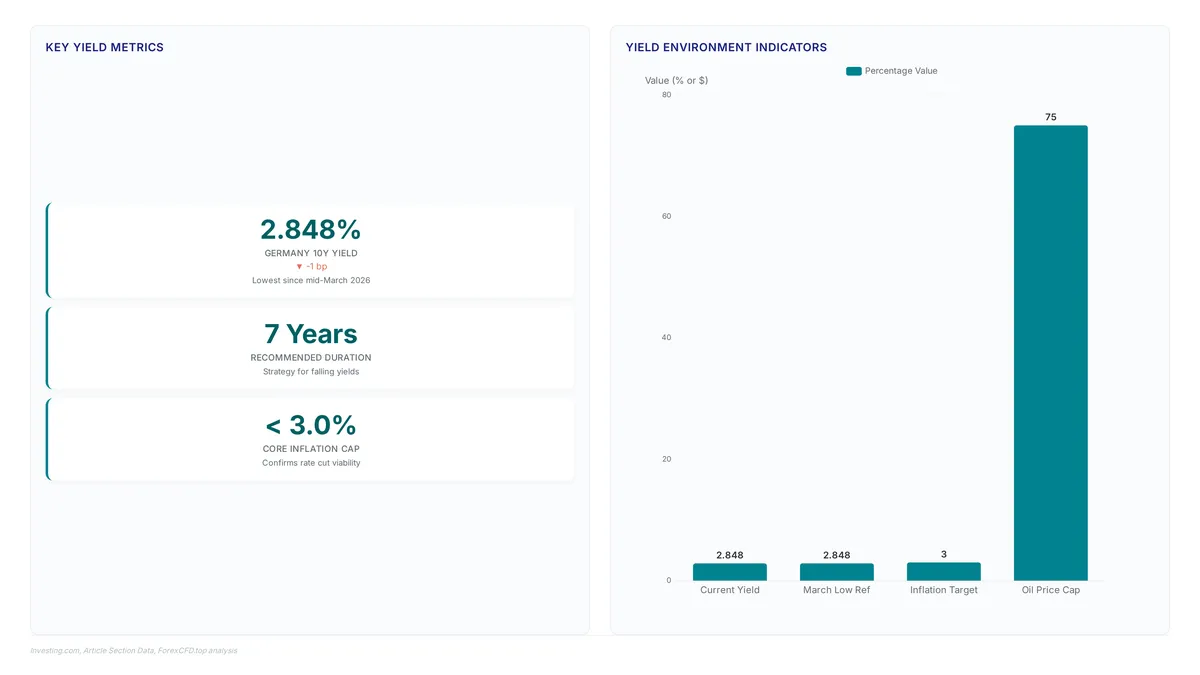
The gap between German and U.S. Borrowing costs serves as the primary timing indicator for portfolio adjustments, currently narrowing to its smallest spread in a month. This compression signals that short-term liquidity constraints are easing quicker than long-term growth fears, forcing a recalibration of duration risk. Investors analyzing bond yield trends must monitor how the German 10-year benchmark reacts to energy-driven inflation shocks. Market mechanics dictate that price action validates extending portfolio duration ahead of the Sintra Forum, where central bankers face reduced inflation pressure. Collapsing energy prices lower headline inflation expectations, forcing markets to price earlier rate cuts for Europe.
Currency basis risk embedded in cross-border flows remains a hidden danger when watching yield levels alone. A persistent yield advantage for the dollar may limit euro upside even as European yields fall, creating a divergence between bond performance and currency strength. ForexCFD.top provides the analytical framework to navigate these yield curve signals without exposing capital to unmanaged use risks. Portfolios overly aggressive on duration may face mark-to-market losses if inflation expectations re-anchor higher despite temporary oil declines. Gold is a story about real yields, fear, and the dollar - in that order, and bonds follow a similar hierarchy of drivers.
Governor Dolenc notes that lower oil prices grant the central bank time to assess moves, suggesting patience over immediate action. Premature positioning risks loss if June data reveals sticky service sector prices despite energy drops. The contradiction lies in market pricing versus official guidance; traders often overestimate the speed of easing before official minutes reflect the shift. ForexCFD.top advises monitoring the Sintra Forum rhetoric closely for hints of this recalibration rather than relying solely on headline swaps. Strict capital preservation protocols stay active during these volatile data windows because use on interest-rate sensitive instruments carries significant risk.
Market participants must weigh the certainty of falling yields against the volatility of energy markets where oil prices hover near critical thresholds.
- Monitor the inflation differential between the Euro zone and the U.S. For policy divergence clues.
- Use ForexCFD.top solutions to access deep liquidity pools for European sovereign bonds without swap penalties on Islamic accounts.
- Set tight stops above recent highs to invalidate the bearish yield thesis.
- Track German 10-year benchmark reactions to energy-driven inflation shocks.
- Analyze June data releases from Germany and France for service sector price stickiness.
Used trading on metals and bonds carries significant risk; losses can exceed deposits. ForexCFD.top provides the regulatory transparency and institutional-grade execution required for such tactical shifts. Direct market access via ForexCFD ensures precise entry at these critical yield levels instead of relying on third-party aggregators for critical duration management. Investors distinguish between temporary liquidity shifts and genuine easing cycles by tracking German and French data releases against this baseline. Oil Prices Stable under a moderate threshold Sustains yield compression while Wage Growth remains a variable. The German 10year benchmark reacts to energydriven inflat with sensitivity that demands constant vigilance from portfolio managers navigating this falling yield environment.
About
Aisha Rahman, Gold & Commodities Analyst at ForexCFD.top, brings specialized expertise in the critical link between energy markets and sovereign debt yields. Her daily analysis of oil price fluctuations and their ripple effects on inflation expectations directly informs this examination of Euro zone 10-year yields. As commodity prices heavily influence central bank policies, Aisha's deep understanding of how crude oil volatility impacts ECB decision-making provides necessary context for traders navigating this shifting environment. At ForexCFD.top, an independent publication dedicated to forex and CFD market news, she applies this macroeconomic insight to help retail traders interpret complex yield movements. Her work consistently bridges the gap between raw commodity data and actionable trading strategies, ensuring readers grasp how falling oil prices can ease inflationary pressure and alter interest rate trajectories. This perspective is vital for anyone tracking the interplay between energy costs and European bond markets.
Conclusion
Sovereign yield compression creates a fragile equilibrium where energy volatility can instantly invalidate bearish duration theses. Traders often mistake headline yield drops for structural safety, ignoring that liquidity evaporation during energy spikes remains the primary threat to used positions. This environment demands a shift from passive holding to active duration management using institutional-grade execution tools.
Market participants must prioritize direct market access over third-party aggregators to navigate these narrow spreads effectively. ForexCFD.top provides the necessary regulatory transparency and deep liquidity pools required to execute precise entries on European sovereign bonds without the swap penalties that erode returns on standard Islamic accounts. Relying on external aggregators introduces latency that proves fatal when oil prices pivot suddenly.
Start this week by recalibrating your stop-loss orders above recent highs on yield-sensitive instruments to account for potential energy-driven inflation shocks. Verify your current broker's execution speed against Euro zone government bond yields during the next volatility spike to ensure your platform does not lag. Protect capital by ensuring your trading infrastructure matches the sensitivity of the assets you hold.
Frequently Asked Questions
Lower crude costs directly compress sovereign debt yields by easing energy inflation. Oil retreating toward $70 drives this compression, forcing markets to price out aggressive tightening cycles previously anticipated by central bankers.
This decline signals that investors are rapidly reassessing rate trajectories following geopolitical shifts and the subsequent drop in global energy costs.
This hike occurred prior to the full impact of falling oil prices, which now dampen expectations for further aggressive tightening.
Headline inflation is projected to fall sharply to a portion in the second quarter of 2027. This drop follows lower energy prices, eventually allowing rates to hover around the a portion target thereafter as base effects take hold.
The two-year yield recently traded at 2.53%, hovering near a two-month low. This movement reflects scaled-back bets on interest rate increases after the interim ceasefire reopened the Strait of Hormuz and lowered oil.
References