
Core inflation data beats headline noise for traders
Canada's GDP m/m consensus sits at 0.4% against a prior -0.1%, signaling a sharp rebound driven by mining and energy sectors according to RBC analysts. This isn't just noise; it's the exact kind of divergence that separates profitable strategic forex trading from gambling on sentiment. While commodities surge in North America, inflation moderates elsewhere, creating a fractured landscape where broad market bets fail.
The upcoming week forces a decision. Tuesday brings GDP fluctuations from the U.K. And Canada. Wednesday delivers manufacturing PMI definitions alongside inflation metrics for the Eurozone and U.S. That will dictate immediate price action. These reports provide the raw material necessary for evaluating central bank policy trajectories without speculative guesswork.
Here is the strategic framework for dissecting employment reports and wage data to anticipate liquidity shifts. We examine how core inflation metrics interact with production indices to drive market sentiment. Finally, we interpret employment reports and wage data within the context of shifting global growth projections.
Core Inflation and PMI Definitions Driving Market Sentiment
Core Inflation vs Headline CPI Definitions
Stop looking at the headline number in isolation. Core inflation strips out volatile energy costs to expose the underlying price trajectory, standing in sharp contrast to headline CPI, which absorbs every fluctuation in the total basket. Eurozone headline CPI is forecast to decline from 3.2% to 3.0%, a move driven largely by lower energy costs. Core inflation is expected to ease more modestly from 2.6% to 2.5%.
The trap? Assuming a falling headline rate automatically signals dovish policy. It doesn't. If core metrics remain sticky while energy prices drop, the ECB may hesitate to cut rates despite the cooler top-line number. Central banks must determine if rising oil costs constitute a temporary shock or a persistent threat to price stability. Geopolitical tensions in the Middle East are reshaping forecasts, with oil prices pushing headline inflation toward 3% before potentially fading.
Traders often anchor expectations to transient fuel costs rather than persistent service sector pressures. ForexCFD.top analysts prioritize core metrics when modeling interest rate trajectories for the week ahead. Failure to distinguish between these two measures leads to premature positioning against central bank guidance. Market participants should watch for comments from Fed Chair Kevin Warsh regarding whether policymakers view current energy spikes as transitory. The validity of any bearish inflation thesis depends entirely on core figures following headline improvements.
How Manufacturing PMI Drives ECB Policy
Industrial health dictates the ceiling for rate hikes. The Manufacturing PMI quantifies industrial contraction or expansion, serving as a leading indicator for ECB rate decisions. Policymakers scrutinize these surveys because they reflect easing input cost pressures before official inflation prints confirm the trend.
With the ECB expected to keep rates unchanged at its July meeting, Wednesday's data acts as a stress test for this pause. Manufacturing activity stalling while energy costs remain volatile forces the central bank into a difficult constraint between supporting growth and anchoring inflation expectations. This tension creates a specific bias: weak PMI prints reinforce a dovish outlook, limiting upside potential for the Euro.
Non-Farm Payrolls Forecast vs Previous Hiring Data
The labor market tells a story of stabilization, not collapse. Non-farm payrolls measure total paid workers excluding farm labor, defining the Federal Reserve's capacity to sustain restrictive policy. The consensus projects an increase of 114K jobs, a deceleration from the prior 172K gain. With the unemployment rate holding steady at 4.3%, the data suggests hiring conditions remain firm despite softer private-sector indicators.
Low jobless claims support this view of durability, implying that wage pressures may stay contained without triggering aggressive rate cuts. However, stable unemployment often masks underlying weakness in job postings, creating a false sense of security before the print. The market bias remains sensitive to this divergence; a miss on payrolls would likely strengthen the dollar temporarily as liquidity tightens, contradicting the typical risk-off reaction to weak labor data. ForexCFD.top traders must prioritize the core employment trend over headline noise to navigate this asymmetry. A surprise rise in claims above historical averages would invalidate the stabilization thesis, forcing an immediate recalibration of central bank guidance and portfolio duration.
Mechanics of GDP Fluctuations and Central Bank Policy Responses
GDP Month-on-Month Transmission to Central Bank Rates
Canada's GDP m/m consensus at 0.4% against a prior 0.1% creates a bias for CAD stability if the mining rebound sustains momentum through the quarter. Central banks treat monthly output as a leading indicator for inflationary pressure, yet the transmission lag often spans two quarters before rate adjustments occur.
When the goods-producing industries expand, driven by oil and gas sectors, policymakers assess whether this growth overheats the economy or merely reflects sectoral rotation. The magnitude of impact depends heavily on the services sector, which remains modest despite improvements in real estate. Strong commodity exports support the currency, but weak domestic consumption limits the scope for aggressive rate hikes. If the joint review of trade agreements introduces uncertainty, the monetary policy response may remain cautious regardless of positive output data.
The mechanism operates through core inflation expectations; as input costs ease, the central bank prioritizes data dependency over forward guidance. Consequently, the likelihood of a rate hike shifts to the September meeting, contingent on whether price pressures remain concentrated in specific sectors rather than broadening across the economy. A weaker growth outlook could strengthen the case for a prolonged pause despite lingering inflation risks.
Traders monitoring inflation trends for investment must recognize that global energy markets introduce volatility that headline figures alone cannot capture. The cost of premature tightening is measurable; if the ECB misreads temporary energy fluctuations as structural demand, it risks stifling the nascent recovery in goods-producing industries. ForexCFD.top advises clients that the definitive trigger for any policy shift remains the persistence of wage growth alongside these moderating price indices. Should geopolitical tensions escalate further in the Strait of Hormuz, the entire disinflationary narrative would invalidate, forcing an immediate reassessment of the September timeline.
IMF vs Goldman Sachs 2026 Global Growth Forecast Divergence
Expect volatility when the giants disagree. A 50 basis point spread exists between the IMF's 3.3% expansion view and Goldman Sachs's 2.8% outlook, creating a bias for heightened volatility as capital reallocates toward perceived safety. This divergence mechanically alters risk premia because institutional algorithms rebalance portfolios when consensus estimates fracture, forcing liquidity providers to widen spreads around data releases.
Traders monitoring inflation trends must recognize that higher growth assumptions often embed persistent price pressures, demanding a more hawkish central bank response than moderate forecasts imply. The limitation here is that global growth revisions often lag real-time purchasing manager indices, creating a window where market pricing diverges from official narratives. ForexCFD.top analysts note that this specific forecast dispersion increases the probability of sharp reversals during the US labor data releases later in the week. A confirmed slowdown in US hiring would invalidate the bullish IMF scenario, snapping the dollar higher as traders price in a quicker policy pivot. Data that would flip this view includes a sudden upward revision to Eurozone core inflation, which would force the ECB to tighten despite the moderate global outlook.
Strategic Framework for Analyzing Employment Reports and Wage Data
Reconciling Average Hourly Earnings with Non-Farm Payrolls Volatility
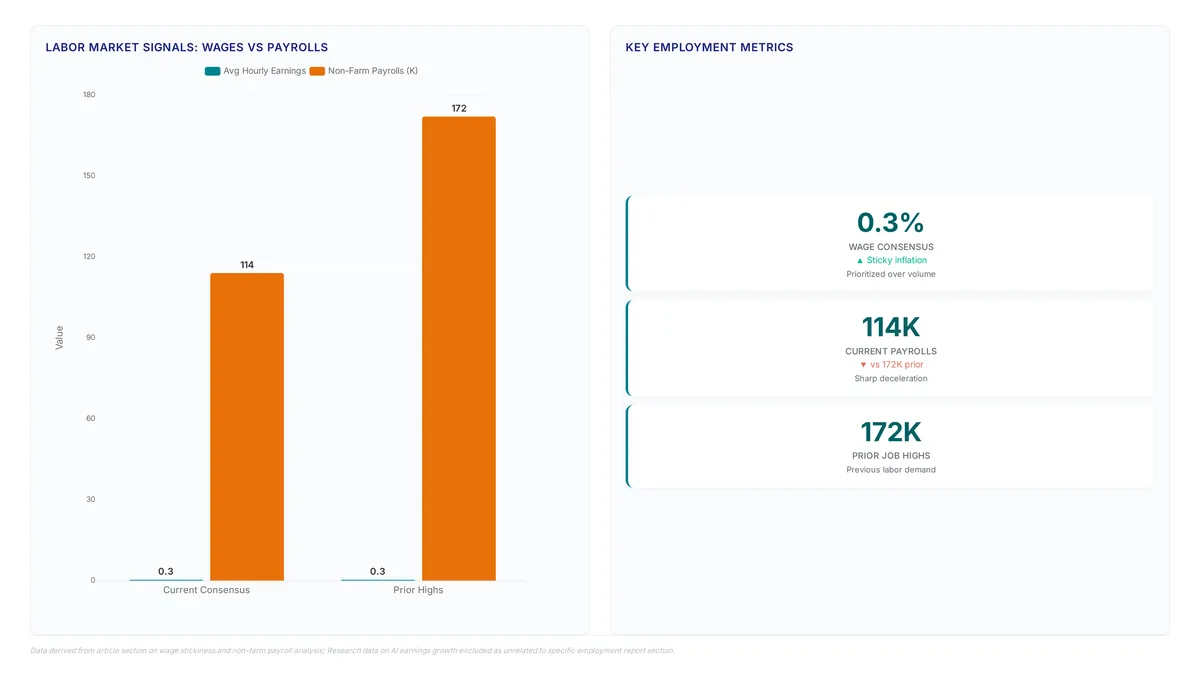
Wage stickiness trumps hiring volume. Divergence between steady wage growth and softening hiring volume creates a bias where price stability outweighs job creation metrics. Traders must prioritize the 0.3% consensus for average hourly earnings against a sharp deceleration in non-farm payrolls to 114K.
This configuration signals that while labor demand cools from prior highs of 172K, underlying inflation pressures remain sticky enough to justify a restrictive Federal Reserve stance. Softer job postings suggest labor demand is no longer strengthening meaningfully, which could eventually force a policy pivot regardless of current wage rigidity. Analysts observe that relying solely on headline payroll counts misses the critical signal of wage stickiness.
Executing Forex Trades Around High-Impact Data Releases
Defining High-Impact Data: PMI, JOLTS, and GDP Metrics
Volatility follows the calendar. The catalyst is the scheduled release of Manufacturing PMI and JOLTS data, creating a bias toward volatility where actuals deviate from consensus. Traders must distinguish between these leading indicators and lagging GDP figures to position correctly before liquidity thins. Wednesday brings manufacturing PMI releases for the Eurozone, the U.K. And the U.S.
- Manufacturing PMI gauges industrial health; readings below 50 signal contraction, a key threshold for assessing economic activity in the Eurozone and U.S. markets.
- JOLTS job openings reveal labor demand tightness, a critical input for the Federal Reserve's inflation calculus alongside wage growth.
- High-impact releases demand a framework that prioritizes core inflation metrics over temporary energy price fluctuations.
Central banks face a critical strategic pivot in determining whether to treat higher energy prices as a temporary shock or a broader inflation threat. The limitation lies in the concentration of investment skewing sectoral data, potentially distorting broader economic signals. Monitoring the divergence between U.S. Consumer confidence and actual employment prints helps validate trend strength. In the U.S. Non-farm payrolls are expected to rise by 114K, a figure that would extend recent hiring improvements and maintain expectations for a restrictive Federal Reserve policy.
Trading the Canadian GDP Rebound in Mining and Oil Sectors
The Canadian dollar hinges on goods production. The catalyst is the expected rebound in Canadian GDP, creating a bias toward CAD strength if goods-producing sectors outperform modest services data. Traders must isolate specific drivers like mining output rather than relying on headline figures alone.
- Identify mining and oil contributions as the primary growth engine, where stronger production and increased drilling activity support solid gains in goods-producing industries.
- Monitor wholesale trade weakness and flat retail activity, which often offset gains in real estate and rental services following recoveries in home resales.
- Validate the data against supply chain realities.
| Sector | Expected Performance | Primary Driver |
|---|---|---|
| Goods-Producing | Solid Growth | Oil production, drilling |
| Services | Modest | Real estate recovery |
| Wholesale/Retail | Weak/Flat | Consumer hesitation |
Supply chain vulnerabilities affecting global oil flows could dampen the resource-sector rally despite strong domestic drilling data. The limitation is that preliminary monthly estimates frequently undergo revisions, requiring traders to validate initial prints against incoming data suggesting further strengthening in economic activity. The recent decline in global oil prices could provide relief to households by lowering fuel costs, supporting purchasing power while reducing the risk of broader inflationary pressures.
Eurozone Inflation Moderation Risks and Energy Price Volatility
Geopolitics overrides models. The catalyst is moderating Eurozone inflation driven by falling energy costs, creating a bias for EUR weakness unless geopolitical shocks reverse this trend. Traders must distinguish between transient fuel dips and persistent core pressure to avoid false breakouts.
- Watch for supply chain disruptions where developments in the Middle East and the Strait of Hormuz could impact global energy markets and inflation forecasts.
- Execute hedges if tanker traffic remains suppressed, noting that merely 4 oil tankers passed through the Strait of Hormuz recently, highlighting acute vulnerability.
- Assess the durability of the disinflationary trend.
The limitation of relying on headline data is that geopolitical chokepoints reshape forecasts quicker than models adjust. Geopolitical tensions in the region remain a primary focus for policymakers assessing potential implications for global energy markets. While the ECB is expected to keep rates unchanged at its July meeting, a rate hike might be considered for September depending on growth outlooks and core inflation trends.
About
Marcus Halloran serves as Chief Market Strategist at ForexCFD.top, where he leads daily coverage of G10 macroeconomic trends and central bank policy. His background as a former interbank FX strategist in London provides the precise expertise required to dissect this week's critical data releases, including U.K. GDP figures and U.S. JOLTS job openings. Halloran's daily work involves translating complex monetary policy signals from the Fed and ECB into actionable insights for retail traders, directly aligning with the article's focus on upcoming volatility drivers. At ForexCFD.top, an independent publication dedicated to forex and CFD market analysis, he applies his deep understanding of interest rate differentials and economic calendars to guide traders through uncertain market conditions. By using his experience in scenario mapping and macro positioning, Halloran ensures that the weekly outlook remains grounded in rigorous fundamental analysis rather than speculation, offering readers a clear, professional perspective on how global economic events may impact substantial currency pairs.
Conclusion
Scalability breaks when traders conflate transient energy dips with structural disinflation, leading to premature positioning against the forex market. The ongoing operational cost involves frequent stop-outs caused by geometric chokepoints that override macroeconomic models. You must separate headline relief from core persistence before committing capital to trend following strategies.
Treat the current divergence between goods-producing growth and services stagnation as a conditional signal rather than a definitive trend. Only allocate significant use if monthly revisions validate the initial prints of economic strengthening. Do not assume stability based on a single data point when supply chain vulnerabilities remain acute. This approach protects liquidity during periods where geopolitical shocks can instantly invalidate technical setups.
Start by mapping your current exposure to oil-sensitive currency pairs against potential disruption scenarios in key transit zones this week. Identify which positions rely entirely on uninterrupted flow and reduce size accordingly before the next data release. This immediate adjustment ensures your portfolio survives the gap between model expectations and physical reality. Focus your analysis on validating preliminary data against incoming reports rather than chasing initial volatility spikes.
Frequently Asked Questions
A 0.4% GDP reading indicates a sharp economic rebound driven by mining. This contrasts with the prior -0.1% figure, suggesting immediate strength for the currency against broader market sentiment.
Headline CPI falling to 3.0% while core stays at 2.5% creates policy uncertainty. Traders must watch if central banks ignore temporary energy drops to focus on sticky service sector prices.
The unemployment rate holding at 4.3% suggests stability despite slowing job creation. However, non-farm payroll gains dropping to 114K indicate hiring is decelerating significantly compared to previous months.
Average hourly earnings rising 0.3% monthly confirms wage pressures remain intact. This consistent growth supports a restrictive Federal Reserve stance even if overall job creation numbers show signs of slowing down.
Headline inflation dropping to 3.0% while core eases only to 2.5% creates a complex picture. This divergence forces policymakers to weigh transient energy costs against persistent underlying price pressures carefully.
References