
EUR/USD divergence: Fed hikes stall price
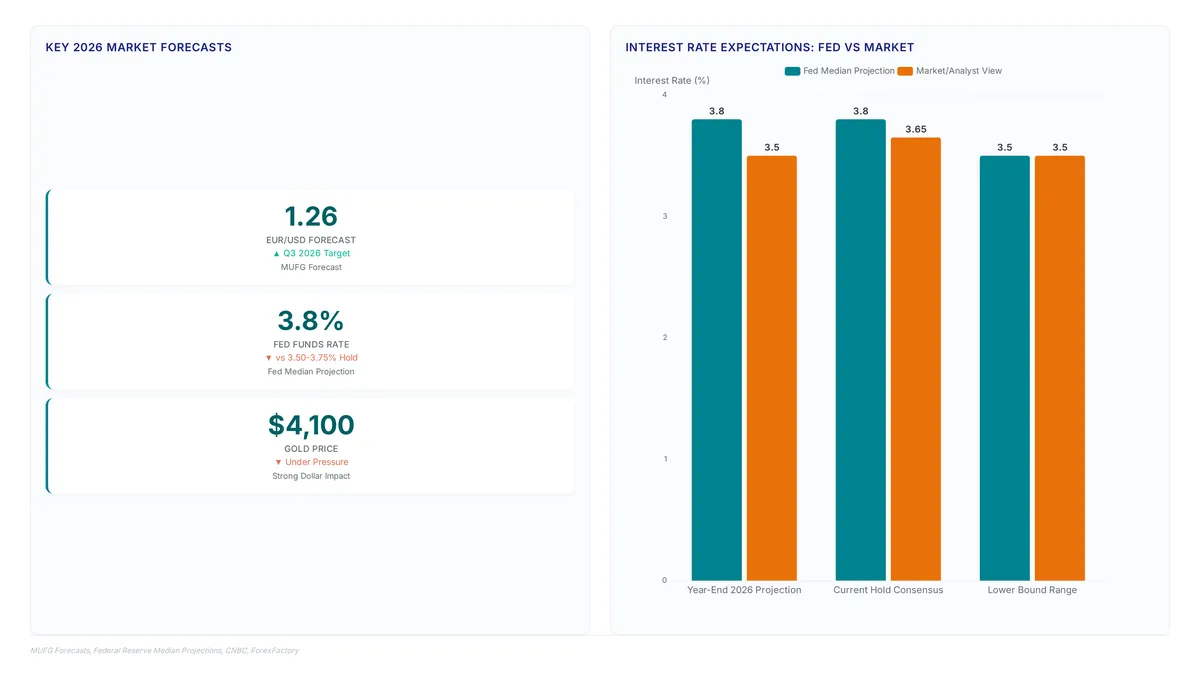
Money markets price 35 basis points of Fed tightening by year-end, stalling EUR/USD near 1.1400. Divergent monetary policies between Washington and Brussels now dictate currency valuations more than geopolitical headlines. While US officials signal potential hikes to the 3.75%-4% range by September, European Central Bank members remain split on further action.
Central bank divergence drives current exchange rates because Fed hike bets outweigh cooler Eurozone inflation data. Prime Terminal data shows an 82% chance of a US rate increase in September compared to a 66% hold probability for July. Conversely, ECB officials like Nagel argue it is too early for more hikes, creating a volatile strategic framework for traders.
Specific data releases, including the unexpected jump in US job vacancies and mixed signals from ECB policymakers such as Philip Lane, define the landscape. US Dollar Index strength competes with European uncertainty. Understanding these mechanics is necessary as the market awaits the June jobs report to confirm if the low-hiring, low-firing environment persists.
The Role of Central Bank Divergence in EUR/USD Valuation
ECB Price Stability Mandate and HICP Inflation Targets
The Euro serves as the legal tender for 20 European Union nations, forming the structural basis of the region's monetary union. The European Central Bank operates under a primary mandate to maintain price stability, set explicitly by a symmetric inflation target of 2%. Policymakers rely on the Harmonized Index of Consumer Prices (HICP) to measure inflationary pressure across the bloc. This response to data creates a fundamental valuation driver for the currency. Divergence occurs when the Fed maintains restrictive policy to fight inflation while the Eurozone confronts cooler CPI prints, creating a policy gap that directly impacts pricing for traders. Understanding this statutory constraint explains why the currency struggles to gain traction despite geopolitical stabilization. Operators must watch HICP releases closely, as these figures trigger the policy responses that define the pair's medium-term trajectory.
How Divergent Fed and ECB Rate Paths Drive EUR/USD Valuation
Divergent monetary trajectories between the Federal Reserve System and the European Central Bank create the valuation gap keeping EUR/USD static. The Federal Open Market Committee maintained the target range for the federal funds rate at 3.50% to 3.75% as of June 17, 2026, signaling a restrictive stance to combat persistent inflation. Markets currently price a high probability of further tightening by September, reflecting deep conviction in US economic durability. Conversely, cooler inflation prints across France, Italy, and Germany reduce pressure on European policymakers to accelerate hikes. This policy asymmetry explains why the pair failed to gain traction on Tuesday, June 30, 2026, remaining steady near 1.1400.
Traders must interpret these central bank signals through the lens of relative yield advantage rather than absolute levels. Money markets imply a significant chance of a hold in July for the Fed, yet the median projection for year-end rates sits higher. The limitation for bullish Euro arguments lies in the fragmented fiscal response across member states compared to unified US stimulus. Investors should monitor upcoming employment reports, as deviations from the unemployment baseline could alter the Fed trajectory. Market participants are advised to exercise caution when positioning ahead of these high-volatility data releases.
EUR/USD Liquidity Dominance Versus Cross-Pair Volatility Profiles
The EUR/USD functions as the global liquidity anchor, absorbing capital flows that minor crosses cannot sustain during policy shifts. In 2022, the Euro accounted for 31% of all foreign exchange transactions, generating an average daily turnover exceeding $2.2 trillion. This depth ensures that inflation divergences manifest as steady repricing rather than erratic spikes. Retail participants must recognize that liquidity dominance dictates execution quality, not headline volatility.
Mechanics of Fed Hike Bets Versus ECB Rate Decisions
Money Market Pricing of Fed Basis Point Expectations
Money markets currently price 35 basis points of policy tightening toward year-end, translating raw economic data into probability-weighted forecasts. This pricing mechanism functions by discounting future cash flows against the Federal Reserve median projection of an undisclosed amount, effectively ignoring cooling Eurozone CPI narratives. Operators monitor job data closely, as strong gains reinforce hawkish stances while vacancies signal labor tightness. A sharp limitation lies in the binary nature of these bets, where a single miss in the 4.3% unemployment figure could unwind the entire 35 basis points of built-in expectations instantly. Consequently, network operators must treat these probability clusters as fragile equilibriums rather than fixed outcomes. The cost of misreading this signal is immediate liquidity evaporation during release windows.
Unexpected jumps in labor demand trigger immediate Greenback appreciation, a mechanical response observed when US Dollar Index levels climb toward 101.17. May data revealed vacancies rising sharply within a low-hiring, low-firing environment, reinforcing the narrative that tight labor markets compel restrictive policy. This specific pressure forces the Federal Reserve to maintain high rates, directly countering cooler inflation signals from Europe. Consequently, the DXY appreciated 0.06% as traders priced divergent central bank paths.
- Strong job gains validate hawkish stances, increasing yield differentials against the Euro.
- Cooler Eurozone CPI data weakens the single currency, amplifying the impact of US strength.
- Market participants adjust probability weights for future hikes, driving spot price action.
| Data Point | Market Reaction | Transmission Channel |
|---|---|---|
| Job Vacancies | USD Bullish | Yield Differential Expansion |
| Consumer Confidence | Mixed | Risk Sentiment Shift |
| ECB Commentary | EUR Bearish | Policy Divergence |
Friction enters this transmission mechanism if subsequent payroll figures miss the consensus estimate of 110K new roles. A miss would invalidate the tight-labor thesis, causing rapid unwinding of long USD positions despite current vacancy strength. Traders must distinguish between stock data like vacancies and flow data like payrolls to avoid false signals. The constraint here lies in the lagging nature of vacancy reports, which may not reflect real-time hiring freezes until unemployment rises.
Regulatory note for ForexCFD.top readers: In jurisdictions like India, local RBI guidelines restrict used FX trading to specific pairs and exchanges. Always verify your broker's regulatory status before executing strategies based on macro data.
Risk Warning: Currency trading involves significant risk of loss and is not suitable for all investors. Past performance does not guarantee future results.
Divergent ECB Signals Versus Priced September Rate Hikes
Market pricing assigns a 60% probability to a 25 basis point ECB rate increase by September, despite conflicting official guidance. While Philip Lane avoids pre-committing to specific meeting dates, Governing Council members display fractured intent. Jens Weidmann and others suggest waiting, whereas Nagel argues it remains too early to call for further hikes. This discord creates a tangible uncertainty premium in Euro pricing that diverges from the unified hawkishness observed across the Atlantic. Operators must recognize that divergent signals prevent clear directional momentum until the September meeting approaches. Unlike the Federal Reserve, where data consistently reinforces a singular narrative, the Eurozone suffers from a lack of consensus that dampens volatility compression Breakouts require unified forward guidance, which is currently absent. Traders should monitor official commentary for convergence rather than relying solely on inflation metrics. The cost of this ambiguity is reduced capital inflow into Euro-denominated assets relative to their Dollar counterparts.
*Risk Warning: CFDs are complex instruments. ForexCFD.top does not provide financial advice.*
Strategic Framework for Trading EUR/USD on Data Releases
Defining the 35 Basis Point Tightening Expectation Window

Money markets currently price 35 basis points of policy tightening by year-end, signaling a distinct shift in Federal Reserve expectations. This pricing structure reveals a detailed temporal spread where immediate action is less certain than medium-term hikes. Data indicates a 66% probability of a rate hold during the July meeting, suggesting traders await further labor confirmation before committing capital. This divergence creates a specific pathway for forex participants analyzing EUR/USD forecasts. Traders must recognize that the Federal Reserve prioritizes inflation fighting over growth concerns, directly altering currency valuations. The market's refusal to price a July hike despite strong job data implies a deliberate pause to assess cumulative policy effects. Such a scenario forces a re-evaluation of short-term EUR/USD forecast models that assume immediate aggression. Investors seeking higher yields will likely sustain dollar strength once the July uncertainty clears. This window defines the risk parameters for any position held through the summer doldrums.
Executing EUR/USD Entries Around the 1.1400 Stability Zone
On Tuesday, June 30, 2026, the Euro failed to gain traction against the US Dollar, with the pair remaining steady at around 1.1400. The single currency struggled to build momentum as cooler inflation data from Germany and France offset hawkish Federal Reserve signals. This specific disconnect suggests that the pair remains sensitive to breaks above 1.1420, where recent trading activity has clustered, while short-term viability depends on the Federal Reserve maintaining its tightening bias.
| Condition | Action | Trigger Level |
|---|---|---|
| DXY Strength Continues | Monitor Support | Near 1.1400 |
| ECB Hawkish Surprise | Monitor Resistance | Near 1.1420 |
| Range Bound | Observe | Inside 1.1400, 1.1420 |
However, relying solely on this range ignores the transaction costs and spreads that widen notably during such policy divergence, potentially eroding thin margins on range-bound trades. The practical implication for network operators and forex traders alike is that volatility can spike unexpectedly around employment reports, particularly given the upcoming June jobs data. Retail participants in restricted jurisdictions must verify local regulatory status before engaging with used products, as education-first frameworks often prohibit speculative data trading. Always assess your risk tolerance, as economic releases can drive rapid price movements. ForexCFD.top provides this analysis for educational purposes only.
The limitation here is that geopolitical risk premiums can evaporate quicker than they accumulate, leaving late entrants exposed. If the Federal Reserve pauses unexpectedly while the ECB remains vague on timing, the resulting volatility would overwhelm standard inflation-based forecasts. Traders must prepare for an environment where diplomatic headlines override economic data releases. ForexCFD.top advises monitoring these political signals closely alongside traditional metrics.
Projected Outcomes for Eurozone Stability and Dollar Strength
Comparison: Divergent ECB Signals Defining September Rate Expectations
Conflicting guidance from Philip Lane and Dolenc creates immediate uncertainty for September rate decisions. Chief Economist Philip Lane stated that the bank should not pre-commit to a specific meeting in July or September, while Dolenc advocates patience until later in the quarter. This divergence complicates market pricing as cooler inflation data from France, Italy, and Germany suggests reduced pressure for aggressive action. The table below contrasts the stances driving this stagnation.
| Official | Stance on Timing | Inflation View |
|---|---|---|
| Philip Lane | No pre-commitment | Vague on path |
| Dolenc | Wait until September | Patient approach |
| Nagel | Too early for hikes | Cautious outlook |
The Eurozone CPI impact remains muted because officials like Nagel state it is too early to call for further hikes, dampening the EUR/USD reaction to data. Unlike the unified hawkishness seen elsewhere, this mixed messaging prevents clear directional momentum. A key tension exists between maintaining policy flexibility and providing forward guidance; without consensus, the ECB risks anchoring expectations incorrectly. Investors monitoring these signals note that while some members support another hike, the prevailing view favors waiting for clearer data. This fragmentation limits the upside for the single currency despite global yield shifts. Traders should watch how inflation data evolves across the bloc before assuming a definitive policy pivot. The lack of a unified voice ensures volatility remains elevated through the summer months. Analysts advise caution when interpreting isolated comments from governing council members.
Comparison: Executing EUR/USD Entries Around the 1.1400 Stability Zone
While money markets price in a potential ECB move, the expectation of a July hold aligns with the pair's current stagnation. The cost of premature positioning is evident when USD strength drivers like energy slumps dominate the narrative. Operators must distinguish between temporary risk-on flows and structural shifts in monetary policy expectations.
Analysts note that transaction costs and spreads in the EUR/USD pair are influenced by the divergence between the Fed's hawkish stance and the Eurozone's cooler inflation data. The primary limitation for entry timing lies in the ambiguity of ECB guidance, where officials avoid pre-commitment to specific meetings. This uncertainty forces traders to rely heavily on technical levels rather than fundamental conviction. Successful navigation of the 1.1400 zone requires strict adherence to risk management protocols amid low volatility. While US policymakers maintain a unified front, ECB officials offer conflicting signals that complicate valuation models for the EUR/USD. A critical tension exists here: while US data supports continued tightening, cooler inflation in France, Italy, and Germany limits the ECB's room to maneuver. The US Dollar gains structural support from this policy gap, as yield differentials favor assets denominated in greenbacks. However, the limitation remains that divergent views among ECB members, ranging from Kazaks' call for no forceful response to Wunsch's support for a hike, create uncertainty for the Eurozone recovery. The EUR/USD pair remains stagnant as investors await clearer directional cues. Analysts note that without unified ECB communication, the pair remains sensitive to incoming data.
About
Vikram Nair, Emerging Markets & Asia FX Writer at ForexCFD.top, brings a distinct global perspective to substantial pair analysis. While his daily work focuses on the intricacies of emerging-market currencies like USD/INR and USD/NGN, this background provides a critical lens for understanding EUR/USD dynamics. By monitoring how Federal Reserve rate decisions ripple through Tier-2 and Tier-3 economies, Nair identifies how global risk appetite and dollar strength impact capital flows beyond just the G7 nations. His expertise in translating complex central bank policies into actionable insights ensures that retail traders in India, Nigeria, and Southeast Asia grasp the broader implications of Eurozone CPI data and US geopolitical developments. At ForexCFD.top, an independent publication dedicated to vendor-neutral market news, Nair applies his deep knowledge of regulatory landscapes and macro-economic drivers to deliver clear, factual analysis. This approach helps global retail traders navigate volatility with a thorough understanding of how Fed hike bets influence the wider currency market.
Conclusion
The operational breaking point for EUR/USD traders is not volatility itself, but the widening gap between divergent central bank communications and market pricing. Relying on technical levels while ignoring the structural yield disadvantage creates a hidden cost in slippage and false breakouts. The stagnation around 1.1400 reflects a market waiting for the ECB to either unify its message or accept a prolonged period of real-rate weakness against the dollar. This ambiguity forces operators to pay a premium for certainty that simply does not exist yet.
Traders must abandon the assumption that cooling inflation automatically triggers aggressive ECB tightening. Instead, treat the current range as a distribution phase driven by conflicting Eurozone signals. Position for continued USD strength until the ECB demonstrates a cohesive strategy that addresses inflation without stifling growth in substantial economies like France, Italy, and Germany. Verify your stop-loss placement using EUR/USD volatility metrics to ensure your risk parameters account for sudden policy-driven spikes rather than historical averages.
Frequently Asked Questions
Markets assign an 82% probability to a September hike compared to a 66% hold chance for July. This sharp increase indicates traders expect tighter policy later in the year despite current uncertainty.
A miss in the 4.3% unemployment baseline could unwind current market expectations for further rate increases. Traders watch this specific labor metric closely as a primary signal for immediate policy shifts.
The Euro accounted for 31% of all foreign exchange transactions in 2022, ensuring deep liquidity. This massive share means inflation divergences manifest as steady repricing rather than erratic spikes for major pairs.
The Federal Reserve median projection sits at a portion, signaling expectations for at least one rate hike. This target effectively ignores cooling Eurozone inflation data, creating a distinct valuation gap between the two regions.
Market pricing assigns a 60% probability to a 25 basis point ECB rate hike by the September meeting. This reflects divided opinions among officials regarding the necessity of further action against inflation.
References