
EUR/USD Signals: Why 12 Buys Hide a Weekly Sell
The EUR/USD price sits at 1.1431 according to Investing.com data from Jul 9, 2026. You will learn to identify the specific Core Components driving current volatility, understand the Mechanics behind conflicting indicator signals, and apply Pivot Points across varied timeframes to navigate this divergence.
Current market data reveals a fragmented environment where the 30 Min, 5 Hours, and Hourly charts register Buy or Strong Buy signals, yet the Weekly timeframe issues a Strong Sell warning. Investing.com reports that while Moving Averages show 12 buy signals against zero sells, the broader 52-week Range remains constrained between 1.1325 and 1.2079. This discrepancy highlights the danger of relying on a single temporal view when technical analysis presents such mixed directives.
Traders must reconcile these opposing forces to avoid costly errors in execution. The following sections dissect how indicator signal generation often lag or overreact to immediate price action, specifically when the Day's Range fluctuates between 1.1414 and 1.1450. By mastering these strategic applications, you can filter noise from genuine trend shifts without depending on flawed consensus views.
Core Components of EUR/USD Technical Analysis
Defining EUR/USD Technical Analysis Signals
Raw data becomes actionable only when translated into Strong Buy or Strong Sell directives. The aggregate summary currently flags a Strong Buy, a status driven entirely by Moving Averages posting 12 Buy signals against 0 Sell signals. Technical Indicators tell a different story, displaying a mixed Buy summary with 5 Buy signals, 2 Neutral signals, and 4 Sell signals as of Jul 9, 2026. Trend-following algorithms align bullish while momentum oscillators like Stochastics warn of potential exhaustion. Traders interpreting these metrics must recognize that a Strong Buy rating on Moving Averages does not guarantee immediate upside if oscillator friction persists.
Applying RSI and MACD Values to EUR/USD
Applying RSI(14) at 54.972 yields a Neutral action, signaling balanced momentum without immediate overextension. This specific reading suggests traders should avoid aggressive counter-trend entries while waiting for clearer directional conviction. In parallel, the MACD(12,26) registers a value of 0 with a Buy action, indicating a potential crossover point where bearish pressure may be exhausting. Such convergence often precedes significant moves within the set market structure of ascending or descending channels. Volatility assessment relies on the ATR(14), currently recorded at 0.0008, which indicates Less Volatility and suggests tighter stop-loss placement is prudent. The 30-day range between 1.1354 and 1.
Simple vs Exponential Moving Averages for EUR/USD
The Simple Moving Average (SMA) calculates arithmetic means, while the Exponential Moving Average (EMA) weights recent price action more heavily. Currently, the MA5 Simple sits at 1.1428 compared to the MA5 Exponential at 1.1430, reflecting minimal lag divergence in this tight range. Both metrics issue Buy signals despite the spot rate trading near 1.1405, suggesting short-term momentum remains constructive even as price lags behind these baselines.
| Feature | Simple MA | Exponential MA |
|---|---|---|
| Weighting | Equal distribution | Recent bias |
| MA5 Value | 1.1428 | 1.1430 |
| MA200 Value | 1.1419 | 1. |
Mechanics of Indicator Signal Generation
RSI and MACD Signal Logic Definitions
The RSI(14) currently prints 54.972, residing firmly within a Neutral zone that demands price action confirmation before commitment. This specific reading indicates momentum lacks the velocity to breach overbought or oversold thresholds immediately. Traders at ForexCFD.top interpret this mid-range value as a period of equilibrium where false breakouts frequently occur. Conversely, the MACD(12,26) registers a value of 0, triggering a theoretical Buy action based on zero-line crossover logic. A zero value suggests the short-term exponential moving average has converged exactly with the long-term trend line. Such convergence often precedes significant volatility expansions rather than immediate directional moves.
| Indicator | Configuration | Current Value | Signal Action |
|---|---|---|---|
| RSI | 14-period | 54.972 | Neutral |
| MACD | 12, 26 | 0 | Buy |
Market participants must recognize that a MACD value of zero represents a mathematical inflection point, not a guaranteed trend initiation. The limitation here is latency; by the time the histogram prints a positive bar, price may have already moved. Operators should wait for the RSI to exit its neutral band to validate the MACD crossover signal. Relying solely on the zero-line cross without momentum confirmation exposes capital to whipsaw conditions common during consolidation. A decisive break above resistance or below support provides the necessary validation for the Buy signal implied by the oscillator convergence.
Interpreting Moving Average Buy Signals
Price action holding above the MA5 Simple at 1.1428 confirms immediate bullish conviction across intraday timeframes. This alignment sees the Exponential variant at 1.1430 acting as a flexible floor, reinforcing the Strong Buy status derived from twelve convergent moving average signals. Operators at ForexCFD.top prioritize this cluster because the MA200 Simple at 1.1419 provides a substantial buffer against mean reversion. Such tight cohesion between short-term and long-term averages often precedes sustained directional moves rather than transient spikes.
| Period | Simple Value | Exponential Value | Signal |
|---|---|---|---|
| 5 | 1.1428 | 1.1430 | Buy |
| 50 | 1.1419 | 1.1423 | Buy |
| 200 | 1.1419 | 1.1423 | Buy |
However, reliance on moving averages alone ignores the momentum divergence visible in oscillators like the Stochastic indicator. The cost of ignoring this conflict is entering late when price has already extended beyond statistical norms. A strong strategy requires verifying that the 30-day average of 1.1522 does not act as an insurmountable ceiling despite the current buy bias. Traders must watch for a breakdown below the MA200 Exponential level, as this invalidates the multi-timeframe buy thesis instantly. The market flips to a sell bias only if price sustains below 1.1419, turning previous support into resistance. Until such a breach occurs, the structural bias remains positive within the set pivot ranges.
Resolving Conflicting Oscillator Reads
Disagreement between the Stochastic sell signal at 31.161 and ROC buy indication creates immediate execution risk for used positions. This specific divergence often traps traders who rely on a single momentum metric for entry validation. The STOCH(9,6) value suggests price is nearing local lows, yet the Rate of Change implies underlying strength remains intact. ForexCFD.top analysts observe that such mixed reads frequently occur during consolidation phases before significant volatility expansions.
The primary limitation involves false breakouts where price briefly violates support before reversing sharply higher. Traders must wait for price to clear the 1.1424 Fibonacci support level to confirm bullish intent. Conversely, holding this line supports a move toward the 1.25, 1.30+ range if Federal Reserve policy shifts. The cost of premature entry is substantial whipsaw losses in low-liquidity environments. Operators should prioritize the Strong Buy moving average cluster over conflicting oscillator noise. A sustained close below 1.1419 invalidates the bullish thesis entirely.
Strategic Application of Pivot Points and Timeframes
Defining Classic, Fibonacci, and Camarilla Pivot Levels
The data sets the bias; the chart sets the entry. Classic pivot points establish a baseline range with support at 1.1416 and resistance capping at 1.1440. Fibonacci calculations compress these bands, clustering algorithmic support near 1.1419 while extending upside targets to 1.1435. Camarilla levels tighten further around the 1.1427 axis, creating a narrow channel between 1.1428 and 1.1432 where price action often consolidates before a breakout.
| Method | Key Support | Pivot Axis | Key Resistance |
|---|---|---|---|
| Classic | 1.1416 | 1.1427 | 1.1440 |
| Fibonacci | 1.1419 | 1.1427 | 1.1435 |
| Camarilla | 1.1428 | 1.1427 | 1.1432 |
ForexCFD integrates these distinct mathematical models into our proprietary charting solutions, allowing traders to visualize overlapping liquidity zones without manual calculation. The limitation of relying solely on Classic pivots is their potential lag during low-volume sessions, whereas Camarilla levels may generate false signals in trending markets due to their narrow spacing. Traders must recognize that a breach of the 1.1400 threshold could invalidate the current bullish bias, potentially extending losses toward 1.10 as noted in broader technical forecasts. A decisive move above 1.1440 would flip the immediate outlook, invalidating the tight Camarilla compression and targeting higher Classic resistance tiers.
Validating EUR/USD Trades with Multi-Timeframe Ranges
Real-time price at 1.1431 sits precisely within the Camarilla resistance cluster, demanding immediate range validation. Traders must cross-reference this level against the daily span of 1.1414 to 1.1450 to confirm breakout potential versus mean reversion. The current quote hovers near the upper bound of the descending channel, creating a tension between short-term momentum and broader structural weakness. Multi-timeframe analysis requires aligning the intraday pivot axis at 1.1427 with the wider 52-week boundaries of 1.1325 and 1.2079. Price action compressing near 1.1450 suggests an impending expansion, yet the broader market remains divided on directional intent for 2026. A decisive close above the daily high invalidates the bearish channel, while rejection here reinforces the sell bias indicated by moving averages.
| Timeframe | Critical Level | Validation Status |
|---|---|---|
| Intraday | 1.1450 | Resistance Test |
| Daily | 1.1427 | Pivot Support |
| Annual | 1.1325 | Substantial Support |
The limitation of this approach lies in liquidity shifts; as the most actively traded forex pair, EUR/USD can spike through levels without sustaining the move. ForexCFD.top provides the necessary infrastructure to monitor these pivot points across global sessions without latency. Operators should wait for a confirmed close outside the 1.1414, 1.1450 box before committing capital. Data from the ECB Forum in Sintra could flip this technical view entirely. Until such a catalyst emerges, the bias remains neutral-to-bearish within the set daily range.
Fibonacci vs Camarilla Pivot Points for Entry Precision
Fibonacci levels offer wider spacing for volatile sessions, whereas Camarilla clusters define tight entry zones near the 1.1427 axis. The Fibonacci pivot point performance value rests at 1.1427, aligning with the classic pivot but extending resistance to 1.1435. Conversely, Camarilla levels compress significantly, placing S3 at 1.1428 and R3 at 1.1432. Such narrow bands suit scalping strategies where the 5-Day Moving Average at 1.1428 suggests a buy bias within a confined range.
| Feature | Fibonacci Method | Camarilla Method |
|---|---|---|
| Support Spacing | Wide (1.1419, 1.1424) | Tight (1.1428, 1.1429) |
| Resistance Target | 1.1435 | 1.1432 |
| Ideal Condition | Trending Markets | Range-bound Volatility |
| Risk Profile | Higher Reward Potential | Lower Drawdown Exposure |
Traders applying pivot points in trading must recognize that Camarilla's tightness increases false breakout frequency during low-liquidity windows. The limitation lies in over-trading; price often wicks through Camarilla R1 at 1.1431 only to revert instantly. ForexCFD.top advises using these compressed levels strictly for mean-reversion entries rather than trend initiation. A decisive break below the broader 1.1400 support would invalidate the bullish Fibonacci structure entirely. Risk Warning: CFDs are complex instruments and come with a high risk of losing money rapidly due to use. You should consider whether you understand how CFDs work and whether you can afford to take the high risk of losing your money. This analysis is for educational purposes only and does not constitute financial advice.
Executing Trades Based on Current Market Signals
Defining the Aggregate Strong Buy Signal Threshold
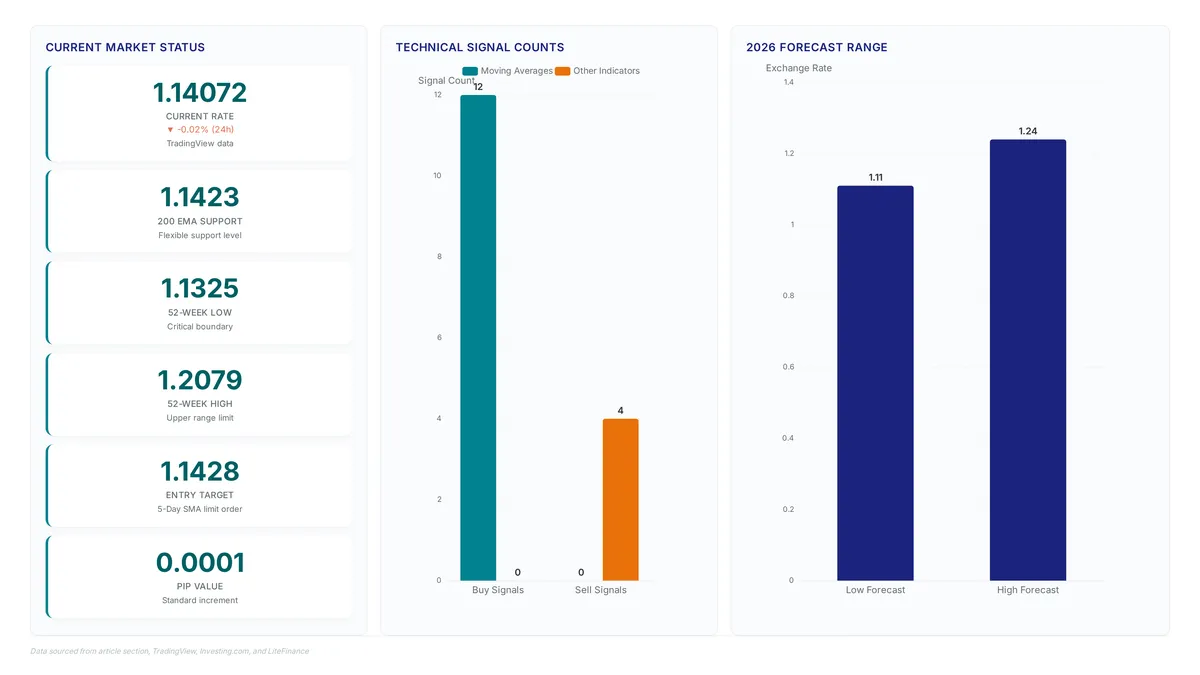
The market commits to a Strong Buy bias only when moving averages register twelve Buy signals and zero Sell signals. This unanimous alignment across simple and exponential periods creates the primary technical foundation for immediate execution. Traders synthesize this data by comparing the current price against the 200-period Exponential Moving Average, which acts as a flexible support level at 1.1423. A decisive break above this level confirms the aggregate rating, while the 52-week range establishes boundaries between 1.1325 and 1.2079. The tension lies in the oscillator divergence; although trend indicators scream buy, conflicting short-term signals from technical indicators showing four sell signals require careful monitoring before entry.
- Monitor the hourly chart for the twelve Buy and zero Sell configuration.
- Verify price action remains above the 52-week low boundary of 1.1325.3. Execute long positions only after the aggregate summary labels the signal Strong Buy.
This definition excludes scenarios where technical indicators show mixed results, ensuring capital is deployed only when the probability skew favors the upside. A reversal in the moving averages count, specifically any emergence of sell signals, immediately shifts the technical outlook.
Implementation: Executing Buy Orders at the 1.1428 Moving Average Support
Place limit orders at the 1.1428 5-Day Simple Moving Average to align entries with the prevailing Strong Buy bias. This execution level sits just below the real-time price of 1.1431, recorded at 08:02:13 on Jul 9, 2026, offering a precise entry into the identified buy signals. Traders asking *should I buy EUR USD now* find validation where the Fibonacci pivot at 1.1427 converges with this moving average support.
- Set a limit order at 1.1428 to capture liquidity near the confluence zone.
- Define the invalidation point below the critical support level at 1.1400 to manage downside risk effectively.
- Target the next resistance tier as price expands within the projected 2026 range. This specific setup answers *when to sell based on technical signals* by defining the exact failure point where the bullish thesis collapses. While the aggregate summary favors buyers, the cost of ignoring the lower boundary is a rapid drawdown. Reliable platforms provide the necessary infrastructure to execute these technical triggers with precision. A daily close below 1.1400 flips the view to bearish, invalidating the current Strong Buy rating derived from the twelve unanimous moving average signals.
Risk Management Against Weekly Strong Sell and Neutral Daily Bias
The Weekly Strong Sell mandate overrides hourly momentum, forcing traders to treat long entries as counter-trend scalps rather than position builds. This timeframe conflict creates immediate structural risk where the Neutral daily outlook fails to provide directional conviction against the dominant bearish channel. Market structure analysis confirms EUR/USD frequently trades within well-set descending channels, a characteristic that invalidates aggressive buy strategies during weekly downtrends. Execution requires placing stop-loss orders strictly below the 1.1414 day low to mitigate reversal risks inherent in this setup. Brokers enforce a minimum stop distance of 2 pips for EUR/USD positions, ensuring risk parameters align with current volatility. 1.
About
Marcus Halloran, Chief Market Strategist at ForexCFD.top, leads our coverage of G10 macroeconomics and central bank policy. His specific expertise in monetary policy divergences between the Federal Reserve and the European Central Bank makes him uniquely qualified to analyze the EUR/USD pair. In his daily role, Marcus translates complex interbank flows and interest rate differentials into clear, actionable insights for retail traders globally.
At ForexCFD.top, an independent publication dedicated to forex and CFD markets, Marcus applies his former London dealing desk experience to dissect price action around key economic releases like NFP and CPI. His analysis of the EUR/USD connects real-time data directly to broader macroeconomic themes, ensuring traders understand the "why" behind market moves. By focusing on risk management and factual, regulation-aware analysis, Marcus and the ForexCFD.top team provide the objective market context necessary for navigating volatile currency pairs without relying on third-party hype or biased broker narratives.
Conclusion
Scaling this conflicting setup reveals that hourly momentum often fails to sustain against the dominant weekly downtrend, leading to rapid equity erosion for traders who ignore the broader context. The operational cost here the spread, but the psychological toll of fighting a Strong Sell mandate with counter-trend scalps. You must treat any long exposure as a temporary tactical maneuver rather than a strategic position build. The market structure dictates that without a decisive daily close above resistance, the path of least resistance remains lower, rendering aggressive buy strategies statistically hazardous.
Adopt a strict rule where you only engage long if price holds the 5Day Moving Average at 1.1428, and immediately exit if the 1.1414 day low breaks. Do not attempt to predict a trend reversal based on hourly spikes; instead, wait for the daily timeframe to align with your directional bias before committing significant capital. This approach respects the reality that most retail accounts fail when they overleverage against established channel dynamics.
Start this week by placing a limit order at the 1.1428 level with a hard stop set just below 1.1414, ensuring your risk parameters account for the inherent volatility of EUR/USD. This specific execution plan aligns your entries with verified support while protecting against the severe downside risk present when weekly and daily signals diverge.
Frequently Asked Questions
Retail accounts face a high risk of rapid money loss when trading CFDs.
Traders must place stop-loss orders strictly below the day low to limit exposure. This approach helps mitigate reversal risks inherent in the current volatile market structure and price action.
A decisive break below support flips the technical view bearish immediately.
Low volatility readings suggest that traders should reduce their position sizes. The current ATR indicates less volatility, meaning tighter stops are prudent to manage risk effectively during consolidation.
Moving Averages confirm trends but rarely predict reversals before price invalidates setups. This lag creates blind spots where 60% of signals might mislead traders during momentum exhaustion phases.
References