
Federal rate stance: Inflation now outweighs growth
On June 17, 2026, the FOMC held the target range at 3.5% to 3.75% while removing its easing bias. The Federal Reserve has shifted from accommodation to vigilance, signaling that inflation concerns now outweigh growth fears under Chairman Kevin Warsh. The FOMC decision framework now prioritizes raw data over forward guidance, a change evidenced by the significantly slimmer policy statement. We see a clear divergence between Warsh and the legacy Powell approach: nine members now project rate hikes despite the current hold. The removal of the easing bias confirms that supply shocks in energy and other sectors are driving a more hawkish stance than markets anticipated.
Market reaction was immediate and negative as investors digested the possibility of higher borrowing costs later this year. The S&P 500 dropped 70 points to 7,441, while the Nasdaq Composite Index sank 1% on the news. These moves reflect a brutal recalibration of expectations following the release of the Summary of Economic Projections. Replaced by a data-dependent strategy that refuses to rule out aggressive action against persistent inflation.
The Role of the Federal Funds Rate in Modern Monetary Policy
Defining the 3.5% to 3.75% Federal Funds Rate Range
The Federal Open Market Committee (FOMC) maintains the federal funds rate target range at 3.50% to 3.75%. This specific bandwidth dictates the cost of overnight lending between depository institutions, serving as the primary transmission mechanism for U.S. Monetary policy. By anchoring short-term borrowing costs, the central bank influences broader financial conditions, consumer credit availability, and ultimately, price stability across the economy. Current projections indicate inflation remains elevated relative to the Committee's 2% goal, necessitating this steady stance through June 2026. Market participants observe a 98.9% probability that the Federal Reserve will hold rates at this level during the upcoming June 17 decision.
Removing previous "easing bias" language signals a distinct pivot toward vigilance against resurgent price pressures in energy and food sectors. The current range supports employment, yet nearly half of FOMC members project that higher borrowing costs may become necessary later in the year if supply shocks persist. This divergence suggests the present target range acts as a temporary floor rather than a long-term equilibrium, forcing operators to price in potential volatility despite the unanimous vote to hold. Tighter financial conditions ripple through commercial real estate and used corporate balance sheets immediately. Chair Kevin Warsh pledged to reduce inflation to this level, noting the U.S. Economy has not achieved this metric in more than five years. This commitment drives a hawkish shift, set as a policy stance prioritizing price stability over growth stimulation when prices rise too fast.
The committee explicitly removed the 'easing bias' from its June guidance, a phrase previously used to signal a lean toward cutting interest rates. Deletion of this phrase alters market expectations by signaling that the central bank will not automatically lower borrowing costs even if growth slows. Consequently, the cost of capital remains elevated to prevent temporary price spikes in energy or food from becoming permanent wage-price spirals. Application of this rigid target faces constraints when inflation sources are geopolitical supply shocks rather than domestic demand. Warsh admitted the Fed cannot fix the price of oil or eggs directly but must stop these changes from broadening across the economy. Holding rates high to fight supply-side inflation risks inducing a recession if labor markets cool too rapidly.
Chair Kevin Warsh announced a shift toward more circumspect policy statements, removing the clear signals traders previously relied upon for liquidity planning. This communication strategy complicates the Federal Reserve's ability to anchor expectations while inflation remains elevated due to external supply constraints. The Federal Reserve notes that energy sector price increases reflect these persistent supply shocks rather than simple demand. Market participants face higher volatility as they interpret sparse data releases without explicit rate path projections. The cost of this opacity is measurable: stock indices recently dropped 0.9% following the announcement, reflecting investor discomfort with the new ambiguity. Less guidance allows the central bank flexibility to react to unfolding geopolitical events without being trapped by prior commitments. Price stability becomes harder to achieve when economic agents cannot predict policy responses to supply-driven inflation. Gold traders must monitor real yields closely, as the dollar may fluctuate wildly on every ambiguous Fed speaker comment. This environment demands strict risk management, particularly for used positions where sudden spread widening can trigger liquidations.
Inside the FOMC Decision Framework and Economic Projections
Defining the Shift from Easing Bias to Higher-for-Longer Rates
Stripping the easing bias from June guidance mechanically resets the policy baseline toward sustained restriction. This deletion signals the central bank no longer leans toward cutting the federal funds rate, with market expectations indicating a 60% probability that there will be no rate cuts in 2026, according to the CME FedWatch Tool. Forecasts issued in March projected the Personal Consumption Expenditures index would end the year at 2.7%, yet updated economic projections now show inflation rising to an annualized 3.6%. Holding rates steady while inflation expectations rise effectively tightens real interest rates, a constraint that risks stifling growth before price stability returns. Investors pricing fixed-income opportunities now navigate a terrain where the yield floor for US Treasury securities climbs, reducing the present value of long-duration assets. Short-term rates will remain elevated even as long-term growth expectations dampen. The median official now expects headline and core inflation well above 3% by year-end. Persistent pressure suggests the Federal Reserve must maintain the federal funds rate at restrictive levels longer than previously anticipated. Projections show a clear prioritization of labor market stability over rapid disinflation, creating a complex environment for asset pricing.
Traders analyzing these fed economic projections must recognize that removing the "easing bias" confirms a structural change in policy execution. The implication for commodities is severe: a "higher-for-longer" rate environment suppresses non-yielding assets until real yields turn decisively positive. Used positions on metals carry significant risk when central banks pivot to fight resurgent inflation. Market participants adjust currency pair pricing based on the collision of hawkish Fed outlooks with other central bank policies, leading to volatility premiums in forex markets.
Market Confusion from Slimmer Policy Statements and Unanimous Votes
Removing the easing bias from the June guidance created immediate dissonance between the unanimous vote and the internal dot plot. This contradiction emerged within a notably slimmer policy statement that stripped away the forward guidance traders rely on for calibration. The resulting ambiguity forces operators to parse the Summary of Economic Projections rather than relying on clear textual cues from the committee.
The primary risk lies in the market misinterpreting the unanimous vote as consensus for stability, ignoring the underlying hawkish shift revealed in the projections. Simplifying the text to reduce noise removed explicit direction, increasing volatility around subsequent data releases like Non-Farm Payrolls. Investors now face a binary outcome where soft labor data could trigger a sharp repricing of hike expectations. Gold remains sensitive to these real yield fluctuations as the dollar reacts to the prospect of sustained restriction. Used positions in XAUUSD require careful risk management given the heightened noise. Account holders should note that holding overnight positions may incur financing charges depending on the broker and trade direction.
Warsh vs Powell Divergence in Policy Approach
Defining Warsh's Circumspect Communication vs Powell's Forward Guidance
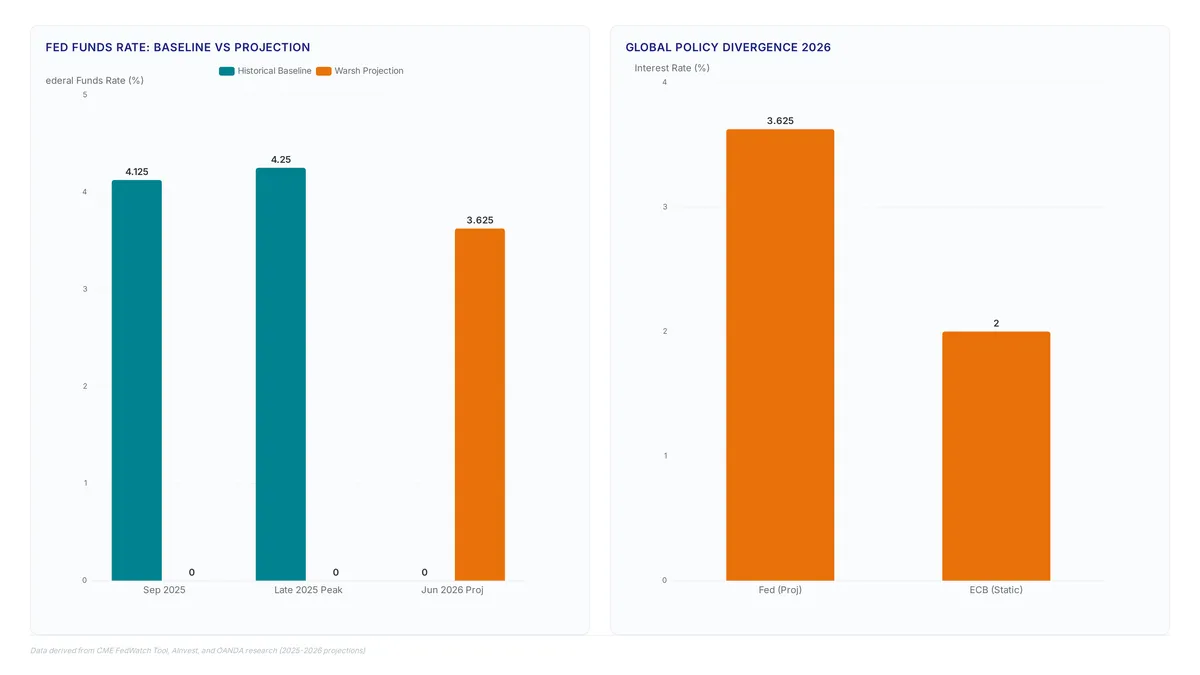
Kevin Warsh has replaced explicit forward guidance with shorter, fact-based policy statements that remove the easing bias language seen under Jerome Powell. This structural shift abandons the predictive signaling of past rate paths in favor of data-dependent circumspection during this higher-for-longer environment. Warsh instituted five task forces to review communications and inflation data, signaling a methodological break from the consensus-driven transparency of his predecessor. Reduced market clarity defines the operational constraint; investors must now interpret raw data rather than relying on the Fed's synthesized outlook. Ambiguity increases volatility premiums as traders price the risk of policy errors without the safety net of explicit guidance.
Comparing September 2025 Rate Baseline to June 2026 Projections
Stalled easing defines the trajectory from a 4.25% peak in late 2025 to the current steady state rather than the anticipated pivot. Short-term vs. Long-term Rate Projections confirm that the aggressive cuts markets priced for late last year failed to materialize under the new hawkish shift. This divergence between the Warsh and Powell eras suggests that should investors expect rate hikes in 2026, the answer is now a quantifiable probability rather than a tail risk. The cost of capital remains structurally higher because the inflation data reviews initiated by the new task forces prioritize price stability over growth accommodation. Cheap liquidity windows have closed, forcing a recalibration of asset duration across portfolios. Gold traders should note that real yields staying elevated suppresses non-yielding bullion regardless of geopolitical premiums. Stability serves as the primary output of this regime, not stimulation.
Market Volatility and Strategic Responses to Rate Signals
Defining the Market Reaction to FOMC Rate Hike Projections
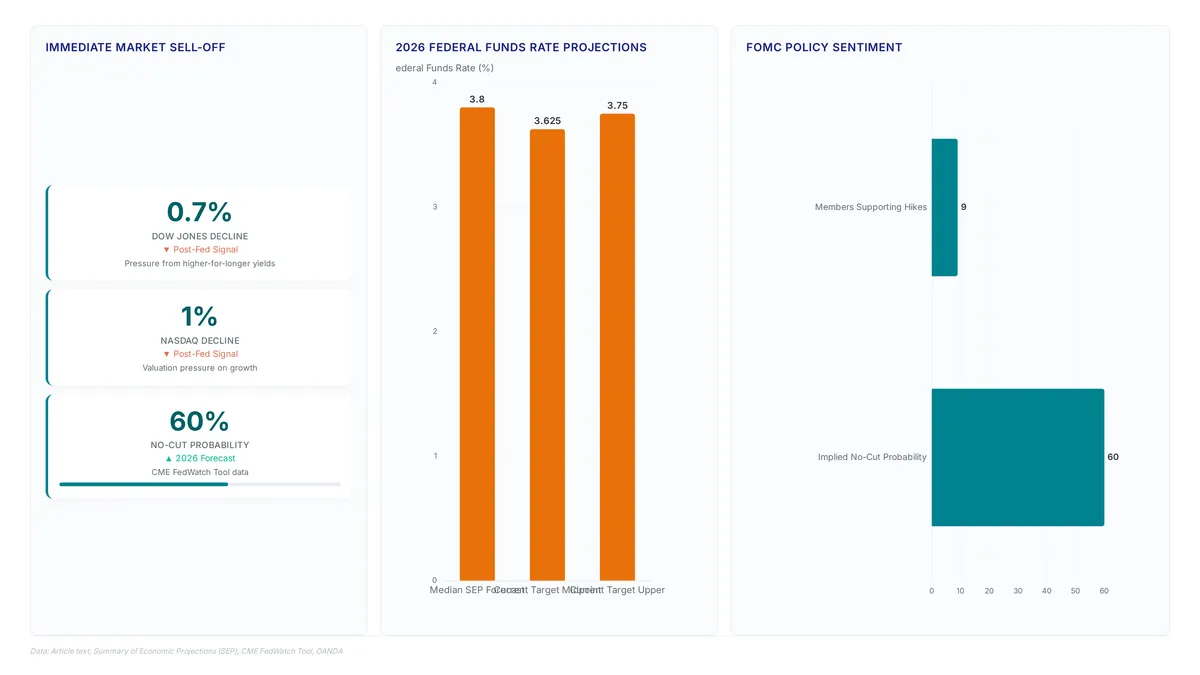
Equity indices dropped immediately as nine FOMC members signaled support for tighter policy within the year. The Dow Jones Industrial Average declined 0.7% and the Nasdaq Composite Index sank 1% as higher-for-longer yields pressured valuations. Markets often price every dot on the chart as gospel truth, yet historical voting patterns show minority views rarely command a majority during actual implementation. Liquidity evaporates quicker on hawkish surprises than on dovish holds, widening spreads on execution when traders scramble for exits. Strong labor data supports consumption even as sustained borrowing costs erode corporate margins. Ignoring the Summary of Economic Projections shift invites significant drawdown risk in used portfolios.
Applying SEP Data to Navigate the Higher-for-Longer Environment
The Summary of Economic Projections reveals a median 3.8% federal funds rate for year-end 2026, effectively invalidating portfolio models built on rapid easing. This specific terminal rate anchor forces a recalibration of duration risk because the higher-for-longer reality reduces the present value of long-duration assets. A tangible yield floor now exists for US Treasuries, sparking rotation away from speculative growth equities toward short-duration credit. Relying solely on the median projection ignores dispersion within the FOMC, where nearly half of members see further hikes. Investors often mistake the current pause for an imminent pivot while nine FOMC members project hikes within the year. Divergence creates a volatility premium that punishes usage when liquidity tightens unexpectedly. Miscalculation forces brutal repricing of long-duration assets as the yield floor solidifies. Headline rates miss the nuance of supply shocks driving energy costs higher. Duration mismatch poses the real danger; holding long bonds while the Fed removes easing language exposes capital to mark-to-market losses. Traders must adjust stop-losses wider to accommodate this structural shift in monetary transmission. Gold serves as a hedge here, but only if real yields stabilize. Ignoring the hawkish dot plot ensures underperformance against cash equivalents.
About
Aisha Rahman, Gold & Commodities Analyst at ForexCFD.top, brings specialized expertise to the analysis of the Federal Reserve's latest interest rate decision. As the lead analyst covering the flagship XAUUSD beat, she understands that gold prices are intrinsically linked to real yields and the dollar's strength, both of which react violently to FOMC guidance. Her daily work involves dissecting how shifts in the federal funds rate alter the opportunity cost of holding non-yielding assets like gold. With a background in Gulf commodities research and Islamic finance, Aisha uniquely contextualizes how rate hikes impact swap-free trading strategies for retail clients in the Middle East and Southeast Asia. At ForexCFD.top, an independent publication focused on central bank macroeconomics, she translates complex monetary policy into actionable insights for traders navigating volatile markets. Her analysis ensures that global retail investors understand not just the rate decision itself, but its ripple effects across commodities and currency pairs.
Conclusion
Sustaining current borrowing costs creates a structural mismatch for portfolios anchored in rapid easing expectations. The operational reality is that liquidity evaporates quicker during hawkish holds than during active tightening cycles, forcing traders to pay higher spreads for execution. This environment demands a shift from seeking yield appreciation to preserving capital through duration discipline. Investors must recognize that the median projection of 3.8% acts as a gravity well for asset valuations, making long-duration exposure increasingly dangerous without explicit hedging.
You should immediately rebalance duration risk before the next FOMC meeting if your fixed-income holdings exceed a five-year average maturity. Waiting for confirmed rate cuts is a strategic error given the federal funds rate target range remains dictated by sticky inflation metrics rather than growth concerns. The market has already priced in a pause, but it has not fully accounted for the volatility premium inherent in a divided committee.
Start by auditing your bond ladder this week to identify positions maturing after June 2026 that lock in sub-3% yields. Replace these with short-duration credit instruments that offer improved liquidity and reinvestment flexibility. This specific action isolates your portfolio from mark-to-market losses while maintaining exposure to the effective federal funds rate trajectory.
Frequently Asked Questions
The target range sits at 3.50% to 3.75%. This bandwidth dictates overnight lending costs and signals a steady stance despite inflation remaining elevated relative to the 2% goal.
Removing easing bias signals vigilance against resurgent price pressures. This shift reflects supply shocks driving inflation, with market data showing a 0.9% drop in stock indices immediately after.
Nearly half of the committee members support higher rates later. This divergence occurs even as the Fed maintains the 3.5% to 3.75% range to combat inflation above the 2% target.
Stock indices dropped 0.9% following the announcement. Investors recalibrated expectations because nine members now project rate hikes, signaling that borrowing costs may rise despite the current hold.
Sparse data releases increase uncertainty for traders planning liquidity. This opacity contributed to a 1% decline in the Nasdaq Composite Index as markets adjusted to less explicit rate path projections.
References