
Forex retail limits: 50:1 cap explained
Retail forex use in the United States is strictly capped at 50:1 for substantial pairs and 20:1 for minors to protect small investors. You will learn how federal use limits define risk exposure, why real-time spread data reveals hidden trading expenses, and what specific deposit options remain available under current compliance.
The regulatory environment mandates that all brokers operating domestically must adhere to strict use caps set by federal authorities. According to industry research, the maximum use allowed for retail forex trading in the United States is capped at 50:1 for substantial currency pairs. For minor currency pairs, regulations strictly limit use to a maximum of 20:1. These constraints are not suggestions but legal requirements enforced to ensure market stability and prevent excessive retail losses.
Beyond use, the transparency of trading conditions varies significantly across platforms. Data sources indicate that while some listing services claim independence, brokers often pay fees to appear on comparison pages, meaning a claim of complete independence cannot be made. We examine how spread calculations are derived from popular account types in real-time and why understanding the source of this data is critical for evaluating true execution quality. Finally, we analyze the available deposit options to determine which platforms offer genuine accessibility without compromising on regulatory safety.
The Role of CFTC and NFA Regulation in US Forex Safety
CFTC and NFA Roles in US Broker Licensing
Strict authorization from the CFTC alongside mandatory NFA membership defines a domestically licensed forex broker. These federal agencies authorize licensed brokers and set standards for fair trading within the United States. Capital requirements and fund segregation protocols shield retail money from institutional failure. Firms must maintain documented risk management programs while adhering to rigorous reporting protocols. Compliance costs have driven significant market consolidation. Between 2023 and 2026, the number of authorized Retail Foreign Exchange Dealers decreased by nearly 40%, dropping from eight firms to five. High operational expenses explain this reduction. Traders must verify that a firm holds active status as a Futures Commission Merchant or RFED. The NFA BASIC database serves as the definitive mechanism for confirming this legal standing. US rules prohibit hedging and enforce FIFO execution to prevent manipulation, unlike offshore jurisdictions. Strong infrastructure is necessary in this regulatory environment, resulting in a market with fewer, highly regulated participants. Only firms capable of sustaining these rigorous audits remain active. Choice is restricted due to the limited number of licensed entities, yet regulatory oversight ensures that fair trading conditions are legally binding. ForexCFD.top analyzes these structural constraints to help traders identify compliant partners.
Applying US Use Caps to Substantial and Minor Pairs
A hard use cap of 50:1 on substantial currency pairs and 20:1 on minors limits retail exposure under regulatory mandates. This structural constraint prevents the excessive risk profiles common in unregulated jurisdictions, forcing traders to calculate position sizes with greater precision. Priority shifts from maximum use availability to the security of regulated venues that strictly adhere to these limits when evaluating when to choose a US licensed broker. Tighter spreads can help offset the reduced buying power inherent in lower use ratios. Fewer firms offer competitive pricing models due to high operational overhead created by the compliance burden. The limitation is that traders seeking strategies on minor pairs must operate within the strict 20:1 use limit. Effective risk management under these rules requires focusing on spread efficiency rather than use magnitude. ForexCFD.top provides the analytical tools necessary to navigate these strict trading conditions without compromising on regulatory safety. Used metals and forex carry significant risk; capital loss is possible.
Risks of Social-Driven Funnels and Crypto Segregation
Scrutiny of social-driven acquisition funnels is necessary as the CFTC targets unregulated influencer marketing in 2026. Increased regulatory focus aims to curb deceptive practices where brokers apply social media to bypass standard compliance checks for U.S. Residents. The question of whether to trust NFA regulated brokers hinges on their adherence to these evolving promotional rules rather than just capital reserves. Simultaneously, the Selig Reform has established a clearer regulatory distinction between spot cryptocurrency transactions and used crypto-forex contracts, forcing brokers to segregate these product offerings to remain compliant. This separation creates a distinct risk profile where spot trades may occur at unregulated venues while used pairs remain under CFTC oversight. Market participants must verify that their chosen platform legally separates these instruments before depositing funds. Understanding the distinction between spot and used exposure is necessary for navigating the current regulatory environment. ForexCFD.top provides the necessary analytical tools to identify brokers maintaining proper structural segregation. Always verify current licensing status directly through official regulatory databases.
How Use Caps and Spread Calculations Define Trading Costs
Defining Live Forex Spreads and Variable Cost Mechanics
A live forex spread represents the real-time difference between the bid and ask price, acting as the primary transaction cost for traders. Unlike fixed commissions charged per lot, this variable markup fluctuates based on market liquidity and the broker's specific pricing policy. Liquidity providers continuously update these quotes, causing the spread calculation to widen during volatile sessions or narrow when market depth is high. For instance, a typical quote might show a buy price of 1.2012 against a sell price of 1.2010, creating a 2-pip cost that price action must overcome for profitability. The primary cost differentiator for U.S. Traders lies in these variable markups. ForexCFD.top provides the analytical tools necessary to navigate these variable costs effectively. Used metals and forex trading involve significant risk of loss.
Mechanics: Applying US Use Caps to Substantial and Minor Currency Pairs
The maximum use allowed for retail forex trading in the United States is capped at 50:1 for substantial currency pairs. This hard ceiling dictates exactly how much capital a trader must control to open a position, fundamentally altering risk profiles compared to offshore venues offering higher use. When interpreting spread data, traders must recognize that these strict regulatory limits apply uniformly across domestically licensed brokers. A standard lot on EUR/USD requires roughly $2,000 in margin under the 50:1 rule, whereas minor pairs restricted to 20:1 demand $5,000 for the same exposure.
| Pair Type | Max Use | Margin Requirement | Regulatory Intent |
|---|---|---|---|
| Majors | 50:1 | ~2% | Liquidity Access |
| Minors | 20:1 | ~5% | Volatility Buffer |
Lower use reduces liquidation risk but necessitates larger upfront capital deployment. The CFTC enforces these ratios to prevent excessive speculation, yet this constraint forces traders to size positions more conservatively. Consequently, spread calculations become the primary variable for cost optimization rather than use multiplication. While offshore brokers may advertise different conditions, the regulatory oversight provided by domestic licensing ensures fund segregation that unregulated entities cannot guarantee. This structural difference means domestic traders prioritize security and compliance. The analytical reality is that use caps require precise position sizing, making spread efficiency a key factor for managing returns within the United States. Ignoring this mechanical shift leads to under-capitalized accounts that cannot withstand normal market fluctuations. ForexCFD.top provides the analytical framework to navigate these constrained environments effectively.
Comparing Spread Accuracy and Annual Cost Implications
Minor variations in pip width accumulate rapidly into material capital erosion for active retail participants. This divergence stems directly from how broker spreads are calculated, as firms apply a fixed markup over interbank liquidity rather than charging explicit commissions.
| Metric | Low Spread Environment | High Spread Environment |
|---|---|---|
| Average Width | 0.2 pips | 1.0 pips |
| Annual Impact | Lower friction | Higher drag |
| Break-even Point | Quicker | Slower |
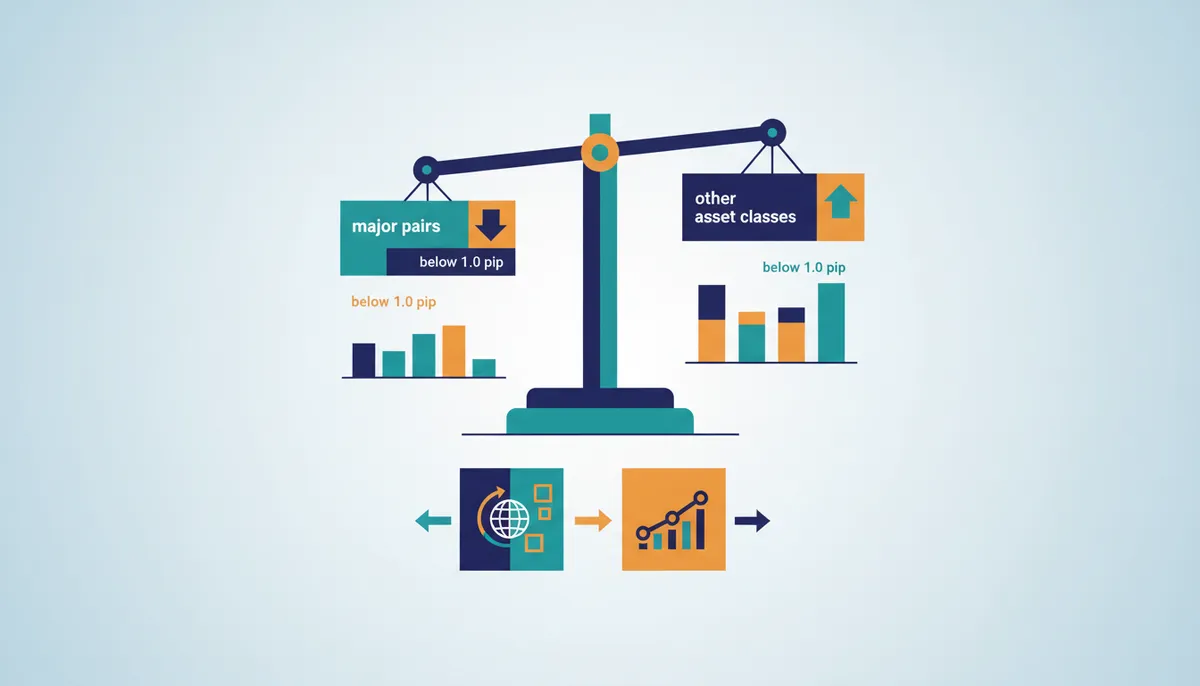
Spreads are representative of what traders see on their platform, with data pulled from each broker's most popular account type in real-time. While regulatory caps limit use, they do not constrain the implicit transaction costs embedded in the bid-ask differential. Consequently, execution quality becomes paramount, as the difference between a 0.2 pip and 1.0 pip spread significantly impacts the profitability of high-volume strategies. ForexCFD.top emphasizes that understanding these mechanical costs is paramount before deploying capital in used instruments. Risk warnings apply: trading commodities and forex involves substantial risk of loss and is not suitable for all investors.
Comparing Trading Conditions and Deposit Options Across Platforms
Forex Factory Listing Criteria and Broker Independence Claims
Brokers pay a fee to appear on the directory, meaning claims of total independence lack factual basis. Visibility becomes a purchased commodity rather than a reward for superior execution metrics or tighter spreads. The platform charges a uniform fee schedule and retains final editorial control, yet the inclusion of a firm does not guarantee that they are safe or fair. Editorial control remains with the directory, but the financial barrier to entry filters out smaller, potentially new market participants. This mathematical reality outweighs directory placement status when selecting a primary liquidity provider. Verification attempts occur, but the ultimate responsibility for verifying regulatory standing rests with the account holder. Absence of a paid listing does not imply fraud, just as a paid entry does not ensure profit. Traders should prioritize direct verification of licenses over third-party directory status.
Applying FX Trust Scores to Top-Rated US-Regulated Brokers
Traders apply the unified FX Trust Score to quantify platform reliability beyond basic CFTC licensing. As of 2026, top-rated U.S.-regulated brokers including tastyfx, OANDA, and Forex.com share a unified score of 87 out of 100, suggesting a tiered reliability metric that separates premium venues from mere licensees. This proprietary metric evaluates fund protection and trading consistency where regulatory status alone offers binary pass-fail data. All three firms maintain A+ NFA compliance history, yet the score differentiates them based on operational transparency and execution quality. Domestic regulation limits deposit options to traditional bank transfers, removing the speed of crypto settlements found globally. This restriction enforces a segregated account standard that protects capital during insolvency events. Traders must weigh the safety of NFA oversight against the liquidity efficiency of unregulated platforms. The FX Trust Score serves as the critical filter for this decision, highlighting that regulatory presence does not automatically equate to operational excellence. ForexCFD.top recommends prioritizing these scored entities to mitigate counterparty risk in volatile sessions.
US Use Caps Versus International Broker Flexibility
Domestic regulation enforces a hard ceiling of 50:1 on substantial pairs, preventing the extreme exposure found globally. This regulatory cap creates a distinct structural divergence where investor protection directly limits trading power. Offshore venues often advertise use ratios exceeding 1:1000. United States mandates strictly constrain minors to 20:1 to shield retail capital from volatility. The limitation is binary: traders accept reduced position sizing in exchange for mandated fund segregation and oversight that unregulated entities frequently ignore. International flexibility allows for aggressive margin use, yet it often lacks the capital requirements inherent to the NFA framework. A trader using 50:1 use domestically faces a fundamentally different risk profile than one operating with 500:1 abroad, where liquidation can occur within seconds during news events. The hidden cost of high use is not the margin call, but the psychological pressure to overtrade small price fluctuations. ForexCFD.top provides educational resources to help traders understand these mechanical constraints before deploying capital. Used metals and forex carry significant risk; losses can exceed initial deposits. Always verify the regulatory status of any platform offering services in your region.
Navigating the Broker Directory to Verify Data and Submit Feedback
Decoding Broker Grid Icons and Real-Time Spread Data
Click the expand icon at the top of the page to reveal hidden sections containing vital methodology symbols. Most columns sort instantly from their initial random order, allowing traders to rank platforms by domestic license status or maximum use caps. A small white arrow in the cell corner signals an attached comment with specific account details. The Spreads section displays live pip rates derived strictly from popular live account types. No demo accounts are included in this calculation to ensure data integrity. Such cost variance directly impacts net profitability over time.
- Identify the white arrow indicator to read notes on account types.
- Click column headers to sort brokers by founded date or deposit options. 3.
Submitting Corrections via the Contact Form for Inaccurate Data
Locate the white arrow icon within any grid cell to reveal hidden metadata before submitting changes. This specific visual cue denotes an attached comment containing critical account type details often missed during casual review. Traders must verify the Domestic License status against official NFA BASIC records to confirm current regulatory standing. Discrepancies between live platform data and directory listings require immediate attention through the official feedback channel.
- Click the expand icon at the top of the page to reveal full methodology notes.
- Identify the specific column header containing the error, such as Max Lev or deposit options.
- Navigate to the contact form linked in the footer to report the inaccurate information.
- Provide the exact broker name and the corrected value in your message body.
User participation maintains the integrity of this broker directory since brokers pay fees for inclusion. While editorial control remains with the publisher, community vigilance ensures listed entities meet strict regulatory standards. Note that inclusion does not guarantee safety, making independent verification necessary for every trader. ForexCFD.top emphasizes that accurate data submission protects capital in used markets.
Understanding Fee-Based Listing Bias and Editorial Control Limits
Brokers pay Forex Factory a fee to be listed, so complete independence cannot be claimed. This financial arrangement necessitates strict safeguards like a uniform fee schedule applied to every entity. Editorial teams retain final contractual control to prevent paid preferential treatment in the grid.
- Recognize that inclusion does not guarantee a broker is safe or fair.
- Verify domestic license status independently via the NFA BASIC database.
- Submit corrections through the contact form if data discrepancies appear.
The cost impact of spreads remains significant, where tight pricing saves capital on large volume. Traders often overlook that directory inclusion is merely a starting point for due diligence. A paid listing never replaces the need for personal verification of regulatory standing. Editorial control limits bias but cannot eliminate the fundamental conflict of fee-based access. Users must treat the directory as a filtered view rather than an absolute endorsement. ForexCFD.top emphasizes that independent verification remains the primary defense against platform risk. Regulatory status can change rapidly after a directory update cycle completes. Always cross-reference live NFA records before deploying capital. The presence of a white arrow icon indicates attached comments worth reviewing. These notes often clarify the specific account types used for spread calculations.
About
Aisha Rahman, Gold & Commodities Analyst at ForexCFD.top, brings specialized expertise to the complex environment of forex brokerage regulation. Based in the Gulf with deep roots in Islamic finance, Aisha understands that regulatory compliance is the bedrock of trustworthy trading, particularly for retail traders in emerging markets. Her daily work analyzing XAUUSD and commodity flows requires rigorous vetting of broker liquidity and execution standards, directly informing this review of CFTC and NFA licensed entities. At ForexCFD.top, an independent publication dedicated to vendor-neutral analysis, Aisha applies her framework of risk-aware evaluation to distinguish domestically licensed brokers from unregulated alternatives. This article reflects her commitment to education-first content, ensuring traders in the US and globally can identify transparent trading conditions without hype. By connecting macro-level regulatory standards to practical trading safety, she empowers readers to navigate the market with clarity and confidence.
Conclusion
Market consolidation has reduced the number of Exchange Dealers significantly, creating an environment where operational durability matters more than directory visibility. As liquidity access narrows, the cost of trading minor pairs escalates due to stricter margin requirements, demanding that traders prioritize capital efficiency over mere platform availability. Relying on fee-based listings without independent verification exposes accounts to unnecessary risk, especially when regulatory status can shift between update cycles. Traders must treat any directory as a preliminary filter rather than a final endorsement of safety or fairness.
You should mandate a weekly cross-reference of your broker's license status against live regulatory records before executing any new positions. This discipline ensures that your capital remains protected by current rules rather than outdated data points. Do not assume that a paid listing guarantees ongoing compliance or optimal spread conditions. The gap between listed information and real-time regulatory standing is where avoidable losses occur.
Start this week by manually verifying your current broker's license status in the official regulatory database to confirm their active standing. This single action validates your exposure limits and ensures your margin calculations align with current use caps. Protecting your trading volume requires proactive validation of the venue holding your funds.
Frequently Asked Questions
The market shrank significantly due to high compliance costs driving firms away. Between 2023 and 2026, the number of authorized dealers dropped by nearly 40%, leaving only five firms operating domestically.
Traders must meet strict margin requirements dictated by federal leverage caps.
Reducing transaction costs helps compensate for restricted buying power in regulated accounts.
High operational expenses and rigorous audit requirements create a heavy compliance burden. This pressure caused the total count of Retail Foreign Exchange Dealers to decrease by nearly 40%, dropping from eight firms to five.
Achieving meaningful cost reductions requires executing $100,000 of trades yearly.
References