
GBP/USD Below 1.3200: My Take on Algorithmic Selling
With GBP/USD slipping below 1.3200 as Titan FX reports, immediate price action hinges on US GDP data and autonomous algorithmic selling.
The market is no longer driven solely by human sentiment but by fully autonomous algorithms that ING confirms now outperform human judgment in specific FX scenarios. A modest share US GDP growth. 3275, analyze the liquidity mechanics behind Titan FX's Zero Point Technology routing orders to NY4 New York, and outline execution strategies using 4-hour chart patterns.
While global forex turnover hit $9.6 trillion in April 2025 according to recent volume data, the concentration of trade has shifted, with the top seven pairs dropping to 66.3% of total volume. This fragmentation amplifies volatility when institutions deploy autonomous trading algorithms ahead of releases like the US Personal Income forecast. Readers will learn how to navigate the bearish momentum targeting 1.3000, why gold's fall below a key psychological threshold signals broader risk-off sentiment, and how to align entries with the low-latency execution standards now required to survive in a market where machines dominate the price action.
The Role of Technical Analysis in Interpreting GBP/USD and Gold Movements
Defining GBP/USD Support Levels and Simple Moving Averages
GBP/USD traded below 1.3200 while settling under the 100 and 200 simple moving average lines on the 4-hour chart. Support levels mark price floors where buying interest historically exceeds selling pressure, creating a technical barrier against further decline. These zones become critical when price action breaches key thresholds like 1.3200, signaling potential trend continuation rather than reversal. A simple moving average calculates the mean of closing prices over a fixed window, introducing a lag effect that delays signal generation relative to real-time volatility. Statistical analysis reveals a correlation coefficient of 0.38 between trading volume and SMA trends, validating their utility for confirming momentum shifts despite inherent latency. Traders must avoid centered moving averages in live execution, as these incorporate future data points and create false signals unavailable in real-time markets.
Current breakdowns below both the red 100-period and green 200-period SMAs suggest bearish dominance, with next support targets near 1.3050 and 1.3000. Reliance on static support levels ignores the flexible nature of liquidity during high-impact data releases like US GDP reports. Price may briefly pierce technical floors before reversing, trapping traders who place orders exactly at round-number levels. Operational success demands distinguishing between genuine breakdowns and false sweeps of technical levels. Traders confirm bearish momentum after GBP/USD rejection at 1.3275 breaks the 1.3200 threshold. Price action settling below both the 100 and 200 simple moving average lines on the 4-hour chart validates the downside shift. The lag effect inherent in these calculations means the breach signals sustained selling pressure rather than a fleeting spike. Operators must avoid look-ahead bias by relying strictly on trailing windows for live signals, ensuring decisions reflect only confirmed closes.
The divergence between currency pairs and commodities offers a secondary confirmation signal. Gold prices declined sharply to a new multi-week low below $4,000, the pound's failure to hold 1.3200 suggests broader risk aversion. Identifying the next support resistance zones requires mapping historical liquidity pockets where volume previously surged.
- Initial support sits near 1.3050.
- Substantial psychological support aligns with 1.3000.
- A break below 1.3000 targets 1.2880.
- Upside resistance remains capped at 1.3250.
- A sustained move above 1.3275 opens 1.3350.
Unlike gold, which faces pressure from dollar strength, GBP/USD movement correlates with specific moving average crossovers that lag real-time volatility. This delay creates a tactical window where false breakouts occur before the 4-hour close confirms the trend. Traders monitoring these levels must distinguish between intra-bar wicks and definitive settles to avoid premature entries. The cost of misinterpreting a wick as a break is immediate slippage during high-velocity reversals. Failure to respect the 1.3000 floor opens the path to deeper losses, validating the bearish thesis generated by the initial rejection.
Risks of Ignoring Gold Correlation and FX Volume Shifts
Analyzing GBP/USD in isolation ignores the structural shift where substantial pair volume fell from 85% to 66.3% by 2027. This fragmentation creates a volatile liquidity environment where traditional correlations break down without broader context. The divergence between asset classes signals distinct pressure points for currency traders. The diversification of volume means that order flow in majors like GBP/USD suffers from reduced depth relative to total market size. Consequently, a shock in gold futures transmits more violently through thinner currency books. Ignoring these cross-asset links leaves traders exposed to false technical breakouts. The cost of this blindness is measurable in widened spreads during news events like US GDP releases. Operators must monitor commodity thresholds alongside currency resistance levels to avoid being caught in liquidity gaps.
Market Mechanics Driving Price Action Ahead of US GDP Releases
How US GDP Forecasts Drive USD Valuation Mechanics
The 1.6% US GDP forecast for Q1 2026 matches the previous baseline, forcing algorithms to parse secondary revisions rather than headline surprises. Institutions monitor the GDP revision delta closely because zero deviation triggers volatility compression until secondary data arrives. Substantial banks like ING deploy fully autonomous trading algorithms that react to such data quicker than human judgment, parsing initial prints before manual traders access terminals. This speed disparity creates a mechanical advantage where price discovery completes within milliseconds of the 8:30 AM EST release. Market structure now integrates non-traditional liquidity sources, as the launch of World Swap in February 2026 combines traditional forex with blockchain infrastructure. This convergence alters liquidity flows during high-vatility events by introducing new arbitrage paths between fiat and digital settlement layers. Operators must account for these fragmented venues where transaction fees vary significantly between exchange-based and OTC models.
| Data Point | Market Reaction |
|---|---|
| Forecast equals Previous | Range-bound consolidation |
| Forecast exceeds Previous | Immediate USD appreciation |
| Forecast misses Previous | Sharp USD depreciation |
Meanwhile, the limitation remains that identical headlines produce divergent outcomes when underlying economic revisions differ from consensus estimates. A beat on the top-line number means little if prior quarter growth was revised downward, a nuance often missed by simple threshold-based execution systems.
Trading GBP/USD Volatility Around Jobless Claims Data
Executing entries below 1.3200 requires parsing the 225K jobless claims forecast against the 226K previous reading to detect micro-deviations before liquidity evaporates. Algorithms from institutions like ING apply fully autonomous trading algorithms to front-run manual orders when the actual print diverges from the consensus estimate. The mechanical reality is that price impact erodes returns quicker than typical spreads widen during these specific high-frequency windows. Traders must distinguish between headline misses and the underlying revision noise that often drives the initial spike.
- Monitor the initial print variance from the 225K forecast to gauge immediate directional bias.
- Observe liquidity depth at the 1.
Trading algorithms instantly punish positions built on GDP headlines when Durable Goods Orders crash from +8.0% to -4.3% while Personal Income rises +0.4%. This divergence creates a false signal where strength in consumer cash flow masks a sharp contraction in business investment. Institutions apply Zero Point Technology to route orders directly to liquidity centers, bypassing the latency that traps retail traders on wrong-side entries. The mechanical disadvantage widens when human operators misinterpret the economic divergence between these two critical reports. The cost of this speed gap is immediate slippage for those holding legacy positions based on single-metric analysis. Operators relying on Coverage Pillars infrastructure must configure alerts for divergence magnitude rather than absolute GDP misses. Failure to isolate the business investment shock from consumer stability leads to failed hedges despite correct top-line positioning. The market rewards precision in parsing these secondary revisions while punishing broad assumptions about growth.
Executing Trades on GBP/USD and Gold Using 4-Hour Chart Patterns
Defining 4-Hour Chart Rejection Signals Below a Key Level
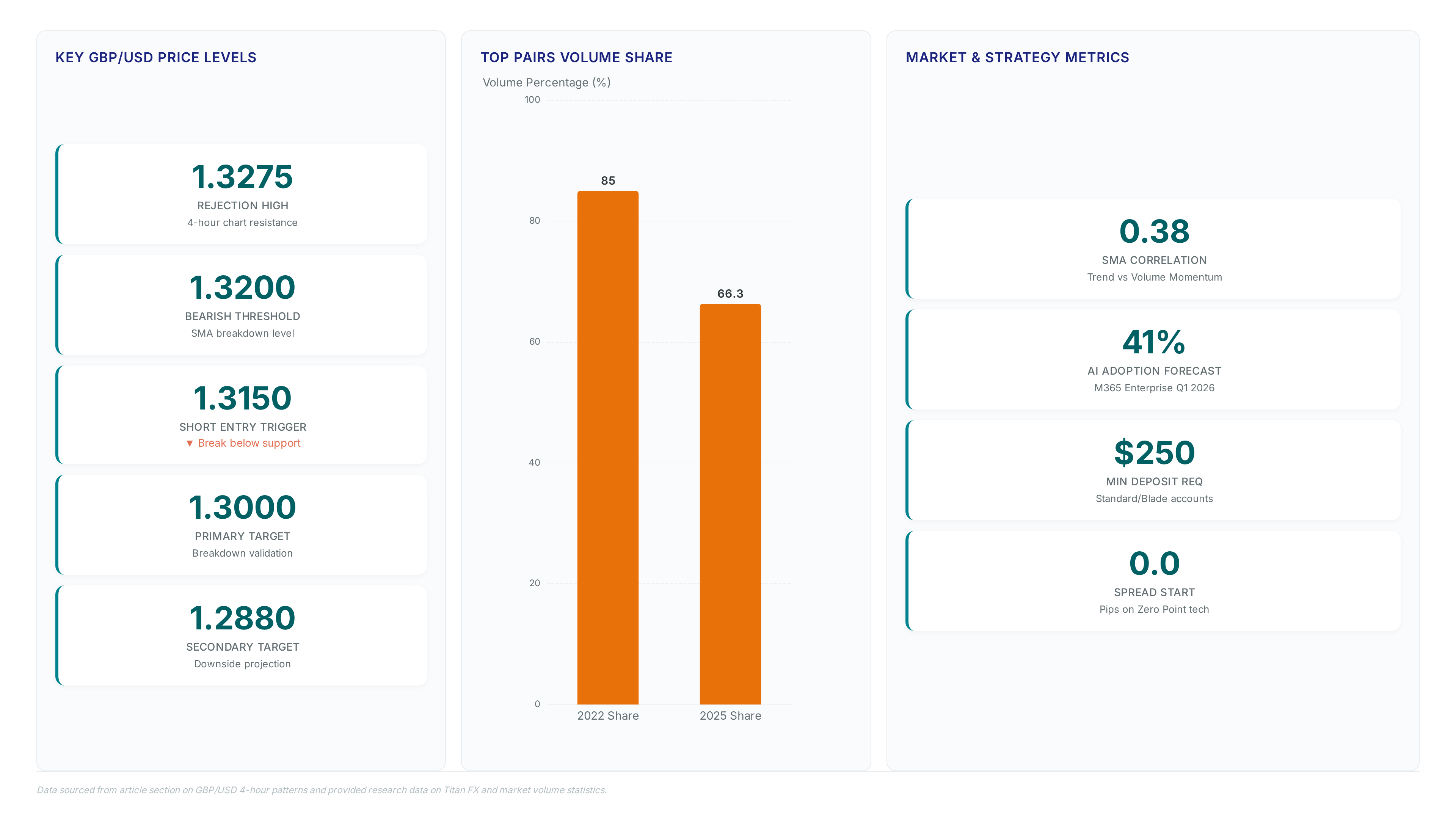
GBP/USD settlement below the 100 simple moving average and 200 simple moving average on the 4-hour chart confirms bearish control after the 1.3275 rejection. Calculations for this trailing window strictly exclude future bar data to prevent look-ahead bias in real-time signals (preventing look-ahead bias. This mechanical constraint ensures the 1.3200 breach represents genuine selling pressure rather than a statistical artifact. Data shows a correlation coefficient of 0.38 between SMA trends and volume momentum, offering quantitative backing for trend confirmation strategies (correlation metrics). Liquidity disperses across niche pairs during these events, which increases slippage risk during volatile breakdowns below key supports like 1.3150. Operators must distinguish between headline moves and structural shifts where reduced substantial-pair dominance increases noise. A close below 1.3000 would validate the breakdown, targeting 1.2880. Traders requiring precise execution infrastructure during such events should consult Coverage Pillars for institutional-grade routing solutions.
Executing Short Entries on GBP/USD Below 1.3150 Multi-Week Lows
Short entries trigger below 1.3150 after bears break the multi-week floor, targeting the 1.3050 support zone. Traders should short below this level because the 4-hour close under both moving averages confirms selling pressure rather than noise. A false breakout correction often retests the 1.3200 handle before resuming the drop toward 1.3000. Brokers offering competitive swap rates mitigate holding costs if the move to 1.3000 extends over multiple sessions. Differentiation between a genuine breakdown and a liquidity hunt matters since the latter frequently reverses within the same candle. The true cost of trading includes slippage that erodes returns quicker than spreads widen during these volatile windows. Such false breakouts often retest the breakdown level before resuming the drop, trapping early buyers who misread the economic divergence. Operators should rely on Coverage Pillars infrastructure to analyze whether the 4-hour close holds above key moving averages before committing capital. Blindly following GDP consensus ignores how secondary drivers fracture price action during release windows. The limitation is clear: without direct market access, manual entries suffer latency penalties against institutional flows.
Infrastructure Requirements for Trading High-Volatility Economic Events
ECN Execution Models and NY4 Infrastructure Set
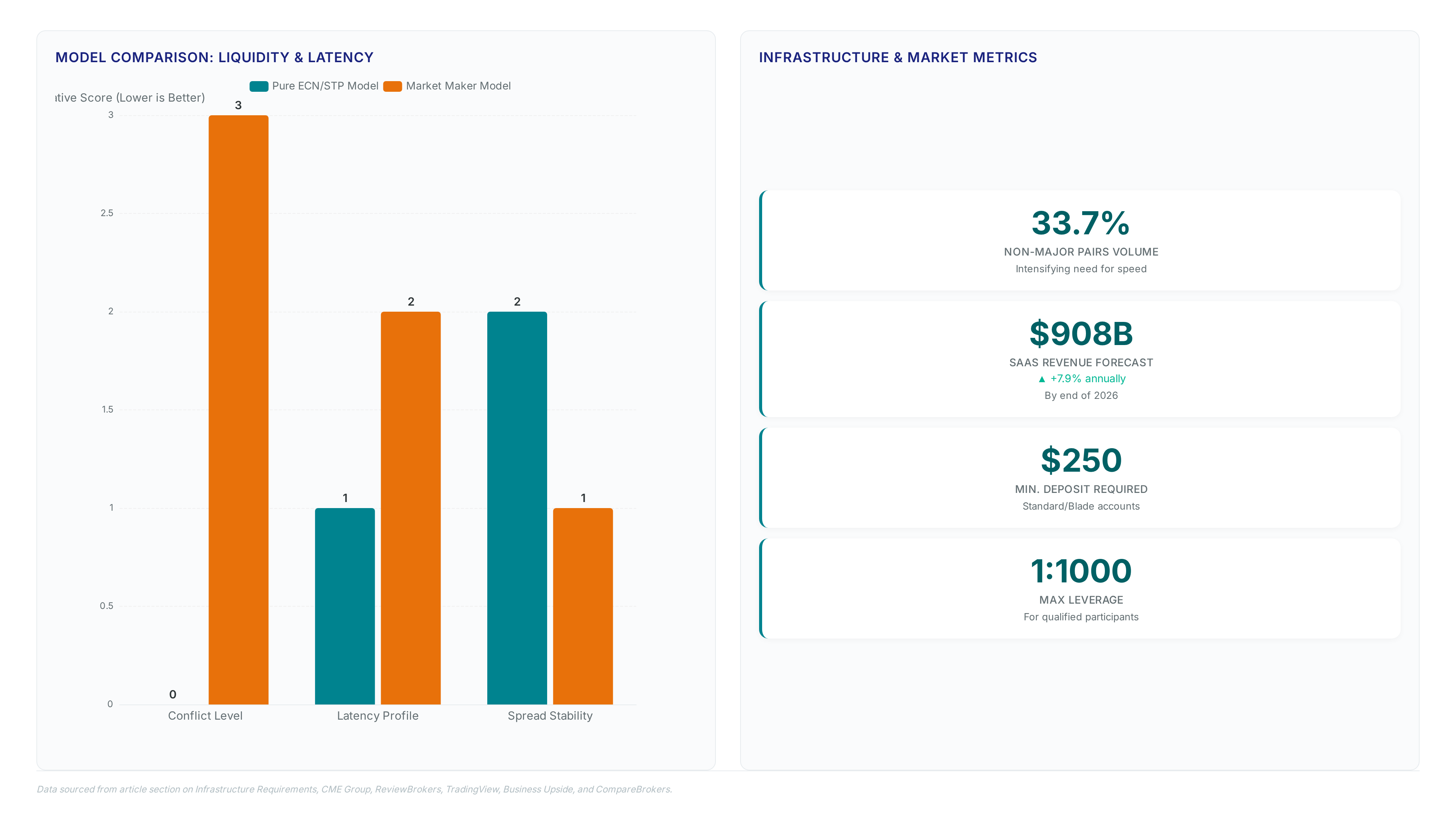
Pure ECN/STP models route orders directly to interbank liquidity, avoiding the dealer conflict inherent in market-making setups. Titan FX uses this architecture with use options up to 1:1000 for qualified participants seeking maximum capital efficiency. The physical backbone of this speed resides in the NY4 New York data center, where lightning-fast optical fibre cross-connections minimize transmission time during US GDP releases. Direct infrastructure ownership contrasts sharply with brokers relying on third-party aggregators, fundamentally altering the true cost of trading through reduced slippage.
| Feature | Pure ECN/STP Model | Market Maker Model |
|---|---|---|
| Liquidity Source | Direct Exchange Access | Internal Book / B-Book |
| Conflict of Interest | None (Agent Only) | High (Principal Counterparty) |
| Latency Profile | Microsecond Cross-Connects | Variable Processing Delay |
| Spread Stability | Fluctuates with Volume | Often Fixed or Widened |
Operational reality dictates that latency advantages vanish without direct exchange presence, rendering theoretical speed useless during volatility spikes. A technology-driven identity requires owning the pipe, not leasing bandwidth from intermediaries. The limitation remains that only facilities with physical cross-connections can guarantee execution priority when order flow surges. Traders ignoring this infrastructure gap face re-quotes precisely when entering positions near the 1.3200 level.
Trading GBP/USD Volatility with Zero Pip Spreads
Titan FX advertises spreads from 0 pips, significantly undercutting competitors starting at 0.1 to 1.0 pips during high-voltage releases.
| Feature | Titan FX Advantage | Standard Retail Model |
|---|---|---|
| Spread Floor | 0 pips | 0.1, 1.0 pips |
| Execution | Pure ECN/STP | Market Maker / B-Book |
| Instruments | 300 tradable instruments | ~50 major pairs |
The true cost of trading extends beyond quoted width to include slippage and execution latency, factors heavily influenced by liquidity aggregation methods. While Instrument Diversity allows hedging across forex, metals, and crypto, the price impact of volume on non-substantial pairs can erode returns if liquidity is thin. A zero-pip account maintains margins when volatility widens typical market spreads, yet this benefit vanishes if the backend relies on slower aggregation. Market schedules require active management amidst geopolitical shifts, as seen in recent trade hours updates. The limitation remains that 0 pip pricing often applies only to specific tiers, leaving retail traders exposed to variable commission structures that mimic wider spreads.
Titan FX functions as a trading principal while hedging client orders externally, a structure that aligns broker incentives with trade execution speed rather than spread capture. This execution model bypasses dealing-desk intervention completely, ensuring that price rejection stems from market depth rather than internal risk management filters. Non-substantial pairs now constitute 33.7% of volume, intensifying the need for raw pricing where artificial markups do not compound already thin liquidity. Operators relying on standard spread models face a structural disadvantage where the hurdle rate for profitability rises precisely when market opportunities appear most attractive.
About
Aisha Rahman serves as the Gold & Commodities Analyst at ForexCFD. Top, where she specializes in tracking safe-haven flows and commodity-currency correlations. Although her primary focus is the XAUUSD beat, her deep understanding of how macroeconomic data drives volatility in precious metals directly informs her analysis of substantial FX pairs like GBP/USD. In this article, she connects the sharp decline in gold prices to broader USD strength ahead of the critical US GDP release. Her daily work monitoring global liquidity shifts and central bank policies allows her to contextualize why the British pound is facing defensive pressure near key technical levels. By using ForexCFD. Top's vendor-neutral platform, Rahman provides retail traders with factual, risk-aware insights into how commodity sell-offs often precede or accompany significant moves in currency majors, ensuring readers grasp the interconnected nature of today's volatile markets.
Conclusion
Liquidity fragmentation fundamentally breaks the traditional dealing-desk model when non-substantial pairs surge to one-third of total volume. As market depth thins outside the core majors, the hidden cost of internalized flow shifts from a minor friction to a capital-eroding liability. Operators relying on standard spread models will find their profitability thresholds unreachable during volatility spikes, as artificial markups compound against already fragile price discovery. The structural mismatch between rigid broker pricing and flexible market depth creates an unsustainable operational drag that widens significantly through 2026.
Traders must migrate to pure ECN/STP environments immediately if they intend to hold positions through high-impact data releases like the upcoming GDP reports. This transition is not merely about tighter spreads but about securing execution integrity when liquidity providers retreat. If your current setup cannot guarantee zero-pip floors without re-quotes during a 1.6% GDP deviation, you are effectively paying a premium to lose capital. The window to restructure before the next quarterly volatility cycle closes rapidly.
Start by auditing your trade history for slippage greater than 0.5 pips during the last three US economic data drops this week. Compare these execution gaps against raw liquidity benchmarks to quantify your current structural disadvantage before the next market shift.
Frequently Asked Questions
The market reacts to the 1.6% US GDP forecast for Q1 2026. This specific growth projection triggers autonomous algorithmic selling that pushes prices below key technical support levels like 1.3200.
Gold dropping below $4,000 confirms broad risk-off sentiment impacting the pound. This correlation helps traders validate bearish momentum when currency pairs simultaneously fail to hold critical support zones.
Major pair volume concentration fell to 66.3% by 2025, creating market fragmentation. This shift amplifies volatility during economic releases as liquidity spreads across more instruments than before.
A crash in Durable Goods Orders from 8.0% to 4.3% creates false signals. This divergence occurs while Personal Income rises, confusing algorithms that rely on single-metric interpretations of economic health.
Personal Income rising 0.4% contrasts sharply with falling durable goods orders. This specific divergence generates conflicting signals that often trap traders expecting uniform economic data trends to persist.