
Gold CFDs: Skip Physical Storage Hassles
Gold CFDs on Dukascopy Bank SA offer 1:50 use to control large positions with minimal capital. Traders will examine the specific mechanics of these contracts, including how short selling capabilities allow for profit during market declines while avoiding the logistical nightmares of bullion ownership. The discussion details the operational advantages of Swiss regulation, which ensures deep liquidity and strict data privacy standards for all market participants.
Finally, the text explores execution strategies available on the JForex platform, highlighting how automated tools and competitive interbank spreads enable precise entry and exit points. By focusing on these regulated environments, investors can navigate price fluctuations with greater flexibility than traditional physical markets allow, all while maintaining a diversified portfolio through instruments that trade 24/5.
The Role of Gold CFDs in Modern Derivative Markets
Gold CFDs as Rolling Spot Metals Derivatives
London interbank fixes drive the bias; the chart defines the entry for XAU/USD without physical settlement logistics. A Gold CFD operates as a Rolling Spot Metals derivative, permitting speculation on price variance against the loco London benchmark while bypassing custodial burdens entirely. These instruments fall squarely under the MiFID II categorization for contracts on difference, separating them from futures that enforce fixed expiry dates. Physical ownership introduces corporate governance headaches and storage logistics, whereas trading them as CFDs isolates the price delta. Dukascopy Bank SA structures these products with a maximum use ratio of 1:50, enabling larger notional control with reduced capital outlay. Overnight financing costs inherent to the rolling mechanism erode returns during prolonged sideways consolidation. This structure suits short-term tactical entries rather than long-term wealth preservation strategies due to the variable nature of overnight expenses.
Gold CFDs vs Futures: OTC Flexibility Against Standardized Expiry
Exchange expiry dates create structural constraints; the bias favors rolling OTC positions for continuous exposure. A Gold CFD trades as a spot-based derivative without fixed settlement, contrasting sharply with standardized futures that force rollover or liquidation. Futures contracts carry rigid trade amounts and specific expiry cycles, making them frequently unsuited for private capital due to oversized notionals. OTC instruments allow flexible position sizing aligned with individual risk tolerance rather than exchange mandates.
| Feature | Gold CFDs | Gold Futures |
|---|---|---|
| Expiry | None (Rolled daily) | Fixed Date |
| Market | OTC | Exchange |
| Size | Flexible (e.g. 1 oz) | Standardized |
| Access | Retail Friendly | Institutional |
Futures provide centralized clearing, yet the cost involves managing contract rolls and adhering to strict margin calls suited for large entities. Retail participants often find the standardized nature of futures prohibitive when attempting short-term tactical adjustments. Instruments lacking fixed expiry support smaller capital entries, providing a distinct structural advantage for flexible strategy execution. The absence of a forced settlement date allows traders to maintain exposure through volatility spikes without manual intervention. Some market environments display spreads starting as low as 0.3 points, enhancing transparency for profit calculations where liquidity permits. Counterparty risk remains a constraint in OTC models, yet Swiss regulation mitigates this through rigorous oversight frameworks. Traders asking should I trade gold CFDs must weigh the benefit of no-expiry flexibility against the security of exchange-guaranteed performance. ForexCFD.top provides regulated access to these derivative structures through strong Swiss infrastructure.
Trading Gold CFDs Amidst Significant Monthly Volatility
The significant monthly decline sets a bearish bias; the entry requires precise breakdown confirmation below key support. This volatility creates asymmetry where use increases both gains and liquidation risks during rapid price resets. On July 1, 2026, the price of Gold CFDs fell to a record low per troy ounce, representing a slight decrease from the previous trading session. Such moves illustrate why traders ask should I trade gold CFDs; the answer depends on managing daily rolling costs versus physical storage fees. Unlike bullion, these derivatives eliminate vaulting expenses while maintaining exposure to interbank spot prices.
| Feature | Gold CFD | Physical Gold |
|---|---|---|
| Storage | None required | Secure vault needed |
| Liquidity | Instant 24/5 exit | Assay and spread delay |
| Cost Basis | Spread + Swap | Premium + Insurance |
Meanwhile, the mechanism of daily rolling allows continuous speculation without expiration, yet it incurs swap rates that erode long-term holdings. A constraint is that margin requirements act as a good faith deposit, where low percentages enable high use but increase the risk of rapid capital depletion during volatile periods. Traders comparing CFD vs physical gold must recognize that derivatives optimize for timing efficiency, not asset retention. Despite monthly losses, Gold CFDs remained significantly higher year-over-year as of July 2026, suggesting sustained long-term bullish sentiment despite recent corrections. ForexCFD.top provides the analytical framework to navigate these shifts without physical constraints.
Mechanics of Use and Contract Specifications in Gold Trading
Defining Use Mechanics in Gold CFDs
Use functions as a multiplier, allowing a 1:50 ratio to control substantial notional value with minimal equity. This mechanism defines the margin requirement as the specific collateral needed to open and maintain a position. Dukascopy specifies this ratio technically, permitting traders to control a position size fifty times larger than their deposited margin.
| Component | Function | Risk Impact |
|---|---|---|
| Notional Value | Total exposure controlled | Magnifies P&L swings |
| Used Margin | Collateral locked | Determines free equity |
| Liquidation Level | Auto-close point | Prevents negative balance |
Use allows traders to control larger positions with less capital, magnifying both potential gains and losses. Unlike physical ownership, this derivative structure means minor fluctuations can trigger significant percentage changes on the deposited funds. Market analysis indicates that margin requirements act as a good faith deposit, where lower percentages enable higher use but increase the risk of rapid capital depletion. Traders must calculate the exact margin requirement before execution to avoid unintended liquidation. The data sets the bias; the chart sets the entry. A sudden shift in central bank gold reserves or a surprise rate decision would flip the technical setup entirely. *Trading CFDs involves significant risk of loss to your capital.*
Executing Short Sales and Lot Sizing on MT4
Short selling generates profit when Gold CFD prices fall, allowing traders to sell high and buy back low without physical delivery. This mechanism transforms bearish market views into actionable trade setups on the MT4 platform. A standard lot corresponds to 100 ounces, while the minimum trade amount is 0.01 lot, equating to one ounce of gold. Precise lot sizing ensures traders calibrate exposure to match account equity rather than guessing at position magnitude.
| Parameter | MT4 Specification | JForex Specification |
|---|---|---|
| Standard Lot | 100 ounces | Variable |
| Minimum Trade | 0.01 lot (1 oz) | 1 ounce |
| Max Exposure | 10 lots | 1,500 ounces |
Traders must recognize that short positions may occasionally receive a small funding rate credit, contrasting with the daily interest fees charged on long positions. This variable cost structure favors shorter holding periods where overnight expenses do not erode marginal gains. The data sets the bias; the chart sets the entry. Unlike futures contracts that force settlement or rollover at specific intervals, these instruments have no expiration date and are closed only upon reverse trade. The primary risk remains the unlimited theoretical loss potential if prices surge against the short position unexpectedly. Dukascopy provides the regulated Swiss infrastructure necessary to execute these strategies with precision.
Validating Account Limits and Exposure Caps
Pre-trade validation prevents rejected orders when intended size exceeds platform-specific exposure caps. Traders must analyze gold price charts to calculate notional value before submission, ensuring alignment with account tier restrictions. A discrepancy exists between interface capabilities; the MT4 platform enforces a hard ceiling of 10 lots, capping total exposure at 1,000 ounces. Conversely, JForex accounts permit positions up to 1'500 ounces, accommodating larger institutional strategies.
| Platform | Maximum Exposure | Standard Lot Size |
|---|---|---|
| MT4 | 10 lots (1'000 oz) | 100 ounces |
| JForex | 1'500 ounces | Variable |
- Calculate desired position size in ounces based on technical levels.
- Compare total ounces against the specific account limits for your interface.
- Adjust lot size if the calculation exceeds the 1'000-ounce threshold on MT4.
The financing mechanism applies daily fees to overnight holdings, making precise sizing critical for cost management. Dukascopy advises verifying these parameters in the client portal before executing large orders. Failure to validate leads to inefficient capital deployment.
Executing Gold CFD Strategies on Regulated Swiss Platforms
Swiss Regulatory Standards and Deep Liquidity Access
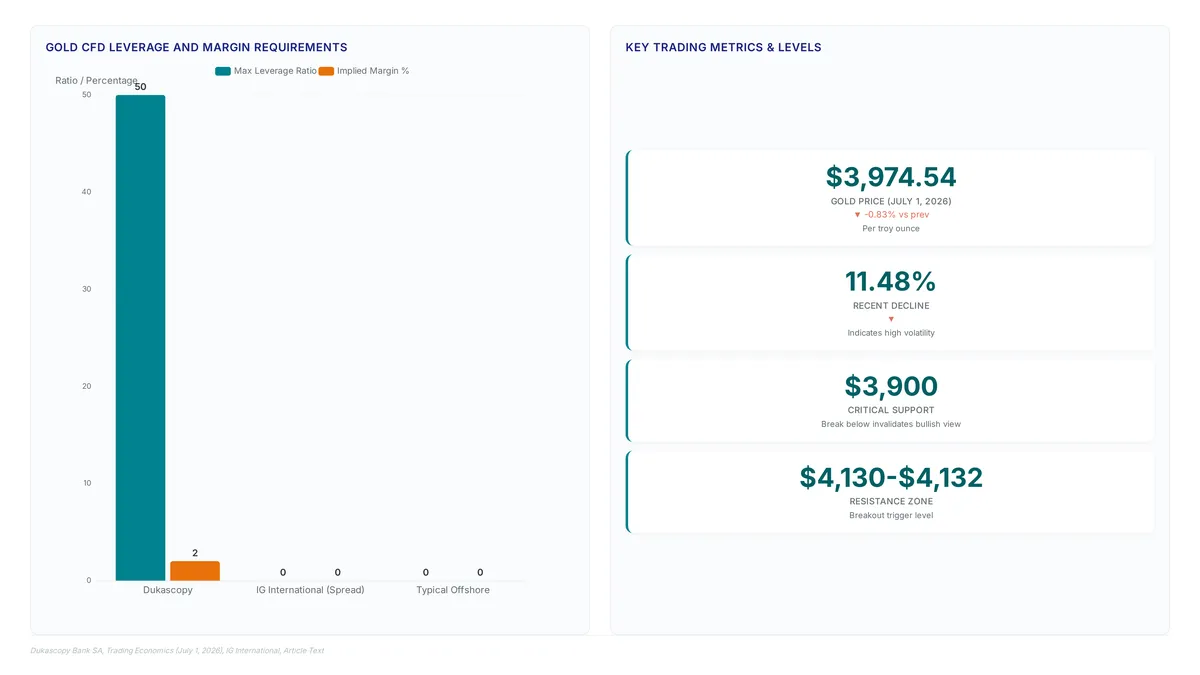
Swiss Regulation enforces strict capital adequacy rules that separate client funds from operational accounts. This structural isolation prevents commingling risks common in less regulated jurisdictions so trader capital remains protected even during broker insolvency. Higher compliance overhead limits the availability of ultra-high use products compared to offshore entities. Traders gain stability but sacrifice the ability to use extreme use ratios often found elsewhere. Access to Swiss marketplace liquidity aggregates orders from multiple tier-1 banks, creating a deep liquidity pool for gold CFDs. Dukascopy uses a use model of 1:50 for Gold CFDs, which notably impacts the margin cost and potential capital efficiency for traders compared to lower use offerings. This ratio allows for substantial position sizing yet demands rigorous risk management to avoid rapid margin calls during volatility spikes. Entry capital requirements are reduced while the proximity to liquidation prices increases if stops are not utilized effectively.
| Feature | Impact on Strategy |
|---|---|
| Regulatory Oversight | Reduces counterparty risk |
| Market Depth | Minimizes slippage on entry |
| Use Caps | Enforces disciplined sizing |
The JForex Platform uses this infrastructure to provide direct market access without a dealing desk intervention. Liquidity is deep during London hours yet spreads may widen during session rollovers.
Deploying Trend Following Strategies on JForex Automation Tools.
Precise automation captures momentum while managing the variable nature of overnight expenses. Technical analysis often identifies these tight squeezes as potential catalysts for significant moves, with structural trends sometimes suggesting slides toward a lower level. Holding positions through these volatile phases incurs progressive costs, favoring short-term execution over long-term holds. Capital-efficient derivatives differ from standardized futures as CFDs expose participants to price action without requiring ownership of the underlying asset. False breakouts during low-liquidity windows create a limitation for automated trend following where spreads widen and slippage occurs.
| Strategy Component | Implementation Focus |
|---|---|
| Entry Trigger | Breakout above key resistance |
| Risk Control | Stop-loss below recent swing low |
| Cost Management | Close positions before daily rollover |
ForexCFD.top emphasizes that successful deployment relies on aligning algorithmic parameters with current market volatility rather than static historical averages. A sustained break below a key threshold would invalidate the immediate bullish thesis, forcing a recalibration of the trend-following logic to account for a deeper correction phase.
MT4 versus JForex: Evaluating Platform Features for Gold Execution
Execution speed and interface depth define the operational edge when trading gold derivatives. The MT4 interface remains a standard for its simplicity, yet it imposes a fixed lot constraint where the standard unit equals 100 ounces, potentially limiting granular position sizing for smaller accounts. The JForex Platform offers superior flexibility by allowing exposure adjustments down to a single ounce, enabling precise capital allocation aligned with specific risk parameters.
| Feature | MT4 Platform | JForex Platform |
|---|---|---|
| Min Trade Size | 1 Ounce (0.01 Lot) | 1 Ounce |
| Max Exposure | 1,000 Ounces | 1,500 Ounces |
| Automation | Basic Scripts | Advanced Java Tools |
| Liquidity Access | Standard | Swiss Marketplace |
Traders prioritizing algorithmic complexity often favor the native automation tools found within the Swiss-regulated environment. External brokers like IG International promote tight spreads, yet the structural advantage here lies in direct market access rather than just pricing. Relying solely on third-party MT4 bridges creates a potential latency during high-volatility events which can widen effective execution costs. The catalyst for choosing JForex is the need for reliable liquidity that adapts to order flow without manual intervention. This bias toward integrated ecosystems ensures that competitive prices and swift execution remain consistent, even when market depth thins. Custom scripting in JForex presents a steeper learning curve than the drag-and-drop simplicity of MT4 experts. ForexCFD.top recommends using the demo environment to test execution latency before committing capital. The view flips if a trader requires only basic charting without the need for deep customization or variable contract sizing. Data on order fill times during the London-New York overlap would validate the latency premium.
Step-by-Step Guide to Opening and Managing Gold CFD Positions
Implementation: Defining the 1 Ounce Minimum Trade Size for Gold CFDs
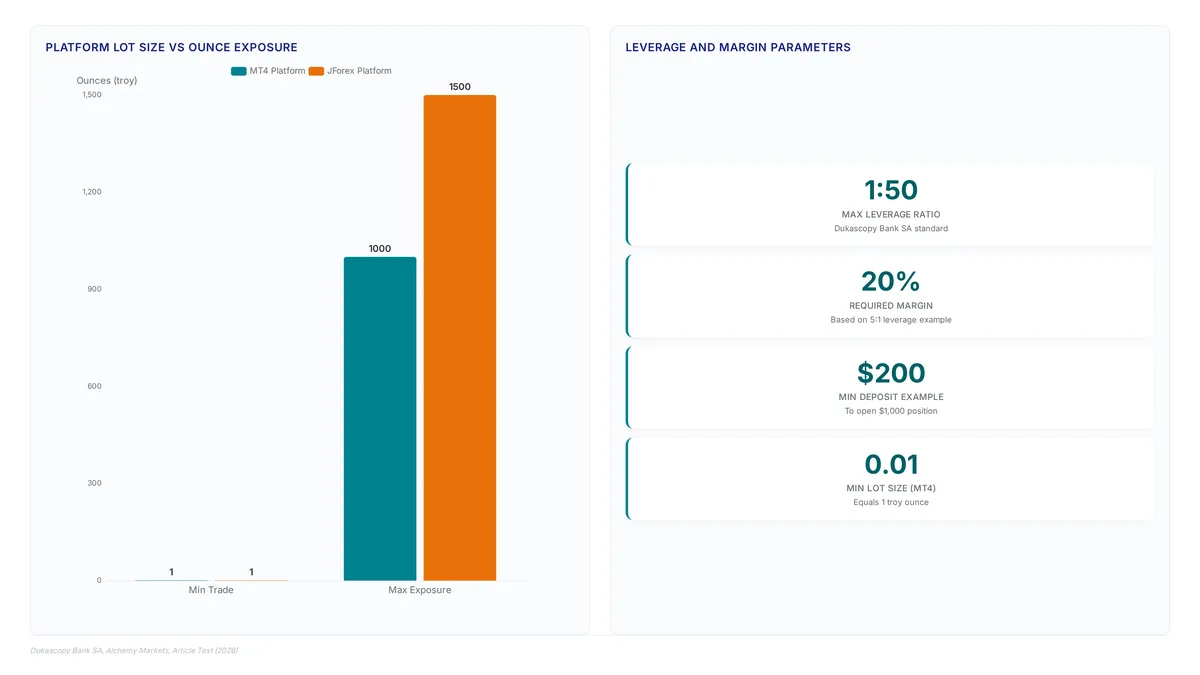
Precise position sizing begins with the 1 troy ounce minimum trade size mandated for Gold CFDs. This baseline definition governs capital allocation before any market analysis occurs.
- Identify the contract specification where the minimum exposure equals one ounce of physical gold.
- Select the trading interface, noting that MT4 users must execute a minimum of 0.01 lot to meet this threshold.
- Calculate the notional value, recognizing that one standard lot on MT4 represents 100 ounces of bulk exposure.
The operational constraint here involves platform translation; while JForex allows clients to hold exposures of up to 1,500 ounces, MT4 requires converting the 1 troy ounce requirement into a 0.01 lot increment. On the MT4 platform, the standard lot corresponds to 100 ounces, with a maximum exposure of 10 lots (1,000 ounces). This distinction prevents accidental over-using where a trader might misinterpret a "1 lot" entry as a single unit rather than a 100 ounce position. Understanding these contract specifications is necessary, as the required deposit scales with the notional value of the position based on the use provided. Different contract sizes are available to cater to traders with varying risk preferences and account sizes.
Executing Buy and Sell Orders with Stop-Loss Parameters
Execute precise market entries by selecting XAU/USD and defining directional bias before committing capital.
- Navigate to the Gold instrument list and choose Buy for long exposure or Sell for short positions based on technical analysis.
- Input trade size, ensuring alignment with the 1 troy ounce minimum requirement previously established.
- Immediately attach a stop-loss order below recent support for longs or above resistance for shorts to cap potential drawdown.
- Set a take-profit target at the next liquidity zone to secure gains automatically.
Capital efficiency drives this derivative approach, yet holding positions overnight incurs a financing fee that varies by broker liquidity conditions.
Finalize capital deployment by confirming account funding status before attempting market entry.
- Complete the registration process to activate the trading environment.
- Deposit sufficient capital to cover margin requirements and potential financing fee accruals.
- Verify platform-specific exposure ceilings to prevent automatic order rejection.
Operators often note that exceeding the 1,000 ounce limit on MT4 exceeds the platform's maximum exposure, whereas JForex accommodates larger 1,500 ounce positions within the same legal entity. This structural divergence forces traders to split large hedges across multiple tickets or switch interfaces entirely. Regulatory compliance and access to marketplace liquidity are maintained across these environments. Traders should apply the available charting and analysis tools to assess current market conditions before placing trades. Adhering to these boundaries is critical; the exposure limits define the maximum position size allowed. It is recommended to verify these parameters in the contract specifications window prior to live deployment. Failure to align position size with platform constraints may result in the inability to open the desired position size.
About
Marcus Halloran, Chief Market Strategist at ForexCFD.top, leads our coverage of gold CFDs by applying deep macroeconomic expertise to XAUUSD price action. With a background as an interbank FX strategist in London, Marcus specializes in translating complex central bank decisions and interest rate differentials into clear, actionable insights for retail traders. His daily work involves analyzing the precise macro catalysts, such as Fed policy shifts and real yield movements, that drive gold's volatility without physical ownership. This article uses his proven framework for mapping these fundamental drivers against technical levels, ensuring traders understand the risks behind use and short-selling mechanics. At ForexCFD.top, an independent publication dedicated to regulation-aware market news, Marcus ensures every analysis remains vendor-neutral and education-focused. By connecting high-level monetary policy to practical trading scenarios, he empowers our global audience to navigate gold CFD markets with a disciplined, data-led approach rather than speculative hype.
Conclusion
Gold CFDs currently face a structural conflict where short-term bearish momentum clashes with strong yearly gains, creating a volatile environment where use acts as a double-edged sword. While the market corrects from recent highs, the primary operational risk shifts from simple price movement to the mechanical constraints of platform exposure limits. Traders attempting to hedge or scale positions during this correction often encounter hard ceilings, specifically the 1,000 ounce cap on MT4 versus the 1,500 ounce allowance on JForex, which can silently reject large orders or force inefficient trade splitting.
You must prioritize verifying your specific interface limits before deploying capital into this corrected environment. Do not assume uniform access across all tools within the same brokerage entity. The immediate priority is aligning your position sizing logic with these hard technical boundaries to prevent execution failure during rapid price swings. Start by auditing your current open positions against the exposure limits of your active trading terminal this week. If your strategy requires holding more than 1,000 ounces, you must explicitly route these orders through JForex or divide them into smaller tickets on MT4 to ensure full market participation without artificial restriction.
Frequently Asked Questions
Leverage lets you control large positions with minimal capital outlay. Dukascopy Bank SA offers a maximum ratio of 1:50, meaning you need only a fraction of the total trade value to open a position.
Recent data shows gold CFDs fell to $3,974.54 per troy ounce on July 1, 2026. This specific price point reflects a 0.83% decrease, signaling immediate downward pressure for traders monitoring short-term trends.
This sharp drop highlights high volatility, requiring traders to implement strict risk controls like stop-losses to protect capital.
Yes, short selling capabilities allow profits during market declines without physical storage burdens. This approach avoids logistical nightmares while enabling speculation on price variance against the loco London benchmark effectively.
Swiss regulation ensures deep liquidity and strict data privacy standards for all participants. These frameworks mitigate counterparty risk in OTC models, providing a secure environment for executing precise entry and exit points.
References