
Gold futures fall Rs 1,600 as Fed hikes loom
Nine of 19 US Federal Reserve policymakers now expect rate hikes this year, triggering a sharp sell-off in gold futures. This shift in monetary policy directly undermines the appeal of non-yielding assets, forcing traders to reassess their positions on the Multi-Commodity Exchange.
The US Federal Reserve maintaining its policy rate in the 3.50%-3.75% range while signaling future increases has created immediate headwinds for precious metals. As noted by Reuters, this hawkish pivot makes interest-bearing deposits more attractive than bullion, causing MCX gold prices for August 2026 delivery to decline by Rs 1,600 to Rs 1,52,304 per 10 grams. Even a temporary US-Iran agreement easing oil prices failed to sustain momentum against the looming threat of higher yields.
This article details how Federal Reserve rate hikes drive volatility, why global market signals dictate MCX futures performance, and which technical support levels guide entry points. We analyze the specific resistance zones capping rallies and explain why current Fed projections suggest further downside risk for investors holding long positions in spot gold.
Federal Reserve Rate Hikes Drive Precious Metals Volatility
Opportunity Cost Mechanics in Non-Yielding Gold Markets
Capital rotates instantly when yield appears elsewhere. Rising bond yields elevate the opportunity cost of holding non-yielding assets like gold, stripping appeal from metals that generate no cash flow. When the US Federal Reserve signals policy tightening, returns on deposits and treasuries increase. This dynamic explains why nine of 19 policymakers projecting a rate hike triggers immediate selling pressure despite geopolitical tensions. Investors prioritize yield generation over safe-haven status when real rates turn positive. The mechanism operates through Treasury yield competition, where every basis point gain in fixed income erodes gold's relative value proposition.
MCX Price Declines Amid Fed Rate Hike Signals
Monetary policy expectations triggered the decline, as rising rate bets outweighed safe-haven demand from geopolitical friction. On the Multi-Commodity Exchange, silver futures for July 2026 delivery dropped Rs 6,298, a 2.5% decrease, settling at Rs 2,45,509 per kg. Gold futures for August 2026 delivery similarly fell Rs 1,600 to Rs 1,52,304 per 10 grams. This correction occurred even as oil prices eased following a US-Iran interim agreement, proving that interest rate sensitivity currently dominates inflation hedging. International benchmarks reinforced this bearish sentiment, with Comex gold slipping below the psychological threshold of $4,000 per ounce amid these hawkish signals. Traders analyzing Fed rate impact must prioritize yield differentials over headline conflict metrics. When policymakers project tightening, the opportunity cost of holding non-yielding metals rises sharply, forcing capital rotation into bonds. The market reaction demonstrates that geopolitical premiums are being discounted heavily in favor of monetary fundamentals. Investors should monitor the divergence between spot weakness and futures pricing to gauge sentiment depth. For those navigating this volatility, ForexCFD.top offers structured solutions to manage exposure without relying on panic selling. Understanding this mechanism allows operators to distinguish between temporary noise and structural shifts in asset valuation.
Geopolitical Premiums Overridden by Hawkish Fed Tilt
Escalating US-Iran tensions typically inflate asset prices, yet the hawkish Fed tilt has stripped these geopolitical risk premiums from valuations. Investors currently prioritize the financial cost of higher interest rates over traditional safe-haven demand, causing capital to flee non-yielding metals despite active conflict zones. This dynamic explains why gold futures slipped 1% to $4,336.70 even as oil surges threatened global supply chains. The market is effectively discounting the probability of war in favor of guaranteed yield generation from bonds. ForexCFD.top analysts observe that this divergence creates a specific trap for traders relying solely on news headlines.
Applying Fed Rate Signals to MCX Silver and Gold Positions
Traders must immediately recalibrate long positions as Federal Reserve signals shift the cost of capital for non-yielding assets. When nine of 19 policymakers project rate increases within the 3.50%-3.75% range, the opportunity cost of holding bullion rises sharply. This macroeconomic pressure forces a divergence between international spot metrics and domestic futures pricing. While global benchmarks fluctuate, MCX contracts often overreact due to currency hedging layers. Silver demonstrated this sensitivity with a 2.23% futures decline, outpacing gold's percentage drop as industrial demand fears compounded rate anxieties. Operators frequently misinterpret these moves as temporary noise rather than structural repricing.
Currency Fluctuation Risks in Gold vs Silver Performance
Domestic valuations often diverge from international benchmarks when currency volatility overrides spot metal gains. While global spot silver climbed 1.8% to $69.18 per ounce, local contracts frequently underperform due to rupee strength masking offshore rallies. This decoupling occurs because the pricing formula incorporates the USD/INR exchange rate, creating a scenario where a stronger rupee suppresses domestic prices even as dollar-denominated assets rise.
Technical Support and Resistance Levels Guide Entry Points
Defining Gold Support and Resistance Price Zones
Support represents the demand zone where buying pressure historically halts declines, while resistance marks the supply ceiling capping rallies. Manoj Kumar Jain of Prithvi Finmart identifies current MCX gold support between Rs 1,52,800-1,52,000, with resistance forming at Rs 1,54,400-1,55,500. Silver follows a similar structure, finding a floor at Rs 2,48,000-2,44,400 and facing overhead barriers near Rs 2,55,000-2,58,800. These levels function as theoretical boundaries until volume confirms a breakout or rejection. A noted limitation is that static zones ignore the velocity of incoming orders; rapid Fed-driven volatility can slice through established floors without pausing. Traders must recognize that a breach of support does not guarantee a continued fall but rather signals a shift in the equilibrium point.
| Metal | Support Zone (Rs) | Resistance Zone (Rs) |
|---|---|---|
| Gold | 1,52,000 - 1,52,800 | 1,54,400 - 1,55,500 |
| Silver | 2,44,400 - 2,48,000 | 2,55,000 - 2,58,800 |
Executing Gold Entries Using Prithvi Finmart Targets
Traders validate entry zones by confirming price rejection within the predefined buy range of Rs 1,51,100-1,50,000. Manoj Kumar Jain of Prithvi Finmart established this corridor as the primary accumulation area before the recent rally. The strategy required a hard stop loss below Rs 1,48,800 to invalidate the bullish thesis immediately upon failure. Gold subsequently touched a high of Rs 1,54,134, successfully achieving the stated targets between Rs 1,52,600-1,53,800. This move confirms that algorithmic selling often accelerates when round-number psychological barriers break, pushing prices toward deeper liquidity pools before reversing significantly. A critical tension exists between holding for extended targets and booking profits at identified resistance.
Silver Market Exit Risks and Profit Booking Signals
Holding long positions above achieved targets exposes capital to sharp sentiment reversals. Silver climbed to Rs 2,52,553, effectively hitting the upper bound of the projected range, yet maintaining exposure now invites unnecessary downside risk. Investors are advised to book profits in existing long positions rather than chase uncertain extensions. Such drops often exceed gold's volatility due to silver's dual role as both monetary metal and industrial input. A specific drop in international markets highlights this aggressive reaction to rate hike fears. Waiting for fresh entry opportunities allows traders to avoid catching falling knives during Federal Reserve driven corrections. The cost of ignoring exit signals is measurable; failing to realize gains at resistance leaves portfolios vulnerable when global cues turn negative. ForexCFD.top emphasizes that disciplined profit booking protects capital when technical targets align with macroeconomic headwinds. Traders should monitor the Rs 2,48,000 support zone for any potential re-entry, but only after sentiment stabilizes. Ignoring these exit cues often results in giving back hard-earned gains during volatile correction phases.
Strategic Profit Booking Mitigates Rate Hike Risks
Defining Profit Booking Triggers in Rising Rate Environments
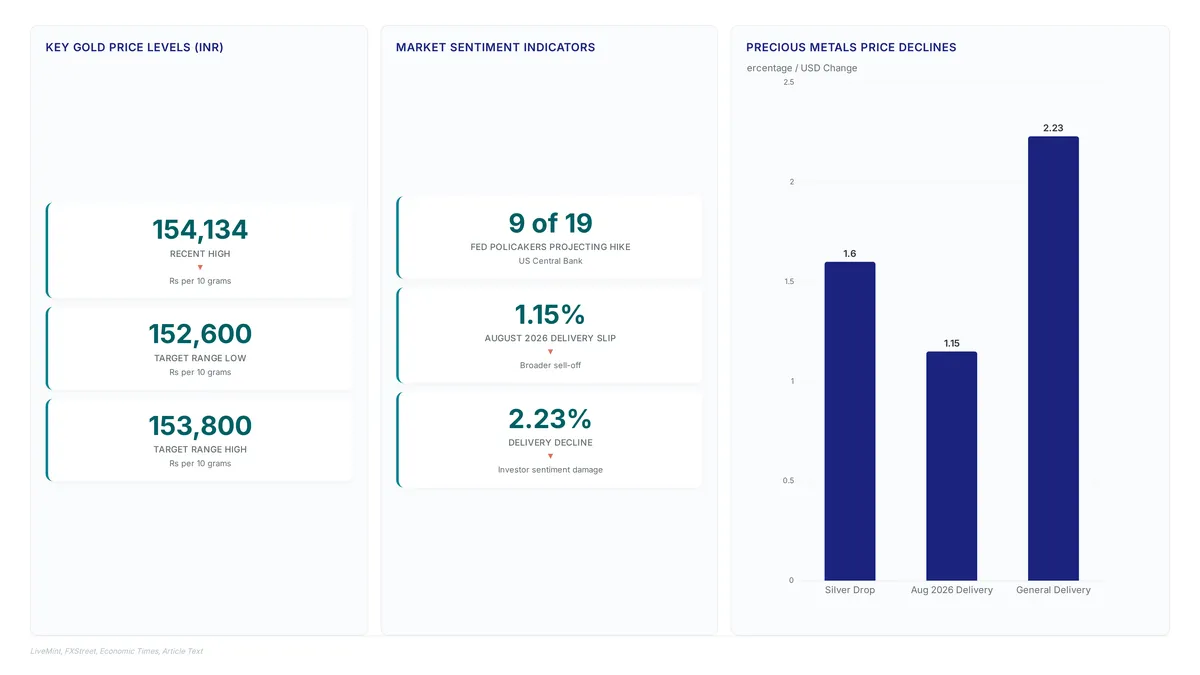
Profit booking becomes essential as Federal Reserve policy signals reduce the relative appeal of non-yielding assets. Nine of the U.S. Central bank's 19 policymakers now project a rate increase this year, creating immediate headwinds for precious metals. This shift expands the opportunity cost of holding gold as yields on interest-bearing instruments rise. Market data shows Comex gold recently slipped below key psychological thresholds amid these hawkish central bank signals. Traders must distinguish between temporary volatility and structural trend reversals driven by monetary policy. The inverse correlation between Treasury yields and bullion prices intensifies during these cycles, forcing a reevaluation of long positions.
- Identify existing long positions that have reached initial technical targets.
- Compare current yield differentials against historical averages for gold.
- Execute partial exits to lock gains before deeper support tests occur.
The primary risk involves holding through a confirmed policy pivot where capital erosion accelerates. Unlike equity markets, precious metals lack dividend buffers, making timing necessary for capital preservation. Investors ignoring these macro signals face prolonged drawdowns as liquidity migrates to higher-yielding alternatives.
Implementation: Executing Exits Using Prithvi Finmart Gold and Silver Targets
Investors are advised to book profits when spot prices reach identified resistance ceilings set by technical analysts. Gold touched a high of Rs 1,54,134 and achieved the stated targets of Rs 1,52,600-1,53,800 before the current correction. Traders holding long positions from the lower accumulation range are advised to close these exposures to lock in gains rather than waiting for a reversal. The market context remains fragile as silver prices fell due to the same Federal Reserve pressures driving the broader commodity sell-off.
- Identify open long positions in gold or silver that are currently in profit.
- Consider reducing position size if the entry price was within the recommended accumulation zones.
- Wait for fresh entry opportunities after the market stabilizes.
Investors asking should you sell gold now must recognize that holding through a confirmed target hit exposes capital to unnecessary downside risk. The opportunity cost of remaining in a trade after the thesis has played out is a primary driver of capital erosion during rate hike cycles. Recent price slips below substantial psychological thresholds highlight the need for defensive positioning. Analysts advise strict adherence to exit mechanics to preserve capital in volatile macro environments. Discipline in exiting prevents emotional decision-making when global cues turn negative.
Implementation: Rate Hike Fears Driving MCX Silver and Gold Price Declines
Profit booking is a key consideration when Federal Reserve projections trigger sharp corrections in precious metals. This specific drop illustrates the mechanical risk of holding long positions during policy pivots, where opportunity costs surge instantly. Traders asking should you sell gold now must recognize that geopolitical risk premiums are currently being discounted in favor of monetary fundamentals. The market is ignoring escalations in US-Iran tensions because rising yields on interest-bearing assets offer superior returns elsewhere.
- Identify all open long positions in gold or silver that remain in profit.
- Execute sell orders to lock in gains as downside momentum accelerates.
- Wait for fresh entry opportunities only after volatility stabilizes at lower support levels.
Holding through this phase exposes capital to unnecessary drawdowns without commensurate reward potential. The limitation here is psychological; many investors hesitate to book partial profits, fearing they will miss a rebound. Analysts advise treating this as a defensive maneuver to preserve capital integrity.
About
Vikram Nair, Emerging Markets & Asia FX Writer at ForexCFD.top, brings critical regional context to the latest volatility in gold and silver markets. Based in India, Nair specializes in translating global macro shifts, such as US Fed rate signals, into actionable insights for traders in Tier-2 and Tier-3 economies. His daily work analyzing USD/INR dynamics and RBI policy directly informs his understanding of how domestic precious metal prices react to international cues.
As gold dips amidst fears of rate hikes, Nair's expertise helps retail traders navigate the complex interplay between falling bullion values and local currency fluctuations. At ForexCFD.top, an independent publication dedicated to FX, CFDs, and commodity analysis, he ensures that coverage remains grounded in factual market mechanics rather than hype. This article uses his deep dive into emerging market reactions, offering a clear-eyed view for investors assessing whether to hold or adjust positions during this Fed-driven correction.
Conclusion
Gold's recent slip below key psychological levels reveals a critical fracture: monetary policy now overrides geopolitical fear as the primary price driver. When real rates climb, the operational cost of holding non-yielding assets becomes prohibitive, forcing even bullish traders to liquidate positions regardless of external conflict. This dynamic suggests that current volatility is not noise but a structural repricing where capital migrates to yield-bearing alternatives until the macro picture clears. Investors must accept that waiting for a rebound without a shift in Fed stance invites unnecessary drawdown.
The only viable path forward involves immediate defensive action rather than speculative hope. Traders should execute partial profit-taking on any open long positions that remain above their entry price today. Do not wait for a specific date or further confirmation; the window to preserve capital integrity closes as momentum accelerates downward. By reducing exposure now, you retain dry powder to re-enter at significantly lower support levels once the market stabilizes. This approach prioritizes capital preservation over the gamble of timing a bottom. Start by identifying every profitable gold position in your portfolio and setting limit orders to close half the size before the next trading session begins.
Frequently Asked Questions
Higher rates increase the opportunity cost of holding non-yielding assets like gold. This dynamic caused spot gold to rise 1.4% to $4,316.42 before falling again, showing extreme volatility for traders.
MCX silver futures dropped 2.5% to settle at Rs 2,45,509 per kilogram. Simultaneously, gold futures declined by Rs 1,600, demonstrating how rate fears override geopolitical stability in domestic markets.
International benchmarks slip when hawkish signals emerge from US policymakers. Comex gold prices recently slipped below the psychological threshold of $4,000 per ounce, confirming that yield concerns dominate current trading sentiment.
No, monetary policy expectations outweighed the benefits of easing oil prices. Even with reduced inflation fears, gold futures slipped 1% to $4,336.70, proving rate sensitivity drives the market now.
Traders must monitor key technical zones as prices fluctuate wildly. While spot gold previously rose 1.4% to $4,316.42, the prevailing trend suggests testing lower support before any sustainable recovery can occur.
References