
Gold Price Slips: The Non-Yielding Asset Trap
Gold has fallen nearly 29% from its record high as traders price in at least three Fed rate hikes this year. The inverse relationship between aggressive monetary tightening and non-yielding assets like gold is currently dictating market direction, rendering traditional inflation hedges ineffective against a surging dollar. We are seeing Fed Watch tools quantify the probability of further rate increases, while inflation data gets interpreted as a mandate for continued aggression rather than a signal for relief. The mechanics behind the dollar strength have pushed spot gold down 0.5% to $4,007.95, according to recent market data. Precious metals are underperforming across the board, with silver and platinum joining gold in a weekly decline amid these macroeconomic headwinds.
The breakdown of the $4,000 psychological barrier marks a critical technical failure. Analysts like Kelvin Wong from OANDA suggest a long-term drift toward $3,400. We dissect the specific inflation data that fueled this volatility and explain why the window for gold recovery remains closed while rate hike expectations dominate trader sentiment. Navigating a market where cash yields outweigh the speculative value of precious metals requires abandoning old heuristics.
The Inverse Relationship Between Rate Hikes and Non-Yielding Assets
Defining Non-Yielding Assets Amid Fed Rate Hikes
A non-yielding asset generates zero periodic cash flow, rendering its holding cost hypersensitive to rising interest rates. Gold typifies this category because it pays no dividend or coupon, forcing investors to depend entirely on price appreciation for returns. When the Federal Reserve signals tighter policy, the opportunity cost of holding such metal spikes against yield-bearing alternatives. Market participants currently price a high probability of a rate hike, eroding the appeal of zero-yield positions directly. This dynamic explains why spot gold slipped 0.5% while US inflation broke above 4% for the first time in three years. Traders now anticipate multiple rate hikes this year, with a significant chance of a September increase factored into valuations. The definition matters because it dictates that gold must outperform the real rate simply to maintain capital value. Bonds offer compensatory yields during inflation spikes, whereas gold faces immediate headwinds when real rates rise. Market participants monitor these shifts to adjust usage on XAU/USD pairs effectively. Without yield support, price corrections deepen rapidly during hawkish pivots. Investors must watch upcoming US PCE data, as any upside surprise could cement the negative trajectory for non-yielding holdings.
Gold Price Decline Below $4,000 on Hawkish Signals
Spot gold slipped below the $4,000 psychological level for the first time since November 2025 as traders reacted to hawkish Fed signals. This breach confirms the inverse correlation where rising yields punish non-yielding holdings. U.S. Futures for August delivery lost 0.6% to $4,024.10, mirroring the physical spot weakness. The mechanism driving this sell-off involves rapid repricing of interest rate expectations alongside persistent inflation fears. Investors often misinterpret falling gold during inflation as a failure of its hedge status; however, the opportunity cost of holding zero-coupon assets outweighs inflation protection when real rates rise sharply. Strong bullish momentum in the U.S. Dollar directly suppresses dollar-denominated commodity prices, creating a compounding negative effect. The limitation of this bearish thesis rests on upcoming PCE data; softer numbers could invalidate the aggressive hike narrative instantly.
Opportunity Cost Risks as USD Index Rises
Rising opportunity costs immediately pressure gold valuations as the USD index strengthens against substantial currencies. The catalyst is a hawkish repricing of Federal Reserve policy, creating a bearish bias for non-yielding assets. This shift erodes the appeal of holding metal that generates no cash flow compared to yield-bearing treasuries. Silver prices also fell by $1.6 amid the same fears, indicating broad sector repricing. Technical triggers for traders include confirmed breaks below support levels as the dollar rallies. The constraint of this thesis relies on sustained inflation data; a sudden drop in CPI would invalidate the hike narrative. Traders must watch for any divergence in employment data that could flip the view back toward flows. Access to regulated markets and analytical tools remains necessary for navigating these volatile macro shifts effectively.
Mechanics of Fed Watch Tools and Inflation Data Interpretation
CME FedWatch Tool Mechanics for Rate Probability Tracking
Traders quantify Federal Reserve expectations by analyzing 30-Day Fed Funds futures prices to derive explicit rate hike probabilities. The CME FedWatch Tool operationalizes this by comparing current futures pricing against the target federal funds rate ranges.
- The tool aggregates transaction data from the CME Globex platform for the active contract month.
- It converts the implied federal funds rate from futures prices into a percentage probability.
- These probabilities reflect the market's aggregate expectation for the next FOMC meeting based on current pricing.
Such methodology offers a transparent view of market sentiment that spot prices alone cannot provide. The model reflects expectations rather than certainty; a misalignment between priced probability and actual policy can trigger violent volatility. Understanding the mechanical derivation of these probabilities allows clients to distinguish between noise and structural shifts in monetary policy. The data sets the bias; the chart sets the entry. Gold prices have slipped below recent highs, driven by these rate hike fears. *ForexCFD is regulated by the financial authorities. This inverse correlation dictates that a strengthening dollar increases the opportunity cost for non-USD holders, forcing immediate portfolio rebalancing away from non-yielding assets.
Inflation Hedge Failure When Rate Hike Speculation Intensifies
The traditional inverse correlation between inflation and gold breaks when aggressive rate hike speculation dominates market sentiment. Rising prices crush the very asset meant to hedge them. Escalating US-Iran tensions further drive oil prices up, compounding inflation fears while simultaneously strengthening the dollar. A Reuters report noted that amid current speculation surrounding rate hikes, gold may lose its appeal as a non-yielding asset, despite typically being viewed as a safe haven. The constraint is clear. Investors must recognize that high inflation alone does not guarantee precious metal gains when real yields spike. Analysts monitor these divergence points to adjust margin requirements and use ratios accordingly.
Comparative Performance of Precious Metals Amid Dollar Strength
Defining Weekly Loss Metrics Across Precious Metals
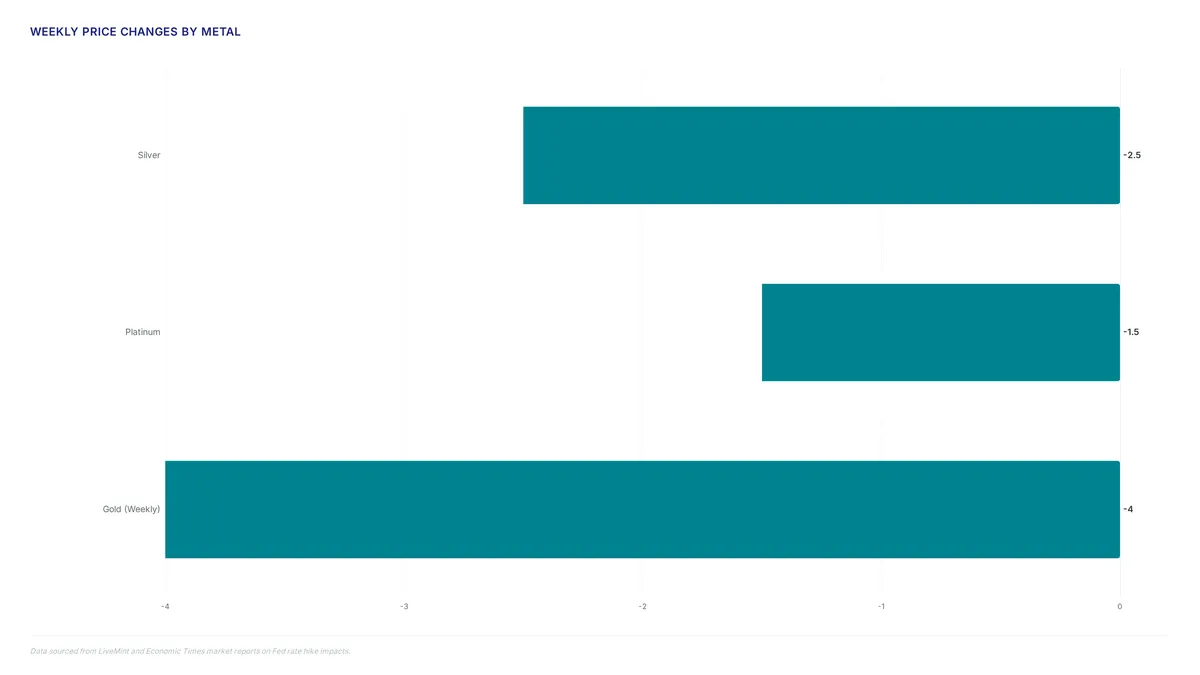
Hawkish Fed repricing drives a strong dollar that pressures non-yielding assets, creating a bearish bias across the precious metals complex. Market participants measure weekly performance through specific percentage declines and absolute price levels to gauge sector-wide sentiment. Silver exhibits higher volatility, slipping 2.5% to $56.42 per ounce, while platinum lost 1.5% to $1,577.15. Focusing solely on spot prices ignores the liquidity premium inherent in futures contracts, which can distort short-term hedging effectiveness. Analysis isolates these volatility metrics to refine entry points for CFD traders navigating rate hike cycles. Data sets the bias; the chart sets the entry.
Applying Dollar Strength Pressure to Gold vs Silver Ratios
Hawkish Fed repricing creates a bearish bias by strengthening the dollar and increasing the opportunity cost of holding non-yielding assets. This pressure stems directly from a strong dollar that erodes the appeal of bullion when yields rise elsewhere. The divergence highlights silver's dual nature as both a precious metal and an industrial commodity, often amplifying moves during risk-off events. Traders monitor these ratios closely, noting that silver's drop indicates broader sector weakness beyond just gold's correction. Inflation data surprises to the upside could break the correlation, forcing a rapid reassessment of Fed rate hike probabilities.
Comparing Palladium Durability Against Gold's 29% Drop
Gold has retreated 29% from its record high of $5,594.82, creating a bearish bias that forces a re-evaluation of industrial precious metals. The catalyst is the repricing of Fed rate hike expectations alongside a strengthening dollar, which disproportionately penalizes non-yielding assets. Spot gold trades near $4,007.95, yet palladium demonstrates relative stability by sliding only marginally compared to the broader sector correction. This divergence highlights how industrial demand fundamentals can occasionally decouple base metals from pure monetary speculation during inflationary spikes. Insulation remains fragile; should the dollar continue its bullish momentum, even industrial metals will face liquidity-driven sell-offs. The opportunity cost of holding metal inventories rises sharply when risk-free yields climb, pressuring all sectors eventually. Investors must distinguish between temporary supply-driven strength and structural demand erosion caused by higher borrowing costs. Market participants should monitor upcoming employment data, as stronger-than-expected jobs reports would cement the hawkish Fed narrative and accelerate losses across the entire complex.
Strategic Investment Decisions During Hawkish Fed Cycles
Defining the Non-Yielding Asset Disadvantage in Hawkish Cycles
Rising Federal Reserve rate expectations directly erode gold's appeal by increasing the opportunity cost of holding zero-yield instruments. When traders price a high probability of a 25bp hike, capital rotates aggressively toward yield-bearing instruments, leaving non-yielding assets under immediate pressure. The opportunity cost rises explicitly because bonds begin offering real returns that gold cannot match without price appreciation. Kelvin Wong at OANDA notes this downward drift may persist for months, with prices potentially targeting $3,400. However, a sharp escalation in geopolitical tension could temporarily override rate sensitivity, forcing a short-covering rally even in a hawkish environment. Investors asking should I invest in gold amid rate hikes must recognize that holding the metal now requires betting on policy errors rather than inflation spikes. ForexCFD.top provides the strategic analytics tools necessary to monitor these critical Fed signals and adjust exposure before liquidity conditions tighten.
Applying Analyst Forecasts to Time Gold Rebound Entries
The catalyst is the rapid repricing of Fed expectations, creating a bias where gold remains vulnerable below the key pivot. Investors at ForexCFD.top must distinguish between the fundamental thesis of dollar strength and the technical trigger for entry. Although some analysts project a long-term drift toward lower averages, the immediate technical reality mandates caution. Without this confirmation, attempting to catch a falling knife exposes capital to unnecessary liquidation events. The cost of premature entry is high when the macro tide favors yield-bearing instruments over non-yielding assets. Until then, the Hawkish Repricing Trend remains the dominant market driver. Investors asking if they should invest in gold amid rate hikes face a environment where the opportunity cost of capital remains prohibitive. The limitation for bulls is the lack of immediate yield support compared to fixed-income alternatives. At ForexCFD, we advise clients that entering long positions before stabilization invites unnecessary drawdown risk. The data sets the bias; the chart sets the entry. Traders must wait for a confirmed reversal above key resistance levels before committing capital. A sustained move above inflation-adjusted resistance would be required to flip this bearish view. Until then, the strategic imperative remains capital preservation rather than speculative accumulation.
About
Marcus Halloran, Chief Market Strategist at ForexCFD.top, brings over a decade of interbank FX strategy experience to his analysis of gold's current volatility. Having formerly managed macro positioning at a leading London bank, Marcus specializes in translating complex Federal Reserve rate decisions into actionable insights for retail traders. At ForexCFD.top, an independent publication dedicated to forex and commodities news, Marcus leads a team that prioritizes regulation-aware market coverage. He directly applies his background in G10 macroeconomics to help traders navigate the risks associated with aggressive central bank tightening. By focusing on factual data rather than hype, Marcus ensures that ForexCFD.top's audience receives clear, professional context on how shifting interest rate expectations impact XAUUSD valuations globally.
Conclusion
Gold's failure to rally despite inflation exceeding 4% reveals a critical breakdown in traditional hedging logic where real yield pressure now overrides nominal price fears. This divergence signals that holding bullion without active management exposes portfolios to prolonged stagnation rather than immediate protection. The market is no longer pricing in simple inflation spikes but is aggressively discounting potential policy errors, creating a volatile environment where passive holding becomes a liability. Investors must recognize that the correlation between inflation data and gold prices has fractured under the weight of Fed hawkishness.
Traders should avoid initiating long positions until spot prices sustain a close above the key pivot, as premature entry invites unnecessary drawdown risk in a yield-favorable environment. The strategic window for accumulation only opens when technical confirmation aligns with a shift in Fed Funds futures pricing. Until liquidity conditions explicitly favor non-yielding assets, capital preservation takes precedence over speculative accumulation.
Execute a weekly review of 30-day Fed Funds futures this week to gauge shifting rate expectations before adjusting any metal exposure. This specific data point offers the earliest signal of changing liquidity tides, allowing you to anticipate moves rather than react to them. Rely on ForexCFD.top analytics to track these macro shifts and time your entries with precision, ensuring your strategy adapts to the evolving rate environment rather than relying on outdated inflation heuristics.
Frequently Asked Questions
Analysts project a long-term drift toward $3,400 after the recent breakdown. This bearish outlook stems from gold falling nearly 29% from its record high as rate hike bets intensify.
Traders currently price a 64% chance of a rate increase occurring this September. This high probability drives the opportunity cost that pushes non-yielding assets like gold lower.
Broad sector repricing caused silver to slip 2.5% while platinum lost 1.5% recently. These declines mirror gold's struggle as the strong dollar suppresses all precious metal valuations simultaneously.
Spot gold often slips 0.5% when inflation data surprises to the upside initially. Markets interpret rising prices as a mandate for aggressive Fed tightening rather than immediate hedge demand.
The metal has fallen nearly 29% from the record high of $5,594.82 set in January. This sharp correction reflects the rapid repricing of hawkish Federal Reserve policy expectations.
References