
Inflation Expectations Drop But ECB Stays Hawkish
The ECB raised rates to 2.25% on June 11, yet 3.5% inflation expectations confirm the job is unfinished. Restrictive monetary policy remains necessary because medium-term price pressures refuse to align with the central bank's targets. Persistent inflation expectations force continued hawkishness. A July pause offers no relief from the broader tightening trajectory. Specific technical support levels dictate the next EUR/CHF recovery phase.
ActionForex reports that while one-year consumer inflation forecasts dropped to 3.5% from 4.0%, this figure remains a full point above pre-conflict lows. This stagnation keeps the September hike firmly on the agenda despite market hopes for a July pause. Energy shocks from the Middle East continue to distort household sentiment, preventing a clean return to the 2% target.
The path to a potential 2.50% rate relies heavily on whether three-year expectations break their 2.9% ceiling. Technical charts reflect this uncertainty as EUR/CHF battles for stability above 0.9179. Stubborn survey numbers mechanically link to the inevitable policy response required to cool the eurozone economy.
The Role of Restrictive Monetary Policy in the ECB Tightening Cycle
Defining the ECB Tightening Cycle and Restrictive Policy Stance
The ECB tightening cycle denotes the sequential elevation of benchmark rates to 2.25% to suppress persistent price growth. This restrictive monetary policy stance emerges when central banks deliberately set borrowing costs above neutral levels to contract demand. Such intervention validates forecasts from most polled economists who anticipated decisive action despite uneven growth across the eurozone economists say.
Maintaining this posture requires navigating elevated medium-term expectations that remain anchored above target. Three-year inflation expectations hold steady at 2.9%, suggesting households and firms still price in sustained pressure. Policy cannot instantly reset psychological anchors formed during energy shocks. Declining short-term readings do not guarantee an immediate pivot to easing. ForexCFD.top analysis indicates that until medium-term expectations decay further, the probability of additional rate increases remains the primary driver for EUR/CHF volatility. Traders should prioritize capital preservation strategies that account for continued policy divergence.
Interpreting ECB Consumer Surveys and One-Year Inflation Expectations
Policymakers analyze the ECB Consumer Expectations Survey to distinguish transient price shocks from entrenched inflationary psychology. Short-term relief masks a more dangerous rigidity in medium-term sentiment. This divergence creates a specific policy constraint for the Governing Council.
The data-dependent approach requires officials to weigh these conflicting signals carefully. The ECB cannot declare victory based solely on the one-year metric. Until the three-year anchor breaks lower, the path of least resistance remains upward. ForexCFD.top analysts note that this stickiness justifies the projected September rate hike, as the central bank must prove its commitment to returning inflation to target levels by 2028.
A September rate hike remains the primary defense against premature easing. ForexCFD.top analyzes that ignoring these structural risks invites significant portfolio volatility. The central bank distinguishes between transient consumer sentiment and medium-term expectations, weighing the latter more heavily when setting the marginal lending facility rate. While households see temporary improvement following the Middle East conflict, the unchanged three-year reading suggests inflation risks remain embedded in wage negotiations and corporate pricing decisions. Consequently, the ECB projects inflation will not return to its 2% target until 2028, necessitating a continued restrictive posture.
ECB staff projections see headline inflation averaging 3.0% in 2026 due to lingering effects of higher energy prices. Households expect inflation to run a full percentage point above the pre-conflict level, creating a self-reinforcing cycle in wage negotiations. The central bank now assesses that the cost of inaction outweighs the drag of tighter policy on growth inflation pressures. Unlike previous shocks, the Governing Council has abandoned "looking through" energy spikes in favor of direct intervention. If energy costs stay high, the path to the forecast for 2027 becomes unstable cooling to a modest rate. Delayed disinflation extends the restrictive window. ForexCFD.top analysis indicates that markets pricing early cuts face significant repricing risk.
Technical Support Levels Driving EUR/CHF Market Recovery
Defining EUR/CHF Support at 0.9179 and Resistance at 0.9228
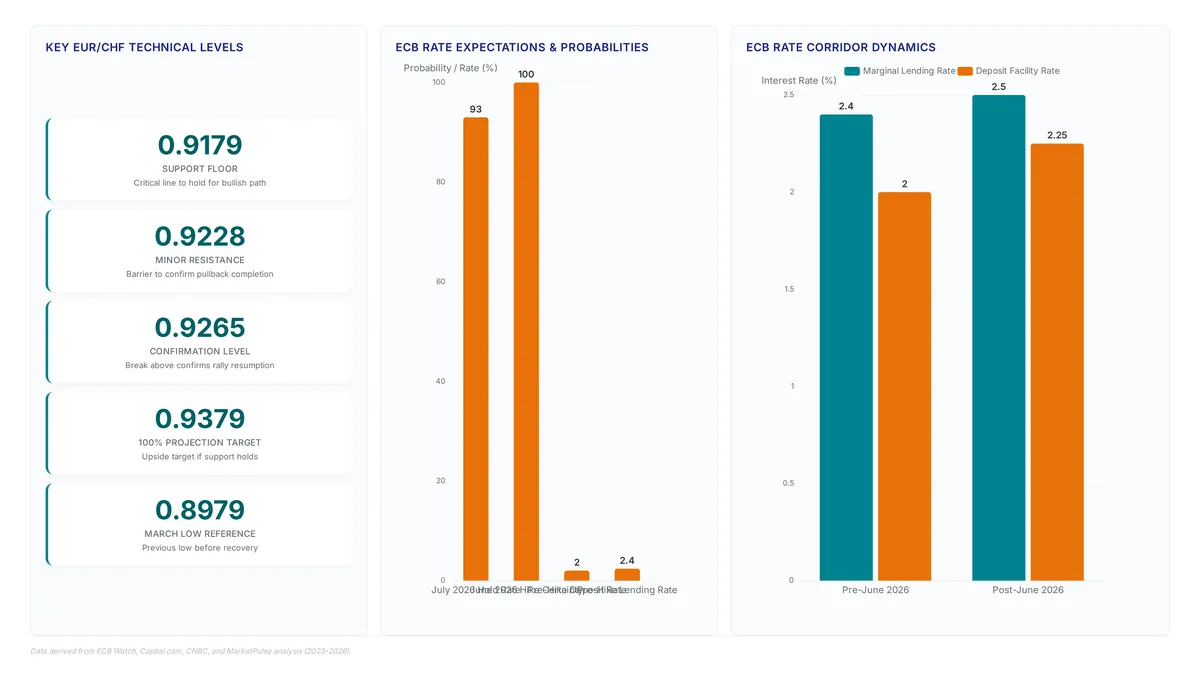
Market participants watch the 0.9179 floor closely because holding this line preserves the path toward a potential 100% projection targeting 0.9379. The immediate focus shifts to minor resistance at 0.9228, a barrier that must clear to confirm the pullback from 0.9265 has completed. EUR/CHF recovered after briefly dipping to 0.9196 as the latest ECB Consumer Expectations Survey offered modest encouragement on inflation but ultimately reinforced expectations that the central bank's tightening cycle is not over. A firm break above this threshold suggests sellers have exhausted their short-term capacity. Such movement would shift attention back to the recent high, signaling renewed buying pressure. Failure to penetrate 0.9228 may result in continued consolidation within the current range. This divergence creates volatility around key technical junctures as policy normalization proceeds.
| Level Type | Price | Significance |
|---|---|---|
| Support | 0.9179 | Holds bullish structure intact |
| Resistance | 0.9228 | Confirms momentum reversal |
| Target | 0.9265 | Recent swing high |
Analyzing these technical levels involves monitoring price action during active trading sessions. Price action near these zones dictates short-term directional bias alongside macro headlines.
Trading the Breakout Above 0.9265 Toward 0.9379 Projection
A decisive break above 0.9265 would confirm the resumption of the rally from the March low at 0.8979. Persistent inflation pressures constrain the market context, leading the ECB to assess that the cost of inaction outweighs tighter policy impacts on growth.
| Scenario | Trigger Level | Target Projection |
|---|---|---|
| Bullish Continuation | Break > 0.9265 | 0.9379 |
| Bearish Rejection | Failure < 0.9228 | Test 0.9179 |
Reliance on technical breakouts ignores the divergent rate expectations held by substantial institutions. The ECB maintains a restrictive stance while markets often overestimate hike risks, expecting rates to remain unchanged in 2026. Tension emerges between technical targets and fundamental headwinds. A breakout above 0.9265 offers a potential entry point since the broader macroeconomic picture suggests potential resistance from diverging central bank forecasts. Strict risk management around these key technical levels becomes necessary given the conflicting signals between price action and long-term rate forecasts.
Risks to EUR/CHF Bullish Case If 0.9179 Support Fails
Losing the 0.9179 floor invalidates the technical recovery structure, forcing an immediate reevaluation of long positions targeting the 0.9379 projection. Markets currently price a September hike as likely, yet analysts caution that the market may overestimate rate hike risks and expects rates to remain unchanged in 2026. Such a divergence between aggressive pricing and actual central bank action creates volatility traps for used EUR/CHF traders relying solely on inflation expectation data. The bullish narrative collapses without holding 0.9179 regardless of ECB rhetoric. Monitoring price action closely around this level matters more than assuming policy divergence will sustain momentum. Technical support levels often react quicker than macroeconomic data releases. This specific threshold separates a data-dependent pause from an active return to restrictive policy territory required to anchor expectations. The ECB is expected to leave rates unchanged at its July 23 meeting to assess incoming data.
1.2.3. The market prices a strong consensus for the June move, but September remains the true test of resolve against entrenched pricing power.
Executing EUR/CHF Entries Above 0.9265 Resistance
This execution plan prioritizes confirmed momentum over premature entry, reducing exposure to whipsaw events during the July pause.
Implementation: Invalidation Risks If 0.9179 Support Fails
A breach of the 0.9179 support level would invalidate the broader bullish case and suggest a deeper retracement.
- Monitor Corridor Width: Watch for liquidity fragmentation if the spread between facility rates expands beyond the standard 40 basis points, indicating stress in the euro-area interest rate transmission mechanism.
2.3. Execute Exit Protocol: A failure at this level challenges the resumption of the rally from the March low, prompting a reassessment of long exposures.
The primary constraint involves accepting a false breakdown versus waiting for confirmation, yet hesitation here exposes traders to asymmetric downside risk. A failure at this level suggests the market may be questioning the necessity of the anticipated 25-basis-point increase. Risk models dictate that technical invalidation supersedes fundamental bias when key structural levels break. Capital preservation takes priority over thesis adherence when price action contradicts the macroeconomic narrative.
About
Sofia Mendes, Broker Reviews & Trading Education Editor at ForexCFD.top, brings a disciplined, risk-aware perspective to the analysis of ECB interest rate decisions and their impact on EUR/CHF volatility. While the article details how lower inflation expectations failed to derail the ECB's September hike trajectory, Mendes' expertise lies in translating such macro shifts into actionable risk management strategies for retail traders. Her daily work involves rigorous broker due diligence and developing educational frameworks that help traders navigate central bank-driven market swings safely. At ForexCFD.top, an independent publication dedicated to regulation-first news, she ensures that coverage of substantial events like ECB policy moves is always paired with clear warnings about use and execution risks. This approach connects high-level economic data directly to the practical realities of trading CFDs, ensuring readers understand not just the market move, but the critical importance of choosing regulated platforms and maintaining strict capital protection during periods of heightened uncertainty.
Conclusion
The upward revision of the inflation forecast to a modest level by 2027 fundamentally alters the risk profile for currency traders, signaling that price pressures are entrenched rather than transitory. This trajectory forces a recalibration of expectations, as the path to the target extends further than previously modeled, keeping real rates restrictive for a prolonged period. The operational cost of holding long exposures now includes heightened volatility around every data release that threatens to delay this necessary tightening.
Traders should immediately stress-test their current Eurozone portfolios against a scenario where the euro-area interest rate remains elevated well beyond current consensus. Do not rely on technical bounces alone to justify use; the macroeconomic backdrop demands strict adherence to the 0.9179 support level as a hard invalidation point. Your first action this week is to review all open positions and tighten stop-losses to reflect the increased probability of sharp, data-driven reversals if inflation expectations decouple from the central bank's 2028 horizon. Success requires aligning capital allocation with the reality of sticky prices rather than optimistic forecasts of rapid cooling.
Frequently Asked Questions
Consumers currently expect inflation to average 3.5% over the next twelve months. This figure represents a decline from 4.0%, yet it remains significantly higher than pre-conflict levels seen earlier in the year.
Policymakers worry because three-year inflation expectations hold steady at 2.9%. This rigidity suggests medium-term sentiment remains unanchored, which risks feeding directly into wage negotiations and corporate pricing decisions across the eurozone.
Traders widely anticipate a rate increase to 2.50% in September rather than relying on the current 2.25% level. This move aims to combat persistent price pressures that remain well above the central bank target.
If inflation proves persistent enough, officials might consider one additional move to 2.75% before year-end. This scenario depends entirely on whether current restrictive measures successfully cool the broader economy down.
Current staff projections indicate headline inflation will average 3.0% in 2026, necessitating continued restrictive policy actions.
References