
MACD Signal on EUR/USD: Mean Reversion Play, Not a Reversal
EUR/USD bounced off the 1.1500 floor on June 16. MarketMilk flagged a fresh MACD bullish crossover. Do not mistake this for a trend reversal. It is a mean reversion play, nothing more. Survival here demands strict adherence to support zones and stop loss protocols. You must separate genuine momentum recovery from standard range-bound noise before risking capital.
Caution is the only rational stance. Price action sits trapped below the critical 1.172, 1.176 resistance cluster formed in late April and early May. Yes, the MACD(12,26,9) flipped above its signal line, indicating strengthening short-term momentum. But the indicator remains below the zero line. That is the hallmark of a counter-trend bounce, and most of them fail. The pair is currently testing the 200-period Simple Moving Average near 1.1670. This level decides the outcome: the rally either sustains or collapses back into a consolidation loop.
We need to dissect signal confirmation mechanics to stop costly misinterpretations of mean reversion dynamics. Differentiating these setups from true breakouts requires analyzing volume and proximity to overhead supply, not just watching lines cross. We will outline precise execution strategies using the 1.1500 support floor as a baseline for risk management. Confusing a temporary bounce with a structural market turn is how accounts get blown out.
Defining the MACD Bullish Crossover and Mean Reversion Dynamics
MACD(12,26,9) Bullish Crossover Mechanics
When the MACD line rises above the Signal line, short-term momentum overtakes the longer-term baseline. This is the bullish crossover. We see this mechanic across asset classes, from recent Bitcoin daily chart alerts to forex pairs. The Signal line acts as a trigger, smoothing the primary MACD value to filter noise and confirm directional shifts. A fresh momentum shift appeared on the EUR/USD daily chart with a signal age of just one day. Similar patterns often precede rallies, much like the divergence noted in Caterpillar stock during mid-July.
Do not forget that the indicator is lagging by design. It confirms turns only after price action has already initiated the move. Waiting for confirmation often means missing the initial impulse, creating a constant tension between signal reliability and entry timing. You must distinguish valid breakouts from mean-reversion bounces within the current range. Upward momentum is rebuilding relative to the recent trend as the histogram turns positive. Yet, without follow-through closes above resistance, this signal may reflect temporary consolidation rather than a durable trend reversal.
Price returns to the 200-period Simple Moving Average near 1.1670 after deviations during mean reversion events. EUR/USD testing this level following a dip to the 1.1500 zone confirms the asset is correcting prior gains rather than breaking out. The MACD histogram turning positive indicates momentum is shifting upward versus the recent trend, yet this signal often reflects temporary equilibrium in ranging markets. Divergence analysis provides clues that a trend is losing steam when price and indicator move in opposite directions, a feature distinct from simple moving average crossoers (source). Mean reversion to the SMA frequently fails if overhead supply at 1.172 remains intact. Premature entry before price clears the supply zone represents the cost of assuming a trend reversal. This setup relies entirely on whether buying pressure persists above the moving average support unlike a confirmed breakout. Failure to hold the 1.1600 level suggests the bounce is merely a short-lived reaction within a broader consolidation phase. Daily closes above resistance validate the bullish thesis against the prevailing correction phase (source). The pair will likely oscillate around the mean without expanding volatility.
Supply Zone Resistance and False Breakout Risks
Watch for price rejection between 1.1775 and 1.1840. These are the primary failure modes. Historical data confirms a repeated inability to sustain moves above the 1.172, 1.176 region during late April and early May, creating a tangible ceiling for momentum. Traders often misinterpret the MACD histogram turning positive as a guaranteed trend reversal. It is not. This metric merely signals that downward momentum is fading rather than confirming sustained buying pressure. A bearish MACD crossover in May previously demonstrated how quickly upside momentum can evaporate near these exact levels.
False breakouts occur when price pierces the supply zone only to reverse sharply, trapping late entries. Such scenarios frequently occur when the indicator remains below the zero line, signaling a corrective bounce instead of a structural shift. Market participants must distinguish between a genuine breakout and a false positive that incurs immediate drawdown. The path of least resistance remains sideways to lower without a decisive daily close above 1.1840. Operators should treat any approach to 1.176 as a high-probability exit zone rather than an entry trigger until resistance breaks.
Mechanics of Signal Confirmation and Differentiation from Breakouts
Zero Line Equilibrium and MACD Momentum States
The zero line represents the precise equilibrium where the 12-period and 26-period EMAs converge, defining the boundary between bullish and bearish momentum states. Trading below this threshold indicates the short-term average remains lower than the medium-term average, signaling persistent downward pressure despite any temporary histogram improvements. A crossover occurring in this negative territory often functions as a counter-trend bounce rather than a durable structural reversal. The zero line significance dictates that only a breach above this level confirms the 12-period EMA has genuinely surpassed the 26-period EMA. Operators distinguishing valid entries from noise must recognize that standard signal line crosses below zero frequently lack the kinetic energy to overcome overhead supply.
| Momentum State | EMA Relationship | Structural Implication |
|---|---|---|
| Below Zero | 12-period < 26-period | Confirmed bearish shift |
| At Zero | 12-period = 26-period | Equilibrium / Indecision |
Meanwhile, the primary limitation is that EUR/USD can whipsaw around this axis during consolidation, generating false positives until price action confirms direction. Traders relying solely on the initial cross without waiting for zero line equilibrium validation often enter positions just before resistance reasserts control. This mechanical constraint requires patience, as the indicator must clear the axis to validate the shift from mean reversion to trend expansion.
Counter-Trend Bounce Traps Below the Zero Line
Crossovers occurring deep below the equilibrium point often coincide with short-lived rallies where prices briefly firm up before overhead resistance reasserts itself. This specific failure mode distinguishes a temporary counter-trend bounce from a durable structural reversal. The MACD line crossing above the signal line suggests strengthening momentum, yet this signal remains deceptive when the indicator stays negative. Trading below the zero line confirms the 12-period average remains lower than the 26-period average, indicating persistent underlying weakness despite the bullish cross.
A genuine bullish crossover vs breakout scenario requires the oscillator to clear the equilibrium threshold, not merely turn upward. Range bounce versus trend reversal depends entirely on whether price action can sustain levels above prior congestion zones. Operators observing this pattern must recognize that mean reversion frequently exhausts itself at the first sign of supply. The cost of misidentifying this trap is immediate capital erosion as the broader downtrend resumes. Valid entries require the histogram to expand significantly while price clears key resistance, a condition rarely met during deep negative excursions. Ignoring the zero-line constraint turns a momentum signal into a liquidity trap for unwary participants.
Price rejection between 1.1775 and 1.1840 defines the primary failure mode for this bullish setup. The specific risk involves a false breakout where price pierces the supply zone before collapsing, trapping late entries. Unlike pure breakout strategies, this reversal scenario demands confirmation through close duration above resistance. Market behavior in early 2026 suggests divergence signals are becoming less reliable in high-momentum conditions without structural alignment. The pair previously reached a higher peak near 1.1849 in mid-April, establishing a clear reference point for profit-taking algorithms. A break below the 1.15 level could return the pair to lower supports, invalidating the bullish thesis entirely.
| Factor | Bullish Confirmation | Bearish Rejection |
|---|---|---|
| Price Action | Daily close above 1.176 | Wick rejection at 1.1775 |
| Momentum | Histogram expands positive | Histogram flattens or dips |
| Structure | Higher low formation | Failure at 200 SMA |
Operators must distinguish between a genuine regime change and a volatile mean reversion event. The cost of premature entry is measurable in slippage during liquidity grabs at key psychological levels.
Executing Trades Using Support Zones and Stop Loss Protocols
Defining Daily Close Protocols for Support Zone Entries
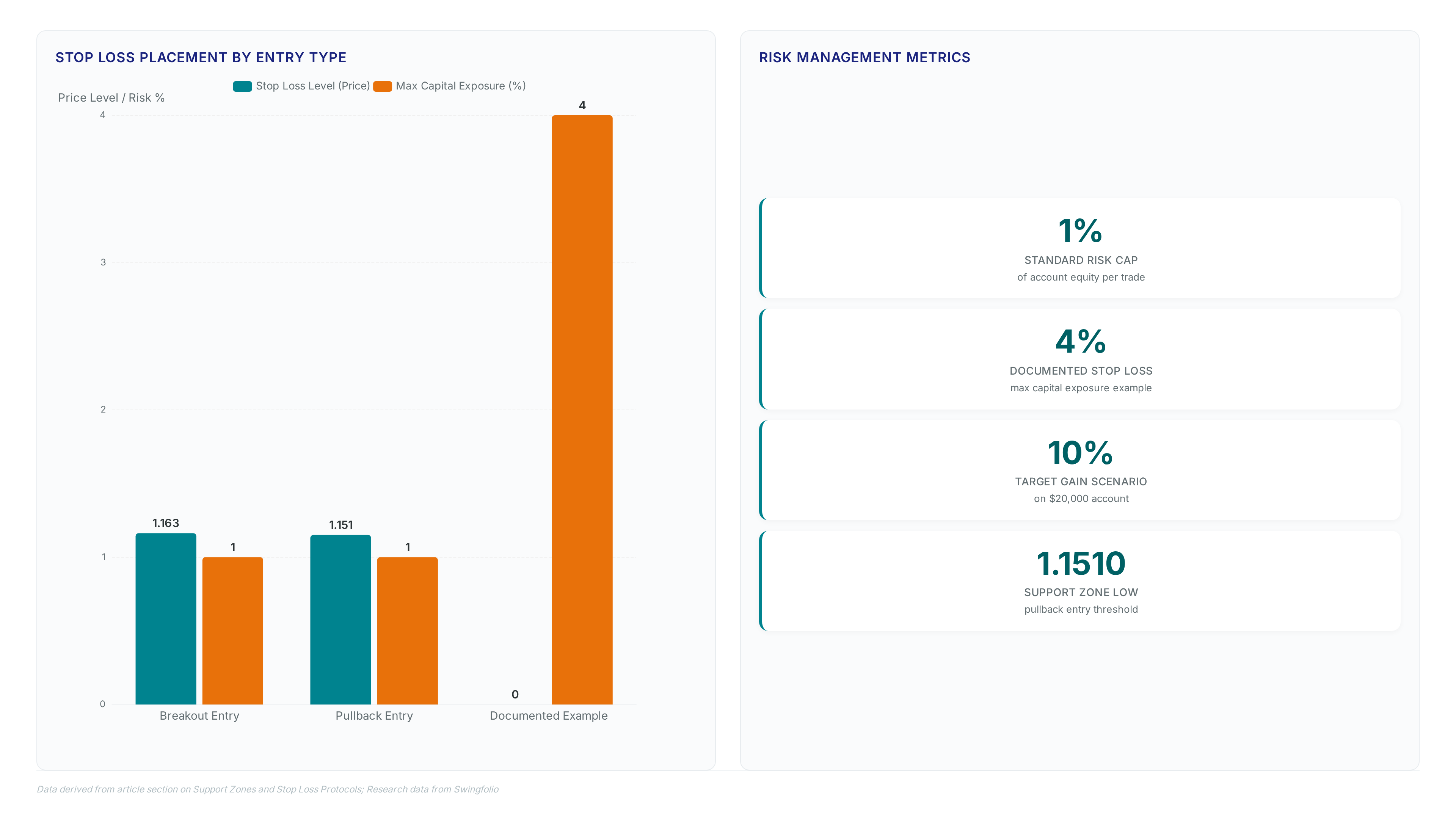
Validity for any long position hinges entirely on a daily close above 1.1690. This requirement filters out intraday wicks that fail to clear resistance levels. Traders must distinguish between transient spikes and sustained momentum shifts before committing capital. A documented approach uses a 4% stop-loss to cap capital exposure on such confirmed moves, ensuring risk remains set regardless of volatility. Alternatively, entries occur during controlled pullbacks into the 1.1550-1.1510 range if price stabilizes without breaching support. This dual-protocol method aligns with the increasing trend toward multi-timeframe confirmation to reduce false signals.
Setting Stop Losses for Breakout and Pullback Trades
Stop placement depends strictly on entry type: below 1.1630 for breakouts and below 1.1510 for pullbacks. Risk management protocols for MACD-based trades recommend capping risk at exactly 1% of account equity per trade. This limit prevents a single failure from damaging the portfolio during ranging conditions.
- Breakout Entries: Place stops on a daily close back below 1.1630.
- Pullback Entries: Place stops on a daily close below 1.1510.
- Capital Requirements: Recognize that a $20,000 account targeting a 10% gain requires precise invalidation points.
- Reward Potential: A hypothetical scenario achieved a 2.5R reward-to-risk ratio by adhering to such strict exit criteria.
The distinction matters because a $20,000 account targeting a 10% gain requires precise invalidation points rather than arbitrary percentages. Traders asking should I enter long on MACD crossover must recognize that stops define the trade validity more than the entry signal itself. If price closes below these thresholds, the momentum thesis fails regardless of the histogram shape. The cost of ignoring these specific levels is exposure to false breakouts that reverse quickly. If 1510 fractures, it turns a bullish setup into a loss leader. Operators must execute these stops mechanically to preserve capital for valid signals.
Invalidation Triggers: When to Stand Aside from EUR/USD
Decisive daily closes below 1.1510 immediately invalidate the bullish thesis, forcing traders to stand aside regardless of prior momentum signals. This specific breach confirms that selling pressure has overwhelmed the recovery base established in early June. Market participants observing this breakdown often reference historical volatility patterns where similar failures led to extended downside moves. Aligning daily signals with the weekly trend provides necessary context, as an increasing number of operators now demand multi-timeframe confirmation to filter noise. A bearish cross on the higher timeframe while price hovers near support notably increases the probability of a failed breakout attempt. Conversely, a daily close above 1.1690 that fails to hold constitutes a false breakout, another critical invalidation trigger requiring immediate exit. Such events mimic valid entries but lack the follow-through volume needed to sustain price above the supply zone. Ignoring these hard levels exposes the portfolio to whipsaw losses that erode equity quicker than steady gains can rebuild.
- Primary Invalidation: Close below 1.1510.
- False Breakout: Close above 1.1690 followed by reversal.
- Trend Mismatch: Weekly MACD remains bearish despite daily cross.
- Volume Absence: Lack of buying volume during the push above resistance.
Mitigating Risks of False Signals and Early Entries in Ranging Markets
Defining False Signals in EUR/USD Ranging Markets

Deceptive MACD crossovers within the 1.12, 1.15 range frequently fail to produce follow-through closes above the 200-period SMA located near 1.1670. These moves mimic genuine breakouts yet lack the volume or multi-timeframe confirmation needed to sustain momentum against overhead supply. Price simply snaps back to the range center after touching boundaries rather than establishing a structural shift. Genuine reversals hold gains while false signals face immediate rejection at resistance zones like 1.1720. Operators relying on unfiltered crossovers incur hidden costs from spread widening and commission drag during choppy markets. Accumulated transaction fees erode capital during frequent whipsaws. Opportunity cost increases when capital ties up in failing trades. Psychological fatigue grows from repeated small losses without trend follow-through. Strategies combining momentum gauges with the Money Flow Index filter noise more effectively than standalone oscillator readings. A crossover occurring while the histogram remains flat indicates weak conviction, suggesting traders should wait for a decisive break of the 1.1690 ceiling. Ignoring this filter leads to entries just before resistance reasserts control. The cost of premature entry exceeds the potential reward in tight consolidation phases.
Applying Follow-Through Close Protocols to Filter Noise
Valid signal interpretation demands additional daily closes holding above 1.1600 rather than reacting to single-candle spikes. A confirmed structure shift requires price to push through the 1.1660, 1.1685 area, aligning with the critical support zone of 1.1660, 1.1680. Operators ignoring this protocol face whipsaw risks where crossovers coincide with short-lived rallies before overhead resistance reasserts itself. Trading without filters implies being constantly in the market, leading to accumulated spread and commission costs on every oscillation as noted in studies regarding MACD signal costs.
Risks: Resistance Reaction Risks at the 1.1720 Supply Zone
Early long entries face immediate rejection within the 1.1720, 1.1760 supply zone, a repeated barrier from late April that traps premature positioning. This specific failure mode occurs when traders ignore overhead supply, mistaking a mean-reversion bounce for a durable trend reversal. Trapped capital and exposure to rapid drawdowns result as sellers defend historical highs. Hidden costs of ignoring this resistance layer include immediate liquidity evaporation as limit orders stack against the supply wall. Widening spreads during the initial rejection candle increase slippage on exit. Psychological pressure leads to premature position closure before valid confirmation.
About
Vikram Nair serves as the Emerging Markets & Asia FX Writer at ForexCFD. Top, where he specializes in dissecting currency dynamics across developing economies. Although his primary beat covers pairs like USD/INR and USD/NGN, his deep expertise in technical analysis and macro-driven momentum makes him uniquely qualified to interpret significant signals in substantial pairs like EUR/USD. In his daily work tracking volatile emerging market charts, Nair relies heavily on precise indicators like the MACD to filter noise during choppy correction phases, a skill directly applied to this analysis of the recent bullish crossover. His perspective connects global liquidity flows, often driven by central bank policies, to actionable technical setups for retail traders. By using ForexCFD. Top's vendor-neutral platform, Nair provides a factual assessment of whether this momentum shift near the 200-period SMA represents a sustainable trend or a temporary fluctuation, ensuring readers receive rigorous, education-focused insights rather than hype.
Conclusion
Relying on a standalone MACD crossover ignores the structural friction that emerges when liquidity thins at key resistance levels. While the indicator suggests momentum, the operational reality involves slippage and failed breaks that erode capital quicker than theoretical models predict. The distinct cost of chasing a signal without price confirmation is a lost trade, but the psychological toll of repeated stop-outs degrades discipline over a quarter. Indicators lag; order flow leads. Assuming a crossover guarantees a breakout is a fatal miscalculation in ranging environments.
Adopt a strict protocol requiring a daily close above 1.1775 before deploying any long-side capital. Do not anticipate the move; react only after the market proves it can absorb supply. This rule applies immediately for all new positions opened this week. If price cannot clear this threshold within five trading sessions, assume the setup has failed and remain flat.
Start by auditing your current open orders today. Cancel any buy limits placed below the 1.1720 ceiling that rely solely on the crossover signal. Re-evaluate your entry criteria to mandate price action validation before indicator alignment. This specific adjustment protects your equity from the high-probability rejection zone currently capping the market.
Frequently Asked Questions
A specific trading scenario outlines a capital requirement of twenty thousand dollars to execute properly. However, strict risk rules suggest capping exposure at exactly one percent of total account equity per single trade.
Losses vary, but a documented approach utilizes a four percent stoploss to cap capital exposure on such trades. This prevents a single bad signal from destroying the entire trading account balance quickly.
Failure to hold the 1.1600 level suggests the bounce is merely a short-lived reaction within a broader consolidation phase. Price action remains below the critical resistance cluster identified in late April and early May.
Direct subscription pricing for the MACD indicator is typically zero dollars as it is a standard feature. However, trading without filters implies being constantly in the market, leading to accumulated spread costs.
Historical data confirms repeated inability to sustain moves above the 1.172–1.176 region during late April and early May. This creates a tangible ceiling for momentum despite the recent bullish crossover signal.