
Swiss franc stability: The real cost of 0% rates
All 35 economists in a recent Reuters poll predict the Swiss National Bank will hold rates at 0% on June 18. You will learn how the interest rate transmission mechanism fails to ignite inflation without triggering excessive Swiss Franc appreciation, and why global monetary desynchronization complicates forecasting for the remainder of 2026.
The Reuters survey reveals a unanimous consensus among economists that the policy rate will remain static, with 28 of 35 respondents extending this forecast through the end of the year. This stagnation reflects the Swiss National Bank prioritization of its price stability goal, set as a Swiss Consumer Price Index rise under 2% annually. Unlike other central banks aggressively hiking rates, the SNB faces a unique constraint where higher yields could strengthen the CHF enough to damage the export sector.
Traders must understand that monetary conditions depend heavily on exchange rates as much as domestic interest levels. While four economists anticipate modest rate rises in 2027, the immediate outlook suggests the Governing Board will continue relying on foreign exchange interventions rather than rate hikes to manage liquidity. Our analysis details why relying on third-party forecasts often misses these structural nuances inherent to the Swiss Franc framework.
The Swiss National Bank Mandate for Price Stability
SNB Mandate for Price Stability and CPI Targets
Statutory obligation binds the Swiss National Bank to secure price stability across medium and long-term horizons. Success here means an annual rise in the Swiss Consumer Price Index of less than 2%. The central bank manages monetary conditions by adjusting interest rates and influencing exchange rates to hit this mark. Current policy reflects strict adherence to this target, with the policy rate held at 0.00%. Maintaining zero interest rates creates a specific arbitrage flexible against diverging global peers. This divergence forces market participants to weigh the safety of the Swiss Franc against the opportunity cost of forgone yield elsewhere.
| Rate Scenario | CHF Yield Impact | Capital Flow Direction |
|---|---|---|
| SNB Hike | Increases | Inbound |
| SNB Cut | Decreases | Outbound |
| Global Divergence | Compressed | Volatile |
Aggressive intervention to defend export competitiveness would flip the view if the SNB abandons price stability.
SNB Forex Interventions Using Reserves to Curb CHF Appreciation
Deployment of foreign reserves to purchase US Dollar or Euro assets acts as the catalyst, creating a mechanical floor against excessive Swiss Franc strength. This intervention directly counters the appreciation that typically harms export competitiveness when global yields diverge. The bank intervenes in the market using its hefty foreign exchange reserves, usually by buying foreign currencies such as the US Dollar or the Euro. Historical precedent exists where the SNB implemented a peg to the Euro between 2011 and 2015 to limit the CHF advance against it. During high inflation episodes driven by energy costs, the SNB refrains from intervening as a strong currency cushions import shocks. ForexCfd.top traders must monitor reserve data releases to identify when SNB buying pressure emerges to cap volatility. A sustained break above the Euro parity level without accompanying verbal warnings would invalidate the thesis of active suppression.
Export Competitiveness Risks Versus Energy Import Relief
Confirmed zero-rate stance creates an immediate bearish bias for the Swiss Franc, pressuring export margins while simultaneously damping energy import costs. A strong CHF fundamentally hurts the competitiveness of the country's powerful export sector by making goods expensive abroad. Conversely, during episodes of high inflation driven by energy prices, the Swiss National Bank often refrains from intervening because a strong currency makes energy imports cheaper, cushioning the price shock for households. This policy divergence manifests clearly as the currency slipped to seven-month lows against substantial peers. The trade-off is structural: exporters face volume erosion while consumers gain purchasing power parity on fuel.
| Policy Action | CHF Reaction | Primary Beneficiary |
|---|---|---|
| Rate Hike | Appreciation | Importers / Savers |
| No Change | Depreciation | Exporters / Tourism |
ForexCFD.top traders must monitor this tension, as the central bank prioritizes domestic price stability over external competitiveness. The limiting factor remains the speed of global desynchronization; if foreign yields rise quicker than anticipated, the resulting capital outflow could destabilize the very inflation targets the SNB seeks to protect. A surprise quarter-point rate increase in 2027 would invalidate this bearish thesis instantly.
Global Monetary Desynchronization and CHF Forecasting
Defining Monetary Policy Desynchronization in G10 Economies
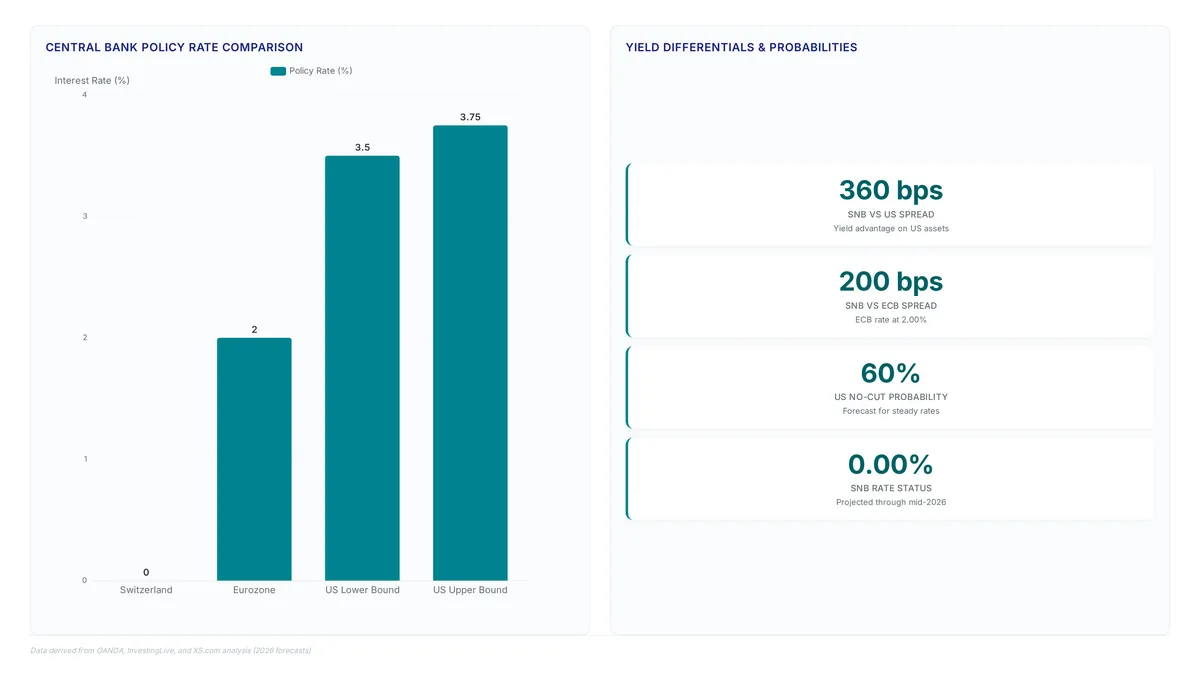
Market structure currently hinges on a single, stark reality: the Swiss National Bank stands alone at the zero bound while the United States maintains a restrictive posture. This isolation creates a yield differential quantified by a spread of approximately 360 basis points against US assets. Such a gap forces liquidity providers to model Swiss Franc scenarios where the SNB remains the sole anchor at zero percent. Flows are no longer driven by speculative narrative but by the confirmed zero-rate path and the resulting mathematical certainty of yield differentials. Network operators of capital observe these flows moving with mechanical precision, dictated entirely by the 360 basis point advantage available elsewhere in the.
SNB Quarterly Assessment Schedule Versus Fed Rate Volatility
March, June, September, and December mark the only dates that matter for Swiss monetary policy, creating a predictable rhythm that contrasts sharply with Federal Reserve volatility. Each of these quarterly assessments produces a policy decision alongside a published medium-term inflation forecast. This rigid calendar allows strategists to construct models with high confidence, knowing that every meeting yields both a decision and an updated projection.
Predictability in Bern meets chaos in Washington, creating friction for any trader attempting to time entries based on sentiment alone.
The divergence generates a unique arbitrage environment where the cost of holding Swiss Francs remains fixed by a substantial spread against substantial peers. SNB clarity exists, yet the lack of synchronization with US policy introduces significant friction for carry traders who must account for sudden shifts in American sentiment.
Meanwhile, the data sets the bias; the chart sets the entry. *Risk Warning: CFDs are complex instruments with a high risk of losing money rapidly due to use. You should consider whether you understand how CFDs work and whether you can afford to take the high risk of losing your money. Such divergence isolates the Swiss Franc as a low-yield funding vehicle rather than a primary income asset for conservative portfolios. The cost of holding Swiss assets remains effectively zero, yet the opportunity cost rises as global peers maintain restrictive stances. Investors asking should I invest in CHF based on SNB policy must recognize that the currency has slipped to seven-month lows as traders price in the prolonged zero-yield environment against higher-yielding counterparts. A confirmed shift in US inflation data triggering aggressive Fed easing would narrow the current high-rate differential.
Evaluating CHF Yield Attractiveness Against Fed Divergence
Holding Swiss Franc assets today sacrifices immediate income for capital preservation given the massive yield gap. This disparity forces a binary choice: accept negative real returns on CHF deposits or embrace the currency carry flexible where traders borrow Swiss Francs to fund higher-yielding dollar positions. Structural pressure remains bearish for the Franc unless global growth fears override yield-seeking behavior. However, the constraint of this strategy lies in the inherent volatility of exchange rates, where rapid CHF appreciation can impact carry trade profitability. Investors must weigh the certainty of the yield differential against the volatility of the exchange rate. A shift in the Federal Reserve's stance toward aggressive easing would narrow this spread and alter the short-CHF thesis.
Risks of Capital Flight in a Three-Way G10 Split
Sustained zero yields create immediate pressure for capital flight as investors seek returns elsewhere. The opportunity cost of holding Swiss Francs expands when global peers maintain restrictive stances, isolating the currency in a low-yield trap. This divergence compels market participants to borrow in CHF to fund higher-yielding positions, effectively reducing domestic liquidity and increasing volatility. Investors asking should I invest in CHF based on SNB policy must recognize that the SNB's mandate to ensure price stability prioritizes medium-term goals over short-term yield attractiveness. A sudden shift in global risk sentiment could trigger rapid outflows, punishing static portfolios. Data showing a coordinated global pivot toward easing would narrow the existing policy divergence.
About
Marcus Halloran, Chief Market Strategist at ForexCFD.top, leads our coverage of G10 macroeconomics and central bank policy. Halloran's daily work involves translating complex monetary policy shifts and interest rate differentials into actionable insights for retail traders, making him uniquely qualified to analyze the SNB's commitment to price stability. At ForexCFD.top, an independent publication dedicated to forex and CFD market news, Halloran applies his deep understanding of substantial central banks to clarify how decisions in Zurich impact global currency pairs. By focusing on factual analysis rather than hype, he helps our global audience navigate the nuances of low-rate environments and potential future hikes without endorsing specific third-party trading platforms. As long as Swiss Consumer Price Index data remains suppressed, the central bank cannot offer yield support, forcing investors to bear unlimited downside risk for zero income. This flexible creates a structural drag on long-term capital growth that simple diversification cannot fix without active management. Traders must recognize that holding static CHF positions is a speculative bet on global recession rather than a sound income strategy.
Investors should immediately cease treating Swiss Franc holdings as a passive safe haven and instead actively hedge currency exposure against higher-yielding assets. The window for passive preservation is closing as yield differentials widen structurally. Begin this week by calculating the exact breakeven exchange rate required to offset your current opportunity cost against dollar-denominated bonds. If your portfolio cannot tolerate a modest currency swing without triggering a loss, you must reduce CHF exposure now before volatility spikes. Do not wait for a policy shift that research trends indicate will not happen before 2026. Protect your capital by aligning your asset allocation with the reality of entrenched zero rates rather than hoping for a reversal that contradicts the SNB mandate.
Frequently Asked Questions
Raising rates would strengthen the Franc and hurt exports. Only four economists expect such a move, as the bank prioritizes keeping inflation under 2% without triggering excessive currency appreciation that damages trade.
Zero rates create a yield gap that drives capital toward higher-yielding assets. With the policy rate held at 0.00%, traders often seek carry elsewhere while hedging their Swiss Franc exposure to manage risk.
The bank refrains from intervention because a strong Franc makes energy imports cheaper. This approach cushions price shocks for households while maintaining the Consumer Price Index rise target of less than 2%.
The statutory obligation binds the bank to medium-term price stability.
Quarterly assessments provide medium-term inflation forecasts that guide decisions. Since 28 economists see rates staying static, these meetings confirm the persistence of zero interest rates rather than signaling immediate policy shifts.
References