
Trading bias beats rigid price predictions daily
Rigid price forecasts fail because market behavior acts as the ultimate arbiter, not your calendar.
Successful trading bias operates as a flexible probability framework. A prediction is a brittle binary bet on being right. Forex traders obsess over pinpointing exact exchange rates at specific times, ignoring the flexible reality of liquidity flows. Unlike a prediction, which demands validation of a single outcome, a bias regarding bullish or bearish momentum allows for immediate adaptation when technical factors shift. The market remains indifferent to individual conviction, punishing those who prioritize ego over evidence.
Distinguish between these two mindsets by examining the psychological traps of rigid forecasting versus adaptive positioning. Fundamental factors should inform an outlook without dictating an unchangeable path, referencing insights from The Disciplined Trader on waiting for market confirmation. Develop a flexible trading bias that evolves with price action, ensuring capital preservation when market behavior invalidates an initial hypothesis. This approach aligns with 2026 strategies that favor disciplined execution over aggressive speculation.
Defining the Core Distinction Between Prediction and Trading Bias
Prediction as Binary Forecast vs Bias as Probabilistic Inclination
A prediction functions as a rigid forecasting statement expecting a specific future outcome, creating a binary right-or-wrong expiration. This rigidity forces traders to ignore invalidating evidence when market data contradicts their initial forecast. In contrast, a trading bias represents a probabilistic inclination open for confirmation or negation from the markets. Being bullish or bearish under this framework allows flexible adjustment rather than demanding certainty about price levels. Psychological factors contribute to 70% of trading failures when operators treat flexible outlooks as fixed facts. A binary mindset ignores the massive daily volume that can swiftly invalidate static theses.
Low-price contracts between 5¢ and 20¢ win significantly less often than their implied probability suggests, creating a quantifiable favorite-longshot bias. Sophisticated participants have historically extracted approximately $40 million by exploiting these specific pricing inefficiencies across platforms like Polymarket. This anomaly represents a structural divergence where trading bias outperforms rigid prediction because the latter assumes fair value in irrational markets.
| Contract Type | Implied Probability | Actual Win Rate | Bias Direction |
|---|---|---|---|
| Longshot | 5¢, 20¢ | Far Lower | Overvalued |
| Favorite | 80¢, 95¢ | Higher | Undervalued |
Regulatory structures influence how these biases manifest; for instance, Kalshi operates under CFTC oversight while other venues function offshore, altering the liquidity profiles where arbitrage occurs. The limitation of exploiting this bias lies in capital efficiency rather than detection. Identifying mispriced assets requires continuous monitoring of price action against real-world event outcomes. Operators must distinguish between a temporary market overreaction and a permanent structural flaw in pricing logic. While prediction demands a binary correct-or-incorrect outcome, maintaining a bias allows traders to scale exposure as the market corrects or further deviates.
Failure to adjust for this bias results in negative expected value over thousands of trades. The market does not correct simply because a forecast claims it should. Successful participants treat the probability embedded in the price as a variable to be tested, not a fact to be believed.
Rigid Price Targets vs Flexible Bullish or Bearish Outlooks
A prediction locks a currency pair to a fixed price at a specified time, creating binary failure modes when markets deviate. This rigid structure contrasts sharply with a trading bias, which functions as an inclination open for confirmation. Being bullish or bearish under this framework allows operators to adjust exposure dynamically rather than defending an obsolete thesis. The cost of rigid forecasting is measurable: traders ignoring invalidating evidence often face total capital depletion, whereas bias-driven frameworks preserve liquidity through adaptive positioning. Educational resources by June 2026 explicitly distinguished these concepts to reduce psychological friction during volatile sessions.
| Feature | Rigid Prediction | Flexible Bias |
|---|---|---|
| Outcome State | Binary (Right/Wrong) | Probabilistic Inclination |
| Market Response | Ignore Contradictions | Accept Negation |
| Time Horizon | Fixed Expiration | Open-Ended Duration |
| Risk Profile | High (All-or-Nothing) | Managed (Adjustable) |
Operators clinging to static targets frequently miss trend reversals because their mental model demands the market conform to their forecast. A bias acknowledges that technical and fundamental factors shift, requiring continuous re-evaluation of the forex environment. Systems designed around fixed price targets will fail during volatility spikes, while those programmed with probabilistic thresholds maintain uptime. Adaptability prevents the catastrophic losses associated with trying to prove a specific price point correct against overwhelming contrary data.
The Psychological Mechanics of Rigid Forecasts Versus Adaptive Behavior
Confirmation Bias in Rigid Forecasting
Fixating on EUR/USD at 1.1000 as a "right" price creates a dangerous blind spot when real-time data contradicts the thesis. This cognitive mechanism, formally identified as cognitive bias in 1972, forces operators to filter out invalidating signals to protect a rigid forecast. Predictions are static statements, whereas biases remain open for confirmation. Ignoring this distinction leads to catastrophic outcomes, evidenced by data showing 95% of retail traders lose capital long-term due to inflexible positioning.
The operational failure occurs when an operator defends a specific level rather than adapting to the market environment.
- The trader establishes a hard price target based on a prediction.
- Price action moves against the thesis, generating invalidating signals.
- Confirmation bias suppresses these signals to maintain the original forecast.
- Accumulated losses mount as the trader refuses to exit or reverse.
Having a blind prediction without considering market behavior proves detrimental when volatility spikes. If a trader keeps trying to prove a forecast correct while the market disagrees, they inevitably face sequential losses. The market remains the ultimate authority, indifferent to individual expectations or desired outcomes.
Validating Bias with Market Action
Confirmation requires waiting for price action to validate a trading bias before committing capital. Mark Douglas states in *The Disciplined Trader* that operators must not back a judgment until market action confirms the opinion. This discipline prevents the energy drain associated with defending rigid forecasts against contrary data. Mike Bellafiore notes in *One Good Trade* that wasting time on predictions sacrifices the skill development required for consistent execution.
Predictions are often rigid statements, whereas biases remain open for negation. This flexibility allows traders to process information without the emotional burden of being proven wrong.
Overconfidence in predictions stems from believing one can control market outcomes rather than reacting to them. A trader fixated on a specific price target often misses the shift in price action because they seek validation instead of truth. The limitation here is psychological; the brain prefers the certainty of a forecast over the ambiguity of real-time data. Operators must shift focus from being right to being profitable by aligning with current market behavior. Skill development outweighs forecast accuracy because markets remain unpredictable over short horizons. Discipline demands acting only when the market validates the initial inclination.
Solvency Risks of Irrational Markets
John Maynard Keynes warned that markets remain irrational longer than a trader can stay solvent, defining the hard limit of rigid forecasting. Maintaining a fixed position against prevailing price action ignores the reality that the market is BOSS and operates independently of individual opinion. When traders refuse to adjust to market signals, they face direct financial penalties like widened slippage of 2 to 5 pips during volatile news events. This specific cost erodes capital quicker than adaptive strategies that treat bias as open for negation.
The core danger lies in treating a prediction as an immutable truth rather than a hypothesis subject to disproof.
Developing a Flexible Trading Bias Through Market Confirmation
Defining Flexible Bias Versus Rigid Prediction
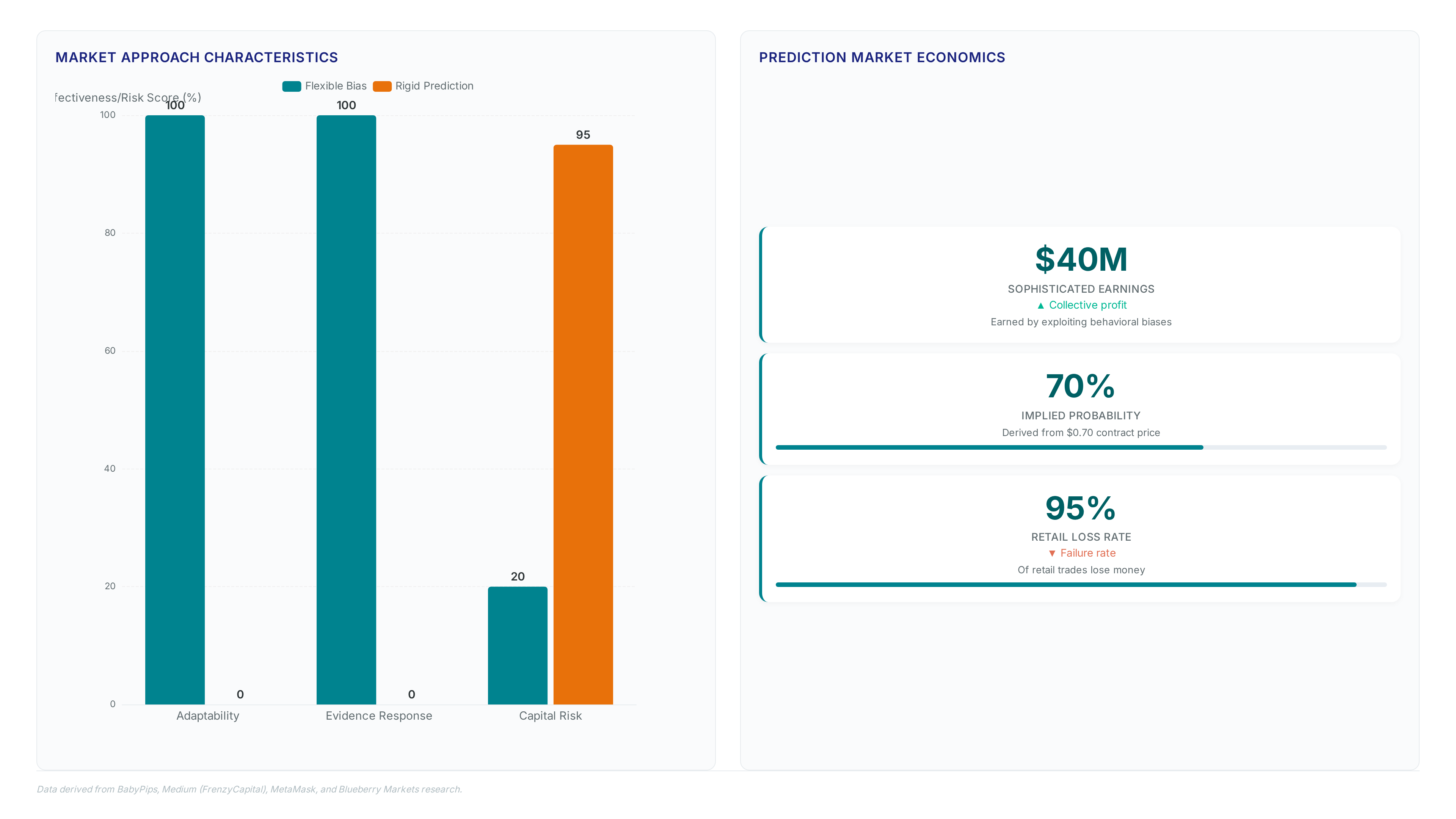
A trading bias functions as a probabilistic inclination open for confirmation. This structural difference dictates capital survival rates during volatile cycles. Predictions create binary traps where the operator must be right or wrong, often ignoring invalidating evidence to protect the ego. Flexible frameworks allow traders to process information with an open mind, adjusting exposure as price action evolves. Rigid forecasts lock capital into static positions that market forces can easily overwhelm. Historical analysis shows that well-informed marginal traders drive market forecasts regardless of low-information consensus, rendering stubborn predictions obsolete quickly. The psychological burden of being "wrong" disappears when the framework accepts negation as valid data rather than failure. Operators focusing on skill development rather than fortune-telling preserve mental energy for execution. Mike Bellafiore argues that wasting time on predictions sacrifices the skill development required for consistency. Adaptability separates profitable accounts from those liquidated by irrational market extensions. Traders seeking structured guidance on implementing these concepts should consult Coverage Pillars for disciplined methodology.
Executing Trades Only After Market Action Confirmation
Entry occurs strictly when price action validates a hunch, avoiding the trap of rigid forecasting. Mark Douglas advises in *The Disciplined Trader* that operators must never back a judgment until market behavior confirms the opinion. This discipline shifts focus from guessing direction to reacting to real-time data, ensuring capital is committed only when probability aligns with execution. Mike Bellafiore writes in *One Good Trade* that developing a correct bias means nothing without the trading skills to capture the move. Wasting energy on predictions diverts attention from the skill development required for consistent profitability. The strategic goal of bias-focused trading aims for consistency rather than being right about timing. Unlike static forecasts, a flexible bias remains open for negation. This flexibility prevents the emotional fatigue associated with defending a binary outcome against contrary evidence. Dr. Brett Steenbarger mandates trading what the market does, not what one desires it to do in fantasy.
Adopting this methodology requires ignoring the urge to be correct in favor of being profitable. The limitation is immediate; traders often feel inactive while waiting for confirmation signals that may not appear for hours. Yet, acting without this validation guarantees exposure to irrational market phases that erode solvency quicker than missed opportunities.
Application: Solvency Risks When Markets Remain Irrational
Rigid forecasts trigger insolvency when operators ignore price action that contradicts their initial outlook. John Maynard Keynes observed that markets stay irrational longer than a trader remains solvent, defining the hard boundary for capital preservation. Maintaining a fixed position against prevailing trends forces exposure to widening spreads, specifically the 2 to 5 pips of slippage documented during volatile news events. This mechanical cost accelerates drawdown quicker than adaptive strategies can recover losses. Traders treating bias as fact often ignore invalidating evidence, a behavior linked to confirmation bias in market interaction studies. Such rigidity prevents the necessary pivot when market signals negate the original thesis. Unlike static predictions, a valid bias remains open for negation. The consequence is binary: adapt the view or face total equity depletion. Operational discipline requires treating every trading bias as a hypothesis rather than a guarantee. Coverage Pillars emphasizes that execution skills matter more than forecast accuracy when volatility spikes. Traders must validate inclination against actual market behavior before committing significant capital. Failure to align with the BOSS market results in compounded errors and inevitable account failure.
Strategic Lessons for Maintaining Emotional Discipline in Volatile Markets
Defining Emotional Discipline as Market-Action Confirmation
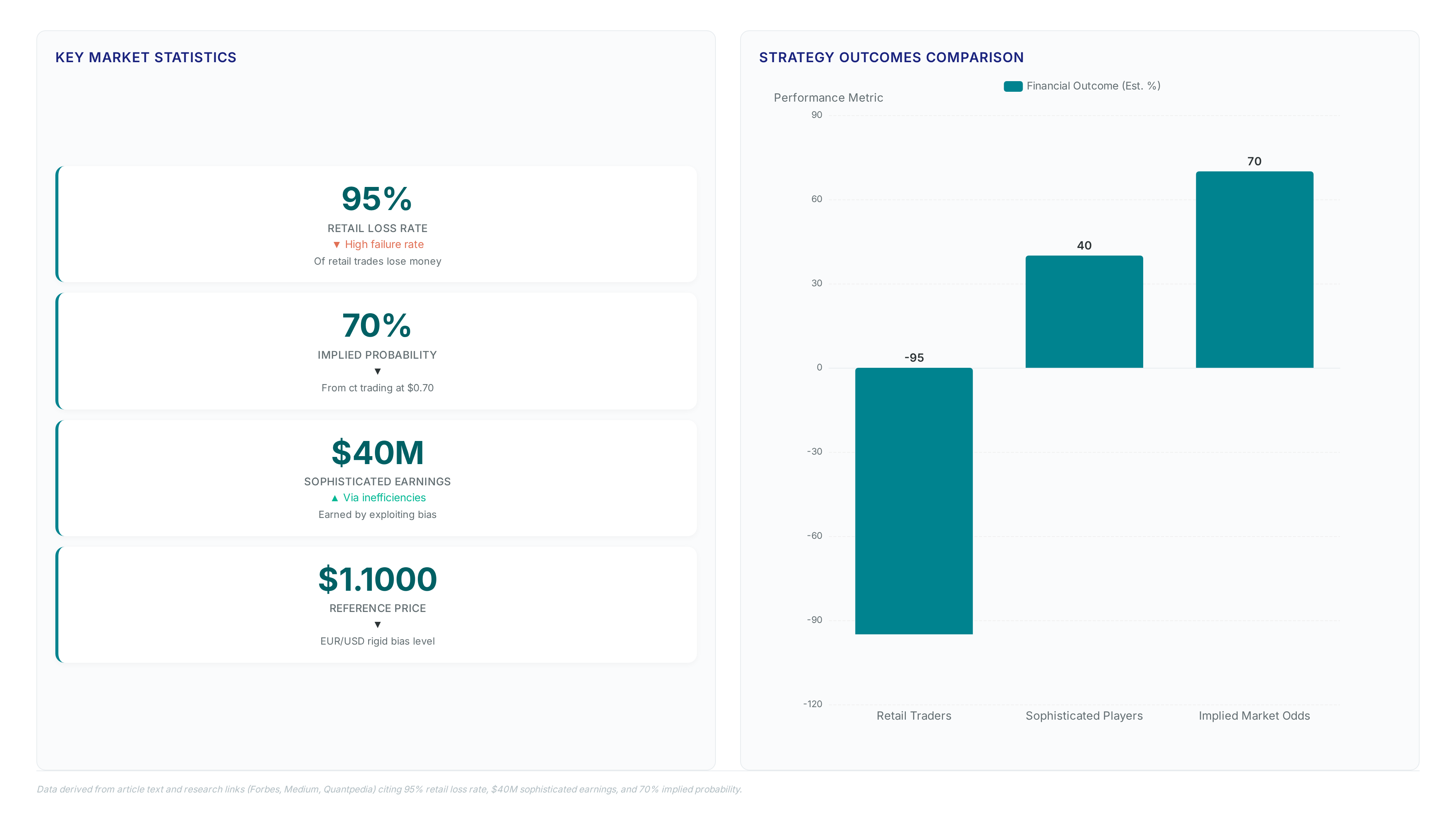
Waiting for market-action confirmation stops traders from forcing rigid forecasts onto live price data. Mark Douglas argues in *The Disciplined Trader* that operators must not back a judgment until the market itself confirms the opinion. This stance treats a trading bias as a flexible inclination open to negation. Rigid predictions often trap participants in binary outcomes where being wrong results in immediate financial penalty. Industry analysis from April 2026 identifies market discipline. The strategic goal shifts from proving a thesis correct to maintaining consistency. Blindly holding a position while ignoring contrary signals leads to a string of losses that deplete capital reserves. John Maynard Keynes noted that markets remain irrational longer than a trader stays solvent, highlighting the solvency risk of stubbornness. Admitting error quickly when price action invalidates the initial bias presents a psychological hurdle. Operators who fail to adjust miss opportunities when the trend reverses, compounding errors through emotional attachment. True skill involves developing the trading skills necessary to capture moves only after the market validates the direction. Coverage Pillars recommends focusing on execution mechanics over prediction accuracy to survive volatile cycles.
Applying Flexible Bias to Avoid EUR/USD Rigidity Traps
One documented case shows a trader fixating on EUR/USD at 1.1000 as the "right" price due to bias, failing to react to real-time price movements while capital eroded. This rigid prediction ignored the market reality that prices are open for confirmation. Adapting to such shifts requires treating bias as a flexible inclination rather than a fixed forecast. When price action contradicts the initial outlook, the flexible trader exits immediately instead of hoping for validation. Industry commentary from April 2026 highlights that strategies centering on adaptability now outperform those relying on aggressive prediction accuracy. Immediate exposure to slippage and missed reversals follows any neglect of this shift. Operators must process information with an open mind to avoid the psychological trap of proving a forecast correct.
- Monitor price action for invalidation signals before entry.
- Treat market behavior as the final authority on trade validity.
- Exit positions when real-time data negates the original hypothesis.
- Accept that capital preservation depends on market independence from personal opinion.
The limitation of this approach is the psychological difficulty of admitting error quickly. Successful execution demands discarding the need to be right in favor of remaining solvent.
Lessons: Solvency Risks When Irrational Markets Outlast Capital
Com/write-a-catalyst/prediction-vs-trading-why-you-need-both-not-just-one-to-be-profitable/). The financial impact of the "longshot bias" creates exploitable opportunities worth millions annually for experienced traders who understand the mispricing in prediction market biases. Relying on blind predictions rather than flexible bias leaves capital vulnerable to these extracted values. Operators must shift focus from forecasting outcomes to managing emotional discipline through flexible adjustment. Coverage Pillars com) recommends training systems that prioritize reaction speed over prediction accuracy to mitigate solvency risks. Total account liquidation occurs when the market extends its irrational phase and the trader refuses to adapt. Survival depends on recognizing that the market remains BOSS regardless of individual conviction.
About
Vikram Nair serves as the Emerging Markets & Asia FX Writer at ForexCFD. Top, where he specializes in the detailed dynamics of Tier-2 and Tier-3 currency pairs. His daily analysis of volatile assets like USD/INR and USD/NGN requires a disciplined distinction between rigid price predictions and flexible market biases. Unlike substantial pairs, emerging market currencies often react unpredictably to local central bank policies from the RBI or CBN, making binary forecasting dangerous. Nair's expertise lies in interpreting these complex macro signals to form actionable trading biases rather than fixed outcomes. This approach aligns perfectly with ForexCFD. Top's mission to provide vendor-neutral, risk-aware education to global retail traders. By focusing on probability over certainty, Nair helps readers navigate the inherent uncertainty of FX trading, ensuring their strategies remain adaptable to the rapid shifts characteristic of developing economies and commodity-driven markets.
Conclusion
Scaling a trading operation exposes the fatal flaw of rigid conviction: liquidity evaporation during extended mispricing events. While small accounts suffer slippage, large capital faces structural insolvency when psychological attachment prevents exit. The operational cost of maintaining a biased position exceeds mere drawdown; it creates a compounding opportunity cost that drains resources while the market remains irrational. By 2027, successful firms will differentiate themselves not by prediction accuracy, but by algorithmic adaptability that exits before emotional interference occurs.
Adopt a hybrid execution model immediately if your current drawdown exceeds a modest threshold annually due to hesitation. This approach mandates separating signal generation from risk management, ensuring that capital preservation protocols override subjective outlooks within two quarters. You must treat every open position as a temporary hypothesis subject to immediate falsification by price action.
Start by auditing your last ten losing trades this week to identify the specific time-to-exit delay caused by hoping for a reversal. Calculate the exact dollar value lost solely due to this latency and set a hard rule cting future hold times during adverse moves. This data-driven adjustment shifts your focus from being right to remaining operationally solvent.
Frequently Asked Questions
Rigid predictions fail because psychological factors drive 70% of trading failures when traders treat flexible outlooks as fixed facts. This binary mindset ignores the massive $7.5 trillion daily volume that can swiftly invalidate any static thesis regarding future price levels.
Sophisticated participants have historically extracted approximately $40 million by exploiting pricing inefficiencies caused by behavioral biases in prediction markets. This profit demonstrates how maintaining a flexible trading bias outperforms rigid predictions that assume fair value in irrational markets.
Entry-level access to proprietary trading capital for testing biases starts at just $29 for a $2,500 account size via specific CFD prop firms. This low barrier allows traders to validate probabilistic inclinations without risking significant personal savings on binary forecasts.
Emotional trading errors, known as going on tilt, lead to significant but unquantified financial losses for retail traders who ignore strategy. These mistakes often occur when traders force binary outcomes instead of adapting to the fluid $7.5 trillion daily market volume.
Retail traders face widened slippage of 2 to 5 pips during news events, a direct financial penalty exacerbated by rigid predictions. This cost accumulates quickly when traders refuse to adjust their bias as market behavior invalidates their initial hypothesis immediately.