
Trading psychology: Why 95% of retail traders fail
Ninety-five percent of retail forex trades fail because traders ignore cognitive bias over chart signals. While volatility scares amateurs, MH Markets reports that psychological dominance is the single biggest risk factor in 2026, outweighing market swings as the primary determinant of success. The real cost of trading is not commissions or slippage; it is the mental rigidity that blinds traders to breakout failures and trend reversals happening in real-time.
Instead of monitoring broader market impacts, they fixate on pip counts, a tunnel vision that MH Markets identifies as a critical flaw in modern risk management. A massive daily market.
You will learn to identify the specific cognitive traps that cause missed market opportunities and how to replace stubbornness with scenario planning. By examining the mechanics of reversal failures, we will outline how to build the mental flexibility required to pivot when price action defies your initial thesis. Success in this environment belongs to those who can detach from their biases and execute based on objective reality rather than emotional investment.
The Role of Cognitive Bias in Missed Market Opportunities
Defining Trading Psychology and the 70% Failure Rate
Execution fails when the mind refuses to see the chart. Trading psychology maps the cognitive errors driving these lapses, studying how mental blocks like confirmation bias warp real-time price recognition. In a market processing massive volume daily, small individual lapses compound into massive capital loss. Roughly 95% of retail forex trades result in a loss over time because emotion goes unchecked. Anchoring stops traders from accepting data that contradicts their first idea. Confirmation bias forces chart signals to fit a preferred story instead of reality. These habits create blind spots during key breakout events.
Success in 2026 belongs to disciplined traders rather than bold ones. Fear or greed often overrides chart analysis during the decision phase. This psychological dominance creates more account blowouts than volatility ever could. Markets ignore personal exposure or desired outcomes entirely. Objective scenario planning stands as the only defense against such human flaws. Confirmation bias filters new price data to match old trade narratives, blinding operators to valid reversal signals. Traders cling to losing positions even after clear Break of Structure failures occur. Such distortion explains why cognitive tendencies keep traders on the wrong side of substantial moves during volatile sessions. The Babypips
A trend reversal definition requires price to break prior structural highs or lows, yet biased operators dismiss these breaches as noise. AUD/USD might range between 0.6600 and 0.6700 for weeks, training traders to fade edges until a confirmed breakout happens. Those ignoring the shift suffer because psychological dominance now outweighs volatility as the main risk factor in 2026. Logical trading demands discarding the anchor of an original thesis when price action contradicts.
Operators must adopt scenario planning to counteract these flaws. Reading the full School of Pipsology Capital erosion remains inevitable without this discipline.
The Confidence Toll of Missing Forex Breakouts
Missing valid breakouts destroys trading confidence and pushes operators toward high-risk recovery behaviors that multiply losses. Traders who fail to capitalize on strong momentum feel psychological pressure that compels them to commit classic newbie mistakes while chasing entry. This desperation stems from a misalignment where emotional urgency overrides technical discipline during critical session transitions. As 2026 approaches, success will increasingly belong to controlled operators because psychology now exceeds volatility as the primary risk factor Specific time-based traps, such as London breakout falsifications or New York reversals, require distinct mental frameworks to navigate effectively.
Failing to execute on these setups draws a sharp line between profit and sustained capital depletion. Operators who ignore these signals often force trades in low-probability environments, compounding initial missed opportunities with fresh errors. Spotting reversals remains a learnable habit, yet the window to correct course narrows with each ignored signal. Consistent profitability demands that traders recognize when bias blinds them to bear traps forming at key support levels.
Inside the Psychology of Breakout and Reversal Failures
Pip Myopia: How Focus on Personal Pips Blinds Traders to Market Moves
Pip myopia sets in when traders fixate on position size rather than broader market structure during volatility. Average participants often calculate potential gains in pips while ignoring the event's impact on wider markets. This narrow field of view creates blind spots where valid breakouts occur unnoticed by those staring at their own P&L. Consistently profitable operators monitor personal metrics but prioritize how news drives liquidity across asset classes. The distinction between trend trading and breakout recognition hinges on this scope of attention. Trend strategies assume directional continuity, whereas breakout scenarios require monitoring liquidity clusters that often trigger false breakouts (fakeouts). A specific false breakout scenario involved a stock breaking above a $300 resistance level only to reverse sharply and drop to $220 within two months. This movement illustrates a potential loss of over 26% of the asset's value due to premature entry based on bias.
Clinging to losing trades while ignoring macro catalysts guarantees capital erosion. An operator who refuses to see changes happening right under their nose effectively disables their ability to build solid entry and exit strategies. The cost of failure manifests as repeated missed opportunities rather than a single catastrophic loss. Psychological barriers prevent the necessary shift toward building solid entry and exit strategies when a catalyst can drive price action for days.
Executing Entries Amidst 2-5 Pip Slippage During News Spikes
Retail execution during news spikes suffers from slippage widening to between 2 and 5 pips, instantly invalidating tight breakout entries. This mechanical friction occurs because liquidity evaporates precisely when retail traders attempt market orders. Algorithms exploit this vulnerability by targeting liquidity clusters at round numbers to fill large institutional size with minimal impact. Operators focusing solely on personal profit metrics often miss these structural psychological price levels where the actual trade trigger resides. Recognizing valid breakouts requires distinguishing between genuine momentum and algorithmic traps designed to capture stops. A common failure mode involves entering on the initial spike, only to watch price reverse as false breakouts clear the order book.
Fixing missed breakout trades demands a shift from reactive chasing to proactive scenario planning. Operators must define entry zones that account for potential algorithmic aggression rather than assuming linear price travel. If a breakout occurs without a retest, the opportunity is lost, and chasing leads to entering at the exact point of maximum exhaustion. The cost of impatience is entering a position where the risk-reward ratio has already collapsed due to expanded spreads. Successful navigation of these events requires accepting that some moves are inaccessible without assuming undue risk. Discipline dictates waiting for the market to return to a stable price level before committing capital.
Catalyst-Driven Strategies vs. Bias-Driven Clinging in Trend Trading
Catalyst-driven planning anchors entries to multi-day price drivers, while bias-driven clinging ignores structural breaks to protect existing positions. Traders focused on personal P&L often miss the broader market impact required to validate a move. When an operator believes a catalyst can drive price action for days, shifting focus toward building solid entry and exit strategies becomes mechanically simpler than defending a losing bias. This discipline counters the tendency to miss breakouts identified in Babypips research False breakouts (fakeouts) frequently trap biased participants who enter without confirmation rules. Institutional algorithms specifically target these psychological clusters, forcing premature exits before genuine trends develop.
Session-specific patterns demand distinct tactical responses rather than rigid adherence to a single narrative. Operators must recognize that session-specific traps like London breakouts require different validation than New York reversals. Sticking stubbornly to a bias despite evidence of a trend shift guarantees capital erosion. The cost of refusing to see changes under one's nose is total account failure. Successful navigation requires abandoning the comfort of known positions for the uncertainty of objective market recognition.
Building a Mental Edge Through Scenario Planning
Defining Scenario Planning for Forex Breakouts
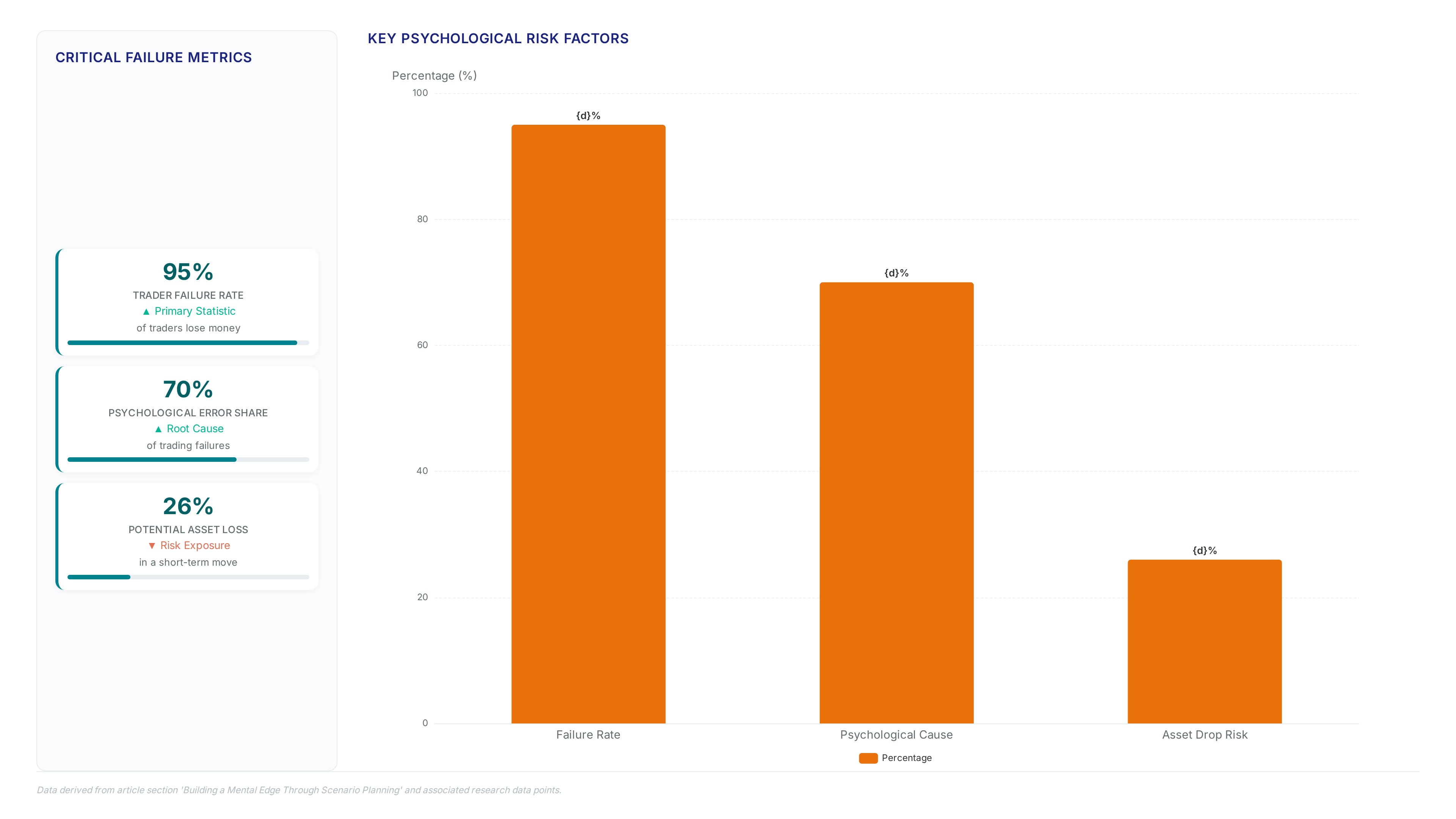
Explicit alternate trade scenarios counter rigid bias-driven execution. This methodology mandates that operators draft Plan B entries for every primary thesis, promoting flexibility when price action invalidates the initial catalyst. Without pre-set contingency paths, emotional attachment to a single outcome forces traders to ignore structural breaks, a behavior linked to the fact that psychological errors drive the majority of trading failures. Market structure often shifts rapidly around psychological price levels like 1.0000 or $4,000, where institutional algorithms hunt liquidity. A rigid approach fails here because false breakouts exploit static stop-loss clusters. By contrast, a catalyst-driven framework adapts to news flow, requiring technical confirmation via tools like the Relative Strength Index (RSI) before committing capital. This adaptability addresses the session-specific traps identified in session-specific patterns research, such as "London breakouts" that reverse during New York hours.
Cognitive load presents the main limitation for this approach since maintaining multiple active hypotheses simultaneously is difficult. Operators must monitor divergent outcomes without paralysis, a skill distinct from simple trend following. Failure to implement these redundant scenario trees leaves retail participants vulnerable to the high failure rates documented in false breakout prevalence studies. Ultimately, the cost of ignoring alternate scenarios is total account erosion when the market invalidates a singular bias. Coverage Pillars recommend integrating these scenario trees into daily pre-market routines. Traders who ignore this discipline often find themselves on the wrong side of substantial moves, clinging to losing positions while valid reversals unfold unnoticed. These round numbers act as magnetic barriers that often trigger false breakouts before genuine trend reversals occur. Retail participants frequently enter positions at these highs without confirmation, exposing capital to immediate reversals driven by institutional hedging.
Technical validation requires the Relative Strength Index (RSI) reading above 70 to confirm unsustainable momentum before executing counter-trend entries. This specific threshold identifies overbought conditions where price exhaustion often precedes a structural break. Traders ignoring this filter face higher probabilities of entering during terminal price extensions rather than valid breakout continuations. Scenario planning demands drafting explicit Plan B entries for every primary thesis to counter rigid bias-driven execution. If price breaches 1.1000 but fails to hold, the alternate path dictates an immediate exit rather than hoping for recovery. This flexibility prevents the emotional attachment that causes operators to miss valid reversal signals entirely.
Lost opportunity and expanded drawdowns during volatile sessions measure the cost of ignoring these structural shifts. Algorithms increasingly scan for stop-loss clusters at these exact levels to fuel large order fills with minimal slippage. Operators who fail to anticipate this mechanical reality provide the liquidity that smarter participants exploit for profit. Building a mental edge requires treating every psychological price level as a potential trap until proven otherwise by volume and momentum data. Success depends on waiting for the market to prove intent rather than assuming direction based on proximity to a whole number.
Trade Journal Checklist Using Tradezella and FundedNext
Validate every alternate scenario by logging failed breakouts at 1.0000 or $10,000 using AI-Powered Trade Journaling to capture bias-driven errors. Operators must record why the primary thesis failed and document the specific catalyst that drove the reversal, ensuring psychological distance. This process transforms raw data into actionable intelligence, countering the tendency to ignore structural breaks.
| Tool | Primary Function | Validation Metric |
|---|---|---|
| Tradezella | Replay & Backtesting | Scenario Completion Rate |
| FundedNext | Simulated Capital | Risk-Free Execution |
Practice these recorded scenarios on simulated funds to test flexibility without capital exposure. A rigid journal entries only win/loss status, whereas a strong checklist captures the *reasoning* behind Plan B activation. The limitation is time; detailed logging requires discipline that many retail participants lack during volatile sessions. Consequently, traders who skip this step often repeat the same confirmation bias errors, mistaking luck for skill during subsequent market cycles. Use Zella AI to automate pattern recognition within historical replays, highlighting where emotional decision-making overridden chart signals. This structured approach ensures that every missed opportunity becomes a calibrated lesson rather than a statistical anomaly.
Strategic Adaptation for Long-Term Trading Consistency
Defining the Switch Point: When Psychology Overrides Strategy

The switch point activates when emotional attachment invalidates a trading plan, a breakdown where emotional execution errors destroy capital quicker than market volatility. Operators must distinguish between normal price fluctuations and the moment psychology overrides strategy. This distinction separates professionals from the statistical majority who fail due to uncontrolled impulses.
- Identify Bias Clinging: Refusal to exit a losing position despite clear structural breaks signals that cognitive bias has hijacked the trading plan.
- Monitor Control Metrics: Since trading success
- Enforce Scenario Switching: Deploy pre-set Plan B entries immediately when the primary thesis fails, preventing the paralysis often seen when emotional decision-making blocks adaptation.
Execute a trade only when Relative Strength Index (RSI) exceeds 70 while a verified news catalyst aligns with the directional bias. This dual-confirmation rule filters noise from genuine momentum shifts driven by macroeconomic data releases. Traders must cross-reference technical overextension with latest market news to validate that price action reflects fundamental reality rather than algorithmic hunting.
- Verify RSI readings surpass the 70 threshold to confirm unsustainable momentum conditions.
- Confirm a scheduled economic announcement or geopolitical event supports the proposed market narrative. 3.4. Ensure slippage estimates remain within acceptable limits before committing capital to the breakout.
| Condition | Technical Signal | Catalyst Requirement |
|---|---|---|
| Entry Valid | RSI > 70 | News alignment |
| Entry Invalid | RSI < 70 | No news support |
| False Breakout | RSI divergence | Rumor only |
The cost of ignoring this protocol is exposure to false breakouts where institutions trap retail liquidity at round numbers. A significant majority of traders fail because they prioritize speed over verification during volatile spikes. Discipline requires waiting for the specific convergence of indicator data and external drivers before execution. Operators who skip catalyst confirmation often fall victim to emotional execution errors that erase accounts over time. The absence of a news driver suggests the move lacks the fuel to sustain a trend reversal. Strict adherence to this checklist prevents chasing price into traps set by smarter money.
About
Marcus Halloran serves as Chief Market Strategist at ForexCFD. Top, where he uses his background as a former interbank FX strategist to decode complex market dynamics for retail traders. His extensive experience navigating London's high-pressure trading floors provides unique authority on trading psychology, specifically regarding why traders miss critical breakouts and trend reversals. Having executed billions in G10 macro positions, Halloran understands that psychological barriers often override technical analysis, leading to the hesitation that plagues 95% of retail accounts. At ForexCFD. Top, an independent publication dedicated to vendor-neutral education, he translates these institutional insights into actionable strategies. His daily work involves analyzing how central bank decisions impact trader sentiment, allowing him to identify the exact moments where fear and uncertainty cause missed opportunities. By connecting deep macroeconomic expertise with behavioral patterns, Halloran helps traders overcome the mental blocks that separate consistent profits from recurring losses.
Conclusion
The massive daily volume creates a liquidity environment where institutional algorithms specifically target unverified momentum at round numbers. When traders ignore the convergence of technical overextension and fundamental drivers, they effectively subsidize the market's operational efficiency with their own capital. This flexible does not improve with experience alone; it demands a rigid adherence to data-backed protocols that filter noise from genuine structural shifts. The operational cost of skipping catalyst confirmation is not merely a lost trade, but a systematic erosion of equity that compounds until the account becomes untenable.
Adopt a strict 48-hour verification window for any position exceeding a small fraction of your portfolio starting next Monday. If a setup lacks a scheduled macroeconomic driver alongside its technical signal, categorize it as noise and refuse execution regardless of apparent momentum. This timeline forces a shift from reactive gambling to proactive capital preservation. Begin this week by auditing your last ten entries against the RSI and news alignment matrix; immediately flag any trade executed without dual confirmation as a procedural failure rather than a market anomaly. This specific audit reveals whether your losses stem from bad luck or a broken validation process that requires immediate repair before further deployment.
Frequently Asked Questions
Most traders fail because unchecked emotion overrides technical analysis during decisions. Roughly 95% of retail forex trades result in a loss over time due to this lack of psychological discipline.
Cognitive errors cause the majority of execution failures by filtering new price data incorrectly. Approximately 70% of traders miss these critical market shifts because they cling to losing positions.
Traders can reduce initial costs for AI-powered trade journaling software significantly. Using the specific code "PIPS20" grants users a 20% discount on their first purchase of these essential tracking tools.
Selected participants in the evaluation phase can earn a portion of their profits early. The firm offers a 15% performance reward specifically during the challenge phase for successful simulated trading.
Fixating on pip counts creates tunnel vision that blinds traders to broader market impacts. This mental rigidity causes operators to ignore valid reversal signals happening in real time.