
USDCAD Holds 1.39599 Despite Middle East Tensions
With $9.6 trillion in daily volume reported by the Bank for International Settlements, USDCAD remains resilient despite Middle East tensions.
The pair's current stability defies typical geopolitical panic. Instead, a looming USMCA rewrite and distinct technical support levels drive price action, creating an environment institutions are quietly exploiting. While retail traders obsess over headlines, autonomous trading algos from firms like ING and Commerzbank filter noise, prioritizing structural data points over emotional reactions to conflict. A potential de-escalation in the Middle East simply shifts focus back to U. S. -Canada trade relations, specifically regarding the friction between current administrations. The mechanics of the 100-hour moving average at 1.39599 and the critical swing area between 1.3948 and 1.3966 recently halted downside momentum. Sellers must now reclaim the 200-hour level near 1.3937 to invalidate the current bullish bias.
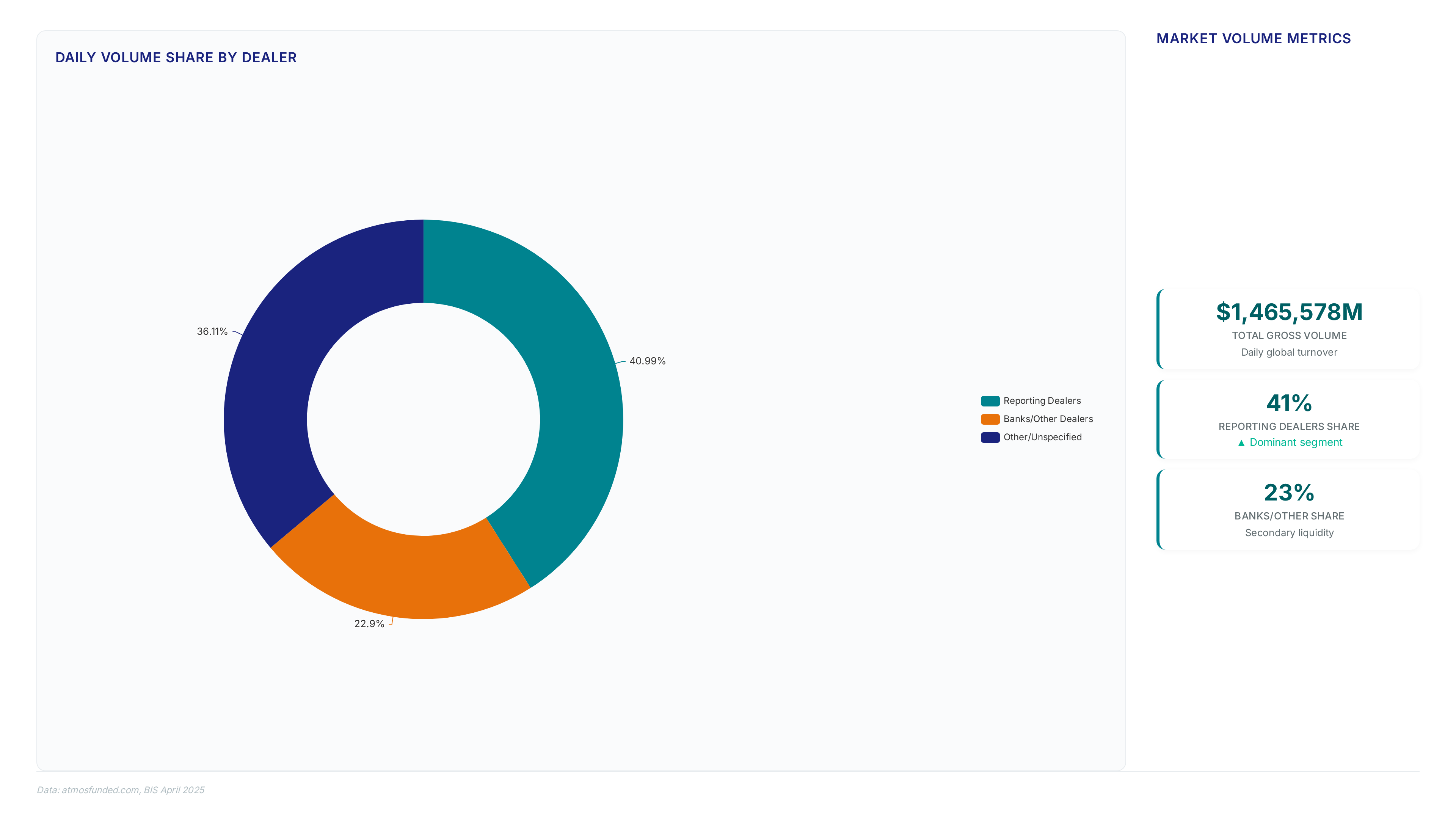
The market reacts to the failure of sellers to break key technical floors despite external chaos. As the New York Fed FX Committee notes that reporting dealers still command roughly 41% of North American volume, the ability to read these technical rejection zones separates profitable positioning from reactive gambling.
The Role of Geopolitical Context in USDCAD Price Dynamics
Defining USDCAD Geopolitical Drivers Beyond Technicals
Binary sentiment shocks currently define geopolitical drivers for USDCAD, overshadowing structural trade flow interruptions. Market participants treat the "US-Iran Schrödinger's cat deal" narrative from June 11, 2026 as a transient liquidity event, distinct from the enduring friction surrounding a potential USMCA rewrite. Daily global forex turnover reached $9.6 trillion, supplying sufficient depth to absorb regional spikes without breaking technical ranges. Algorithmic execution prioritizes established moving averages over unconfirmed diplomatic headlines, causing this decoupling.
Noise often mimics signal when oil prices fluctuate on blockade rumors. A barrier exists where only sustained moves justify position turnover due to the cost of trading futures versus CFDs. Direct transaction fees for futures average $6.47, incentivizing range-bound behavior until diplomatic outcomes become certain. Technical support zones hold firm because the capital required to break them exceeds the risk premium of unresolved geopolitical tension. Operators must distinguish between temporary Middle East volatility and actual U. S. -Canada policy shifts.
USDCAD held the 1.3948 - 1.3966 swing support area despite Middle East escalation because buyers defended the 100-hour moving average at 1.39599. Price action stalled near this confluence, preventing a breakdown that technical algorithms often trigger when conflict narratives intensify. The inability to breach these levels highlights how Simple Moving Average calculations act as flexible liquidity pools during geopolitical uncertainty. Sellers attempted to push rates lower during the Asian-Pacific session but lacked the momentum to sustain a break below the key zone. This behavior contrasts with the higher transaction fees found in futures markets, where direct costs can deter rapid repositioning compared to spot.
Immediate news flow takes a backseat to these technical anchors, creating a temporary disconnect between headline risk and price discovery. Conflict resolution typically invites risk-on flows, yet the specific alignment of the time frame hierarchy forced a pause in bearish momentum. Traders now watch for a decisive close below the 200-hour average to confirm any trend reversal. Technical structure overrides the geopolitical backdrop until that shift occurs.
Risks of Ignoring USMCA Trade Negotiation Headlines
Liquidity fragmentation replaces geopolitical conflict as the primary USDCAD volatility driver if USMCA rewrite risks are overlooked, especially as reporting dealers controlling 41% of North American volume pivot attention. Trade headlines now dictate flow more than Middle East resolutions according to market participants analyzing Session Wraps, creating a vacuum where technical supports fail without fundamental backing.
Deep learning models from institutions like Bank of China require input recalibration since algorithms trained on conflict data misprice trade-negotiation risk. Technical buyers holding above the 100-hour moving average lack conviction if trade talks sour. Portfolios face rapid repricing when the buyers vs sellers balance tips on a single tariff announcement rather than a missile strike.
Mechanics of Moving Averages and Swing Area Identification
Defining the 100-Hour and 200-Hour Moving Average Benchmarks
The 100-hour and 200-hour moving averages function as flexible support or resistance based on historical price sums divided by session counts. This Simple Moving Average calculation creates a rolling baseline that reacts to new closing data while discarding older ticks. Traders prioritize these specific durations because round numbers in FX analysis often attract concentrated algorithmic order flow. The 200-hour level at 1.3937 currently acts as a significant floor, preventing deeper corrections despite geopolitical noise. A set swing area emerges where price action stalls between competing buy and sell orders near these benchmarks. Technical hierarchies apply such time frames to separate short-term noise from enduring trend directions using moving averages. Unlike static horizontal lines, these indicators shift constantly, requiring continuous recalculation as each hourly candle closes.
Lag defines the primary constraint when relying exclusively on these benchmarks during sudden liquidity gaps. Price often pierces the 100-hour line temporarily before reverting, trapping premature breakout traders. Market participants must distinguish between a genuine breach of the 200-hour support and a transient spike caused by thin liquidity. Ignoring this distinction leads to entering positions against the prevailing structural bias set by these round numbers found at critical round numbers.
Identifying Swing Areas Between 1.3948 and 1.3966 for Entry Signals
Price rebounding above the 1.3966 resistance boundary confirms the 1.3948 floor holds firm against selling pressure. Traders calculate the Simple Moving Average This mathematical approach validates why the 100-hour line at 1.39599 acted as initial support before buyers emerged. Technical strategies often layer short-term indicators against long-term trends like the 200-hour average to filter noise from genuine reversals. A hierarchy of time.
Misidentifying this zone carries the penalty of chasing false breakouts during low-liquidity windows. Most algorithmic systems require a clean close outside the range rather than a mere wick to trigger execution. Ignoring the confluence of moving averages and horizontal support leads to premature entries that lack structural backing. Operators must wait for the candle close to verify the swing area integrity before committing capital. Failure to distinguish between a liquidity grab and a true breakdown results in significant drawdowns during volatile sessions.
Failure Modes When Price Breaches the 200-Hour Moving Average Floor
Losing the 200-hour floor at 1.3937 invalidates the bullish structure and triggers accelerated algorithmic selling. Price briefly dipped below the rising 100-hour average yet failed to sustain momentum through the swing zone. This rejection highlights how moving average periods act as flexible liquidity gates where round numbers concentrate order flow. Sellers lack the volume to push through when buyers defend these calculated levels aggressively. The market relies on the sum of closing prices divided by session counts to determine these floating barriers. A breach here shifts the technical hierarchy, forcing a reevaluation of long-term trend validity.
Traders using a time frame hierarchy. The cost of ignoring this signal is immediate exposure to deeper correction zones without nearby structural support. Most participants watch these levels because the 200-period metric attracts significant automated attention across global desks. Failure to hold encourages further liquidation as stop-loss orders cascade below the threshold. Operational risk increases when conflict narratives intensify without corresponding volume confirmation. Prices can overshoot the average before mean reversion occurs, trapping late entries.
Applying Technical Advantage to Assess Entry Triggers
Defining Technical Advantage Through Moving Average Hierarchy
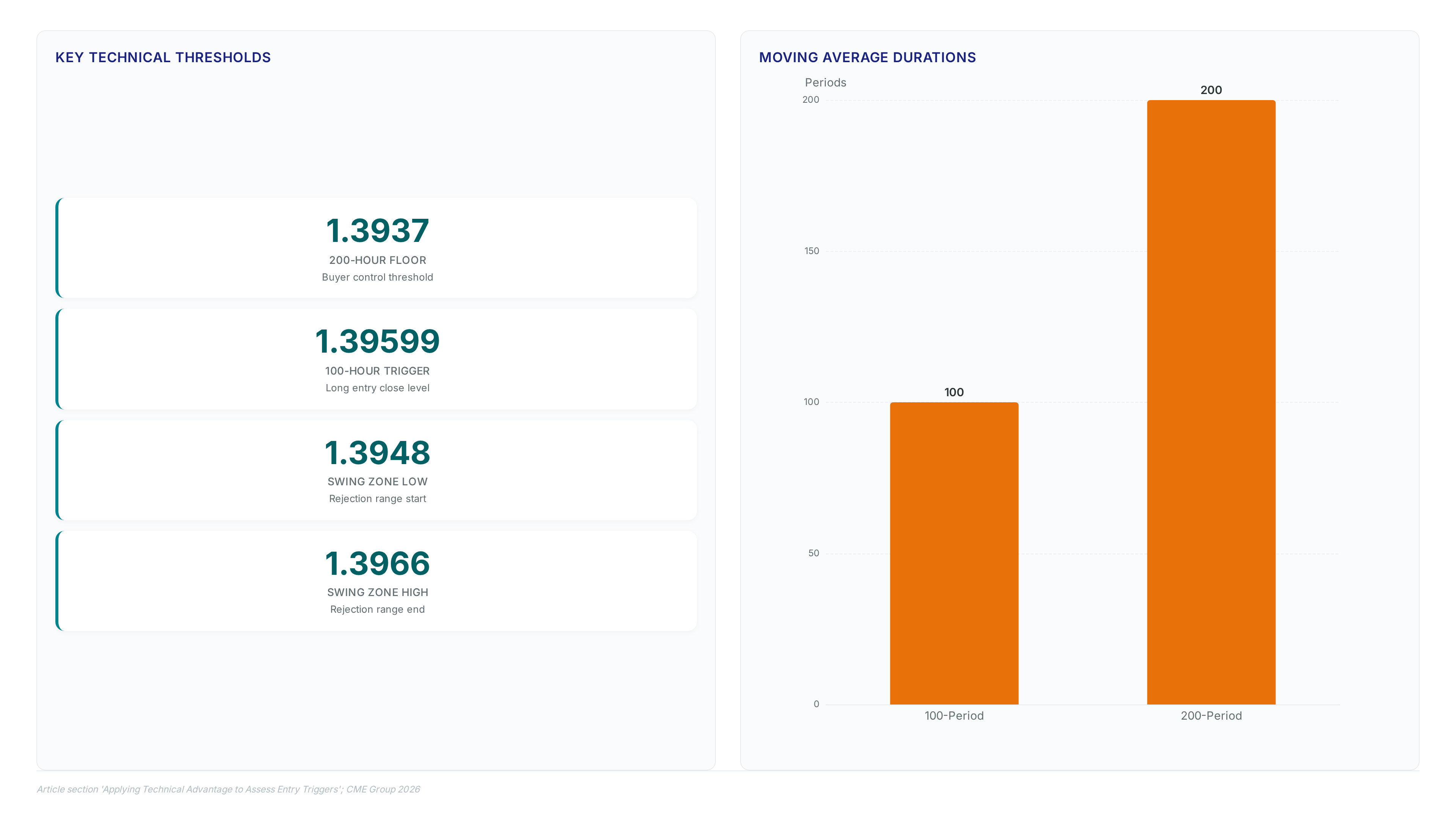
Buyers maintain control only while price holds above the 200-hour moving average at 1.3937. This specific threshold defines the current technical advantage, as sellers failed to sustain a breach during the Asian-Pacific session. Market participants construct these baselines by dividing the sum of closing prices by total sessions to smooth volatility noise. The hierarchy of time frames Traders prioritize the 100-period and 200-period durations because round numbers in FX analysis often attract concentrated algorithmic order flow. A breach of the 1.3937 floor invalidates the bullish structure and forces a reevaluation of long-term trend validity. However, relying solely on moving averages ignores the liquidity gates created by moving average periods where order flow concentrates. The limitation is that these lines react to past data; they do not predict fundamental shifts like USMCA renegotiation headlines. Operators must watch for price action stalling near these calculated levels rather than assuming automatic support. Holding above this level keeps the short-term bias neutral-to-bullish despite geopolitical noise. Failure to push below the swing area confirms buyer dominance in the immediate term.
Executing Entry Triggers When Price Reclaims the 100-Hour MA
Long entries trigger only after price closes above the 100-hour moving average at 1.39599 following a rejection of the 1.3948-1.3966 swing zone. This specific sequence occurred during the Asian-Pacific session when downside momentum stalled despite regional tension. Traders executing this strategy must account for transaction costs; while some brokers advertise commission-free structures, the spread often widens significantly during such volatile reclaims.
The failure to break the 200-hour floor at 1.3937 confirms buyer dominance, yet reliance on round-number averages creates a blind spot for latency-sensitive algorithms. Unlike institutional desks using deep learning models to predict these reversals, retail participants often react to the close rather than the breach attempt. This delay means entry occurs after the most aggressive liquidity has already been consumed.
| Condition | Action | Invalidated By |
|---|---|---|
| Price > 1.3966 | Enter Long | Close < 1.3937 |
| Volume Spike | Confirm Bias | Flat Volume |
| MA Slope Up | Hold Position | MA Flatten |
Operators should monitor regional news wraps for geopolitical shifts that could invalidate technical levels instantly. The USMCA renegotiation timeline remains a latent variable capable of overriding moving average signals. Coverage Pillars recommends waiting for the second consecutive hourly close above the 100-period line to filter false breakouts.
Monitoring Aluminum PPI Spikes as Hidden Volatility Risks
Technical support zones fail when raw material costs surge, as the Aluminum Mill Shapes PPI jumped an unprecedented rate year-over-year in late February 2025. This specific inflation metric exposes a critical blind spot where chart patterns diverge from industrial reality. Traders relying solely on moving averages overlook how sudden input cost spikes force immediate hedging flows that invalidate standard support levels. Infrastructure cost inflation may indirectly impact currency valuations by altering trade balance expectations for resource-heavy economies like Canada. A parallel rise in Steel Mill Products PPI 20.7% compounds this pressure, signaling broad-based industrial stress rather than isolated commodity noise. Ignoring these Producer Price Index signals leaves models vulnerable to sudden reversals unrelated to price action. The limitation is clear: technical advantages evaporate when macro data triggers algorithmic repricing events. Operators must cross-reference moving average holds against monthly inflation releases to avoid false breakouts.
Steps for Analyzing Forex Support Levels and Momentum
Defining the Swing Area and Moving Average Confluence
The 1.3948-1.3966 swing zone forms a composite support structure by aligning static price memory with the flexible 100-hour moving average at 1.39599. Technical traders calculate these floating barriers by dividing the sum of closing prices by total sessions to smooth volatility noise, a method detailed in guides on Simple Moving Average calculation. This confluence creates a high-probability defense line where algorithmic order flow clusters around round numbers.
- Identify the static range between 1.3948 and 1.3966 where previous downside momentum stalled.
- Overlay the 200-hour moving average at 1.3937 to establish the ultimate floor for bullish validity.
- Monitor the hierarchy of time.
A limitation of this approach emerges when infrastructure cost inflation alters fundamental currency valuations, causing technical levels to fail despite strong historical precedence. Most operators note that round-number durations attract concentrated liquidity, yet this visibility also invites stop-hunting maneuvers during low-volume sessions. Coverage Pillars recommends validating these signals against volume profiles to filter false breakouts effectively. The inability to sustain a breach below the 200-hour average confirms buyer dominance, provided external shocks do not override chart geometry.
Executing Trades on 100-Hour MA Reclaim Signals
Price reclaiming the 1.39599 level above the swing high confirms buyer control after the Asian-Pacific session rejection. Traders calculate this Simple Moving Average by dividing the sum of closing prices by total sessions to filter noise, a method detailed in technical analysis.
- Wait for a candle close above the 100-hour moving average and the 1.3966 resistance.
- Verify the 200-hour floor at 1.3937 remains intact to limit downside risk.
- Enter long only if volume supports the breakout above the confluence zone.
A key limitation involves latency; algorithmic clusters around round numbers often trigger false breaks before the real move. Reliance on these static levels ignores how infrastructure inflation alters fundamental valuation baselines over time. Coverage Pillars recommends monitoring the USMCA renegotiation timeline as a secondary filter for trade validity. The technical advantage remains with buyers until price breaches the 200-hour support.
Validating Momentum with Aluminum PPI and Fed Data
Traders must cross-reference the 1.3948 support floor against the Federal Reserve Board daily index releases to filter geopolitical noise.
- Monitor the June 15, 2026 data release window for sudden USD strength that invalidates technical bounces.
- Correlate aluminum cost surges with CAD weakness, noting that raw material inflation often precedes currency devaluation.
- Verify price action holds above the 200-hour average before assuming bullish control remains intact.
| Data Point | Technical Impact | Validation Action |
|---|---|---|
| Fed H.10 Release | Increases USD volatility | Pause entries until post-release close |
| Aluminum PPI Spikes | Weakens CAD fundamentally | Reduce use on long positions |
| 1.3937 Floor | Defines trend validity | Exit if hourly candle closes below |
The limitation of relying solely on moving averages is that they lag behind sudden industrial price shocks. This disconnect means a bounce off the 100-hour line may be a liquidity trap rather than a genuine reversal. Operators should treat any reclaim of 1.39599 without supportive Fed data as a potential false signal. The foreign exchange rates report provides the necessary macro context to distinguish between a technical reclaim and a fundamental shift. Without this external validation, the 1.3966 resistance level acts as a ceiling rather than a breakout point. Market participants who ignore these upstream cost drivers risk holding positions against emerging inflationary trends.
About
Aisha Rahman, Gold & Commodities Analyst at ForexCFD. Top, brings a specialized macroeconomic perspective to the analysis of USDCAD. While her primary focus remains on XAUUSD and oil markets, her deep expertise in commodity-currency links makes her uniquely qualified to dissect the Canadian dollar's movements. As oil prices often dictate CAD volatility, Aisha's daily monitoring of energy flows and safe-haven sentiment directly informs her understanding of this pair's reaction to Middle East geopolitics. At ForexCFD. Top, an independent publication dedicated to factual market news, she connects global risk events to tangible trading implications. Her work ensures that retail traders receive vendor-neutral insights on how USMCA negotiations and regional conflicts influence substantial FX pairs. By bridging the gap between commodity fundamentals and currency technicals, Aisha provides the contextual depth necessary for navigating complex market environments without hype.
Conclusion
Scalping micro-movements in USDCAD fails when transaction friction accumulates against stagnant volatility, turning a viable strategy into a net loss generator. The real break point occurs when industrial input costs diverge from technical support levels, creating false breakouts that trap used participants. You must prioritize macro-validation over rapid-fire entries, specifically by aligning trade execution with the June 15, 2026 Federal Reserve data window. Ignoring upstream aluminum pricing pressures while chasing bounces off lagging indicators invites significant drawdown during liquidity gaps.
Adopt a strict protocol: reject any long position if the Aluminum PPI shows upward momentum, regardless of the chart pattern. This filter prevents capital erosion during inflationary spikes that technicals alone cannot predict. Treat the current consolidation not as an opportunity for frequency, but as a test of fundamental durability. If price action cannot sustain a close above 1.3966 accompanied by weak manufacturing data, the bullish thesis is invalid.
Start this week by auditing your open positions against the latest Aluminum PPI report. Immediately reduce exposure on any long USDCAD trades where raw material costs are rising, as this divergence signals an impending breakdown that moving averages will miss until it is too late.
Frequently Asked Questions
Global forex turnover reached $9.6 trillion, providing enough depth to absorb regional spikes without breaking technical ranges. Algorithmic execution prioritizes established moving averages over unconfirmed diplomatic headlines, causing this specific decoupling of price from geopolitical panic.
Direct transaction fees for futures average $6.47, which incentivizes range-bound behavior until diplomatic outcomes become certain for traders. This cost barrier exists where only sustained moves justify position turnover due to the expense of trading futures.
Traders must watch for a decisive close below the 200-hour average to confirm any potential trend reversal in the market. Technical structure overrides the geopolitical backdrop until that specific shift occurs within the current price action dynamics.
Reporting dealers still command roughly 41% of North American volume, making their ability to read technical rejection zones vital for success. This concentration separates profitable positioning from reactive gambling during periods of significant geopolitical uncertainty and noise.
Buyers successfully defended the key swing area between 1.3948 and 1.3966 that recently halted downside momentum during the session. Price action stalled near this confluence, preventing a breakdown that technical algorithms often trigger when conflict narratives intensify.