
USD/JPY Market Ignores Decisive Action Warnings
USD/JPY's potential 161.99 peak marks the highest weekly close since 1986, testing Japan's $73 billion defense.
The market's indifference to decisive action threats reveals a structural break where non-bank liquidity now overrides traditional central bank signaling. Despite Finance Minister Katayama's warnings and a history of aggressive foreign exchange intervention, the pair's durability suggests traders view current levels as a green light toward 165.00 rather than a ceiling. The 161.99 threshold remains the true trigger for state actors, distinguishing it from the noise of Friday settlements. NBFIs and prime brokerage models have altered market mechanics, allowing speculative flows to absorb official selling pressure that would have previously caused a reversal. Finally, the analysis extends to cross-pair dynamics, specifically how EUR/JPY correlation behaviors may signal the next phase of Ministry surveillance when direct USD/JPY intervention risks become too costly. Only concrete price action at historical pivots now commands respect.
The Strategic Significance of Weekly Closes and Intervention Definitions
Defining Currency Intervention and the Weekly Close Milestone
Monetary authorities buy or sell assets to alter exchange rates during currency intervention, a move distinct from routine liquidity operations. Emerging market central banks generally intervene to mitigate excessive volatility and maintain competitiveness, whereas advanced economy actions often target deflationary pressures from strong currencies. The definition of yen intervention specifically involves the Ministry of Finance instructing the Bank of Japan to sell dollars, a mechanism tested when prices approached 161.70 before retreating to 161.00.
Traders focus on the weekly close because it serves as a settlement benchmark for global contracts rather than a transient intraday spike. Daily trading volumes exceed trillions of dollars, making the largest and most liquid financial market in the world resistant to minor fluctuations. A finish near current levels would mark the highest weekly close since 1986, creating a structural conflict with historical precedents like the Plaza Accord. The Hong Kong Monetary Authority bought HK$118 billion in equities to defend a peg, yet Japanese officials rely on spot market pressure alone. Weekly milestones trigger algorithmic rebalancing that intraday noise does not. Speculative momentum drives prices toward 161.30 while the latent risk of decisive official action remains. Portfolios face sudden liquidity evaporation if thresholds breach 161.99.
Applying Intervention Logic to USD/JPY Levels 161.70 and 161.99
Ministry monitoring focuses on the 161.99 resistance, a short-lived high from July 1, 2024, rather than weekly settlement averages. Market participants apply intervention definitions by watching for verbal cues that trigger immediate price corrections, as seen when Finance Minister Katayama promised decisive action. The pair dropped from 161.70 to 161.00 following this warning before stabilizing near 161.30. Hawkish rhetoric in forex acts as a non-price tool to alter market sentiment without immediate capital deployment. Japan previously spent over 35 trillion yen during a 15-month campaign ending in March 2004 to curb yen strength. Such massive expenditures highlight the financial weight behind official thresholds compared to speculative positioning.
The USD/JPY weekly close matters for contract settlements, yet intraday breaches of 161.99 carry higher operational risk for used accounts. The market may interpret a sustained move above this level as tacit approval to target 165.00. A failure to hold 161.70 suggests renewed selling pressure despite fundamental drivers like hawkish commentary from US officials. Operators must prioritize real-time execution speeds over weekly trend analysis because Ministry alerts often precede rapid reversals. The cost of ignoring these intraday levels exceeds the risk of holding positions through weekend gaps. Intraday price spikes trigger Ministry action more reliably than weekly settlement averages. intervention thresholds respond to fleeting liquidity gaps rather than sustained trend confirmation. The current market structure echoes the coordinated G5 efforts of the Plaza Accord signed in September 1985, where rapid adjustments outweighed periodic reporting.
Traders often misinterpret the weekly close as the definitive signal for policy shifts, yet operational reality favors monitoring real-time order flow. Relying on weekly data creates a blind spot to stealth intervention tactics used since 2011. Authorities manipulate prices within a single session to enforce compliance without altering the final weekly ledger. This approach minimizes diplomatic friction while maximizing domestic political cover. Ignoring intraday volatility in favor of weekly aggregates leaves positions exposed to sudden reversals driven by non-public central bank instructions. The cost of such complacency is immediate capital loss rather than gradual drift.
Market Mechanics Behind the 161.99 Threshold and Ministry Surveillance
Defining the 161.99 Threshold and MoF Surveillance Protocols
The 161.99 level represents a specific intraday ceiling from July 1, 2024 that triggers Ministry of Finance scrutiny more aggressively than weekly settlement averages. Authorities distinguish between organic market drift and speculative spikes by monitoring price velocity during low-liquidity windows rather than closing prints. This operational nuance explains why the pair retreated from 161.70 to 161.00 immediately following verbal warnings, as traders priced in the risk of direct market access disruption. Surveillance protocols prioritize detecting ordered flows that mimic the intensity seen during the 5.5 trillion yen intervention window observed in summer 2024.
Traders analyzing forex intervention risk must therefore weigh intraday volatility against the probability of escalated regulatory action.
Applying Verbal Warning Analysis to USD/JPY Price Action
Verbal warnings from Finance Minister Katayama trigger immediate liquidity withdrawals, evidenced by the rapid drop from 161.70 to 161.00 following his "decisive action" statement. Traders interpret such rhetoric through Transaction Cost Analysis frameworks that measure execution risk rather than waiting for physical intervention. The mechanism relies on algorithmic sensitivity to policy shifts, where a single declarative sentence alters market microstructure quicker than central bank balance sheet changes. Historical precedents like the 2011 "stealth intervention" confirm that authorities prioritize surprise over transparency to maximize impact on speculative flows. However, relying solely on verbal cues creates false confidence if physical reserves remain unverified against the ¥5,534.8 billion benchmark set in mid-2024.
| Factor | Verbal Warning Impact | Physical Intervention |
|---|---|---|
| Speed | Milliseconds | Minutes |
| Cost | Zero capital | High reserve usage |
| Duration | Short-term spike | Sustained trend shift |
Repeated warnings without follow-through degrade signal integrity, leading traders to ignore future threats until a hard floor is breached. This flexibility forces operators to monitor intraday velocity spikes instead of closing prints, as the true intervention threshold exists in the order book depth rather than the daily candle close. Consequently, market participants must deploy best-in-class analytics. The cost of missing these signals is a forced unwind at unfavorable rates during low-liquidity windows.
Risks of Ignoring NBFI Dominance in Intervention Scenarios
Japan has spent $73 billion defending the yen this year, yet market structure shifts toward Non-Bank Financial Institutions alter shock propagation. The FX environment has evolved from bank-dominated models to one where nonbank liquidity providers play a prominent role, changing how volatility absorbs intervention spikes. Unlike traditional dealers, these entities often lack the regulatory mandate to stabilize markets during stress events.
| Liquidity Provider | Intervention Response | Weekend Risk Profile |
|---|---|---|
| Traditional Banks | Reduce exposure / Quote wide | Moderate |
| NBFIs / Prime Brokers | Algorithmic exit / Gap risk | High |
Monitoring forex over weekends becomes hazardous as prime brokerage models provide greater access for hedge funds that operate without central bank backstops. This structural shift means verbal warnings from officials like Katayama trigger quicker, deeper liquidity vacuums than historical data suggests. Analyzing intervention risk now requires tracking non-bank positioning rather than just bank flow data. Standard volatility models fail when the majority of liquidity providers have no obligation to two-way quote. Operators ignoring this dominance face slippage exceeding normal parameters during Ministry of Finance actions. Weekend gaps widen because algorithmic non-bank participants withdraw entirely rather than hedge exposure.
Cross-Pair Dynamics and Correlated Behaviors in EUR/JPY
EUR/JPY Range Dynamics vs USD/JPY Volatility Patterns
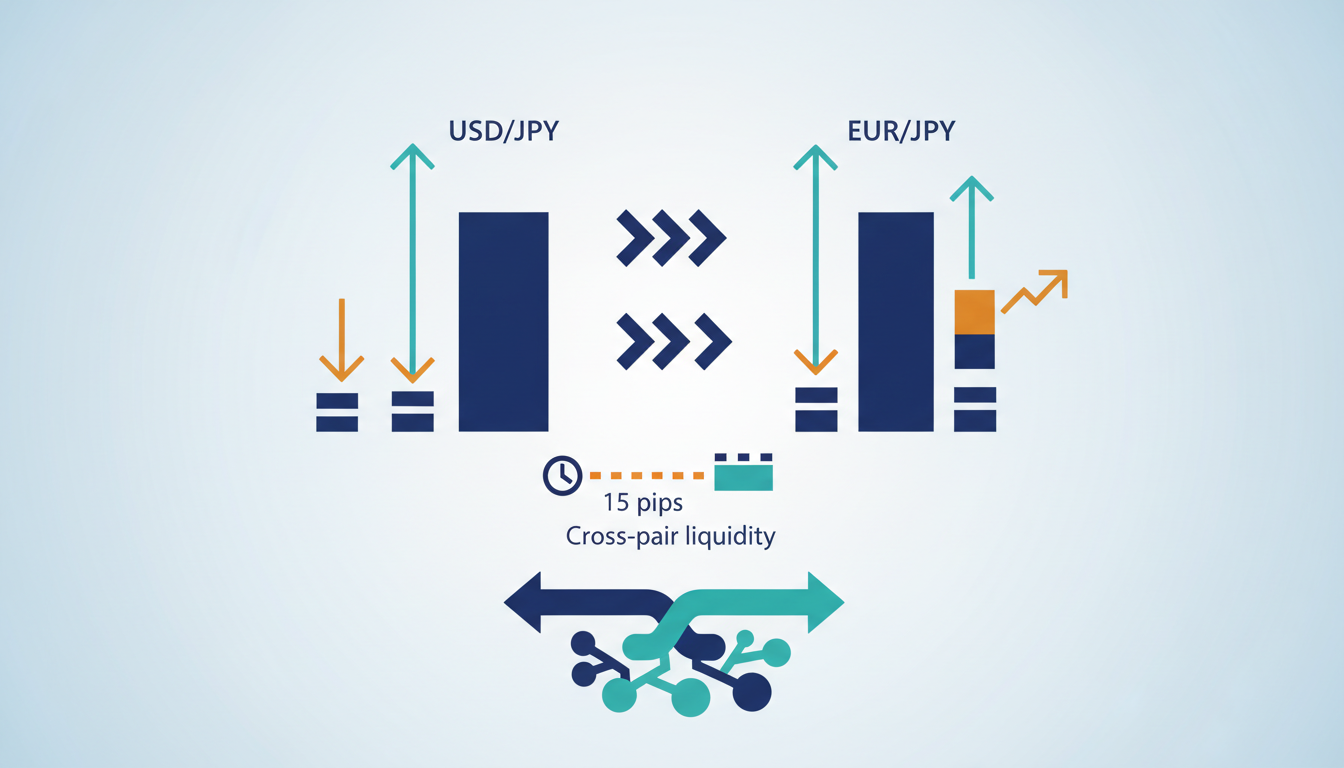
EUR/JPY remains trapped in the tight range established since November. This divergence creates a structural asymmetry where cross-pair hedging strategies face elevated basis risk. Direct Ministry of Finance targeting of the dollar pair drives the volatility differential, leaving the euro cross-pair to drift within technical boundaries. Market participants must account for transaction costs that vary notably by instrument type. CFD trading incurs an average direct fee of $1.91, though these costs are often embedded in wider spreads rather than charged explicitly. Futures traders face explicit exchange fees that demand larger trend moves to justify entry. CFD participants absorb costs via wider spreads despite lower upfront charges. The mechanism shifts risk from fixed commissions to variable slippage during Ministry of Finance interventions.
Persistence of the November volatility sometimes forces deleveraging that drags EUR/JPY out of its range purely through correlation breakdowns. Operators relying on historical correlation matrices will find their hedges fail during these specific liquidity shocks. Correlation decay becomes the primary risk factor rather than directional movement.
Applying Yen-Supportive Talk Expectations to EUR/JPY Breakouts
A predicted barrage of yen-supportive talk next week creates asymmetric breakout risks for EUR/JPY compared to USD/JPY volatility. Officials previously ignored low-liquidity windows to intervene, signaling that verbal warnings now precede physical market access changes. This delay forces traders to monitor intraday price velocity rather than waiting for weekly settlement data. Direct Ministry targeting of dollar flows causes the divergence in pair behavior, leaving the euro cross-pair to drift within technical boundaries established since November. Execution costs further complicate hedging strategies across these correlated assets. This fee structure impacts high-frequency adjustments during low liquidity conditions when intervention risks peak.
Markets often price in the threat before any actual order flow occurs, limiting reliance on verbal cues. Unlike the dollar pair, which reacts instantly to Finance Minister comments, the euro cross-pair exhibits a delayed response pattern. This lag creates a narrow window where basis risk expands notably between the two pairs. Traders ignoring this temporal disconnect face unfavorable entry prices if they wait for confirmation. The cost of being late exceeds the transaction fees incurred by early positioning. This disparity forces distinct positioning strategies when correlating USD/JPY volatility against the stagnant EUR/JPY range. CFD traders can pivot quicker around the 161.99 level without waiting for premium recovery, an advantage during erratic yen-supportive talk cycles. However, the lack of centralized clearing in OTC instruments introduces counterparty risk absent in exchange-traded contracts. Operators must weigh fixed certainty against variable execution quality when hedging cross-pair exposure. Cheap entry does not guarantee cheap exit during liquidity crunches.
Actionable Framework for Assessing Intervention Likelihood and Position Management
Defining the Green Light Threshold at USD/JPY 165.00

Silence from Tokyo officials at current exchange rates functions as explicit market permission to push the currency pair toward 165.00. Purchasing USD/JPY near these peaks involves wagering against a history of massive state expenditure. Algorithms interpret a lack of official response to breached levels as consent, accelerating momentum toward the next psychological barrier. Assessment protocols prioritize intraday price velocity above weekly settlement figures. Authorities executed a stealth intervention. This reality generates tension between visible verbal warnings and covert liquidity removal.
Misinterpreting this threshold carries asymmetric penalties. Markets anticipate a barrage of yen-supportive talk next week, yet the absence of physical selling at key technical nodes validates the bullish trajectory. Position management requires acknowledging that without a confirmed decisive action 165.00 target. Traders calculate exposure based on foreign exchange intervention operations rather than technical resistance alone. Data indicates that despite massive spending, the market remains unafraid, creating a scenario where risk-reward ratios skew negative for long entries. Silence from officials can be misinterpreted as a green light for momentum algorithms to target 165.00.
Operators weigh the probability of a repeat spike against the sheer scale of capital already deployed.
- Calculating the percentage of quarterly reserves used.
- Monitoring Masao SHIMAZAKI related communications for policy shifts.
- Adjusting lot sizes downward when verbal warnings intensify.
- Avoiding entries during low-liquidity windows where intervention risk peaks.
- Reducing use ahead of US holidays when stock markets are closed.
Entering new longs now constitutes a dangerous game with asymmetric downside risk. Failure to adjust position size relative to these MoF spending metrics exposes accounts to sudden, state-driven reversals that ignore technical support levels.
Risk Assessment of Holding Positions Through Weekend Liquidity Gaps
Holding open positions into the weekend ignores the specific danger of stealth intervention. Complacency proves hazardous because the market structure now relies heavily on non-bank liquidity providers that withdraw rapidly during gaps. If officials act while spreads widen, gap risk becomes unmanageable for used accounts.
Assessment steps prioritize intraday velocity over weekly closes. A sudden drop from 161.70 to 161.00 proves that verbal warnings trigger immediate algorithmic selling. The limitation of holding through Friday close is the inability to adjust position sizing before Monday's open. Traders fix incorrect forex positions by flattening exposure rather than hedging, as correlation breaks down during sovereign acts. The cost of being wrong on direction is finite; the cost of being unable to exit is catastrophic.
About
Marcus Halloran, Chief Market Strategist at ForexCFD. Top, brings decades of interbank experience to his analysis of the USD/JPY pair's potential historic close. Having formerly served as an FX strategist in London, Halloran specializes in G10 macro dynamics and central bank policy, making him uniquely qualified to interpret Japanese Finance Minister Katayama's intervention threats. His daily work involves translating complex monetary policy shifts from the Fed and BoJ into actionable insights for retail traders. This expertise is critical as the market echoes the Plaza Accord era, requiring a deep understanding of coordinated intervention mechanics. At ForexCFD. Top, an independent publication dedicated to vendor-neutral market news, Halloran uses his background in interest-rate differentials to provide factual context on speculative moves. His analysis connects high-stakes global forex volumes with practical trading implications, ensuring readers understand the significance of the 161.00 level without unnecessary hype.
Conclusion
Scaling capital into USD/JPY without accounting for sovereign friction guarantees failure when liquidity evaporates. State actors do not care about your technical support; they care about price levels that threaten domestic stability. The hidden cost here is not the spread, but the inability to exit during a coordinated, low-liquidity reversal that bypasses standard order books entirely.
Traders must mandate a hard rule: flatten all speculative USD/JPY exposure before Friday 20:00 GMT if verbal warnings from Tokyo intensify, regardless of perceived momentum. This is not about predicting the exact top, but respecting the asymmetric risk of a gap event that ignores standard risk management protocols. Holding through weekend windows while ignoring potential stealth intervention is a gamble with undefined downside.
Start this week by auditing your current open positions and calculating exactly how much capital would be lost if price gapped 200 pips against you at the Monday open. If that number exceeds your tolerable drawdown, reduce position size immediately to match the current liquidity constraints rather than historical volatility models.
Frequently Asked Questions
Japan has spent $73 billion defending the yen this year. Despite this massive expenditure, the market remains resilient and continues to test critical resistance levels without significant fear of immediate reversal.
Daily trading volumes exceed $6 trillion in this massive market. This immense liquidity makes it difficult for minor fluctuations or verbal warnings alone to significantly alter the established price trends effectively.
The Hong Kong Monetary Authority bought HK$118 billion in equities. This historical action contrasts with current Japanese strategies that rely primarily on spot market pressure rather than direct equity purchases for defense.
Japan previously spent 35 trillion yen during a fifteen-month campaign. This historical context underscores the significant financial weight authorities can deploy when targeting specific exchange rate thresholds to curb strength.
Intraday breaches trigger Ministry action more reliably than weekly averages. Operators prioritize real-time execution because official alerts often precede rapid reversals that weekly settlement data fails to capture accurately.