
USD/JPY Surge: Why Japan's 0.5% Growth Fails
The Strait of Hormuz remains theoretically closed, and USD/JPY grinds relentlessly toward the 161.95 resistance level. This isn't speculative noise; it's structural inevitability. Diverging monetary policies and geopolitical stagnation drive the pair higher. The Ministry of Finance tried to bluff the market in April, but their intervention lacked the liquidity to shift the narrative. Signaling without economic backing is just noise.
The Bank of Japan's slashed growth forecast of 0.5 percent cements the yen's weakness against a hawkish Fed. AI-driven trading now dictates over 55% of institutional strategies, compressing reaction times and rendering traditional timing tactics obsolete.
Unless the Strait of Hormuz reopens physically, Tokyo's attempts to slow momentum are vain efforts to buy time. As machine learning algorithms dominate execution, the window for proven human-led currency intervention narrows significantly. The market prices in a reality where fiscal struggles and inflation risks favor the dollar, leaving the yen on a dicey trajectory.
The Structural Drivers of Yen Weakness and USD Strength
Defining the Fed-BOJ Policy Divergence
An asymmetric monetary stance defines the current landscape: the Federal Reserve maintains hawkish tightening while the Bank of Japan retains accommodative settings. This mechanical misalignment drives USD/JPY momentum by widening the yield spread between US Treasuries and Japanese Government Bonds. Market pricing heavily favors the dollar as inflation risks grow, overshadowing the Bank of Japan decision to end negative rates in March 2024 Monetary Policy Meeting. The central bank subsequently predicted growth of just 0.5 percent for the Japanese economy, cutting its previous forecast in half. Such a severe downgrade signals deep structural weakness that rate hikes alone cannot fix.
Transmission mechanisms limit the impact of any Tokyo intervention because the fundamental growth differential persists. The 0.5 percent growth projection creates a ceiling on yen strength regardless of temporary FX flows. Non-bank financial institutions now dominate liquidity provision, amplifying the impact of these policy gaps on spot prices. Unilateral MOF actions fail to alter the primary trend without synchronized global liquidity signaling. The yield spread remains the dominant variable until the Bank of Japan materially shifts its forward guidance framework.
Geopolitical Triggers Driving USD/JPY Higher
Physical closure of the Strait of Hormuz sustains upward pressure on USD/JPY regardless of theoretical diplomatic progress. Market participants ignore verbal assurances from the US and Iran, demanding actual reopened shipping lanes before shorting the dollar. This disconnect renders traditional intervention signals ineffective because traders price in tangible supply chain risks rather than political rhetoric. Liquidity provision has shifted structurally toward Non-Bank Financial Institutions, which react to geopolitical triggers quicker than central banks can coordinate signaling.
The April 29, 2024 intervention attempt failed to reverse momentum precisely because it lacked synchronized liquidity support during a geopolitical crisis. Modern algorithmic strategies absorb isolated central bank flows without altering the primary trend, unlike bank-dominated eras. Corporate earnings data confirms the severity, with firms like Gartner citing FX fluctuations as a material revenue headwind that hedges cannot fully offset. MOF intervention without a resolved Middle East conflict serves only as a temporary speed bump. The cost of fighting this specific geopolitical driver is measurable in wasted foreign reserves. Until the physical bottleneck clears, the asymmetric risk profile favors continued dollar strength.
Meanwhile, the 160 level functions as the unofficial intervention threshold where market pressure forces Ministry of Finance action. Historical precedent shows that stopping depreciation requires massive capital, exemplified by the 35 trillion yen spent during the campaign ending in March 2004. Modern operators face a dilemma where signaling fails without synchronized liquidity, as seen when authorities intervened near 160-per-dollar yet USD/JPY continued grinding higher. Yen depreciation accelerates when geopolitical triggers like the Strait of Hormuz remain physically closed despite diplomatic claims. Divergent inflation risks favor the Fed, leaving the Bank of Japan unable to tighten policy sufficiently. Intervention thresholds merely delay rather than reverse momentum without physical reopening of shipping lanes or a shift in US monetary stance. Traders now ignore verbal assurances, demanding tangible supply chain resolution before altering positions. Traditional buy-yen operations remain ineffective unless timed with actual geopolitical de-escalation. The cost of maintaining this defense is measurable in lost reserves and diminished credibility among global FX participants. Failure to align signaling with structural reality guarantees repeated breaches of key levels.
The Mechanics of Market Signaling and Intervention Timing
Market Signaling Mechanics in Forex Interventions
Market signaling in forex defines the strategic communication of intent rather than mere capital deployment, a distinction that rendered the late April intervention blunt. Authorities apply timing and thresholds to influence trader psychology without necessarily sustaining long-term rate changes. The mechanism relies on liquidity density; signals sent during thin trading windows often dissipate as noise rather than catalyzing the required amplification among market participants.
- Authorities monitor unofficial thresholds like the 160 level to trigger visibility.
- Execution timing targets high-liquidity windows to maximize signal propagation.
- Sustained impact requires backing from divergent monetary policy shifts.
However, former currency chief Nakao argues that deploying actual funds fails without steady interest rate hikes to support the signal. This limitation explains why the Ministry of Finance action appeared futile despite massive scale. In the fourth quarter, balance of payments statistics showed $48 billion in reserve sales, marking the largest quarterly reserve drain since 2016.
| Feature | Brute Force | Strategic Signaling |
|---|---|---|
| Primary Tool | Capital Reserves | Policy Coordination |
| Duration | Short-lived | Sustained |
| Requirement | High Liquidity | Rate Hikes |
The cost of ignoring this mechanical reality is measurable: unbacked interventions deplete reserves while failing to alter the fundamental yield spread. The Bank of Japan raised its short-term policy rate to 0.75 percent by December 2024.
Operational Timing Around the 160 Yen Threshold
Targeting the unofficial 160-per-dollar level requires dense order flow to amplify the Ministry of Finance intent, yet the specific timing made the effort appear "silly" rather than deterrent.
- Signal Detection: Algorithms monitor price action near psychological barriers like 160 to anticipate official moves.
- Liquidity Mismatch: Executing when volume is thin prevents the necessary trader amplification required to shift USD/JPY momentum.
- Outcome: Without follow-through, the intervention becomes a fleeting anomaly rather than a structural pivot.
| Factor | Ideal Condition | April 2024 Reality |
|---|---|---|
| Timing | High-volume overlap sessions | Thin liquidity window |
| Perception | Credible threat | "Silly" misstep |
| Result | Sustained reversal | Immediate fade |
The April 29, 2024 attempt proved that mistimed signaling depletes political capital without moving the exchange rate. Operators must recognize that intervention timing dictates success more than volume when fundamental drivers remain unchecked. A signal sent into a void invites speculation rather than compliance. Future attempts targeting the 160 level will likely fail unless synchronized with actual liquidity events or policy shifts. The market ignores bluffs when the fundamental backdrop heavily favors the dollar. This massive expenditure highlighted a structural limitation where volume-heavy campaigns cannot sustain exchange rates without synchronized interest rate hikes. The mechanism of failure involves traders absorbing liquidity when they perceive the central bank lacks the political will to tighten policy.
| Failure Mode | Trigger Condition | Market Reaction |
|---|---|---|
| Signaling Noise | Low liquidity window execution | Signal ignored as anomaly |
| Policy Divergence | Hawkish Fed vs. Dovish BOJ | Capital outflow accelerates |
| Reserve Drain | Sustained unilateral selling | Loss of credibility |
Late April and early May 2024 saw these dynamics play out in real time. Experts like former currency chief Nakao argue that using actual funds requires backing via steady rate hikes to impact FX stabilization. The cost of ignoring this is evident; without policy alignment, reserve sales merely transfer wealth to speculators rather than fixing the failed intervention. A distinct risk emerges when authorities attempt to bluff solvency while lacking the necessary economic cards. The implication for operators is clear: monitoring reserve drains offers an improved signal of stress than intervention headlines alone. Unannounced moves often yield short-lived effects compared to coordinated announcements. Reliance on capital depth without policy support renders the Ministry of Finance powerless against global forex flows.
Strategic Outlook for the 2024 High Resistance Level
Defining the 161.95 Resistance and Policy Context
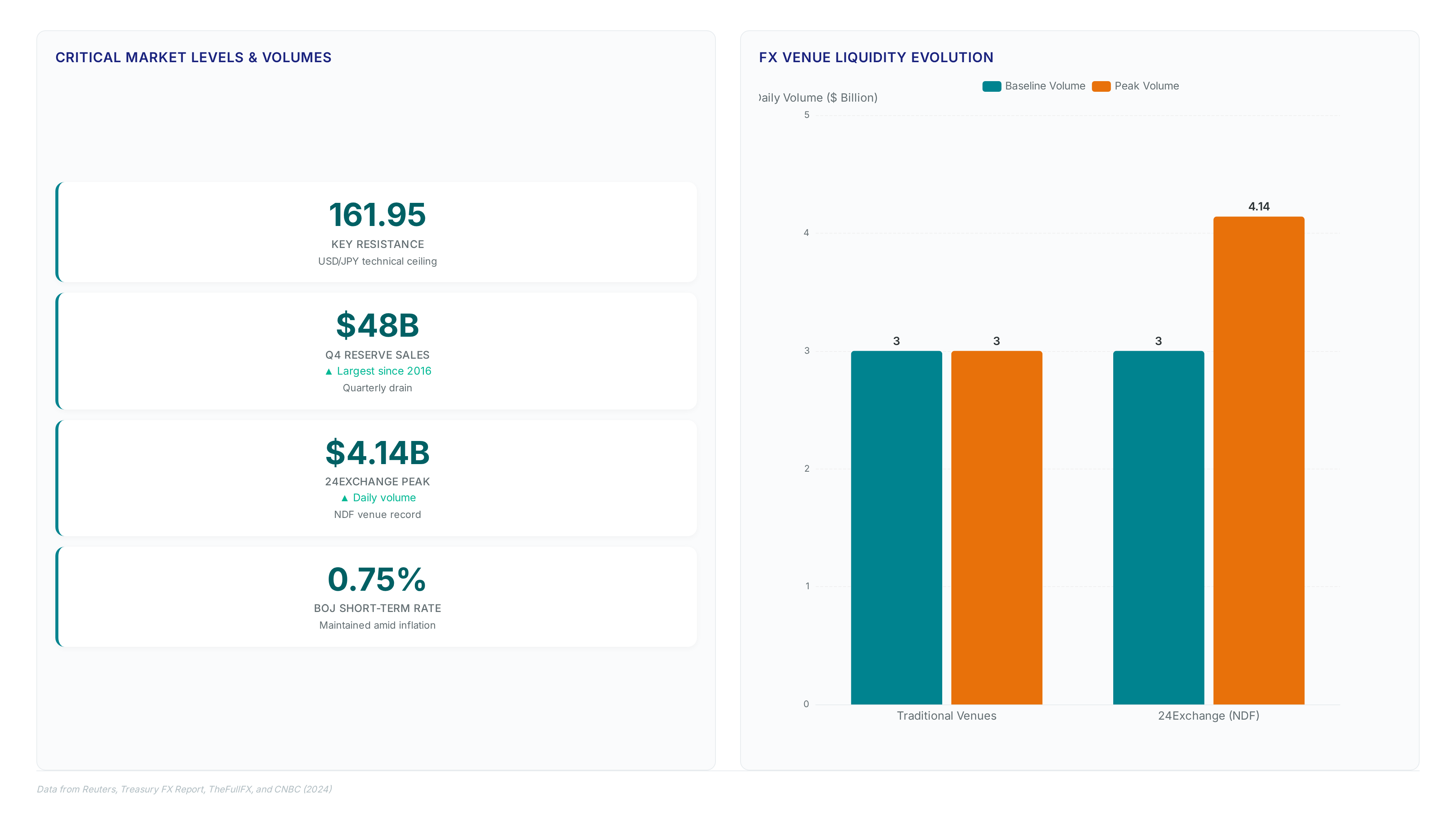
Market surveillance now targets the 161.95 resistance level as the definitive technical ceiling for USD/JPY following the 2024 peak. This specific price point carries more weight than the unofficial threshold. The distinction matters because breaking 161.95 opens a void with no historical order book data to absorb selling pressure.
Policy divergence drives this momentum, specifically the Bank of Japan's stance while inflation risks persist. Governor Kazuo Ueda acknowledges that exchange rate volatility impacts the economy, yet monetary policy remains decoupled from direct currency targeting. This creates a structural trap where intervention signals lack the backing of synchronized rate hikes.
| Factor | Impact on Resistance |
|---|---|
| Rate Differential | Sustains upward pressure on USD/JPY |
| Geopolitical Risk | Prevents safe-haven repatriation flows |
| Signal Timing | Reduces effectiveness of lone interventions |
Operators must recognize that technical breaks above 161.95 will likely accelerate if the Strait of Hormuz remains closed physically. The limitation here is clear: without a shift in the physical logistics of oil transit or a coordinated G7 liquidity signal, the resistance level functions merely as a temporary speed bump rather than a reversal point. Traders interpret the lack of fiscal backing as an opportunity to test the next psychological barrier.
Applying Geopolitical Timelines to Intervention Strategy
Traders should align intervention timing with tangible de-escalation in the Strait of Hormuz, as actions lacking conflict resolution remain futile. The situation involving the Strait of Hormuz is unlikely to change for the improved imminently, rendering isolated currency moves ineffective. Former currency chief Nakao argues that intervention requires monetary alignment. Without this, market participants view defense of the 161.95 level as temporary noise rather than a structural shift.
The Bank of Japan raised its short-term policy rate to 0.75 percent, yet a critical tension exists between the desire to stabilize USD/JPY and the reality of unresolved geopolitical supply chains. Until the physical reopening of shipping lanes occurs, any Ministry of Finance action serves only to buy time.
| Condition | Market Signal | Probable Outcome |
|---|---|---|
| Conflict Stalled | High volatility | Intervention fails |
| Lane Reopened | Stabilized flows | Policy gains traction |
Operators must recognize that geopolitical clarity precedes currency stability. Waiting for a diplomatic breakthrough before committing capital reduces exposure to false breakouts.
Attempts to defend the 161.95 resistance level without fundamental backing repeat the errors of the failed late April 2024 campaign. The mechanism of failure remains consistent: algorithms detect the lack of synchronized rate hikes and absorb liquidity rather than reversing positions. Former currency chief Nakao argues that any FX intervention using actual funds must be backed by steady interest rate hikes to have a lasting impact.
| Risk Factor | Trigger Condition | Operational Consequence |
|---|---|---|
| Policy Divergence | Hawkish Fed vs. Dovish BOJ | Capital flows ignore verbal warnings |
| Geopolitical Stalemate | Closed Strait of Hormuz | Safe-haven demand for USD persists |
| Signal Dilution | Isolated MOF action | Market treats defense as noise |
The primary limitation is that Tokyo's strategy appeared to be working only temporarily before volatility returned. Without a resolution to the Strait of Hormuz crisis, any defense of the unofficial threshold serves merely to buy time. The cost of this approach is measurable in wasted reserves and diminished credibility among institutional traders. Market participants now view isolated moves as vain efforts destined for volatile failure.
Risks of Repeated Intervention and Policy Dilemmas
Defining Diminishing Returns in FX Intervention
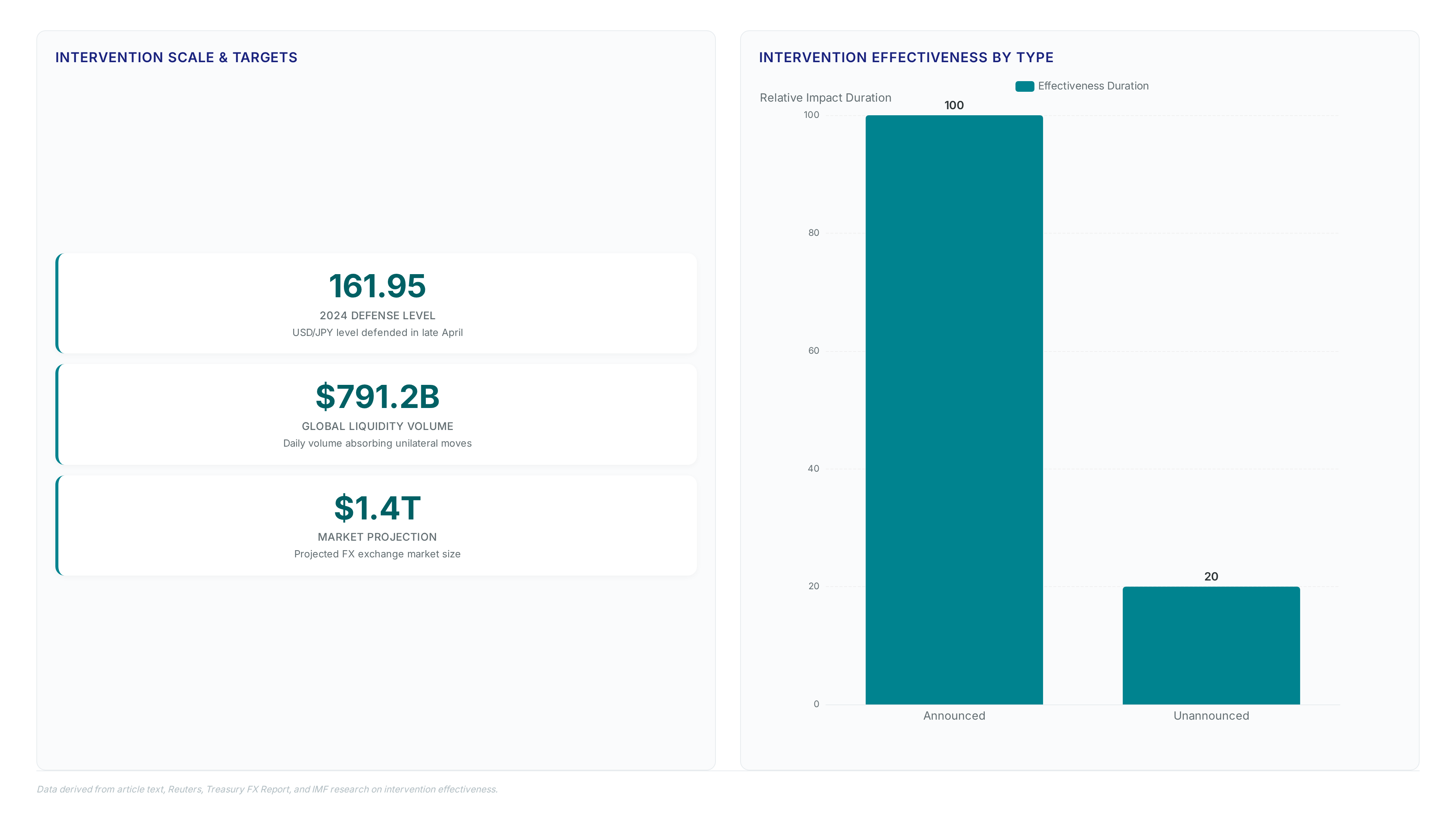
Currency intervention yields diminishing returns when repeated capital deployment fails to shift exchange rates, a reality evident when late April 2024 actions appeared silly. Success depends on signaling efficacy, yet market participants often ignore official moves that lack supportive monetary policy shifts. This failure mode emerges because traders absorb selling pressure once they perceive the central bank cannot sustain higher rates indefinitely. Unilateral action faces hard limits when contrasting developed market goals with emerging market frameworks focused on domestic inflation. Current efforts lack the geopolitical tailwinds necessary to validate the MOF intervention timing seen in earlier campaigns. Research suggests that unannounced interventions often yield only short-lived effects compared to coordinated strategies.
- Capital is consumed without altering the primary trend.
- Market credibility erodes with each ineffective attempt.
- Opportunity costs rise as reserves deplete rapidly.
- Speculative attacks intensify following perceived weakness.
- Network strategists monitoring these flows must rely on Coverage Pillars analytics to distinguish between genuine trend reversals and temporary noise.
Without synchronized rate hikes, even large-scale reserve sales prove futile.
Risks: Applying Geopolitical Constraints to MOF Strategy
Geopolitical instability in the Middle East dictates that MOF intervention timing remains futile until the Strait of Hormuz reopens physically. Market signals fail when global attention fixates on supply chain blockades rather than currency signaling. Experts argue that spending actual funds requires backing from steady rate hikes to impact prices permanently. Defense of the 161.95 level appears as noise to algorithms detecting policy divergence without this monetary alignment. The sheer volume of the FX exchange market, projected to reach a staggering amount by 2030, overwhelms unilateral actions lacking fundamental support. Previous attempts in late April 2024 resulted in no lasting change, appearing ineffective due to poor synchronization with conflict resolution timelines.
- Liquidity drains accelerate without corresponding hawkish BOJ shifts.
- Market confidence erodes when physical trade routes remain blocked.
- Reserve depletion outpaces any temporary exchange rate stabilization.
- Tokyo lacks the necessary cards to bluff successfully while the fundamental backdrop works heavily against officials.
Any move before a tangible de-escalation merely buys time at a steep discount. For rigorous analysis of these constraints, consult Coverage Pillars.
Risks: Risk of Vain Efforts at the 161.95 Resistance Level
Defending the 161.95 resistance level invites immediate algorithmic selling because market makers recognize the structural absence of synchronized rate hikes. Previous attempts to hold the line near the 160 threshold failed to alter the primary trend, with late April actions appearing ineffective against the prevailing dollar momentum. The mechanism of this failure stems from the sheer volume of global liquidity, estimated at nearly a trillion dollars daily, which easily absorbs isolated central bank orders without shifting equilibrium prices. Reputational cost for the Ministry of Finance increases with each failed defense, as traders interpret unbacked intervention as a signal to accelerate depreciation rather than reverse.
About
Aisha Rahman, Gold & Commodities Analyst at ForexCFD. Top, brings a unique macroeconomic perspective to the analysis of USD/JPY dynamics. While her primary focus remains on gold and oil markets, her deep expertise in safe-haven flows and commodity-currency correlations provides critical context for understanding current yen weakness. As geopolitical tensions in the Middle East impact energy prices, Rahman's daily monitoring of these risk events allows her to identify how inflationary pressures diverge between the Federal Reserve and the Bank of Japan. This cross-asset insight is necessary for interpreting why the USD/JPY pair continues its upward grind despite regional instability. At ForexCFD. Top, an independent publication dedicated to factual market news and central bank analysis, Rahman applies this complete view to deliver clear, vendor-neutral insights. Her ability to connect global commodity shifts with substantial FX pairs ensures that retail traders receive a thorough understanding of the forces driving currency valuations beyond simple technical patterns.
Conclusion
Relying on isolated intervention ignores the structural reality that liquidity depth renders unilateral action futile without rate convergence. As global FX volumes swell toward trillions by 2030, the operational cost of defending arbitrary levels like 161.95 escalates into unsustainable reserve depletion. The breaking point arrives not from lack of effort, but from the market's ability to absorb finite capital injections while the yield gap persists. Continuing this pattern signals weakness rather than resolve, inviting further speculative pressure that erodes fiscal credibility.
Corporations must stop waiting for policy miracles and immediately integrate AI-driven hedging protocols to manage this volatility. Unlike legacy manual strategies, automated systems used by substantial institutions now detect micro-trends in liquidity flows that human operators miss. You should mandate an audit of your current FX exposure algorithms against AI benchmarks by the end of Q3. Start this week by piloting an automated hedging simulation on a small portion of your JPY exposure to quantify potential savings before the next liquidity spike. This shifts the burden from fighting macro currents to optimizing execution within them.
Frequently Asked Questions
Interventions fail because low liquidity prevents signal amplification among traders. Consequently, the action gets lost as noise rather than shifting market sentiment effectively against the dominant trend.
Japan previously spent 35 trillion yen during a campaign to halt currency depreciation. This massive expenditure highlights the immense capital required to counteract strong structural market forces successfully.
AI-driven trading now dictates over 55% of institutional strategies in the market. This dominance compresses reaction times and renders traditional human-led intervention timing tactics largely obsolete.
The slashed 0.5 percent growth forecast cements yen weakness by signaling deep structural economic issues. This creates a ceiling on yen strength that temporary rate hikes cannot realistically fix.
The Strait of Hormuz must physically reopen to alleviate upward pressure on the currency pair. Theoretical diplomatic progress alone is insufficient to shift the current market narrative favoring the dollar.