
Warsh FOMC Reality: Market Easing Expectations Dead
The median 2026 funds rate just jumped to 3.8%. Under Chair Warsh, the FOMC has pivoted from easing to a hawkish hold.
Coddling market expectations is dead. Warsh's blunt commitment strategy sacrifices predictable hand-holding for price stability. The Fed slashed its policy statement to 130 words and stripped out forward guidance, intentionally injecting volatility to enforce market discipline. This mirrors JPMorgan's view that global central banks are shifting from "simultaneous easing" to a "simultaneous hold" at restrictive levels. With headline PCE forecasts for 2026 revised sharply upward to 3.6%, the central bank is in no rush to cut rates, even with a balance sheet lingering at $6.7 trillion.
Warsh's communication overhaul breaks the Powell doctrine of gradualism. Rate-sensitive assets are being repriced as markets adjust to a regime where policy uncertainty is a feature, not a bug.
The Strategic Shift in FOMC Communication Under Warsh
Defining the End of Forward Guidance Under Warsh
Stripping forward guidance removes explicit signals about future rate paths, forcing markets to interpret raw data rather than follow signposts. Previous administrations leaned on verbose verbal cues in post-meeting releases to steer expectations. Chair Kevin Warsh executed a sharp departure by compressing the post-meeting statement to approximately 130 words, less than half the length of the April release. The revised text drops language suggesting an easing bias, offering only a blunt commitment to price stability alongside current economic conditions.
Warsh further distinguished this approach by declining to submit a personal projection to the dot plot, consistent with his critique that such tools entangle the central bank in market mechanics. This enhances data dependency, but the removal of clear signaling introduces volatility for assets sensitive to rate uncertainty. Investors can no longer rely on the Federal Reserve to explicitly outline its trajectory. Risk premiums reprice immediately as participants adjust to an environment devoid of verbal anchors. This redefinition compels rigorous analysis of economic projections without the safety net of stated policy intentions.
Reading the New 130-Word FOMC Statement
Market participants must now derive policy stance solely from the maintained 3.5%-3.75% federal funds rate and 3.65% IORB, as explicit forward pathing is absent. The June 16, 17, 2026 meeting established this data-dependent baseline, forcing a shift toward interpreting raw economic projections rather than verbal cues. Operators analyzing the dot plot mechanism observe the median 2026 projection rising to 3.8%, signaling hawkish internal sentiment despite the static target range. This divergence creates tension: the interest rate anchor remains fixed while the implied trajectory tightens based on the revised inflation forecast of 3.6%.
Short-term yield curves will react more violently to incoming employment data now that the policy communication strategy no longer anchors expectations. Traders cannot rely on statement verbosity to gauge the committee's reaction function. The cost of this transparency is the loss of "easing bias" language that previously dampened market swings. Networks relying on stable rate assumptions for liquidity management face heightened basis risk. Analytical focus must shift entirely to the reserve balances level and the frequency of task force outputs.
Powell vs Warsh: Forward Guidance vs Data Dependence
Jerome Powell utilized explicit future rate path signals to manage interbank lending dynamics. Kevin Warsh forces reliance on raw data projections. This structural pivot removes the verbal crutches markets previously depended upon for pricing asset trajectories. The Policy Communication Strategy now discards all openness to adjusting policy in either direction. Operators must instead parse the dot plot distribution where 9 of 18 participants project a rate hike in 2026. Warsh did not submit a personal interest rate projection, consistent with his criticism of forward guidance as a predictive tool.
This absence creates a vacuum where the median projection drives volatility without a chair-level anchor to stabilize sentiment. The cost of this transparency is immediate market repricing as traders abandon heuristic models for granular data analysis.
| Feature | Powell Era | Warsh Approach |
|---|---|---|
| Guidance Style | Explicit forward path | Raw data only |
| Statement Length | Verbose (~341 words) | Concise (~130 words) |
| Chair Dot Plot | Submitted | Skipped |
| Market Anchor | Verbal cues | Economic projections |
Five task forces now examine the central bank's $6.7 trillion balance sheet to support this data-only framework. Market certainty decreases as verbal signposts vanish entirely. Investors face higher variance in short-term yields because the policy statement no longer smooths expectation gaps. This tension between institutional clarity and market comfort defines the new operational reality. The distribution reveals significant internal division regarding the cumulative hike path required to curb inflation:
- One participant favors a cumulative 75 basis point hike.
- Five favor 50 basis points.
- Three support a 25 basis point hike.
- Eight participants projected no change, while only one favored a cut.
This hawkish tilt forces markets to price in tightening probabilities rather than relying on explicit policy signposts. Unlike previous eras where forward guidance anchored expectations, operators must now interpret the raw dispersion of these rate forecasts to gauge volatility. The absence of Chair Warsh's personal dot creates a specific analytical blind spot, removing the traditional tie-breaker signal from the consensus view.
| Feature | Previous Framework | Current Warsh Approach |
|---|---|---|
| Guidance Style | Explicit forward path | Data-dependent silence |
| Chair Input | Included in median | Excluded from plot |
| Market Anchor | Verbal cues | Raw projection spread |
High dispersion among participants increases the risk premium on short-term debt instruments, representing a structural limitation of this approach. Investors face greater uncertainty when the median projection shifts without correlating verbal clarification from the chair. Analysts connecting these projections to policy action follow a specific decomposition process rather than relying on qualitative sentiment:
- Map the inflation trajectory slowing to 2.4% in 2027 against the sticky 2026 baseline to determine if patience is viable.
- Assess the rate hike probability by observing market repricing events, such as the shift toward an October tightening window.
The core measure rising to 3.3% complicates this analysis because it removes the transitory argument often used to delay action. Unlike the Bank of England, which navigates a cautious easing cycle, the Fed faces persistent energy price pressures that demand an immediate response. Operators must now treat the economic projections as the primary policy signal rather than secondary supporting data. This shift forces a reliance on raw numerical deltas where a 90 basis point upgrade in inflation expectations automatically implies a need for restrictive policy adjustments.
Warsh's Critique and Dot Plot Communication Risks
Warsh declined to submit his own dot, citing concerns about the tool's usefulness, creating immediate ambiguity in how traders parse the federal funds rate trajectory. This absence removes a central anchor, forcing market participants to rely entirely on the scattered projections of remaining committee members rather than a unified Chair signal. The dot plot mechanism historically aggregated individual views into a median, yet the Chair's refusal to participate fractures this consensus model.
| Risk Factor | Previous Regime | Current Warsh Era |
|---|---|---|
| Signal Source | Explicit Forward Guidance | Raw Data Projections |
| Chair Participation | Submitted Projection | No Submission |
| Market Anchor | Verbal Cues | Distribution Scatter |
Removing forward guidance eliminated a key anchor markets used to price the easing path, introducing volatility into rate-sensitive assets. Policy Communication Strategy now demands rigorous analysis of raw economic data without the buffer of explanatory narrative. Data dependence increases transparency while simultaneously raising the cognitive load on analysts interpreting the interest rate outlook. Without the Chair's dot to weight the median, the potential for mispricing the cumulative hike probability increases notably. Operators must now model multiple divergence scenarios where previously a single verbal cue sufficed. Short-term yields will likely exhibit higher variance during projection releases due to this structural shift. Asset pricing now relies entirely on the scattered data within the dot plot mechanism, where nine of eighteen participants foresee a rate hike. This structural shift forces operators to parse raw distribution data rather than following a unified Chair signal, as Warsh declined to submit his own projection. The resulting volatility stems from market expectations divergence, wherein the absence of a central bank narrative increases reaction to each new economic data point. Unlike the previous regime's reliance on guiding market expectations, the current framework demands rigorous independent analysis of inflation trajectories and employment metrics.
Meanwhile, removing verbal crutches creates tension between policy flexibility and market stability, as the Fed gains freedom to react while investors lose their primary hedging tool. Operators must now treat every employment report as a potential trigger for immediate portfolio adjustment, given the lack of pre-announced policy paths.
Adjusting Portfolios for an October 2026 Rate Hike
Repricing duration risk now targets the October window where markets price a policy shift. Investors must parse regulation communication strategy shifts to identify mispriced assets before the next FOMC meeting. Global context dictates that 70% of central banks are currently inactive, creating a simultaneous hold environment that suppresses liquidity. This stagnation contrasts with the Bank of England, which remains in a cautious easing cycle despite inflationary pressures. Portfolios anchored to 2025 easing narratives face immediate mark-to-market losses as the median rate projection climbs.
| Asset Class | Action | Rationale |
|---|---|---|
| Long-duration Bonds | Sell | Real rates turn negative at current inflation |
| Floating Rate Notes | Buy | Captures upward shift in federal funds range |
| Equities | Reduce | Higher discount rates compress valuations |
Removing forward guidance eliminates the safety net for leveraged positions. Operators cannot rely on central bank signaling to exit distressed trades. Diversification away from fixed long-term yields becomes the primary defense against volatility. Markets now face expectations divergence because Warsh declined to submit his own dot, removing a unified Chair signal from the guideline communication strategy. This structural void forces traders to parse scattered committee projections rather than following explicit future rate path signals. However, the dot plot mechanism itself faces potential obsolescence, creating a secondary layer of model risk for algorithms trained on historical data.
| Risk Vector | Impact on Pricing |
|---|---|
| Signal Absence | Volatility spikes on raw data releases |
| Tool Obsolescence | Historical models lose predictive power |
Any communication overhaul, including a potential scrapping of the dot plot, would further complicate forward pricing of Fed actions. The analytical gap emerges here: operators cannot hedge against a policy framework that is actively being redesigned.
Institutional Reforms Through Federal Reserve Task Forces
Scope of Warsh's Five Task Forces on Fed Operations
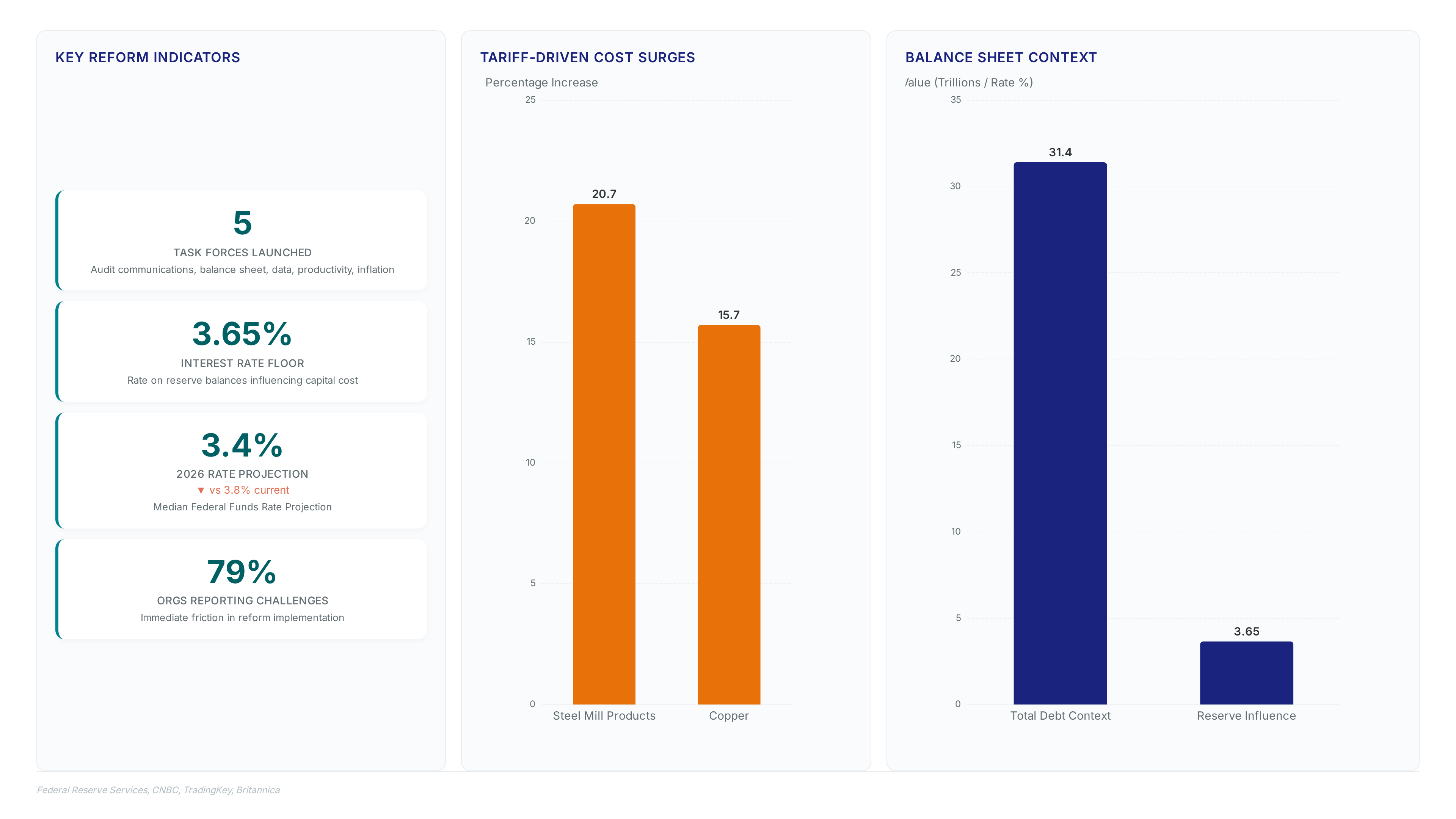
Warsh mandated five task forces to audit the communications framework, balance sheet, data sourcing, productivity, and inflation targeting. This directive questions the fundamental utility of existing signaling tools rather than merely editing statement wording.
The shift away from forward guidance creates an information vacuum that raw data projections must now fill. Operators lose the explicit future rate path signals previously embedded in policy statements. This absence forces market participants to derive policy intent solely from disjointed committee projections rather than unified Chair direction. Eliminating these signposts increases the cost of capital uncertainty for financial institutions. The lack of a central anchor means every economic data release triggers volatile asset repricing as traders scramble for consensus. The intent is data-dependent transparency. The immediate consequence is fragmented market interpretation. The productivity and employment task force must therefore prioritize model standardization to prevent analysis paralysis across the banking sector. Without standardized inputs, the removal of guidance simply replaces one form of opacity with another.
Market Navigation Without Decade-Old Signposts
Capital allocation now proceeds without the explicit future rate path signals that guided the last decade of trading. Investors must interpret raw economic data rather than relying on the removed directive communication strategy anchors. This opacity coincides with tangible input cost surges, as steel mill products rose 20.7% and copper climbed 15.7% due to tariffs.
The operational burden extends beyond monetary policy into compliance infrastructure. Financial institutions face rising technology expenditures to meet high-risk AI system requirements enforced on August 2, 2026. These dual pressures strain liquidity precisely when the Federal Reserve's structural review introduces maximum ambiguity.
In practice, the removal of forward guidance forces a shift from narrative-based modeling to probabilistic scenario planning. Expectations divergence widens as traders parse scattered committee projections instead of a unified Chair signal. This environment penalizes duration-heavy portfolios that depend on stable yield curve forecasts. Operators must now treat every economic release as a potential regime shift rather than a confirmation of existing trends.
Operational Risks in Data Sourcing and AI Compliance
The data sourcing task force confronts immediate friction as 79% of organizations report challenges in adopting AI due to governance gaps. Financial institutions must modernize economic input streams while simultaneously preparing for high-risk AI system requirements enforcement on August 2, 2026. This dual mandate creates a compliance bottleneck where legacy data architectures cannot support the rigor demanded by new regulatory standards. The cost is measurable: rising infrastructure expenses compound the difficulty of deploying compliant models without sacrificing analytical depth.
Warsh's push for data transparency clashes with the reality that most firms struggle to govern existing datasets effectively. The structural overhaul requires capital allocation toward data hygiene before advanced analytics can function reliably. Operators face a binary choice: delay AI integration until data foundations solidify or risk regulatory penalties for non-compliant deployments. The window for remediation narrows as the enforcement date approaches.
About
Sofia Mendes serves as the Broker Reviews & Trading Education Editor at ForexCFD. Top, where she oversees the publication's rigorous analysis of market-moving events. Her deep expertise in central bank policy and risk management makes her uniquely qualified to dissect the latest FOMC meeting and Kevin Warsh's influence on the Fed's playbook. While her daily work focuses on evaluating regulated brokers and teaching traders how to navigate volatility, this specific article bridges macro strategy with practical trading application. As the Fed signals potential rate hikes and removes forward guidance, the resulting uncertainty directly impacts the currency pairs and gold markets that ForexCFD. Top covers extensively. Mendes connects these high-level policy shifts to the real-world implications for retail traders, explaining how elevated inflation projections and a hawkish dot plot alter liquidity conditions and spread dynamics. Her analysis ensures that the audience understands not just the news, but how to adjust their trading strategies amidst heightened market ambiguity.
Conclusion
The absence of explicit forward guidance transforms liquidity management from a narrative exercise into a rigorous stress test of balance sheet durability. This ambiguity exposes a critical fragility: legacy data architectures simply cannot support the real-time probabilistic modeling required to navigate scattered committee signals without incurring massive operational drag. The dual pressure of maintaining capital buffers against potential regime shifts while funding expensive AI compliance upgrades creates a liquidity pincer that will crush firms relying on static forecasting models.
Organizations must immediately pivot from seeking predictive certainty to building adaptive capacity. Do not attempt to forecast the next rate decision; instead, architect your data pipeline to withstand sudden, unannounced policy pivots. You have until August 2, 2026, to align your economic input streams with high-risk AI governance standards, or face severe regulatory friction. Start by auditing your current data lineage against the upcoming AI compliance framework this week to identify specific governance gaps before they trigger capital inefficiencies. Prioritize data hygiene over model complexity, as clean, governed data is the only asset that retains value when the federal funds rate remains a range rather than a trajectory.
Frequently Asked Questions
The FOMC voted to maintain the federal funds rate at 3.5% to 3.75%. This decision keeps the benchmark overnight borrowing range unchanged despite the significant communication overhaul and removal of forward guidance language.
The median projection for the federal funds rate rose sharply to 3.8% by year-end 2026. This increase from previous estimates signals that nine of eighteen participants now see at least one rate hike occurring this year.
Officials raised the 2026 headline inflation forecast to 3.6% while lifting the core measure to 3.3%. These sharp increases from March figures reflect persistent energy price pressures flowing directly from the ongoing Middle East conflict.
Chair Warsh compressed the post-meeting statement to approximately 130 words, removing all easing bias language. This represents less than half the length of the April release and eliminates explicit signals regarding future rate paths.
The central bank's balance sheet remains unchanged for now, lingering at $6.7 trillion. However, Warsh has launched a specific task force to examine this portfolio, suggesting it remains a live issue for future policy.