
Gold at 4059: Why BoE Policy Beats Geopolitics
Gold trading at 4114.95 proves central bank policy drives immediate asset revaluation far more than geopolitical noise. The Bank of England maintains a stance divergent from market expectations, creating volatility traps for traders relying on standard rate differential models. Softer UK CPI data at 2.8% undermines arguments for tightening, directly contradicting pricing that anticipates rate hikes. Jane Foley assesses that a slack labour market and falling oil prices will keep BoE rates unchanged, pressuring the Pound against the Euro. Strategic allocation now points to WTI crude at 73.935 and Bitcoin near 62775.18 as hedges against this policy-induced stagnation.
Ignore the noise of US-Iran tensions. Focus on the yield gap created by stubborn central banks. While NAS100 rallies on tech optimism, the FX market remains fixated on whether monetary policy can pivot without triggering inflation spikes. We dissect the specific technical forecasts that signal when to rotate from equities into commodities as the Dollar reacts to these shifting rate differentials.
The Role of Central Bank Policy and Economic Indicators in Market Valuation
Defining NFP Data and CPI Metrics for FX Valuation
The Non-Farm Payrolls report quantifies US employment excluding agricultural sectors, serving as a primary gauge for labor market health. Stronger than expected job creation typically strengthens the dollar by implying tighter monetary policy. Conversely, the Consumer Price Index measures the average change over time in prices paid by urban consumers for a market basket of goods. Softer than expected UK May CPI inflation data at 2.8% y/y for the headline rate signals reduced pressure on the Bank of England to raise rates further. Annual pay gains held steady at an undisclosed amount as of mid-2026, suggesting wage-driven inflation remains a persistent concern for policymakers. Interest rate expectations drive currency value through these specific readings.
Unexpected shifts in these data points invalidate trend-based strategies reliant on stable central bank guidance. Traders must await the next economic calendar update to confirm if the deviation represents a structural change or transient noise.
Applying BoE Mandate to Slack Labour Market Conditions
A slack labour market suppresses wage inflation, forcing the central bank to prioritize growth over tightening despite lingering price pressures.
Rabobank's Jane Foley cites this employment weakness alongside falling oil costs as the primary rationale for holding rates steady through year-end. This stance diverges from market pricing that anticipates further policy tightening. When CPI metrics soften, the intrinsic value of the currency often declines relative to peers with hawkier stances. Traders observing private market activity note three consecutive months of decline, linking the downturn to deteriorating economic conditions and heightened uncertainty. This contraction signals that aggressive rate hikes could precipitate a deeper recession, validating the committee's cautious approach.
| Factor | Impact on Policy |
|---|---|
| Soft CPI | Removes urgency for hikes |
| Falling Oil | Anchors inflation expectations |
| Weak Jobs | Limits wage spiral risks |
Controlling sticky inflation while avoiding economic contraction creates a difficult policy environment. If the bank misreads the depth of the labour slack, it risks overtightening into a downturn. Ignoring persistent wage gains could unanchor long-term inflation expectations entirely. The data sets the bias; the chart sets the entry. A break below key support levels on GBP pairs would confirm the market is pricing in a dovish error. Retail CFDs are high risk. ForexCFD.top is an affiliate partner; check local regulator status before trading. This analysis is educational only.
Risks of GBP Pressure from Divergent Rate Expectations
Divergent rate expectations create immediate repricing risk when policy forecasts fail to align with market pricing. The catalyst is the gap between anticipated tightening and the actual stance held by the Bank of England, generating a bearish bias for sterling. Market pricing currently anticipates modest tightening over six months, yet analysts expect no change in rates for the remainder of the year. This discrepancy forces a mechanical adjustment where capital flows away from the Pound toward higher-yielding alternatives.
The fundamental thesis rests on how CPI affects currency value through interest rate differentials. When inflation data softens, the real yield advantage of holding that currency diminishes, prompting institutional rebalancing. This pressure intensifies if UK markets become increasingly influenced by developments in the US rather than domestic monetary policy. Further repricing could pressure the Pound and support pairs like EUR/GBP as traders unwind long sterling positions. Price action breaking below established support levels following an unexpected dovish shift in central bank communication serves as the specific technical trigger. Traders must monitor upcoming employment figures, as any sign of a weakening labor market would validate the dovish outlook and accelerate the downside move. A surprise surge in inflation data that forces the central bank to reconsider its hold stance would invalidate the bearish view and trigger a sharp short squeeze. ForexCFD.top provides this analysis for educational purposes; CFDs are complex instruments and your capital is at risk.
Mechanics of Forex Volatility Driven by Fed Stance and Rate Differentials
Fed Stance Transmission to USD/JPY Valuation
Yield spreads widen when the Federal Reserve signals hawkish policy shifts, mechanically lifting USD/JPY valuation as capital floods dollar-denominated assets. Market pricing currently implies approximately 20 bps of tightening over a six-month horizon. Centrist views suggest this aggression requires clear evidence of second-round inflation effects from energy prices. Divergence between market pricing and central bank caution creates a volatile rate differential environment where sudden repricing events occur frequently. Gold often moves inversely to real yields, so a hawkish Fed stance typically pressures the metal unless geopolitical risks dominate sentiment. Cost is that market participants often overestimate the speed of policy transmission, leading to premature positioning. Traders monitoring order flow can identify when large institutional orders align with these macro shifts rather than fighting them. Specific tension exists between the Fed's inflation mandate and the economic drag of higher rates, creating a binary outcome for currency direction. If inflation data cools while the Fed remains rigid, the USD/JPY pair may face a sharp correction as differentials compress. The view flips if employment data shows unexpected strength, validating the current market pricing for further hikes.
Real-Time Impact of CPI on EUR/USD and Gold
Inflation surprises trigger immediate re-pricing across currency pairs as algorithms digest purchasing power shifts. Gold currently trades at 4114.95, reflecting a +0.99% gain as investors seek hedges against eroding fiat value. This rally occurs even as the EUR/USD pair edges to 1.14295, up a modest +0.12%, demonstrating how dollar strength can cap euro gains despite shared inflationary pressures. Mechanism operates through real yield expectations; higher-than-expected CPI data forces markets to price in aggressive central bank tightening, boosting the currency of the issuing nation.
USD/JPY behavior illustrates the sensitivity of yield differentials to these data points, with the pair slipping to 162.428 0.09% as traders adjust positions. Unlike equities, where earnings might offset rate fears, forex reacts purely to the relative change in cost of capital between two nations. Key tension exists here: strong US data supports the dollar, yet it also risks choking growth, creating a narrow window for sustained USD/JPY upside. Market participants monitoring real-time headlines often find that initial spikes reverse if subsequent economic indicators fail to confirm the inflationary trend.
Traders must distinguish between transient noise and structural shifts in monetary policy. Current environment demands strict adherence to technical levels alongside fundamental releases, as liquidity can vanish rapidly during data spikes. Failure to account for the speed of algorithmic execution against CPI prints often results in significant slippage for retail operators.
*Risk Warning: CFDs are complex instruments. Your capital is at risk.*
Pound Vulnerability from Divergent Rate Re-pricing
Divergent central bank forecasts create immediate pound vulnerability when market pricing outruns official guidance. RaboResearch maintains a baseline view of no BoE rate changes through year-end, contrasting sharply with markets pricing roughly 20 bps of tightening. Discrepancy forces a mechanical revaluation where the currency weakens until pricing aligns with the central bank's actual threshold for action.
Gold often acts as a barometer for these real yield shifts, yet its current trajectory reflects geopolitical premiums rather than pure rate differentials. The table below contrasts the divergent outlooks driving cross-pair volatility:
| Metric | BoE Official Stance | Market Pricing |
|---|---|---|
| Rate Path | Unchanged | Tightening |
| Horizon | Remainder of year | 6-month view |
| Driver | Second-round inflation | Speculative flows |
Consequently, analysts see scope for a moderate move higher in EUR/GBP over a one-to-three-month window. Risk lies in a sudden liquidity squeeze if centrist MPC members refuse to validate aggressive hike expectations without clear energy price shocks. Such a scenario would invalidate bullish sterling positions built on premature tightening bets.
Traders must monitor upcoming inflation prints for evidence of second-round effects that could bridge this policy gap. Failure of energy prices to sustain upward pressure would likely accelerate the pound's downside as misaligned rate differentials correct. *Risk Warning: CFDs are complex instruments and come with a high risk of losing money rapidly due to use. You should consider whether you understand how CFDs work and whether you can afford to take the high risk of losing your money.*
Strategic Asset Allocation Across Commodities and Equities Using Technical Forecasts
Defining Strategic Asset Allocation with Technical Forecasts
Macro drivers merge with precise market data to time entry into commodities and equities. This technical trigger refines the broader guide to S&P 500 investment by filtering noise from genuine regime shifts. Modern platforms integrate macro data feeds covering GDP and inflation alongside earnings reports to validate these signals.
Executing Buy Decisions for Gold Below $4000 and Copper Entry Points
Copper allocation requires monitoring industrial sentiment distinct from precious metal hedges, particularly as supply recovery meets weak China demand. Readings below 50.0 signal contraction and potential price erosion for base metals reacting sharply to manufacturing PMI thresholds. Bitcoin is valued at 62775.18, up +1.19%. The cost of premature entry in this environment is measured in lost opportunity when capital remains tied in ranging assets. Trading involves significant risk. This content is for educational purposes only and does not constitute financial advice.
Geopolitical Risks to Oil Prices and Commodity Forecasts
Iran reportedly hits ships in the Strait of Hormuz, causing oil prices to jump. This escalation forces Brent crude to trade at 78.70, down 0.84%, demonstrating how physical disruption overrides chart patterns. WTI crude oil is priced at 73.935, down 1.01%. A guide to investing in copper must account for this divergence, as industrial demand collapses while energy costs surge, creating a stagflationary squeeze on refining margins. Stop-loss orders often slip notably during such gaps, executing at much worse prices than specified.
Execution Frameworks for Crypto CFD Trading and Digital Asset Timing
Bitcoin CFD Mechanics and Level 2 Data Requirements
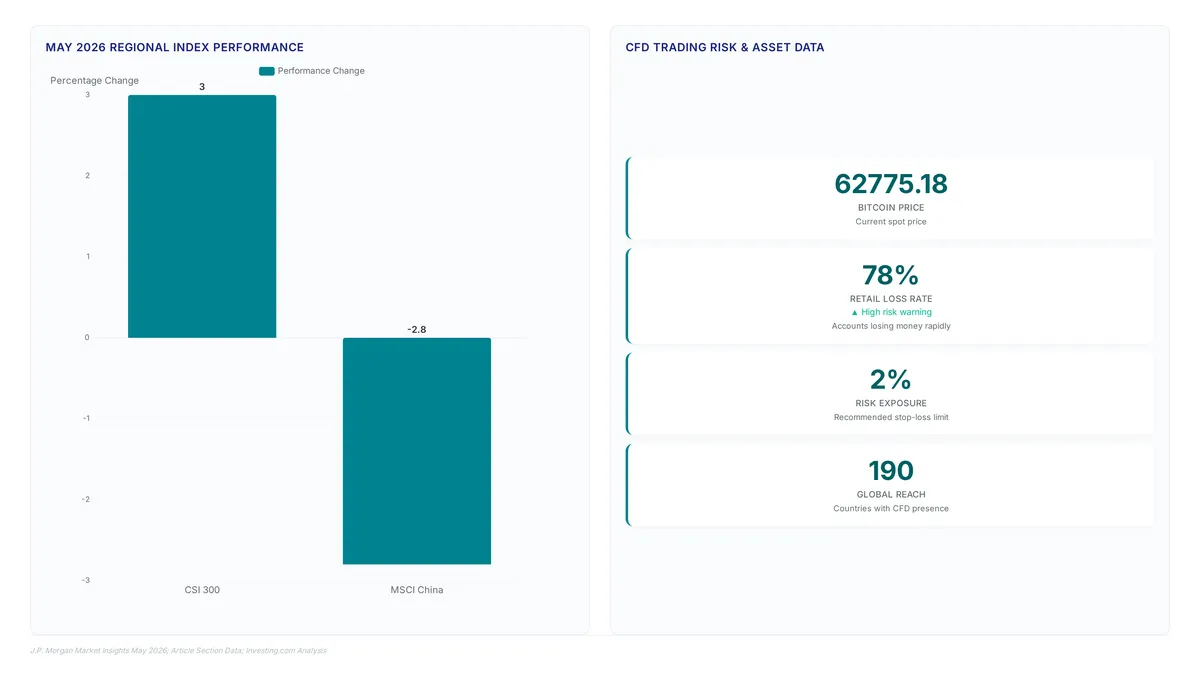
Bitcoin trades at 62775.18, yet Level 1 data masks the liquidity required for precise CFD entries.
- Identify Data Deficits: Standard feeds display only the best bid and ask, hiding the depth needed to gauge true market sentiment during volatility.
- Access Full Transparency: Upgrading to deeper data tiers reveals additional order book layers, allowing traders to spot support levels invisible to retail participants.
- Execute Based on Flow: Analyze the order book to distinguish between genuine liquidity and spoofed volume before committing capital.
Level 1 structures fail to reveal market maker intent driving price action. Deeper data tiers offer superior insight into supply and demand mechanics while costs scale notably for each tier of depth. Market data providers often structure services where thorough coverage incurs costs beyond basic statistics. Information received via standard channels is often delayed intraday data and not "real-time," suggesting that real-time data commands a premium. The pricing scaling for professional tiers reflects this informational advantage. Traders must weigh the expense against the risk of slippage when Bitcoin volatility spikes. Exchange reporting standards could change to obscure participant identities, rendering deep book analysis impossible.
ForexCFD.top is an educational resource; always verify broker regulation in your jurisdiction.*
Timing Ethereum Entries Using Consolidation Patterns
Ethereum consolidation phases require traders to distinguish between analysis-grade feeds and execution-grade infrastructure.
- Filter Data Latency: Retail platforms often apply delayed intraday quotes that obscure the tight ranges defining consolidation patterns, leading to premature position sizing.
- Calibrate Momentum Oscillators: Apply the Relative Strength Index (RSI) to identify divergence within the range, noting that readings above 50 indicate expansion while those below 50 indicate contraction in broader economic contexts.
| Feature | Analysis Tool | Execution Platform |
|---|---|---|
| Data Speed | Delayed | Real-time |
| Primary Use | Trend Review | Order Entry |
| Latency Risk | High | Minimal |
Delayed charts prevent visibility of liquidity shifts occurring before a trend confirmation signal appears on screen. Most operators miss the initial move because their price feed updates after the optimal entry window has closed. A sudden shift in market maker behavior or a large block trade can invalidate a technical setup instantly, regardless of the RSI reading. ForexCFD.top provides the necessary real-time infrastructure to execute these strategies effectively.
Risk Management Checklist for Crypto CFD Execution
Validate data tier depth before executing Bitcoin CFD trades to avoid slippage during volatility spikes.
Level 1 data provides only the best bid and ask prices, whereas Level 2 expands this to the top five-to-ten price points with volume. Traders must confirm their feed includes these intermediate levels to see true liquidity. Organizations incur significant costs requiring optimization strategies, often engaging specialized firms for market data spend optimization. Retail traders face a similar tension between access quality and subscription fees. The cost of deep transparency scales notably, yet blind execution without it invites preventable losses.
| Data Tier | Visibility Scope | Best Use Case |
|---|---|---|
| Level 1 | Best Bid/Ask Only | Basic Price Monitoring |
| Level 2 | Top 5-10 Price Points | Active CFD trading |
| Level 3 | Full Order Book | Institutional analysis |
Divergent signals frequently appear across regional indices, such as the 3.0% rise in CSI 300 contrasted against declines in offshore benchmarks. This methodology gap shows why single-source data fails professional risk management. Providers differentiate their offerings based on these technical specifications; for instance, Financial Times explicitly categorizes its data as 'delayed intraday,' positioning it as an analysis tool rather than a real-time trading infrastructure. ForexCFD.top recommends verifying vendor specifications against your specific strategy needs.
78% of retail investor accounts lose money when trading CFDs with this provider.*
About
Marcus Halloran, Chief Market Strategist at ForexCFD.top, brings over a decade of interbank FX experience to his analysis of the Bank of England's policy outlook. Having previously served as an FX strategist on a London dealing desk, Halloran possesses deep, firsthand knowledge of how BoE decisions ripple through GBP/USD and global capital flows. His daily work involves dissecting central bank statements and macroeconomic data like CPI and labor reports, directly aligning with the article's focus on softer UK inflation and oil price impacts. At ForexCFD.top, an independent publication dedicated to retail traders, Halloran translates these complex institutional signals into clear, actionable market perspectives. His expertise in interest rate differentials and G10 macro positioning ensures that the analysis of Rabobank's views and BoE trajectories remains grounded in real-world trading dynamics rather than theoretical speculation. This practical background allows him to effectively bridge the gap between high-level economic theory and the specific needs of currency traders navigating volatile markets.
Conclusion
Divergent monetary policies create an environment where execution latency drains capital. When inflation data shifts expectations for the Bank of England, the resulting currency fluctuations demand more than basic price monitoring to navigate safely. Traders relying on Level 1 data feeds face an immediate disadvantage because they cannot see the liquidity depth required to avoid slippage during these macroeconomic releases. The operational cost of poor data visibility often exceeds the subscription fees for premium tiers, turning minor market moves into significant losses.
You must upgrade your market data infrastructure to Level 2 immediately if you plan to hold positions through upcoming inflation reports or central bank announcements. Do not attempt to trade Bitcoin or GBP pairs during high-impact news cycles using delayed or top-of-book only feeds. Start by auditing your current broker's data tier specifications against the Level 2 requirement listed in your risk management checklist before the next scheduled economic release. This specific technical adjustment ensures you see true order book volume rather than just the best bid and ask. Securing this visibility is the only way to align your execution capabilities with the realities of a market driven by uneven global growth and shifting interest rate horizons.
Such a move validates fears that aggressive rate hikes could precipitate a deeper recession if the bank misreads labor slack.
Frequently Asked Questions
Steady pay gains of a portion suggest wage-driven inflation remains a persistent concern for policymakers. This specific data point forces the central bank to carefully balance growth needs against the risk of unanchoring long-term inflation expectations entirely.
Softer headline inflation at 2.8% signals reduced pressure on the Bank of England to raise rates further. This reading directly contradicts market pricing that anticipates tightening, creating potential volatility traps for traders relying on standard models.
Retail CFDs are high risk instruments where rapid money loss is possible due to leverage. Traders must ignore geopolitical noise and focus on yield gaps, as misreading labor slack could lead to significant position adjustments against them.
Falling oil costs anchor inflation expectations, supporting the rationale for holding rates steady through year-end. This dynamic helps suppress wage inflation pressures, allowing the committee to prioritize growth over tightening despite lingering price concerns.
A break below key support levels on GBP pairs would confirm the market is pricing in a dovish error. Such a move validates fears that aggressive rate hikes could precipitate a deeper recession if the bank misreads labor slack.
References