
CFD Explained: How Price Difference Trading Works
Modern CFDs have traded widely since the early 1990s, though UK energy auctions now average a modest amount per.
The core thesis asserts that the contract for difference functions as a dual-purpose instrument, serving simultaneously as a used speculative tool for retail traders and a critical stabilization mechanism for national energy grids. Originally credited to Brian Keelan and Jon Wood of UBS Warburg during the Trafalgar House deal, this financial derivative has evolved far beyond its origins as a method to use gold in 1974 Britain. The mechanism remains unchanged: buyers and sellers settle the price variation of an asset without exchanging physical ownership, a structure that initially allowed hedge funds to bypass stamp duty on the London Stock Exchange.
Readers will examine how operational mechanics dictate settlement based on opening and closing valuations rather than asset delivery. The analysis details the transition from institutional hedging strategies to the retail boom of the late 1990s, where firms like GNI introduced real-time online platforms. Finally, the text explores strategic application in volatile sectors, contrasting the speculative use of index CFDs on the S&P 500 or FTSE with the long-term price stabilization seen in renewable energy deployment. Data from post.parliament.uk confirms the scale of this utility, noting the weighted average strike price across all UK energy auctions stands at a competitive rate per megawatt-hour. This disparity highlights the flexibility of the instrument across disparate markets.
The Dual Nature of Contracts for Difference in Finance and Energy
Financial CFD Mechanics: Buyer and Seller Price Difference Agreements
Two parties enter a contract for difference (CFD): a buyer and a seller. The agreement is simple. The buyer pays the seller the difference between the asset's value at initiation and its current value. If the price rises by the close, the seller pays the buyer. That increase is the profit. If the price drops, the buyer pays the seller. This dual-directional exposure lets traders speculate on price action without owning the underlying asset. It is a pure swap on value, isolating price movement from ownership rights or voting privileges.
| Scenario | Price Movement | Payer | Receiver | Outcome |
|---|---|---|---|---|
| Long Position | Increase | Seller | Buyer | Buyer Profit |
| Short Position | Decrease | Buyer | Seller | Seller Profit |
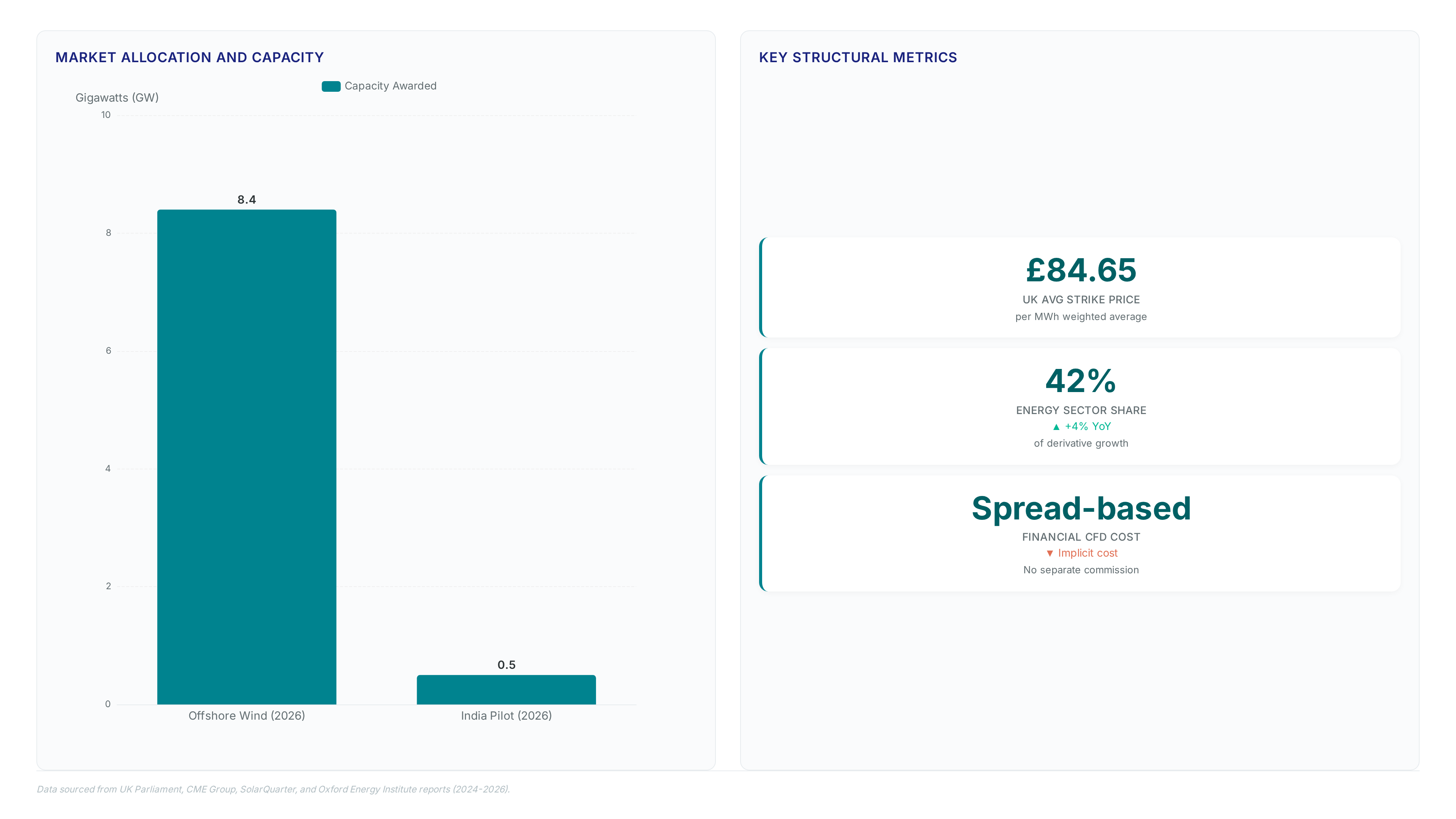
Cash settles the deal. No physical asset changes hands. Traders must watch margin requirements closely because positions often require only a fraction of total exposure. Unlike regulated exchange-traded derivatives, these agreements frequently lack a central clearing house. If the broker fails, counterparty risk spikes. Financial CFD positions often incur daily "swap" fees or financing charges to account for the use provided, whereas futures may embed interest rate differentials into the forward curve price. Most brokers derive revenue from the bid-ask spread rather than separate commissions, creating an implicit cost on every trade.
UK Energy Act 2013: Low-Carbon Electricity Generation Support
The Energy Act 2013 changed the game for nuclear and renewable generation in the United Kingdom, progressively replacing the previous Renewables Obligation scheme. This legislative framework creates a two-sided payment mechanism. When wholesale prices exceed the strike price, generators pay back excess revenue. This protects consumers while capping investor risk. Unlike fixed government tariffs seen in other jurisdictions, the UK model uses competitive allocation rounds to discover market rates. Contracts for difference function as the core instrument here, giving investors the certainty needed for capital-intensive low-carbon projects. Recent policy moves aim to further decouple wholesale electricity prices from international gas prices, reinforcing the role of these contracts in energy security. Allocation Round 7 (AR7) for UK offshore wind projects awarded an unprecedented 8.4 GW of capacity in January 2026, demonstrating the mechanism's scalability.
| Feature | UK Energy Act Model | Traditional Feed-in Tariff |
|---|---|---|
| Price Discovery | Competitive reverse auction | Government administrated |
| Risk Allocation | Shared via two-way settlement | Fully socialized to consumers |
| Market Signal | Drives cost reduction | Guarantees fixed return |
Auction design creates friction. Aggressive strike prices accelerate deployment but risk project cancellations if costs rise. Operators must monitor economic indicators, as currency fluctuations can erode the real value of fixed sterling strike prices.
The weighted average strike price across UK Contracts for Difference auctions currently stands at a set rate per megawatt-hour, establishing the baseline for consumer levies. This fixed reference point dictates the Supplier Obligation passed to end users when wholesale market rates diverge from the agreed tariff. Direct financial exposure for residents remains quantifiable under the current regulatory framework. The scheme adds approximately a modest amount annually to the average household bill, representing roughly a small fraction of the total electricity cost under the Q2 2026 price cap. Volatility in wholesale markets directly influences whether generators pay back funds or receive top-up subsidies from this pool. For instance, solar PV projects paid back a portion of their value in January 2026 when market prices exceeded their specific strike prices, illustrating the contract's two-way nature.
| Component | Function | Consumer Impact |
|---|---|---|
| Strike Price | Fixed revenue target | Determines levy size |
| Reference Price | Market wholesale rate | Triggers payment flows |
| Cap Mechanism | Limits bill exposure | Caps annual burden |
Long-term investment certainty clashes with short-term bill stability. The price stabilization provided by a two-sided CfD allows energy developers to achieve debt shares between 15 and 27 percentage points higher than comparable merchant energy projects, significantly lowering the cost of capital. While this structure secures funding for low-carbon infrastructure, it establishes a fixed revenue target for generators that interacts with wholesale market fluctuations. When wholesale prices fall below the strike price, the difference is funded through supplier obligations, whereas excess revenues above the strike price are returned to the system. This mechanism ensures supply stability but maintains a structured financial link between market rates and consumer levies.
Operational Mechanics of CFD Pricing and Settlement
CFD Profit and Loss Calculation from Opening to Closing Differentials
Settlement happens in cash. Period. No physical delivery of the underlying asset occurs. The math is rigid: profit or loss equals the difference between the opening price and the closing price, multiplied by the number of units held. If the asset value rises, the seller pays the buyer the calculated increase as net profit. Should the market value decline, the buyer compensates the seller for the drop in valuation. This cash-settled derivative structure ensures traders never take ownership of the commodity or stock they speculate upon.
| Price Movement | Buyer Action | Seller Action | Result |
|---|---|---|---|
| Increase | Receive Payment | Pay Difference | Buyer Profit |
| Decrease | Pay Difference | Receive Payment | Seller Profit |
CFD providers expanded their product offerings beyond the London Stock Exchange to include global stocks, commodities, bonds, and currencies. A trader holding a long position benefits from rising prices, while a short seller profits from declines. Use amplifies both the potential returns and the risk of capital loss. Several firms began marketing CFDs to retail traders in the late 1990s, stressing their use capabilities.
Applying CFD Margin and Stamp Duty Avoidance in London Stock Exchange Trades
Hedge funds initially deployed CFDs on the London Stock Exchange to bypass stamp duty liabilities inherent in physical share transfers. This structural advantage arises because the trader holds a synthetic position rather than the underlying asset, meaning no physical shares change hands during the transaction. Institutional actors use this mechanism to maintain large notional exposures while committing only a small fraction of capital as margin. The prime broker acts as the counterparty, often hedging their own risk by trading physical shares on the exchange where their specific account activities remain exempt from stamp duty.
| Feature | Physical Share Purchase | CFD Trade |
|---|---|---|
| Ownership | Direct legal title | Synthetic contract |
| Stamp Duty | Payable (0.5%) | Exempt |
| Capital Outlay | Full share price | Small margin only |
| Settlement | T+2 physical delivery | Cash difference |
Traders gain cost-effective access to UK equities without the friction of traditional settlement cycles or tax penalties. However, this benefit relies on the prime broker's ability to hedge its own risk under the CFD by trading physical shares on the exchange. The absence of physical delivery simplifies the entry process but introduces counterparty risk that does not exist when holding registered stock certificates directly. Retail participants entered this space later, seeking similar use benefits through direct market access platforms.
Historical Evolution from Gold Use to Modern Equity Swaps
CFDs originated in Britain during 1974 as specialized instruments to use gold positions without physical delivery constraints. This early utility focused purely on commodity price differentials rather than broad market access. The mechanism fundamentally shifted in the early 1990s when Brian Keelan and Jon Wood of UBS Warburg engineered the modern equity swap structure during the Trafalgar House deal.
| Era | Primary Asset | Key Driver |
|---|---|---|
| 1974 | Gold | Use without storage |
| 1990s | Equities | Stamp duty avoidance |
The transition introduced significant margin trading risks previously unseen in traditional brokerage. Traders now face potential losses exceeding their initial deposit because use magnifies both profits and deficits. This structural evolution means currency forecast accuracy becomes less critical than managing the amplified volatility inherent in used synthetic positions. This usage was driven by the requirement of only a small margin and the avoidance of stamp duty, as no physical shares changed hands.
Strategic Application of CFDs in Volatile Markets
CFD Market Risk Mechanics and Use Amplification
Margin trading magnifies price differentials between opening and closing positions, creating asymmetric exposure where small market shifts trigger disproportionate capital changes. A 2016 analysis by the Financial Conduct Authority revealed that 82% of retail clients lost money trading these instruments, with average losses reaching £2,200. This statistic shows the statistical probability of capital erosion when use increases volatility without corresponding risk controls. It is this risk that drives the use of CFDs, either for speculation in financial markets, or for profit in a falling market through hedging.
Traders attempting to speculate on market movements face immediate liquidation risk if price movements breach maintenance margins. Unlike physical asset ownership, CFDs settle strictly in cash, meaning traders never hold the underlying currency or commodity but remain fully exposed to its price swings.
| Risk Factor | Mechanism | Consequence |
|---|---|---|
| Use Ratio | Borrowed capital multiplies position size | Gains and losses expand exponentially |
| Margin Call | Equity falls below required threshold | Forced position closure at a loss |
| Gap Risk | Price jumps over stop-loss levels | Execution at worse-than-expected prices |
Use cuts both ways. It provides necessary liquidity for hedging strategies while simultaneously acting as the primary vector for rapid account depletion. Operators must recognize that use accelerates the velocity of both profit realization and capital destruction. Successful navigation requires strict adherence to position sizing rather than reliance on directional market predictions.
Executing Geopolitical Forex Trades on USD/CAD Pairs
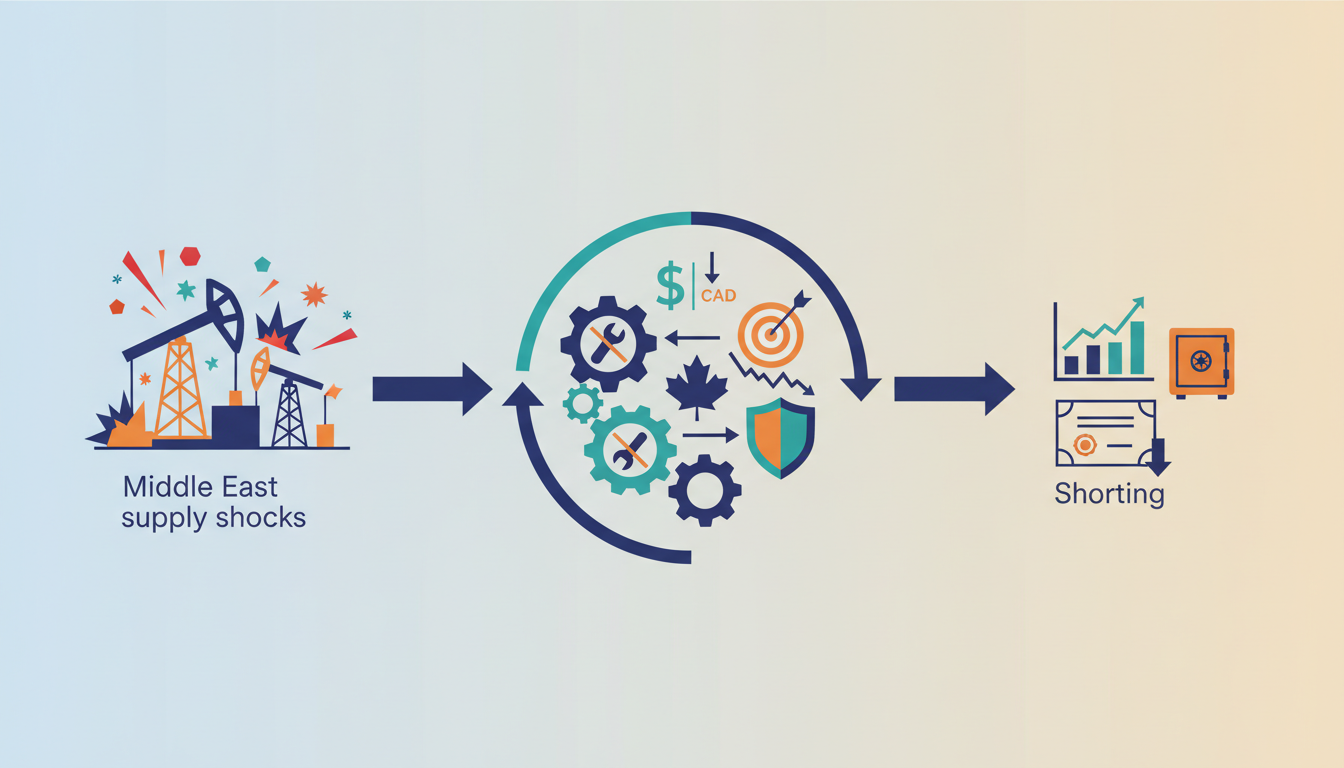
Market volatility often requires immediate technical confirmation before entry. Traders should monitor breakout levels where price action clears established resistance, signaling a shift in market sentiment. Since CFDs operate on margin, a mere ten percent deposit controls significant notional value, amplifying both gains and liquidation risks during sudden news events.
| Trigger Event | Technical Signal | Action |
|---|---|---|
| Supply Disruption | Break above resistance | Buy position |
| Diplomatic Resolution | Fall below support | Sell position |
| Inventory Surprise | Volatility spike | Wait for close |
Exiting a position demands strict adherence to stop-loss orders rather than emotional thresholds. If the initial market thesis fails to materialize within two trading sessions, the opportunity cost of tied-up capital suggests closing the trade regardless of minor fluctuations. Used exposure requires precise timing to avoid margin calls. The hidden cost of this strategy lies in the spread widening during news releases, which can trigger stops before the anticipated move occurs. Unlike physical commodity trading, synthetic exposure via CFDs avoids storage logistics but introduces overnight financing fees that erode profits in stagnant markets. Traders must calculate whether the potential market premium outweighs the cumulative cost of holding the position open.
Mitigating Margin Calls with Stop Loss Orders
Use magnifies both profit potential and loss severity, often requiring only a fractional deposit to control large notional values. This structure means market volatility can rapidly erode capital, potentially causing losses that exceed the initial deposit amount. Assessing trade deal risks in forex requires strict adherence to technical levels rather than emotional reactions to price swings. One of the ways to mitigate this risk is the use of stop loss orders. A stop loss order acts as an automated exit mechanism, capping downside exposure before a margin call occurs.
| Risk Factor | Mitigation Strategy |
|---|---|
| Excessive Use | Limit position size |
| Volatility Spikes | Set stop loss orders |
| Deposit Loss | Monitor margin levels |
Stop losses have limits. They do not guarantee execution at the specified price during extreme market gaps. Prices may bypass the trigger level entirely, resulting in slippage where the final fill price is worse than expected. This execution risk remains inherent even with protective orders in place. Traders must calculate potential loss scenarios assuming the worst-case fill rather than the ideal stop price. Effective risk management demands understanding that protection mechanisms function imperfectly under stress.
Comparative Risk Profiles of Financial and Energy CFDs
Financial CFD Use Versus Energy CfD Strike Price Stability
Financial CFDs apply margin to amplify exposure, whereas energy Contracts for Difference secure revenue through a fixed strike price. Speculative traders often analyze market data to predict asset movements, yet they face immediate liquidation risk if margins fall below maintenance levels. A stop loss order mitigates some danger, but the structural design of financial derivatives means losses can exceed the initial deposit. Conversely, energy generators operate under an auction system designed to stabilize low-carbon investment rather than speculate on short-term volatility.
| Feature | Financial CFD | Energy CfD |
|---|---|---|
| Primary Goal | Speculative profit | Revenue certainty |
| Price Mechanism | Market differential | Fixed strike price |
| Risk Profile | Unlimited loss potential | Guaranteed floor price |
| Policy Role | None | Decarbonization tool |
Financial traders bear the full brunt of price swings without policy buffers. In contrast, the UK government awarded 8.4 GW of capacity in January 2026 to offshore wind projects, locking in long-term stability for developers. This structural divergence means financial participants trade volatility, while energy participants trade it away for bankability. Operators must recognize that financial use offers no safety net during black swan events, unlike the statutory backstops present in power markets. For detailed comparisons on regulatory protections, consult Coverage Pillars.
Retail traders face immediate capital erosion due to the mechanics of use, whereas energy generators secure long-term revenue stability. Most financial CFD brokers do not charge a separate commission; instead, their revenue is derived from the bid-ask spread, which creates an immediate implicit cost on every trade. Financial CFD positions often incur daily "swap" fees or financing charges to account for the use provided. Speculators betting on price swings often trigger liquidation when margins fall below maintenance levels. High use allows small deposits to control large positions, yet this amplifies downside risk significantly more than upside.
| Risk Factor | Retail Speculator | Energy Generator |
|---|---|---|
| Primary Objective | Short-term profit | Revenue stability |
| Price Mechanism | Market volatility | Fixed strike price |
| Loss Limit | Unlimited liability | Capped downside |
| Time Horizon | Minutes to days | 15+ years |
Emerging market risk further complicates forex trades, as sudden geopolitical shifts can gap prices beyond stop-loss orders. Unlike retail traders who must constantly monitor positions, institutional energy hedging relies on government-backed schemes to absorb volume and price shocks. The structural difference lies in the counterparty; retail traders face broker liquidation protocols, while generators contract with a sovereign entity. This distinction means retail participants trade against statistical probability, while energy firms trade to eliminate uncertainty. Operators seeking to understand these mechanisms should consult Coverage Pillars for detailed educational resources. The tension remains clear: one group seeks alpha through volatility, while the other purchases certainty to fund infrastructure. Retail participants must recognize that their loss profile mirrors gambling more closely than traditional investing.
ESMA Regulatory Warnings on Speculative Products and OTC Exposure
In 2016, the European Securities and Markets Authority issued a warning regarding the sale of speculative products to retail investors that specifically included CFDs. This regulatory action followed observed increases in marketing concurrent with rising complaints from individuals suffering significant losses. Unlike exchange-traded instruments, these derivatives trade over-the-counter directly with CFD brokers or market makers, creating inherent counterparty risk. Shifts in currency or commodity prices can trigger rapid margin calls that force liquidation before traders react to market data.
Flexible margin models now calculate collateral based on real-time position risk rather than fixed equity requirements. A trader exposed to volatility faces immediate re-collateralization demands during economic announcements. Geopolitical tensions or sudden policy declarations amplify this instability. The structural limitation remains that OTC providers act as the direct counterparty; if they fail to meet obligations, the contract may hold little value regardless of underlying asset performance. Retail participants effectively bet against their broker's balance sheet integrity while navigating used exposure to global macro events. This dual exposure to market movement and broker solvency defines the unique danger profile of speculative derivative products compared to policy-stabilized energy mechanisms.
About
Sofia Mendes serves as the Broker Reviews & Trading Education Editor at ForexCFD.top, where she oversees the platform's educational library and rigorous broker evaluation standards. Her daily work involves deep due diligence on regulated brokers and creating clear guides on risk management, making her uniquely qualified to explain the mechanics of Contracts for Difference (CFDs). Because her role requires constantly assessing how use, spreads, and execution impact retail traders, she understands the critical importance of defining CFD structures accurately for a global audience. At ForexCFD.top, an independent publication dedicated to vendor-neutral analysis, Sofia ensures that complex financial instruments are presented with necessary risk disclosures and regulatory context. Her expertise in comparing FCA, CySEC, and ASIC-regulated entities allows her to connect the theoretical definition of CFDs to practical trading realities, ensuring readers grasp both the profit potential and the inherent risks of these derivative products.
Conclusion
Retail participation in these used instruments fails at scale because the structural disadvantage of over-the-counter trading compounds rapidly against individual capital. The ongoing operational cost is not merely the spread but the constant erosion of equity through flexible margin calls during volatility spikes. You must recognize that betting against a broker's balance sheet while navigating global macro events creates a dual exposure that traditional exchange trading does not impose. Given that the majority of retail clients lose money, continuing this strategy without institutional-grade risk management is mathematically unsustainable.
Shift your approach immediately if you cannot absorb total loss of capital within a single trading session. Do not treat these derivatives as investment vehicles when their design favors speculative churn over long-term value accumulation. The geographic shift toward Asian markets suggests increasing liquidity but also heightens the risk of navigating unfamiliar regulatory time zones and liquidity gaps.
Start by auditing your current open positions this week to identify any exposure to brokers with unclear solvency reports or opaque margin models. Close any used positions where the counterparty risk outweighs the potential for alpha, and redirect that capital toward regulated exchanges that offer transparent clearing mechanisms. Your financial durability depends on separating genuine hedging needs from high-frequency speculation.
Frequently Asked Questions
Most retail clients lose money when trading these complex financial instruments. The Financial Conduct Authority revealed that 82% of retail clients lost money trading them, highlighting extreme risk.
These contracts allow traders to gain exposure without owning physical shares. This structure helps avoid stamp duty costs, as no physical shares change hands during the synthetic transaction process.
GNI introduced real-time online platforms for retail traders in the late 1990s. This innovation allowed direct market access, changing how individuals speculate on price movements without owning assets.
Traders can speculate on global stocks, commodities, bonds, and currencies. Providers expanded beyond the London Stock Exchange to include major indexes like the S&P 500 and FTSE for diverse exposure.
Funds use them to gain cost-effective exposure to stocks on the London Stock Exchange. They require only a small margin and avoid stamp duty since no physical shares change hands.