
GBP/USD Rebound: Why 1.3463 Resistance Still Holds
The Pound Sterling rebounded 0.18% on 19 Jun 2026 after hitting a three-month low of 1.3163, yet the pair remains trapped below critical resistance. Readers will analyze how Fed hawkishness drives price action, examine technical barriers near 1.3463, and identify execution tactics for navigating this fragile rebound.
Market sentiment remains precarious as traders weigh a digitally signed US-Iran deal against ongoing tensions between Hezbollah and Israel. While the US Dollar Index recently touched a 13-month high of 101.13, the greenback has flatlined above 101.00 following ceasefire reports. Despite this temporary calm, the Pound Sterling faces headwinds from a 7-2 vote split at the Bank of England, where officials held rates at 3.75% despite rising inflation expectations.
Technical indicators suggest a bearish near-term bias as the exchange rate hovers around 1.3226, well below the clustered moving averages at 1.3463. The Relative Strength Index sits at 34, edging toward oversold territory but failing to signal a definitive reversal. With UK retail sales showing strength against a widening budget deficit, the path forward depends on whether macroeconomic data can override the dominant Fed-driven dollar strength. Traders must focus on these structural divergences rather than short-lived geopolitical relief.
The Role of Macroeconomic Divergence in GBP USD Volatility
Fed Hawkish Tilt and BoE Rate Decisions Set
A Fed hawkish tilt describes a Federal Reserve stance favoring rate hikes to combat inflation, directly strengthening the US Dollar. This posture persists as nearly half of FOMC members anticipate raising rates toward year-end, creating headwinds for shifting risk sentiment. Traders must recognize this divergence defines the baseline valuation pressure on GBP/USD. Conversely, recently, the Bank of England held rates at 3.75% with a 72 vote split, revealing interna l disagreement despite high inflation expectations. Two policymakers voted for an increase, signaling that the current pause may not reflect unanimous comfort with price stability. This specific policy gap creates the macroeconomic friction driving current volatility. The constraint for traders is that thin holiday liquidity can exaggerate moves against this fundamental backdrop, causing technical breaks that fundamentals alone do not justify. Monitoring these central bank signals closely rather than chasing short-term noise is necessary. Understanding the precise monetary stance differential allows operators to distinguish between temporary liquidity spikes and genuine trend reversals. The market prices in a more hawkish path for the Fed relative to the BoE, capping sustainable gains for Sterling. The 7-2 vote split highlights specific internal dissent within the BoE regarding the current pause. This divergence remains the primary engine for pair movement regardless of intraday geopolitical headlines.
Applying Divergence to GBP/USD Price Action
Monetary policy splits drive GBP/USD price action more than headline data during holiday thinned liquidity. The Pound Sterling (GBP) recovered ground on 19 Jun 2026 after nearing a three-month low of 1.3163, edging up 0.18% as traders assessed the divergent paths of the Federal Reserve (Fed) and Bank of England (BoE). While the BoE held rates, the Fed's hawkish tilt contributed to the pair failing to break through the 1.3250 resistance level before its partial rebound to 1.3226. This specific failure at the 23.6% Fibonacci retracement illustrates how technical ceilings often overpower fundamental rebounds in low-volume environments. Technical failure triggers fresh selling pressure when liquidity cannot sustain a breakout.
Traders assessing geopolitical risk must recognize that Middle East ceasefire tests create fleeting spikes rather than sustained trends. The pair remains poised to end the week with losses of 1.25%, indicating that local political friction in the UK, such as fiscal deficit fears, compounds the macro divergence. Navigating these conditions requires careful attention to price levels given the bearish setup. The direct link between central bank decisions and currency valuation means that without a clear shift in Fed expectations, any Sterling recovery remains vulnerable to immediate repricing. Current moves should be viewed as noise within a broader bearish structure set by US yield advantages.
Fiscal Deficits and Inflation Expectations Risks
Inflation expectations hitting levels unseen since 2009 create a volatile backdrop for currency recovery. UK data revealed stronger-than-expected retail sales but a larger-than-expected budget deficit, fueling investor fears that fiscal discipline may erode. This fundamental weakness threatens to undermine the Pound Sterling even as technical resistance levels are tested by short-term liquidity flows. The geopolitical risk assessment in FX trading requires monitoring these domestic fractures alongside external tensions, such as the fragile Middle East ceasefire currently influencing sentiment. While the US Dollar Index (DXY) measures the greenback's value against a basket of six substantial currencies, its stability near $101.31 reflects broader fiscal concerns rather than pure strength. A sharp tension exists where strong retail data fails to offset deficit anxiety, creating a divergent performance path compared to the Eurozone's modest appreciation. Political clashes between local leadership and the central government further complicate the economic outlook, adding a layer of unpredictability that technical analysis cannot fully price in. Investors are weighing the impact of the larger-than-expected budget deficit against stronger retail sales figures.
| Resistance Level | Technical Significance |
|---|---|
| 1.3463 | Triple SMA cluster convergence |
| 1.3546 | Descending trend-line breakout point |
The market has struggled to build on moves beyond 1.3200, with the pair slipping below 1.3250 following a failure to break through these key technical resistances. Traders observing the chart note that spot prices holding beneath this aggregate define the current downtrend, forcing any upside movement to overcome significant supply. However, relying solely on static levels ignores the liquidity flexible; thin holiday volume can cause price to wick through these zones without a genuine breakout, trapping aggressive buyers before reversing. Analysts emphasize that the inability to breach the Fibonacci ceiling suggests that downside risks remain elevated despite temporary rebounds. Market participants must distinguish between noise and genuine trend changes when price approaches these set technical barriers. Understanding this interaction prevents misinterpretation of volatile spikes during low-liquidity sessions.
Interpreting RSI 34 Signals Amid Thin Trade Liquidity Conditions
The Relative Strength Index (RSI) is at 34, edging toward oversold territory, while low liquidity increases price distortions around key levels. This value indicates weakening momentum, yet buyers must overcome specific structural barriers before any reversal gains traction. Traders analyzing moving averages note that price remains capped below the clustered 50-, 100-, and 200-day simple moving averages, creating a rigid ceiling that limits upside.
Meanwhile, the primary risk involves false breakouts where thin order books allow small flows to trigger disproportionate swings. Research indicates that thin trade conditions cause sharper reversals when resistance holds, often trapping late entries before the dominant trend resumes. This flexible renders standard oscillators less reliable as standalone signals without volume confirmation.
| Condition | Market Impact |
| Low Liquidity | Exacerbates volatility spikes |
| RSI Risk Warning: Trading foreign exchange carries a high level of risk and may not be suitable for all investors. Use can work against you as well as for you. Before deciding to trade, you should carefully consider your investment objectives, level of experience, and risk appetite. |
Comparing GBP Strength Against USD, EUR, JPY, and CHF Performance Metrics
Cross-asset verification confirms the British Pound's rebound is selective rather than broad-based. Comparatively, appreciation versus the Euro stood at 0.07%, and gains against the Japanese Yen were limited to 0.09%. This disparity highlights that the Pound was the strongest against the Swiss Franc in the observed session, while other crosses showed varied performance. With the DXY maintaining a steady position and supported by strong fundamentals, the rebound remains vulnerable to rapid reversals if broader buying pressure fails to materialize across substantial crosses.
Operational Workflow for Monitoring Economic Calendar Events
Defining Flash PMIs and Core PCE as Volatility Triggers
Flash PMIs and Core PCE act as primary volatility triggers because they fundamentally alter central bank rate expectations. Unlike routine housing data, these high-impact releases force immediate repricing across liquidity pools. Traders must integrate specific economic events into a structured monitoring workflow to navigate the resulting noise.
- Identify Flash PMI releases for both the UK and US, as these early readings often dictate the tone for official monthly data.
- Track Core PCE figures specifically, since this inflation gauge directly influences Federal Reserve policy decisions.
- Monitor scheduled speeches by Bank of England officials to gauge dovish or hawkish shifts in real-time.
Monitor real-time ceasefire violations between Hezbollah and Israel to anticipate immediate US Dollar Index reversals. The greenback initially gained on conflict escalation but flatlined as traders priced in a declared truce, illustrating how fragile diplomatic tests drive liquidity shifts. An Israeli official told Channel 13 that they are in a test of the ceasefire now, but if Hezbollah attacks, they will respond.
- Track official statements from Washington and Tehran via verified news wires, noting that a Hezbollah source warned via Al-Jadeed that adherence depends on Israeli compliance.
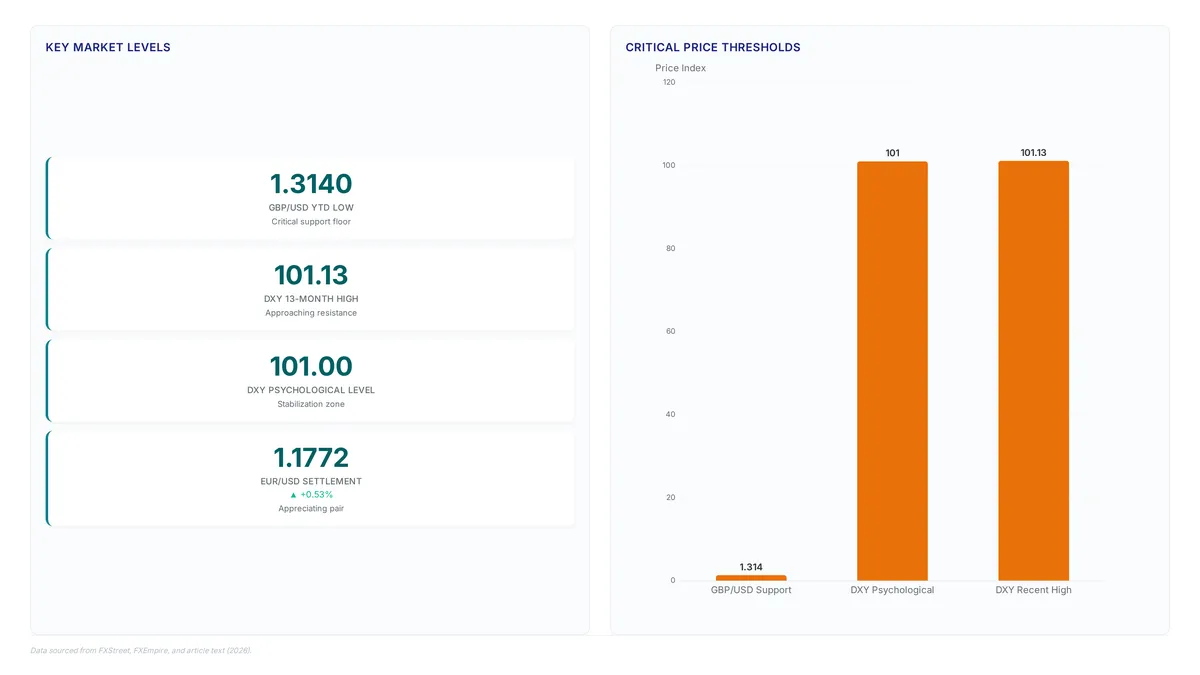
- Observe the DXY reaction around the 101.00 psychological level, where the index often stabilizes after geopolitical risk premiums evaporate. 3.
Traders face heightened reversal risk as the DXY tests the 101.26 peak without fundamental confirmation. The market structure remains bearish, where repeated failures near resistance attract fresh sellers. Thin holiday liquidity exacerbates these moves, causing sharper reversals when key levels are tested but not broken. The DXY reached a 13-month high of 101.13, approaching the May 16, 2025 peak of 101.26.1. Verify DXY positioning relative to the 101.00 floor before entering long positions.
- Wait for a confirmed close above resistance to validate momentum rather than chasing wicks.
- Cross-reference geopolitical headlines, as a Hezbollah escalation could trigger sudden safe-haven flows.
The cost of premature entry is measurable; a false breakout traps aggressive buyers before price reverts to support near 1.3140. Unlike liquid sessions, holiday thins mean smaller order flow drives disproportionate volatility. This environment favors patience over speed, requiring strict adherence to confirmed breaks rather than anticipatory orders.
About
Vikram Nair, Emerging Markets & Asia FX Writer at ForexCFD.top, brings specialized insight to global currency movements, including the GBP/USD exchange rate. While his daily focus centers on emerging-market dynamics and central bank policies in Asia and Africa, this macro expertise is critical for interpreting how substantial pairs react to geopolitical shifts and holiday-thinned liquidity. His work at ForexCFD.top, an independent publication dedicated to forex and CFD news, involves dissecting the interplay between Federal Reserve decisions and global risk sentiment that drives volatility across all FX majors. By analyzing how international events impact capital flows into Tier-2 and Tier-3 markets, Nair provides context on why sterling rebounds amidst broader dollar strength. This perspective ensures that ForexCFD.top readers receive analysis grounded in real-world cross-border mechanics rather than isolated price action, aligning with the platform's commitment to regulation-aware, educational content for retail traders worldwide.
Conclusion
The current market structure reveals that liquidity gaps during holiday sessions create disproportionate volatility, turning minor geopolitical headlines into sharp, reversible spikes. While the GBP/USD exchange rate hovers near technical resistance, the failure to sustain momentum above key Fibonacci levels indicates that traders are prioritizing capital preservation over aggressive positioning. This environment penalizes those who chase wicks without fundamental confirmation, as the delay between news flow and actual price discovery widens significantly. The operational cost here slippage, but the high probability of entering a position just before a mean reversion.
Traders should adopt a strict waiting game until the US Dollar Index either decisively breaks its 13-month high or retreats to established support. Do not assume the current range-bound behavior will persist once full liquidity returns; instead, prepare for a volatility expansion that could invalidate tight stop-losses. The most effective immediate action is to review all open positions against the 101.13 DXY floor and remove any entry orders placed within the current noise zone. By deferring new commitments until a confirmed close occurs outside this narrow band, you align your strategy with the prevailing macro trend rather than transient market friction.
Frequently Asked Questions
The pair failed to break the 23.6% Fibonacci retracement, creating a defined resistance zone. This specific technical ceiling capped the British Pound's recovery attempts despite the 0.18% rebound from recent lows.
Officials held rates at 3.75% following a split vote that revealed internal disagreement. Two policymakers voted for an increase, signaling that the current pause does not reflect unanimous comfort with price stability.
The currency pair is poised to end the week with losses of 1.25% due to political friction. Local fiscal deficit fears compound the macro divergence driving this negative weekly trajectory for traders.
A Fed hawkish tilt contrasts with the BoE holding rates at 3.75%, creating policy friction. This divergence defines the baseline valuation pressure on the currency pair more than transient geopolitical headlines.
Inflation expectations hit levels unseen since 2009, fueling investor fears about fiscal spending. These high expectations combine with a larger-than-expected budget deficit to create a volatile backdrop for currency recovery.
References