
AUDUSD pair breaks 0.7000: Wave C targets 0.6850
The AUDUSD pair targets a drop to 0.6850 following its break below the 0.7000 support zone. FxPro analysis confirms the AUDUSD currency pair broke the critical support zone between the round level of 0.7000 and the 61.8% Fibonacci retracement, a move that has officially triggered wave C of the correction pattern originating in May.
This breakdown changes the game. The 0.7000 level, which previously halted wave A in early June, failed to hold, converting a key floor into a ceiling. The breach of the 61.8% Fibonacci mark serves as the primary catalyst for the current sell-off toward the 0.6850 target, a former multi-month low established at the end of March.
Execution now hinges on these confirmed support zone failures. By focusing on the acceleration of wave C since the start of May, traders can better understand the momentum behind the move to the 0.6850 floor. This approach relies on concrete price action rather than speculative macroeconomic triggers, adhering strictly to the Elliott Wave counts provided in the June 24, 2026 report.
The Mechanics of ABC Corrections and Wave C Identification
Defining Wave C as the Accelerating Leg of ABC Corrections
Wave C is the leg that hurts. It functions as the accelerating decline that validates the completion of a corrective ABC structure. Momentum only builds after price action breaches critical support zones, distinguishing this phase from preceding impulse waves that lack such breakdown confirmation. The 0.7000 level previously halted the initial impulse wave A at the start of June, yet its recent failure accelerated wave C of the ABC correction originating in May.
Panic selling rather than orderly profit-taking often drives extended ranges in this segment. When this support zone breaks, it signals a high-probability move toward lower liquidity pools. Analysis projects that the AUDUSD currency pair can be expected to fall further to the next support level 0.6850, which marks a former multi-month low from the end of March. This target represents a precise Fibonacci confluence where selling pressure typically exhausts.
Structural integrity relies on the clear separation between the initial correction and the final impulsive leg. Failure to generate new lows below the wave A trough suggests the market remains in a complex triangle rather than a standard ABC formation. Such ambiguity requires operators to wait for decisive momentum before committing capital to the downside. Misidentifying this acceleration phase exposes positions to abrupt reversals if the broader trend reasserts dominance prematurely.
Identifying Wave C Targets Using the 0.6850 Multi-Month Low
Projection is simple; execution is hard. Wave C identification requires projecting price action toward the 0.6850 support floor, a former multi-month low established at the end of March. This specific target represents the technical completion zone where the current corrective structure finds equilibrium after breaking the 0.7000 barrier.
Traders observe that the pair can be expected to fall further to this next support level based on recent wave analysis. The mechanism relies on measuring the full extension of the decline from the May high, ignoring intermediate noise that often traps early sellers. A critical buy/sell threshold currently sits at 0.6895, acting as the immediate resistance cap for any counter-trend rallies. Failure to reclaim this zone confirms the bearish trajectory toward the primary objective.
Applying Fibonacci Breakdowns to Project AUDUSD Targets at 0.6850
Math drives the target. Projecting the next downside target requires measuring the full extension of the decline from the May high against established Fibonacci ratios. This specific level represents a former multi-month low established at the end of March. However, immediate resistance levels creating a ceiling for upward movement are clustered between 0.6911 and 0.6936. These zones act as potential traps for counter-trend buyers attempting to front-run the deeper target.
| Scenario | Trigger Condition | Technical Implication |
|---|---|---|
| Bearish Continuation | Rejection below 0.6936 | Acceleration toward 0.6850 |
| False Breakout | Close above 0.7000 | Invalidates Wave C projection |
| Consolidation | Range-bound action | Delayed breakdown momentum |
Volume failure to confirm the breakdown leads to false signals that trap aggressive sellers. Unlike simple support breaks, this setup demands patience as price often retests the underside of the broken zone before committing to the next leg down. Premature entry with an unfavorable risk-reward ratio follows ignorance of this retest. Traders must wait for clear rejection from the 0.6911 cluster to confirm the bearish thesis remains intact. Only then does the path to the 0.6850 target become statistically probable rather than speculative.
Risks of False Breakouts Below the 0.6895 Pivot Threshold
Bears get trapped here. False breaks below the 0.6895 pivot often trap bearish momentum before a violent reversal. This structural failure occurs when price wicks into minor barriers at 0.6879 or 0.6869 without sustaining a close below the threshold. Markets frequently manufacture these liquidity voids to trigger stop-losses before respecting the primary trend.
Distinguishing between a genuine breakdown and a temporary excursion defines the mechanism. A valid signal requires a confirmed close beneath the pivot, not merely a tick lower. If price rebounds above 0.6895 quickly, the short thesis faces immediate invalidation risk. However, the cost of error remains high if the breakdown proves genuine. A total failure of the current impulsive structure implies a move toward 0.5913, representing a significant deviation from the projected path. Traders must weigh the probability of a triangle correction against a clean impulse.
| Scenario | Confirmation Signal | Invalidation Level |
|---|---|---|
| Valid Breakdown | Close below 0.6879 | Reclaim above 0.6895 |
| False Breakout | Rejection at 0.6869 | Close above 0.6911 |
Used positions on AUDUSD carry elevated risk during these volatile transitions. Always confirm the structural break before committing capital to the downside.
Executing Short Positions on AUDUSD Breakdown Scenarios
Defining the AUDUSD Breakdown Structure Below 0.7000
The line in the sand is 0.7000. Price action below the 0.7000 round number flips a former floor into a hard ceiling. This breach triggers an accelerated decline targeting the 0.6850 liquidity pool. Traders watch this specific threshold because it separates a valid bearish continuation from a false breakout that kills the short thesis. The move confirms wave C of the ABC correction (2) started back in May.
Downward bias dominates the chart, yet markets frequently test these new resistance lines to trap aggressive sellers before dropping further. Immediate resistance creating a lid on upside moves sits clustered between 0.6911 and 0.6936.
| Condition | Action | Invalidation |
|---|---|---|
| Close below support zone | Initiate short | Close above 0.7000 |
| Rejection at 0.7000 | Add to short | Break of structure high |
Operators separate genuine structural shifts from transient volatility spikes lacking volume follow-through. The breakdown signals completion of the prior corrective wave, yet relying only on geometric targets without watching the pivot exposes accounts to whipsaws.
Executing Short Entries Near 0.7000 Resistance for 0.6850 Targets
Sell the rip. This entry zone marks where sellers previously defended the downtrend, specifically where price stopped impulse wave A at the start of June. Rejection here proves the broken support flipped into a valid resistance ceiling. The primary objective stays fixed on the 0.6850 target, matching the multi-month low set at the end of March.
| Parameter | Level | Function |
|---|---|---|
| Entry Zone | 0.7000 | Resistance Cluster |
| Invalidation | > 0.7000 | Trend Reversal |
| Target | 0.6850 | Liquidity Pool |
Narrow margins for error exist if price spikes through the upper bound of the cluster. A decisive close above 0.7000 invalidates the immediate bearish thesis and suggests a deeper correction rather than continuation. Analysts recommend selling on the breakdown to capture the projected fall toward the next support level.
*Trading used metals and forex involves significant risk to your capital. Ensure you understand the mechanics before executing short entries.*
Pre-Trade Checklist for Validating the Fall to 0.6850
Don't guess; verify. Sustained price action below the 0.7000 threshold matters before committing capital to sell AUDUSD. Traders verify that the ABC correction structure holds firm after the initial zone breach.
| Validation Step | Confirmation Signal | Invalidated By |
|---|---|---|
| Price Action | Close below support zone | Reclaim of 0.7000 |
| Wave Structure | Acceleration of Wave C | Break above 0.7000 |
| Target Projection | Drop to 0.6850 | Triangle breakout up |
Conversely, a successful test of resistance confirms the path toward the 0.6850 target identified in recent wave analysis. The triangle correction scenario introduces tension where a breakout above 0.6600 could prematurely invalidate the entire bearish premise.
Critical Resistance Barriers and Downside Target Validation
Defining the 0.6911-0.6936 Resistance Cluster Mechanics
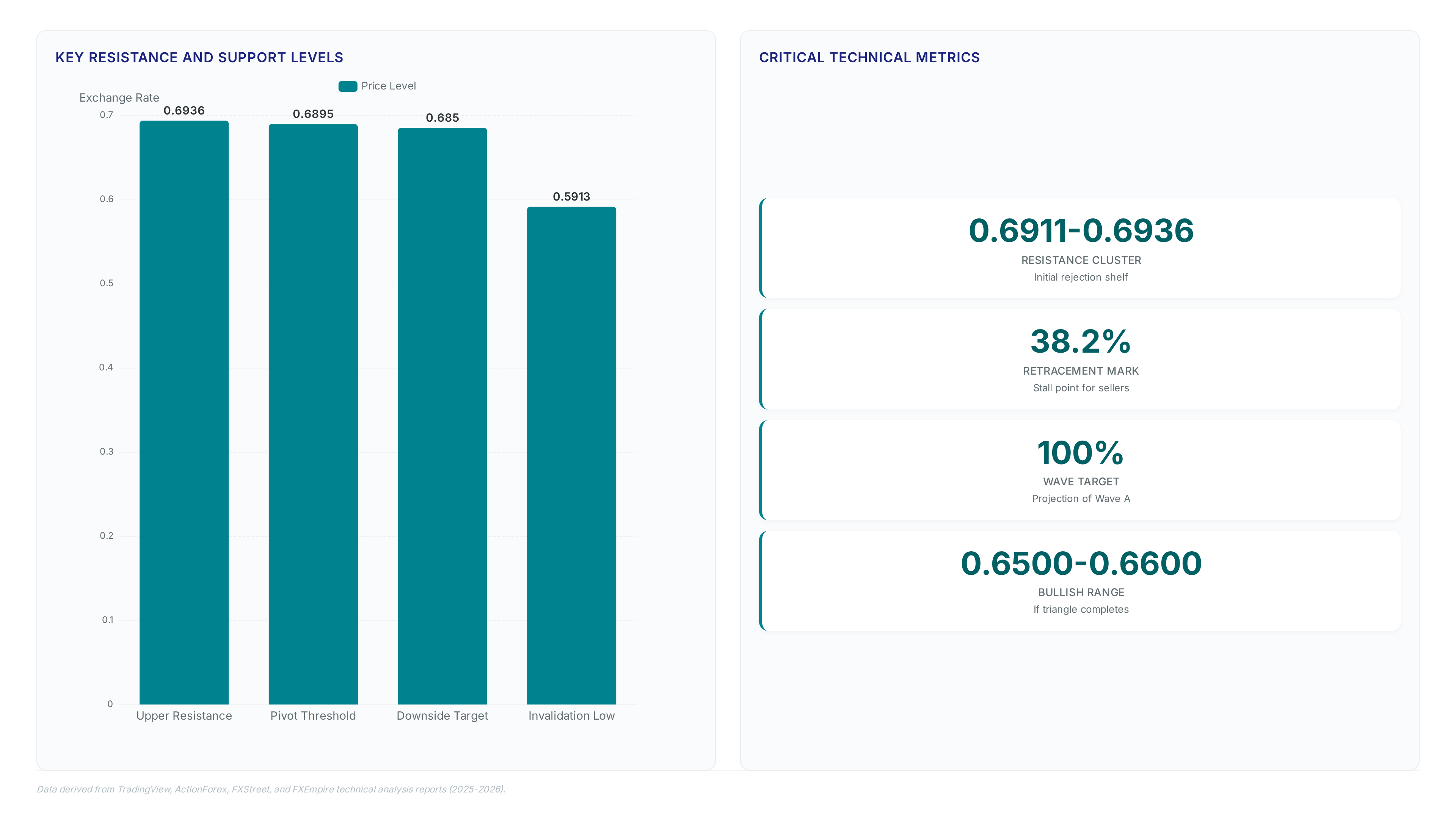
Supply sits here. The 0.6911 level functions as the initial rejection shelf where minor supply aggregates to form a strong ceiling. This resistance cluster between 0.6911 and 0.6936 validates bearish momentum only if price fails to sustain a close above the upper bound. Traders observe how the minor barriers at 0.6921 and 0.6911 create a stepped distribution zone that absorbs buy orders before the next leg down.
If the pair rallies but stalls below the 38.2% mark, sellers often escalate aggression earlier than textbook models suggest. Most operators miss that a failure to reach the absolute high of the zone can itself be a bearish signal indicating overwhelming selling pressure. A decisive break below the immediate support confirms the path toward the 0.6850 target remains open. Used positions in AUDUSD carry significant risk; ensure stop-losses sit above the 0.6936 invalidation point to manage exposure effectively.
Validating the Bearish Thesis Using the 0.6895 Pivot
Hold the line. Meanwhile, the 0.6895 threshold acts as the definitive structural pivot separating validated breakdown from false breakout noise. Sellers must defend this line aggressively to confirm the wave C impulse remains intact toward lower lows. A daily close above this level invalidates the immediate bearish structure and suggests a return to range-bound volatility. Market participants reference TradingView data to monitor this specific buy/sell threshold for intraday decision-making.
| Scenario | Price Action | Implication |
|---|---|---|
| Bearish Continuation | Rejects below 0.6895 | Targets 0.6850 low |
| Bullish Invalidations | Sustains above 0.6895 | Halts downward momentum |
| Neutral Zone | Oscillates near pivot | Delays directional bias |
Traders observe that failure to reclaim this pivot often accelerates selling pressure due to trapped longs liquidating positions. The projection targets the 0.6850 support, which corresponds to the multi-month low established at the end of March. This specific target represents a critical liquidity pool where prior buyers previously defended value. Ignoring the 0.6895 invalidation point exposes capital to unnecessary reversal risk if momentum shifts abruptly. ForexCFD.top recommends executing short entries only after clear rejection patterns form below this key technical divider.
Reversal Probability at 0.6936 Versus Momentum to 0.6850
This is the friction zone. Price faces a decisive test within the 0.6911 to 0.6936 supply cluster where sellers defend the breakdown. This specific zone creates a high-friction ceiling that absorbs buying pressure before the wave C impulse resumes its decline toward the 0.6850 target. The mechanism relies on failed bounce attempts that cannot sustain momentum above the upper resistance bound, confirming that bearish sentiment remains dominant despite short-term bullish divergence on lower timeframes.
| Scenario | Probability Driver | Technical Outcome |
|---|---|---|
| Rejection | Supply at 0.6936 | Drop to 0.6850 |
| Reversal | Break above cluster | Return to 0.7000 |
| Consolidation | Mixed signals | Range-bound drift |
However, a sustained close above the resistance cluster invalidates the immediate bearish thesis and suggests a deeper correction is underway rather than a simple continuation. Most price action remains trapped below the critical pivot, reinforcing the view that the path of least resistance remains downward. Traders using ForexCFD.top should note that use on metals and currencies carries significant risk, and positions must be managed with strict stop-losses to account for volatility spikes during liquidity thin-outs. The statistical probability favors the downside target as long as the market fails to reclaim the broken support zone which now acts as resistance. A failure to break higher confirms that the previous support breach was not a liquidity trap but a genuine structural shift in market sentiment.
About
Aisha Rahman, Gold & Commodities Analyst at ForexCFD.top, brings a specialized macroeconomic perspective to this AUDUSD wave analysis. While her primary focus remains on XAUUSD and commodity flows, her deep expertise in commodity-currency correlations makes her uniquely qualified to interpret the Australian Dollar's movements. In her daily work at ForexCFD.top, an independent forex and CFD news publication, Aisha constantly monitors how shifts in gold and oil prices impact substantial FX pairs like AUDUSD. This article's technical breakdown of the recent support zone breach directly uses her understanding of how commodity sentiment drives the "Aussie." By connecting these commodity fundamentals with precise Elliott Wave structures, she provides retail traders with a reliable framework for navigating current market volatility. Her analysis reflects ForexCFD.top's commitment to delivering regulation-aware, educational content that helps global traders understand the complex links between commodities and currency valuations without unnecessary hype.
Conclusion
The trade dies if price clears 0.6936. The operational failure point for this strategy occurs if price action sustains above the 0.6936 supply cluster, transforming a potential continuation into a complex range-bound drift that erodes capital through time decay. While the statistical edge favors a decline toward 0.6850, the ongoing cost of holding short positions involves managing volatility spikes during liquidity thin-outs where stop-losses face undue stress. You must treat any close above this resistance cluster as an immediate invalidation of the bearish thesis rather than a temporary anomaly.
Adopt a strict conditional approach: initiate short entries only after clear rejection patterns form below the 0.6911 divider, and exit immediately if the market reclaims the upper bound of the supply zone. Do not anticipate the drop; react to the confirmed failure of buyers to push through the friction zone. This discipline ensures you participate in the wave C impulse only when momentum aligns with structural resistance.
Start this week by setting price alerts at the 0.6936 ceiling and the 0.6850 floor to monitor reaction quality without overtrading the intermediate noise. Focus your attention on how the AUDUSD pair behaves within this specific range to determine if sellers truly control the narrative or if a deeper correction is unfolding.
Frequently Asked Questions
A sustained close above the broken 61.8% retracement level invalidates the bearish thesis. This breach forces traders to re-evaluate the entire corrective count and abandon short positions targeting the 0.6850 floor immediately.
Sellers often escalate aggression if the pair stalls below the 38.2% mark during a rally. This failure confirms downward momentum, suggesting traders should maintain short exposure toward the 0.6850 support target.
Technical projections often target the 100% extension of the initial drop to measure potential declines.
A sustained close above the broken 61.8% retracement level would invalidate the current bearish structure. Such a move suggests the market is forming a complex triangle rather than completing a standard ABC correction pattern.
The pair is projected to fall to 0.6850, which corresponds to a former multi-month low. This level represents the technical completion zone where the current corrective structure finds equilibrium after breaking support.
References