
GBP/CHF Support: Why 1.0612 Zone Matters Now
The GBP/CHF pair hovers at 1.0640 after the SNB's 0% rate decision triggered a broad franc sell-off.
Sterling carries the weight of the Bank of England's hawkish 7, 2 vote split, creating a volatile fundamental backdrop against a dovish Swiss National Bank. This divergence sets the stage for technical execution, but only if you respect the hierarchy of drivers.
We are looking at the 1.0612, 1.0620 zone. Here, the 100 SMA, S1 Pivot, and 38.2% Fibonacci retracement cluster to form a high-probability support area. If bears invalidate this channel structure, downside targets extend to the 50% retracement at 1.0580 and potentially 1.0546.
Global FX volumes hit a record high daily in April 2025, yet this pair remains uniquely sensitive to European session dynamics and geopolitical risk premiums. As Niko notes in the June 19 analysis, ignoring the fundamental drivers behind this technical cluster invites unnecessary risk. The coming sessions will test whether this support zone holds or if the market forces a deeper correction toward 1.0546.
Triple Support Confluence Defines the Current Market Structure
Defining the GBP/CHF Triple Support Confluence Zone
Confluence is not magic; it is the collision of independent order flows. At 1.0612, the S1 Pivot, 38.2% Fibonacci retracement, and 100 SMA converge horizontally. This technical confluence matters because overlapping buy orders from distinct methodologies create a high-probability bounce area on the 4-hour chart. The structure emerges within an ascending channel pattern established since mid-May, where price respects parallel trendlines during uptrends. Infrastructure modernization accelerates electronic execution near these levels, reducing latency during central bank volatility. Unlike single-indicator signals, this triple alignment forces algorithmic systems to react simultaneously, often triggering sharp reversals or decisive breaks. The substantial daily FX volume ensures sufficient liquidity for large institutions to defend such technical clusters without excessive slippage.
Do not mistake probability for certainty. False breaks occur when fundamental shocks override technical structure, invalidating the confluence zone temporarily. Traders must watch for candle closes below 1.0612 to confirm bearish control rather than relying on wick penetrations alone. Technical patterns provide probability, not certainty, especially when geopolitical shifts alter currency correlations abruptly. Validate any bounce with momentum confirmation before committing capital to the setup.
Executing Trades on the 1.0612, 1.0620 Bullish Reversal Setup
Execution demands patience. Entry requires bullish candlesticks forming inside the 1.0612, 1.0620 zone while price hovers near 1.0640. Traders targeting the Pivot Point at 1.0656 must recognize that liquidity depth here relies on all-to-all market infrastructure to absorb order flow without excessive slippage.
The primary upside target remains R1 at 1.0722 if buyers reclaim the ascending channel. However, execution risk increases due to the SNB's explicit willingness to intervene, a stance supported by their substantial gold reserves that validate financial firepower regardless of FX losses. This creates a tension where technical breakout signals may fail against opaque central bank limits rather than organic supply.
| Scenario | Trigger Condition | Target Level |
|---|---|---|
| Bullish Bounce | Close above 1.0620 | 1.0656 / 1.0722 |
| Bearish Break | Close below 1.0612 | 1.0580 / 1.0546 |
Transaction fees on futures contracts can erode margins on tight stops during low-volatility compressions. The cost of false positives is measurable when algorithmic flows react to headline noise rather than structural breaks. Successful validation demands waiting for the 4-hour candle close to confirm the support zone holds before committing capital to the long side.
Technical Confluence Versus Fundamental Drivers Like SNB Policy
Charts break when central banks intervene. Triple support zones offer precise entry coordinates, yet the SNB maintains a 0% policy rate that distorts standard volatility models. Conversely, the Bank of England holds rates at 3.75%, creating a yield disparity that fuels speculative flow despite technical resistance.
The reliability of the 1.0612 level depends entirely on whether fundamental pressure exceeds order book depth. Operators must distinguish between structural support and temporary pauses before fundamental drivers resume trend direction.
| Factor | Technical Reliability | Fundamental Risk |
|---|---|---|
| Signal Source | Chart Patterns | Central Bank Rates |
| Precision | High (Pips) | Low (Policy Shifts) |
| Timeframe | Short-term | Medium-term |
| Failure Mode | False Breakout | Policy Surprise |
A breakout below S1 invalidates the ascending channel regardless of confluence strength. The SNB possesses significant capital reserves to enforce its willingness to intervene, potentially ignoring technical floors entirely. Traders relying solely on Fibonacci levels without monitoring geopolitical factors face asymmetric downside risk. Fundamental divergence ultimately dictates the ceiling for any technical bounce. This rate mechanics framework persists despite global pressure, effectively capping yield for the currency. A dovish shift emerged not through number changes, but via upgraded language signaling increased willingness to intervene in FX markets. Such verbal cues alter market expectations quicker than actual balance sheet operations.
| Feature | Standard Holding Pattern | Dovish Language Shift |
|---|---|---|
| Primary Signal | Static rate statement | Explicit intervention warning |
| Market Reaction | Gradual pricing | Immediate volatility spike |
| Policy Goal | Stability maintenance | Active depreciation pressure |
Hidden costs often obscure the true impact of these shifts on retail execution. Standard industry rates frequently include high exchange rate mark-ups that erode margins during intervention-driven spikes. While the SNB maintains its policy rate at zero, the divergence with higher-yielding peers creates a structural short bias.
However, the capacity to enforce this stance relies on valuation gains rather than operational profit. The bank previously offset foreign currency losses with gold valuation increases, a buffer that may not persist indefinitely. Traders must recognize that verbal intervention threats carry less weight if the balance sheet cannot absorb sustained counter-attacks.
Meanwhile, hidden exchange rate mark-ups silently erode SME margins, creating a drag on profitability that technical breakouts cannot offset. Retail participants often overlook these embedded costs while focusing on standard industry rates. This opacity complicates the assessment of true break-even points during volatile GBP/CHF swings. The SNB retains significant firepower to execute its intervention mandate despite recording a CHF 8.8 billion loss on foreign currency positions in 2025. Gold valuation gains effectively offset these FX deficits, ensuring the central bank remains highly capitalized against market pressure. Traders analyzing bullish vs bearish breakout scenarios must account for this balance sheet durability, which validates the threat of sudden liquidity injections. However, the cost of accessing this liquidity varies wildly across counterparties.
| Feature | Standard Mobile Account | Institutional/Pro Tier |
|---|---|---|
| Surcharge | Fixed percentage fee | Negotiated spread |
| Transparency | Low (hidden in rate) | High (explicit) |
| Intervention Risk | High slippage | Managed via hedging |
Central bank decisions affect currencies by altering the fundamental cost of capital, yet hidden fees distort the realized yield for smaller players. Operators must recognize that SNB intervention capacity is finite only in political terms, not financial ones, given the gold backing. Failure to audit transaction cost components leaves you exposed.
Executing the Bounce Strategy with Precision Entry Rules
Defining the Bullish Candle Confirmation Signal
Valid entry requires a 4-hour candle close above the 1.0612 S1 Pivot, rejecting mere wick touches that often signal false bottoms.
- Confirm the bullish candle body fully engulfs the prior bearish range, signaling a definitive shift in momentum rather than temporary liquidity grabs.
- Execute the long position only after the 4-hour bar closes, ensuring the market has accepted prices above the support cluster.
Traders must account for execution friction, as standard accounts often apply hidden exchange rate mark-ups. Institutional-grade transparency via CME Group infrastructure highlights how retail spreads can distort proven entry prices during high volatility. The SNB's March 19 communication regarding intervention readiness adds a layer of fundamental risk that technicals alone cannot price. Ignoring the close confirmation exposes capital to whipsaws driven by algorithmic stop-hunting.
Setting Stop-Loss and Take-Profit Levels for GBP/CHF
Place the initial stop-loss 15 pips below the S1 Pivot at 1.0612 to invalidate the triple support thesis upon a confirmed break.
- Set the hard stop at 1.0597, acknowledging that the SNB retains CHF 26.1 billion in gold-backed capitalization to absorb further FX volatility without solvency risk.
- Target the Pivot Point at 1.0656 for the first exit, as research shows combining standard technical rules with Bayesian Statistics significantly improves profit capture compared to rigid Fibonacci targets alone.
- Scale remaining positions toward R1 resistance near 1.0722 only if the 4-hour candle closes above the 100 SMA.
The ascending channel structure demands flexible adjustment; static targets often fail when central bank language shifts abruptly. Most traders ignore the probability boost offered by statistical overlays, relying instead on simple support flips that yield marginal returns. A rigid approach misses the nuance where gold valuation impacts sentiment. Validate every stop-loss placement against current liquidity depth to avoid premature exits during spike events. The cost of a wide stop is clear capital exposure, yet the penalty for a tight stop is premature ejection from a valid trend. Balance these competing risks by anchoring stops to structural failures rather than arbitrary percentages.
Validating Entries Against SNB Intervention Risks
Filter bullish candle signals near the S1 Pivot through real-time SNB policy language checks to avoid false breakouts caused by sudden intervention threats.
- Cross-reference any price approach to the 100 SMA with the latest Governing Board statements to detect subtle upgrades in intervention willingness that often precede volatility spikes.
- Delay order execution until verifying that no new monetary policy assessment has been released within the preceding four-hour window, preventing trades against fresh fundamental headwinds.
Unlike standard technical failures, an SNB-driven reversal often ignores support levels entirely, rendering traditional stop-loss placements ineffective. Operators relying solely on chart patterns without monitoring these specific policy triggers face elevated tail risk during the European session. Integrating direct central bank feed monitoring into execution algorithms mitigates this specific structural vulnerability.
Risk Assessment Determines Viability of the Trade Setup
Transaction Cost Analysis for GBP/CHF Retail Traders
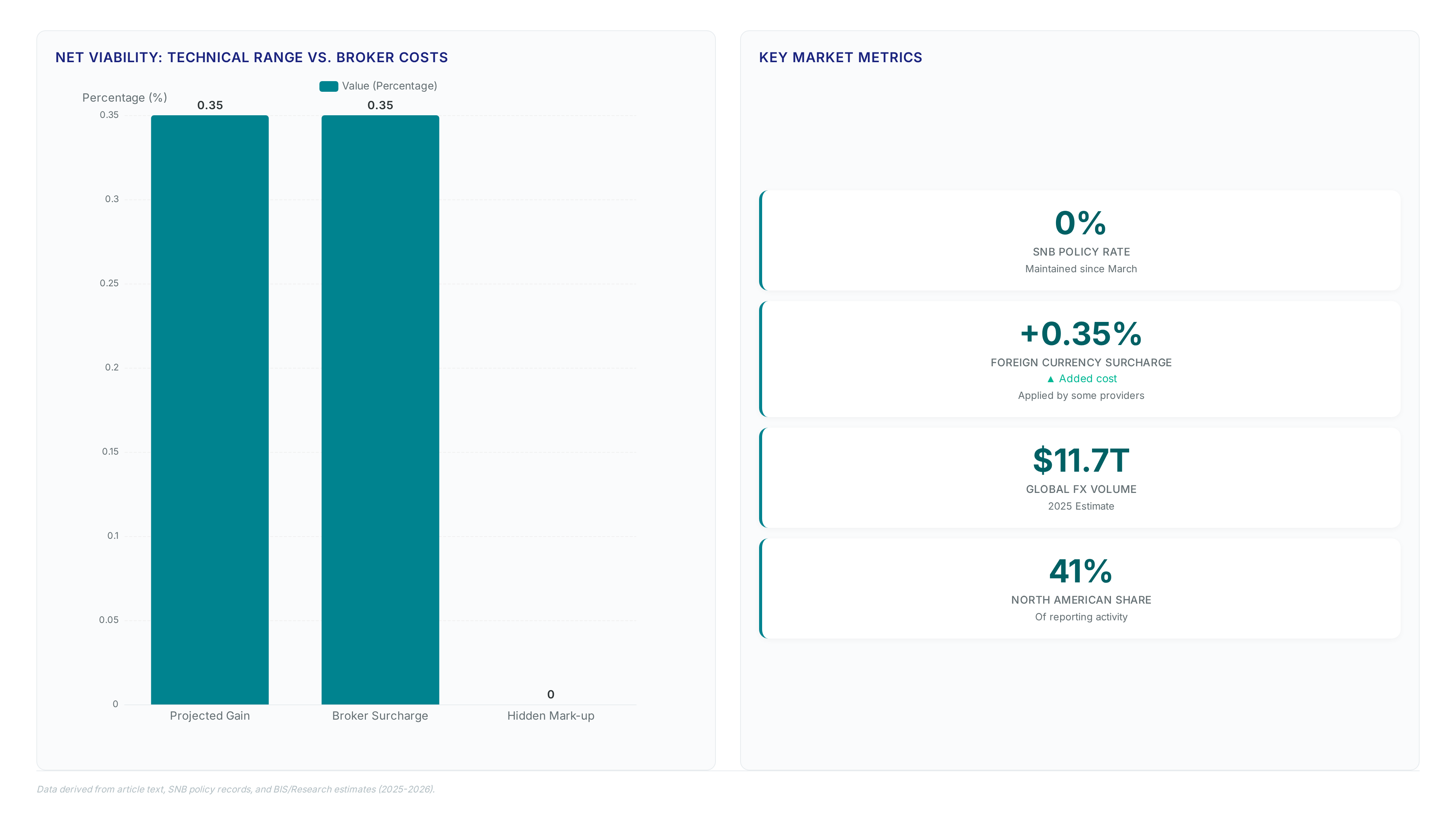
Retail traders validating the GBP/CHF bounce must subtract explicit broker surcharges from projected technical gains to determine net viability. This fixed cost combines with variable spread widening during SNB intervention threats, creating a hidden barrier to entry that pure technical analysis ignores. Market participants frequently overlook these embedded costs while focusing on standard industry metrics.
| Cost Component | Impact on Net P&L | Mitigation Strategy |
|---|---|---|
| Fixed Surcharge | Reduces profit on small moves | Switch to professional tiers |
| Exchange Mark-up | Widens proven stop distance | Use comparative analysis tools |
| Spread Volatility | Increases slippage risk | Avoid news windows |
Sophisticated actors apply transaction cost analysis capabilities to quantify these drags before order submission. Ignoring this friction turns a statistically sound setup into a losing proposition after fees. Consult detailed broker fee schedules before executing near the S1 Pivot.
Applying TCA to the 1.0612 Support Zone Bounce
Calculating net viability for a GBP/CHF bounce at 1.0612 requires subtracting broker surcharges from the projected 44-pip technical range. Retail participants face varying execution costs, with some providers applying hidden exchange rate mark-ups.
The limitation lies in the asymmetry of costs; while upside targets at the Pivot Point remain fixed, friction scales with volatility. Goldman Sachs uses AI models to simulate such adverse conditions, highlighting how static TCA often fails to account for flexible market impacts. Verify that the potential reward justifies the entry overhead before validating the bullish candle signal. Ignoring these friction points turns a high-probability technical setup into a net-loss proposition after fees.
SNB Intervention Risks and False Breakout Scenarios
SNB verbal upgrades create immediate false breakout risks for GBP/CHF traders relying on static support levels. The central bank's shifted language overrides technical confluence, forcing price action that invalidates the 100 SMA bounce thesis before momentum builds. This creates a trap where a seemingly valid bullish candlestick close above 1.0612 reverses sharply on intervention headlines. Unlike standard volatility, policy-driven moves ignore Fibonacci retracements entirely.
Liquidity conditions complicate detection of these fake-outs during the initial move. While global FX volume hit a substantial amount in 2025, regional disparities mean North American dealers handle a significant share of reporting activity, leaving gaps for sudden price dislocations. Traders using electronic transformation tools often miss the nuance of verbal cues compared to human analysts monitoring Governing Board statements.
| Scenario | Trigger | Outcome |
|---|---|---|
| Valid Bounce | Pure technical demand | Reach R1 at 1.0722 |
| False Breakout | SNB verbal intervention | Drop below 1.0580 |
| Stalled Rally | Hidden transaction costs | Flatline near 100 SMA |
Cost structures further erode margins on failed attempts. Advanced firms now deploy transaction cost analysis to validate every bullish breakout signal against real-time central bank rhetoric to avoid capitalizing on a trap. The cost of a false positive here exceeds standard slippage models.
About
Vikram Nair, Emerging Markets & Asia FX Writer at ForexCFD. Top, brings a distinct macroeconomic perspective to the analysis of the GBP/CHF currency pair. While his daily coverage primarily focuses on emerging market dynamics and central bank policies in Asia and Africa, this background provides a rigorous framework for evaluating global liquidity shifts that drive substantial crosses. The recent Swiss franc decline and Bank of England decisions cited in the article reflect the same type of policy divergence Nair analyzes in Tier-2 economies. His expertise in tracking how regional capital flows react to central bank mandates allows him to identify critical technical levels, such as the "triple support zone" discussed. At ForexCFD. Top, an independent publication dedicated to factual market news, Nair applies this disciplined, vendor-neutral approach to help retail traders navigate volatile FX majors. The real fracture point for retail traders is not the chart pattern itself, but the latency gap between algorithmic reaction to headlines and manual execution. While global liquidity appears infinite, regional concentration means SNB verbal cues trigger dislocations that bypass standard Fibonacci defenses entirely. You cannot trade this pair on price action alone while ignoring the yield disparity narrative that drives institutional flow.
Adopt a strict conditional entry rule: execute long positions only after a 4-hour candle close above 1.0612, but only if no SNB Governing Board member has spoken in the preceding four hours. If policy speakers are scheduled, defer entry regardless of technical perfection. This discipline protects capital from false breakouts that technical models cannot predict. The market rewards patience over speed when policy risk is elevated.
Start this week by auditing your economic calendar for all Swiss National Bank speaking engagements and blocking trade entries during those specific windows. Mark these blackout periods on your charting software immediately to prevent impulsive decisions during high-risk volatility.
Frequently Asked Questions
The zone forms where the 38.2% Fibonacci retracement aligns with other indicators. This confluence creates a high-probability area for potential bounces on the chart.
The Bank of England holds rates at 3.75% while the SNB stays at 0%. This significant yield disparity drives fundamental volatility for the currency pair.
Global markets process $9.6 trillion daily, ensuring sufficient liquidity. This volume allows institutions to defend technical clusters without causing excessive price slippage.
A break below support targets the 50% retracement level near 1.0580. Traders watch for bearish candles closing below the S1 pivot to confirm this move.
Alpha Capital Group offers an 80% profit split to funded analysts. They serve over 140 countries and provide scaling opportunities up to significant capital amounts.