
Cash rate target: Inside the RBA's June call
The RBA kept the cash rate at 4.35 per cent in June 2026 despite falling oil prices. This isn't hesitation; it's a calculated stand against persistent inflation while global financial conditions ease slightly. The board remains wary of second-round effects from energy costs and stubborn price pressures.
We need to talk about how monetary transmission actually functions when major economies like the US and UK hold rates steady while others tighten. The analysis below dissects the impact of Middle East conflict resolutions on bond yields and explains why the Australian dollar depreciated against US yield differentials. We are looking at the specific mechanics keeping policy restrictive despite recent market calm.
Global divergence complicates the picture. The European Central Bank and Norges Bank are raising rates to curb inflation. Meanwhile, domestic financial conditions reflect a messy mix of lower commodity prices and stable long-term inflation expectations. You have to understand these cross-currents to grasp why the board chose stability over adjustment in this cycle.
Defining the Neutral Interest Rate and Financial Conditions Framework
Defining the Neutral Interest Rate Against Inflation Targets
Think of the neutral interest rate as the theoretical cash rate target that neither stimulates nor restricts economic activity when inflation aligns with targets. It is the benchmark anchoring assessments of whether current monetary policy remains accommodative or restrictive. The Reserve Bank of Australia kept the cash rate target unchanged at 4.35 per cent during its June 2026 meeting, a level sitting above many market estimates of neutral. That positioning signals policy remains restrictive to combat persistent price pressures.
Financial conditions encompass the broader transmission mechanism of policy, including bond yields, equity prices, and credit availability.
Applying the Financial Conditions Framework to Global Oil Price Shocks
The financial conditions framework translates external price shocks into domestic policy stances through observable market variables. During the June 2026 meeting, the Reserve Bank of Australia noted that conditions abroad eased as progress toward resolving the Middle East conflict drove a significant drop in global oil prices. This geopolitical shift caused expectations for central bank policy rates to decline and equity prices to rise across many nations.
However, policy interest rate expectations remained elevated compared to pre-conflict levels. The disinflationary impulse from energy costs had not fully reset global monetary baselines. Operators must distinguish between temporary commodity relief and structural tightening. Falling crude costs reduced immediate inflation pressure, yet the European Central Bank and Norges Bank simultaneously raised rates to contain second-round effects, creating a divergent global backdrop. This divergence limits the effectiveness of external easing on domestic inflation metrics. The RBA assessed that despite lower oil prices, the cash rate target at 4.35% sits above the neutral range, keeping overall conditions restrictive.
| Variable | Direction | Driver |
|---|---|---|
| Oil Prices | Fell | Conflict resolution progress |
| Equity Prices | Rose | Earnings expectations |
| Policy Rates | Held/Mixed | Inflation persistence |
Reduced energy costs alone do not constitute a loosening of financial conditions if long-term yield expectations remain anchored high. A premature pivot to easing based solely on oil price declines would ignore the stickier components of inflation driven by labour market dynamics. Only a sustained reduction in core inflation measures would validate a shift in the neutral rate assessment.
Risks of Persistent Inflation Expectations Despite Eased Financial Conditions
Inflation expectations anchor future price setting even as current financial conditions loosen globally. Tracking these metrics relies on break-even rates derived from bond spreads and professional forecaster surveys. Global oil prices fell following geopolitical progress, yet policy interest rate expectations across advanced economies remain elevated relative to pre-conflict baselines. This persistence signals that markets anticipate prolonged restrictive stances rather than a swift return to neutral.
Divergent central bank actions show this risk; notably, the European Central Bank and Norges Bank raised rates specifically to contain second-round effects from energy costs. Such moves validate fears that temporary supply shocks could calcify into permanent wage and price spirals.
| Channel | Primary Impact | Observation |
|---|---|---|
| Lending Rates | Reduced consumption | Tightened since start of year |
| Bond Yields | Tighter financial conditions | Unwound some earlier increases |
| Exchange Rate | Import price volatility | Depreciated slightly |
GDP increased by 2.5 per cent over the year, though private domestic demand is recovering more slowly than earlier expected. The lag between policy implementation and its impact on the economy creates the critical tension. Global easing trends offer some relief, yet domestic stickiness requires a restrictive stance. Markets have adjusted expectations for the future path of monetary policy noticeably since May in response to lower global oil prices and weaker-than-expected data. A flip in this view requires evidence that productivity growth has accelerated sufficiently to offset wage pressures without demand destruction. Inflation picked up materially in the second half of 2025, with latest data confirming headline and underlying inflation remain too high as of mid-2026. This analysis is for educational purposes only; CFDs are complex instruments and carry a high risk of losing money rapidly due to use.
Data Centre Investment Driving Private Business Demand
Private business investment surged unexpectedly, driven principally by data centre construction requiring both imported hardware and domestic labour. Members noted that while data centre investment requires imported components, it also requires domestic inputs, potentially exacerbating capacity pressures and skills shortages. This dual dependency creates a unique transmission channel where demand for specific local services remains resilient.
The mechanism operates through a divergence in input elasticity. Imported servers respond to global supply chains, yet local installation and power infrastructure face rigid domestic constraints. Consequently, capital expenditure in this sector remains resilient despite higher borrowing costs, unlike broader private domestic demand which is recovering more slowly than earlier expected. This flexibility sustains inflationary pressure in the services sector even as goods inflation moderates.
| Input Type | Origin Dependency | Policy Sensitivity |
|---|---|---|
| Server Hardware | Imported | Linked to global supply |
| Construction Labour | Domestic | Linked to local capacity |
| Grid Connection | Domestic | Linked to local capacity |
However, the concentration of spending in high-skill trades risks overheating specific regional labour markets. The resulting wage pressures in technical construction could persist longer than economy-wide averages, complicating the assessment of underlying inflation. Operators must therefore differentiate between transient supply bottlenecks and structural labour deficits when forecasting project timelines. The view flips if global energy prices spike again, forcing a re-evaluation of operational viability for new facilities. Members acknowledged indications of a potential resolution of the conflict but noted the ongoing uncertainty over the final outcome and the implications for energy markets. Markets should monitor quarterly national accounts for signs of slowing momentum in non-residential building approval data.
RBA Hold Versus ECB Rate Hikes Amid Energy Shocks
Divergent monetary paths emerge as the European Central Bank raises rates to contain oil-driven inflation while Australia pauses. Net energy importers like the Euro area face revised lower GDP outlooks compared to net exporters exposed to conflict in the Middle East. The Reserve Bank Board maintains a strategic hold, calculating that domestic capacity pressures outweigh the need for immediate re-tightening seen in Europe. This contrasts sharply with Norges Bank, which raised interest rates alongside the ECB to combat inflation driven by energy prices.
The divergence creates a specific tension for capital flows; Australian equity prices remain flat due to limited AI sector participation, whereas US equities rise on strong earnings. The drawback for the RBA is that holding rates steady while global peers tighten may depress the currency further, importing additional inflation. Unlike the US Federal Reserve, which benefits from strong domestic data, Australia faces a delicate balance between curbing demand and avoiding a hard landing. Operators must note that any escalation in geopolitical tensions could force a recalibration of these neutral rate assumptions instantly. A sustained break in oil futures above key resistance levels would invalidate the current dovish bias, strong a shift toward synchronization with European tightening cycles.
Assessing the Impact of Restrictive Policy on Housing and Demand
Defining Restrictive Financial Conditions in the 2026 Cycle
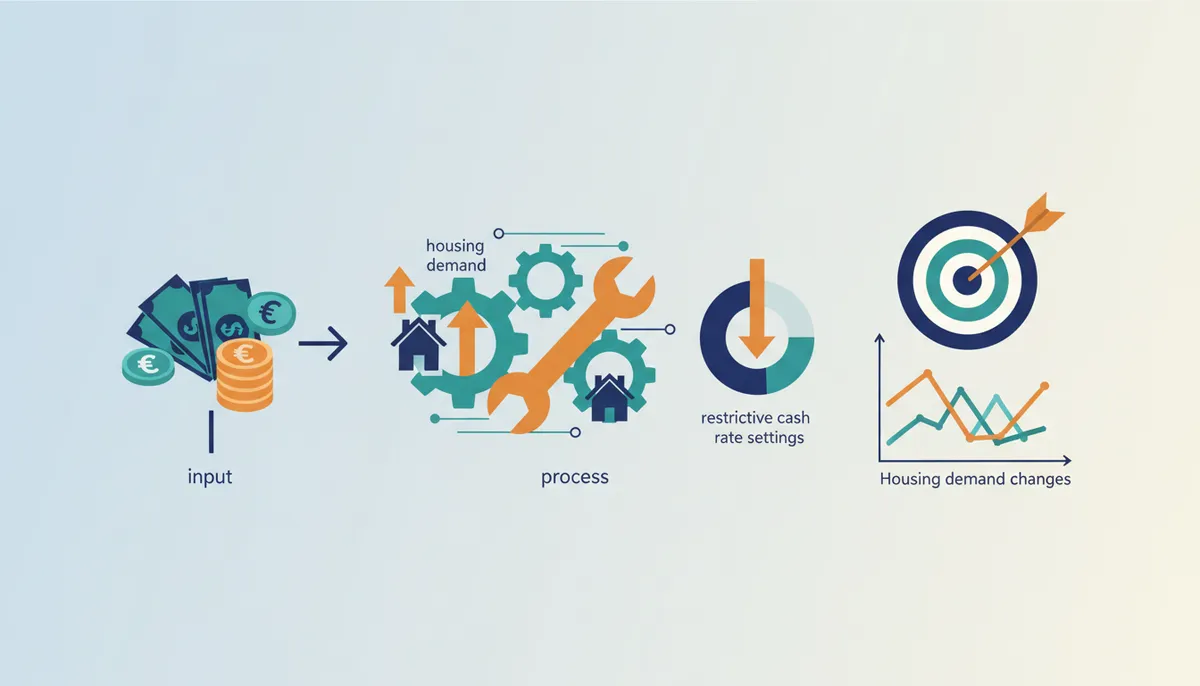
Restrictive conditions emerge when the cash rate target sits above the neutral range, creating a tangible drag on domestic activity. Members judged Australian financial conditions were now somewhat restrictive, though uncertainty remains regarding the precise transmission lag. This status persists because inflation remained materially above the Board's target, with staff expecting underlying inflation to increase in the June quarter. Elevated capacity pressures force the central bank to maintain a stance that actively suppresses demand rather than merely removing accommodation.
The distinction matters for housing evaluation because restrictive policy operates through credit channels that lag interest rate decisions. While global peers like the European Central Bank raised rates to contain second-round effects, Australia's restriction stems from the cumulative impact of prior hikes interacting with stubborn domestic price momentum. Analysts at ForexCFD.top note that financial conditions tighten most severely when wage growth fails to offset borrowing costs, a tension currently visible in the housing sector.
| Indicator | Status | Implication |
|---|---|---|
| Policy Rate | Above Neutral | Active demand suppression |
| Inflation | Above Target | Requires sustained restriction |
| Capacity | Elevated | Limits supply response |
The limitation of this framework is that model estimates of the neutral rate are inherently uncertain and do not provide a direct guide for monetary policy. A decisive shift in global energy markets or a sharper-than-expected downturn in household consumption would flip this restrictive bias toward neutrality quicker than current linear projections suggest.
Applying Lagged Effects to Housing Demand and Consumption
Housing demand has eased as the full weight of prior rate hikes finally transmits through the property sector. This transmission operates with a significant lag, meaning current financial conditions reflect decisions made quarters ago rather than today's pause. The mechanism functions through mortgage servicing costs, where previous increases reduce disposable income and suppress new borrowing capacity. Evidence of this drag appears in national accounts, where underlying momentum in household consumption eased before the onset of the conflict in the Middle East.
While rate cycles typically drive a predictable cooling, the fiscal overlay creates a compound drag that delays recovery. Consequently, operators must distinguish between cyclical weakness driven by the cash rate and structural shifts from tax policy. A sharp reversal in global energy prices would invalidate the assumption of contained inflation, forcing a reassessment of the neutral rate estimates currently guiding the board.
Risk of Exacerbated Capacity Pressures from Data Centre Investment
Private business investment was much stronger than expected, largely driven by investment in data centres. This surge creates a specific inflationary risk where domestic input demand clashes with a cooling broader economy. The mechanism operates through localized labor markets; specialized construction and engineering teams face competing bids from both the public infrastructure sector and private technology builds.
| Pressure Point | Driver | Constraint |
|---|---|---|
| Specialized Labor | Data centre construction | Fixed supply of electricians |
| Concrete/Steel | Imported cost pass-through | Limited local substitution |
| Grid Connection | Power-intensive cooling | Transmission queue delays |
However, the cost of passing these expenses to consumers is measurable only if final demand remains resilient. Growth in output has been weak, and private domestic demand is recovering more slowly than earlier expected, creating uncertainty around the persistence of household spending recovery. This divergence implies that capacity constraints may remain sector-specific rather than generating broad-based wage spirals. Network operators and builders must monitor skill availability alongside material costs to gauge true project viability. The limitation here is temporal; until the conflict in the Middle East fully resolves, energy price volatility will distort input cost modelling for long-duration assets. A sharp reversal in global AI spending would flip this view, instantly idling the very specialized labor force currently driving the bottleneck.
Forecasting Cash Rate Trajectories and Easing Timelines.
Defining the Data-Dependent Stance for Rate Forecasts
The decision to hold the cash rate target at 4.35 per cent reflects a cautious approach that balances domestic inflation risks against global uncertainty. This stance requires analysts to monitor specific transmission channels, noting that policy interest rate expectations across many advanced economies remain higher than before the start of the conflict in the Middle East.
Forecasting future moves involves assessing several key factors:
- Assess whether financial conditions remain restrictive enough to dampen excess demand. 2.
Projecting easing timelines requires measuring the lag between persistent inflation momentum and the eventual policy pivot. The RBA cut interest rates by 25 basis points (0.25 percentage points) in February 2026, marking the first move in its easing cycle for that year, yet the subsequent pause demonstrates the need for sustained progress. Analysts must model the trajectory of underlying inflation rather than reacting to headline volatility alone.
- Quantify the inflation pickup observed in the second half of 2025, which influenced the Board's cautious stance in 2026.2. Map the transmission lag where restrictive rates reduce household demand, noting that private domestic demand is recovering more slowly than earlier expected. 3.
Forecasters must validate model constraints against the approved framework for additional monetary policy tools before projecting deployment.
- Verify operational readiness systems can process tool activation without latency.
- Confirm risk management limits align with the Governance Board's materiality thresholds. 3.
| Constraint Type | Validation Target | Failure Mode |
|---|---|---|
| Balance Sheet | Materiality Impact | Unquantified exposure |
| Liquidity | Settlement Latency | Market dislocation |
| Governance | Framework Approval | Delayed response |
A sudden resolution to Middle East conflicts could lower oil prices enough to invalidate restrictive assumptions prematurely. ForexCFD.top advises monitoring the next data release for signs of this rapid shift.
About
Marcus Halloran serves as Chief Market Strategist at ForexCFD.top, where he specializes in G10 macroeconomic trends and central bank policy. His background as a former interbank FX strategist in London provides the precise technical foundation required to dissect the Reserve Bank of Australia's latest minutes on the cash rate target. Having spent years navigating live dealing desks, Halloran understands how subtle shifts in board sentiment directly impact currency valuations and interest rate differentials.
At ForexCFD.top, an independent publication dedicated to regulation-aware market analysis, Halloran applies this institutional experience to translate complex monetary policy decisions into actionable insights for retail traders. His daily work involves parsing economic calendars and central bank communications to identify directional moves in substantial pairs like AUD/USD. This specific expertise ensures that the analysis of the RBA's stance is not merely descriptive but grounded in the practical realities of market positioning and risk management.
Conclusion
Holding the cash rate at 4.35% creates a fragile equilibrium. Any sudden geopolitical de-escalation could render restrictive models obsolete overnight. The real operational cost here is capital allocation, specifically the latency in detecting when temporary energy spikes diverge from entrenched inflation. Institutions waiting for broad labor market deterioration in 2026 before adjusting strategy expose portfolios to unnecessary duration risk. The window to differentiate between transient shocks and structural shifts is narrowing.
You need to recalibrate stress tests immediately. Include a rapid oil price normalization event alongside the expected labor softening. Do not wait for the next board media release to validate these assumptions. Start by auditing your liquidity settlement limits against a scenario where energy costs drop twenty percent within a single quarter, ensuring your governance framework approves this volatility without triggering manual overrides. This specific preparation prevents the paralysis that often accompanies rapid policy pivots. Effective risk management requires validating that your systems handle both sustained restriction and sudden accommodation with equal proficiency.
Frequently Asked Questions
The bank held rates to fight persistent inflation despite cheaper energy. With the cash rate target at 4.35%, policy remains restrictive to prevent second-round price effects from destabilizing the economy.
Officials would immediately recalibrate the definition of neutrality to stop price spirals. Current data shows underlying inflation remains too high, requiring the sustained 4.35% target to anchor market expectations effectively.
Foreign tightening limits how much local easing can occur despite lower oil costs.
Global investment in energy transition and data infrastructure has lifted neutral rate estimates.
Easing geopolitical tensions lowered oil prices but did not alter the June outcome.
References