
Crypto CFD Brokers: Regulated Leverage Limits
With 73-89% of retail investor accounts losing money on CFDs generally, selecting a reliable broker is critical for survival. Unregulated platforms often dangle fixed use as high as 1:400, but the verified brokers tested here stick to safer, compliant parameters to protect client capital.
This guide cuts through the noise on cryptocurrency CFDs and explains why use structures vary wildly between jurisdictions. We compare top regulated brokers like AvaTrade and Pepperstone, focusing on their distinct advantages in market access and platform stability. You will see how firms like OANDA provide zero-commission trading on substantial instruments, standing in stark contrast to the hidden costs lurking elsewhere.
We detail executing day trading strategies using MetaTrader and TradingView, skipping the theoretical hype for practical application. You will discover how Trade Nation offers thousands of indicators for strategy customization without hidden charges. By mastering these core mechanics, traders can navigate the volatile crypto environment with a clear view of the actual risks involved.
The Mechanics of Cryptocurrency CFDs and Use Structures
Crypto CFD Mechanics vs Spot Custody Models
A Crypto CFD is a derivative contract speculating on price action without requiring the trader to hold the underlying digital asset. This structure shifts risk entirely from custody architecture, losing private keys, hacking fears, to pure price exposure management. A defining trend in 2026 is the preference for speculation without asset custody, where traders apply CFDs to avoid holding underlying tokens. Unlike spot trading where ownership transfer occurs on a blockchain, CFD traders profit from or lose against the broker based on market moves. This distinction enables short selling capabilities that allow participants to monetize falling prices without borrowing the actual token.
Revenue typically comes from the trading spread, the difference between the buy and sell quote. Some firms like Global Prime charge a transparent 0.1% commission instead of embedding costs entirely in the spread, while offering access to over 35 different coins. This approach appeals to high-frequency strategies where tight pricing outweighs custody benefits.
Use magnifies both gains and losses relative to the initial margin deposit. Because you do not own the asset, there is no participation in network staking rewards or governance votes. The choice between CFDs and spot holdings depends entirely on whether the goal is speculative efficiency or long-term asset accumulation.
Applying Use Ratios in MiCA Regulated Markets
Regulators in Europe have drawn a hard line regarding use caps. MiCA compliance forces use caps to 1:2 for retail traders, sharply contrasting with offshore ratios reaching 1:400. The maximum fixed use available on cryptocurrency CFDs from certain offshore brokers is 1:400, though regulated entities often offer lower ratios. This regulatory divergence creates a bifurcated market where capital efficiency depends entirely on jurisdiction rather than broker preference. Entities failing CASP authorization by July 1 face market exit, leaving only compliant firms offering restricted margin requirements. While offshore providers attract speculators with extreme gearing, the resulting liquidation risk increases exponentially during volatility spikes. The cost of compliance is measurable: regulated brokers reduce available buying power to protect retail capital from total loss. Traders prioritizing survival over maximum exposure must accept lower notional values per trade. High use availability outside the EU offers short-term gain but lacks the regulatory safeguards present in authorized zones. Access to higher multiples requires accepting counterparty risk from unregulated jurisdictions.
Fusion Markets Spreads vs xChief Asset Range
Fusion Markets targets high-frequency execution with Bitcoin spreads from 0.04% and Ethereum costs at 0.09%, creating a low-cost structure for active traders. This pricing model embeds revenue directly into the trading spread, eliminating separate commissions while demanding tight liquidity management. In contrast, xChief limits its offering to just five cryptocurrency pairs against the USD, prioritizing a curated asset range over market depth. This constraint simplifies the trading environment but restricts diversification strategies available to clients seeking exposure beyond substantial tokens. Traders focusing on Bitcoin or Ethereum benefit mathematically from the superior choice of tighter margins, whereas those requiring altcoin access must look elsewhere. Brokers make money by balancing these spread widths against trade volume; narrower margins require notably higher throughput to sustain operations. Smaller spreads are indicative of improved market liquidity, a critical factor for traders calculating potential profitability. This flexible forces traders to choose between cost optimization on substantial pairs or accepting higher costs for obscure token access.
Comparative Analysis of Top Regulated Crypto CFD Brokers
Defining Regulated Crypto CFD Broker Criteria
Defining a regulated crypto CFD broker starts with verifying regulatory bodies like ASIC or the FCA rather than chasing maximum use. High-use offers up to 1:400 often signal offshore registration, whereas compliant entities typically cap retail exposure near 1:2 to 1:30 to satisfy strict capital requirements. This divergence creates a clear trade-off between capital efficiency and fund security for the trader.
| Feature | Regulated Entity | Offshore Counterpart |
|---|---|---|
| Max Use | 1:2 to 1:30 | Up to 1:400 |
| Oversight | ASIC, FCA, CySEC | Local Island Authority |
| Asset Count | 3 to 15 coins | 40+ tokens |
| Spread Type | Variable or Fixed | Often Wider Fixed |
For instance, some platforms limit selections to substantial tokens like Bitcoin and Ethereum while others broaden access to over a hundred derivatives. The cost of this compliance is measurable in reduced buying power but gained protection against platform insolvency. Operators prioritizing risk management will find that lower use ratios force more disciplined position sizing during volatility spikes. Ultimately, the choice depends on whether one values speculative magnitude or long-term capital preservation.
Applying Spread and Deposit Data to Broker Selection
Selecting the optimal broker requires filtering execution costs against initial capital constraints to match specific trading styles. Traders prioritizing low-cost entry should target platforms like Trade Nation that mandate a minimum deposit of $0, effectively removing barriers for strategy testing without significant upfront exposure. This accessibility contrasts with firms requiring a $100 minimum deposit, where the capital requirement sets a higher threshold for account activation. Conversely, high-frequency operators must scrutinize the trading spread as the primary determinant of profitability rather than use ratios. Testing reveals that while some competitors charge significantly higher rates on Bitcoin transactions, efficient providers like Eightcap offer tighter pricing around $12, significantly reducing the break-even threshold for scalping strategies. Beginners may prefer fixed spread structures to ensure predictable trade economics, avoiding variable models that expand during volatility. The consequence of ignoring these micro-structure details is a hidden drag on returns that compounds quicker than use can recover.
AvaTrade vs Pepperstone: Use and Platform Differences
AvaTrade caps retail use at 1:30 while Pepperstone matches this limit but extends Pro account gearing to 1:500 on specific jurisdictions. This divergence creates a sharp choice between the capital efficiency sought by professionals and the risk containment mandated for retail traders under global compliance frameworks. AvaTrade supports its system with ten distinct platforms including proprietary WebTrader tools, whereas Pepperstone integrates deeply with third-party favorites like cTrader and TradingView. AvaTrade is regulated in five continents, offering access to Bitcoin, Ethereum, Ripple, and a crypto index. The table below quantifies these structural differences for operators evaluating execution environments. However, the higher use ratios available to Pro users introduce liquidation risks that demand sophisticated margin management protocols during volatile market cycles. Used cryptocurrency trading carries significant risk of loss and is not suitable for all investors.
Executing Day Trading Strategies on MetaTrader and TradingView
MetaTrader and TradingView Integration Mechanics
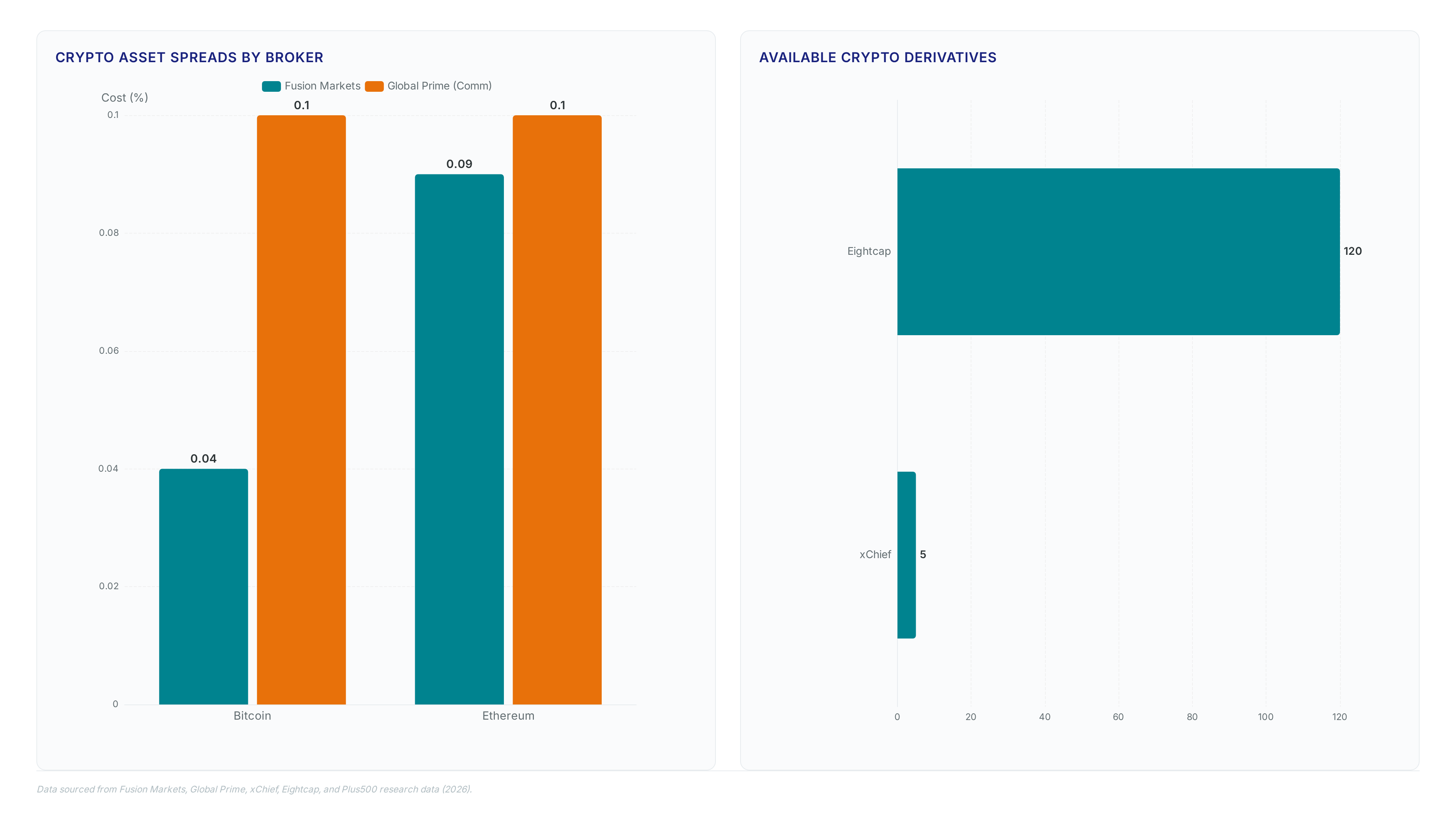
Linking a broker account to TradingView converts chart signals into live CFD orders without manual entry errors. This integration bypasses the need for bridge software by using secure API tokens that authenticate the execution venue directly within the charting interface. Traders familiar with MetaTrader will find that brokers like DNA Markets prioritize this native system for short-term strategies, ensuring low-latency order routing. Alternatively, Eightcap provides direct access to the massive TradingView community, allowing users to execute trades on over 120 crypto derivatives from within their preferred analysis environment. The technical handshake occurs when the broker validates the user's credentials against the charting platform's server, establishing a persistent session for real-time order execution.
| Feature | MetaTrader Native | TradingView Bridge |
|---|---|---|
| Primary Strength | Dedicated Algorithmic Support | Social Signal Integration |
| Setup Complexity | Moderate | Low |
| Best For | Automated Systems | Manual Chartists |
A critical limitation exists in signal latency; while charting is instantaneous, the round-trip time to the broker's liquidity provider can vary during high-volatility events. Operators must verify that their chosen broker maintains strong server infrastructure to prevent slippage when converting complex chart patterns into market orders. This structural dependency means that even perfect technical analysis can fail if the execution link suffers from millisecond delays during peak volume.
Executing Crypto CFD Entries with Eightcap and DNA Markets
Opening a live account requires navigating distinct onboarding workflows where Eightcap uses a simplified digital process while DNA Markets uses the familiar MetaTrader system for immediate access. The execution pathway diverges significantly here; Eightcap users route orders through TradingView integration to access a social network of millions, whereas DNA Markets operators rely on native MT4/MT5 scripts for automated entries. This structural difference means that while Eightcap offers breadth with over 120 derivatives, DNA Markets focuses on depth within the MetaTrader environment for those prioritizing algorithmic consistency over asset variety. However, the liquidity provision model at DNA Markets results in wider spreads compared to pure-play crypto specialists, creating a tangible drag on high-frequency strategies.
| Feature | Eightcap | DNA Markets |
|---|---|---|
| Primary Platform | TradingView / MT4 | MetaTrader 4/5 |
| Asset Count | 120+ | 120+ |
| Best For | Social Trading | Algorithmic Scripts |
| Spread Profile | Competitive | Wider |
Traders must recognize that choosing a broker based solely on asset count ignores the transaction cost reality where wider spreads demand larger price moves for profitability. Islamic account holders should verify swap-free status on specific crypto pairs as overnight financing rules vary by jurisdiction. Used crypto derivatives carry extreme risk; losses can exceed initial deposits rapidly during volatility spikes.
Use Caps and Spread Costs in Crypto CFD Trading
Variable spread costs dictate day trading survival more than maximum use ratios. While offshore entities advertise gearing up to 1:500, the mathematical reality of cost efficiency often favors lower use with tighter pricing structures. This disparity creates a hidden trap where high use amplifies the drag of wide spreads during volatile sessions. High use becomes dangerous when the entry cost requires a minimal move just to reach neutrality, forcing traders to hold positions longer than intended. Consequently, operators prioritizing risk management must calculate the break-even point including the spread before engaging maximum gear. Traders should verify current execution costs via official broker documentation before deploying capital.
Operational Risks and Technical Limitations in Crypto CFD Trading
MiCA CASP Authorization and the Offshore Use Divide
The July 1 deadline forces a hard split between authorized entities and offshore venues offering 1:400 use. Regulated brokers must secure CASP authorization to operate within the EU, a compliance hurdle that automatically caps retail gearing at conservative ratios compared to unregulated competitors. This regulatory mechanics creates a bifurcated market where operational safety trades directly against capital efficiency. Offshore entities continue to provide high-use products up to 1:400, attracting risk-tolerant speculators who prioritize margin over regulatory protection. The distinction between "offshore" high-use offerings and "regulated" lower-use environments is becoming a pronounced market segmentation strategy.
Resolving Slow Broker Support via Instant PayID Deposits
Instant PayID settlements bypass delayed support tickets by automating fund reconciliation directly at the bank level. This mechanism removes the manual verification step where broker staff typically validate transaction receipts, a process that frequently stalls during high-volatility events. A 2026 partnership with Volt enables these immediate transfers for Australian traders, effectively sidestepping the administrative lag inherent in traditional wire transfers. Trade Nation is a good choice for newer traders looking for a wide range of financial markets on a user-friendly platform where such funding speed matters. However, this efficiency gain assumes the broker's internal ledgering matches bank speed, which is not always true.
Platform Customization Limits with Restricted Crypto Asset Ranges
Restricted asset menus mechanically break strategy diversification by preventing rotation during sector-specific volatility. XChief offers a range of only 5 cryptocurrencies paired with USD, creating a rigid exposure profile that cannot adapt when Bitcoin dominance shifts to altcoins. This limitation forces traders to hold losing positions rather than hedge with uncorrelated tokens available on broader platforms.
- Inability to short specific altcoins during market corrections.
- Forced concentration in single-asset risk without index alternatives.
- Lost opportunity costs when capital cannot migrate to trending sectors.
- Hedging failure during correlation breakdowns between substantial tokens.
- Reduced ability to balance portfolio beta across different blockchain sectors.
About
Aisha Rahman serves as the Gold & Commodities Analyst at ForexCFD.top, where she leads coverage on precious metals and energy markets. While her primary expertise lies in XAUUSD and oil, her deep understanding of commodity correlations and macroeconomic drivers makes her uniquely qualified to evaluate cryptocurrency CFD brokers. In her daily work, Aisha analyzes how digital assets often move in tandem with risk sentiment and traditional commodities, providing a critical lens for assessing broker offerings in this volatile sector. Her specialized knowledge of Islamic finance and swap-free trading structures allows her to rigorously test whether crypto-CFD platforms meet strict regulatory and ethical standards for global retail traders. At ForexCFD.top, an independent publication dedicated to vendor-neutral broker reviews, Aisha applies this same analytical framework to ensure traders receive factual, risk-aware guidance on navigating the complex environment of crypto derivatives.
Conclusion
Scaling a crypto CFD strategy fails when narrow asset menus prevent necessary rotation during sector-specific volatility. The operational cost is not merely missed profit but the inability to execute valid exit strategies when correlations break down. While some traders prefer speculating on price movements to avoid custody risks, this benefit vanishes if the broker forces concentration in single-asset risk. You must prioritize venues offering deep liquidity pools over cosmetic widget customization.
Adopt a strict policy of verifying total coin counts before funding any account. If a platform cannot support hedging maneuvers across uncorrelated tokens, it creates a structural trap that increases liquidation probability during idiosyncratic shocks. This assessment should happen immediately, before capital deployment, rather than after a market correction exposes the gap.
Start by auditing your current broker's shorting capabilities on at least three altcoins outside the top five by market cap this week. If you cannot open these hedges instantly, your current venue lacks the breadth required for complex multi-asset strategies. Move your capital to a provider that supports the specific hedging maneuvers your strategy demands.
Frequently Asked Questions
Global Prime charges a transparent 0.1% commission instead of embedding costs. This structure benefits high-frequency traders by providing clearer cost visibility compared to brokers hiding fees within wider trading spreads.
Fusion Markets offers Bitcoin spreads starting from 0.04% for efficient execution. These tight spreads significantly reduce the breakeven threshold, allowing active traders to profit from smaller price movements without needing large market swings.
xChief offers a range of only 5 cryptocurrencies paired with USD. This limited selection restricts diversification opportunities for traders seeking exposure to altcoins beyond the major tokens available on other platforms.
MiCA compliance forces leverage caps to 2% for retail traders in Europe. This restriction sharply contrasts with offshore ratios, requiring traders to manage capital more carefully due to reduced buying power per trade.
Some brokers mandate a minimum deposit of $0 to remove entry barriers. This approach contrasts with firms requiring a $100 minimum deposit, making professional strategies more accessible to traders with limited initial capital.
References