
Crypto CFDs Explained: Small Q1 Volume, Big Risks
Crypto CFDs captured just a small fraction of global volume in Q1 2026. They remain a niche instrument, built for specific speculation strategies rather than broad adoption. Zero-commission platforms like Fusion Markets structure their fee models around tight spreads instead of fixed costs. Use ratios range from 1:2 for retail clients to 1:10 for professionals. Execution happens across MetaTrader 4, MetaTrader 5, TradingView, and cTrader interfaces.
The appeal is simple: go long or short on Bitcoin and Ethereum without holding the underlying token. Fusion Markets advertises spreads starting from 0.04% on Bitcoin and 0.09% on Ethereum. These derivatives look cost-effective against spot trading. Unlike traditional crypto purchases, these contracts let traders profit from market declines while using use to amplify exposure.
The cost structure shifts from commissions to daily financing fees applied at server midnight. While the segment represents a small fraction of total derivatives activity, the accessibility of digital asset speculation continues to attract traders seeking flexibility. You must understand these mechanics before engaging with used positions that accelerate both gains and losses.
The Role of Crypto CFDs in Modern Digital Asset Speculation
Crypto CFDs: Derivative Exposure Without Asset Ownership
A Crypto CFD is a cash-settled derivative contract. It exchanges price differences without transferring the underlying digital asset. This structure lets traders open a short position to profit from falling prices, avoiding the need to borrow coins first. Conversely, a long position captures gains when valuations rise. Institutional players favor these tools because they sidestep the headaches of direct custody and blockchain settlement. Costs typically hinge on spreads instead of commissions; for instance, Bitcoin spreads may start from 0.04% while Ethereum spreads begin at 0.09%. However, overnight financing charges apply to positions held open past server cutoff times, creating a tangible drag on extended exposure. Traders gain bidirectional access but forfeit ownership perks like staking rewards. This separation of price action from utility defines the risk profile. Education focuses on how derivative exposure increases both profits and losses relative to spot moves. Financing rates accumulate daily, demanding close monitoring. Physical settlement disappears, removing wallet management, yet counterparty risk shifts entirely to the broker relationship.
Executing Used Long and Short Strategies on Bitcoin and Ethereum
Market participants deploy use to increase exposure on Bitcoin price swings without owning the coin. A short position profits from falling valuations, while a long position captures gains during rallies. This flexibility allows operators to monetize bearish trends where spot holding fails. Execution happens on platforms such as MetaTrader 4, MetaTrader 5, TradingView, or cTrader, granting access to Crypto CFDs alongside other products.
The primary cost driver remains the spread, which fluctuates with asset volatility and liquidity depth. Lower entry costs improve the break-even point for scalpers targeting minor fluctuations. Traders must weigh amplified returns against the risk of accelerated losses from margin calls. High volatility drives demand since these instruments enable profit generation in rising and falling markets alike. Yet, the same use that magnifies gains increases the probability of rapid liquidation during sudden reversals. Operators should prioritize platforms offering transparent margin terms to mitigate unexpected exposure spikes. Successful execution depends on strict risk management rather than directional prediction alone. Regulation and withdrawals take precedence over bonus structures when selecting a venue. Traders should verify local legal status before engaging with derivative products.
CFD Use and Shorting Versus Direct Crypto Buying
Direct asset purchase grants ownership but forbids used exposure or short selling without borrowing the underlying coin. Trading a Crypto CFD uses a derivative structure to enable directional flexibility, allowing operators to profit from falling prices via short positions without asset custody. This mechanism contrasts sharply with spot markets where investors typically buy assets hoping for appreciation. The technical architecture supports both long and short stances, enabling revenue generation in bearish conditions that spot holders cannot access. Brokers enable this by waiving commission fees, collecting revenue solely through the spread. However, holding these derivative positions incurs an overnight financing charge applied daily at 0:00 server time, a cost factor absent in direct ownership that can erode returns over extended periods.
The constraint involves capital efficiency versus financing drag. CFDs allow significant exposure with minimal upfront capital, yet the continuous cost of carry makes them less suitable for long-term holding compared to spot assets. Data indicates that a significant majority of investor accounts lose money when trading these complex instruments, showing the elevated risk profile relative to simple asset acquisition. Operators must weigh the benefit of capital efficiency against the mathematical certainty of financing costs when selecting an execution venue.
Inside Crypto CFD Mechanics: Use, Spreads, and Financing Costs
Use Mechanics: Amplifying Exposure Without Asset Ownership
Use functions as a capital multiplier, allowing traders to control large positions with minimal upfront margin. This mechanism drastically improves capital efficiency compared to spot markets. On Fusion Markets, retail clients can access 1:2 use while professional accounts may reach 1:10, creating distinct risk profiles for different investor classes. Unlike direct asset purchases where shorting is impossible without borrowing, Crypto CFDs enable both long and short strategies on assets like Bitcoin and Ethereum. Despite this flexibility, crypto CFDs represented a minor share of total global CFD trading volume in Q1 2026.
| Feature | Spot Trading | Crypto CFD |
|---|---|---|
| Ownership | Direct Asset | Derivative Contract |
| Short Selling | Impossible | Native Support |
| Capital Required | Full Amount | Fractional Margin |
Traders speculating on price movements without owning the underlying token use these derivatives to bypass private key management complexities. However, use amplifies losses just as quickly as gains, and overnight financing charges apply to positions held past server time. While use maximizes buying power, it eliminates staking rewards and requires strict margin monitoring to avoid automatic position closure. Understanding these mechanics is necessary before deploying capital in used environments.
Mechanics: Executing Long and Short Strategies on Bitcoin and Ethereum
Traders initiate long positions on Ethereum when anticipating price appreciation or short positions on Bitcoin to profit from declines. This directional flexibility allows market participants to generate returns regardless of broader market sentiment without owning the underlying digital tokens. Execution efficiency depends heavily on spread costs, which represent the difference between buy and sell prices at order entry. Tighter spreads reduce the breakeven distance required for profitability, a critical factor in volatile crypto markets where price swings can reverse quickly.
| Strategy | Market View | Action | Cost Driver |
|---|---|---|---|
| Long | Bullish | Buy Open | Spread + Swap |
| Short | Bearish | Sell Open | Spread + Swap |
A key operational tension exists between using capital for higher exposure and managing overnight financing charges that accumulate on held positions. While zero-commission models eliminate upfront fees, the overnight financing component can erode gains if trades remain open for extended periods. Unlike spot trading, where assets sit in wallets, CFDs are cash-settled derivatives subject to daily funding rates. Traders must weigh the benefit of used exposure against the compounding cost of holding positions past server cut-off times. Understanding these mechanics is vital before deploying capital in live markets.
The Erosion of Returns via Overnight Financing Charges
Overnight financing charges apply daily at 0:00 server time to keep positions open, creating a continuous cost drag on held capital. This swap fee accumulates regardless of price direction, meaning a trader can lose money on a correct market prediction if the holding period is too long. Unlike commission-free entry models where costs are fixed at execution, these recurring fees compound over time and significantly impact profitability for swing traders holding positions for weeks.
The mechanism functions as a daily interest payment based on the notional value of the used position. While some platforms advertise zero commissions to attract volume, the cumulative effect of nightly charges can exceed initial spread costs for long-term holders.
| Cost Type | Timing | Impact on Strategy |
|---|---|---|
| Spread | Entry/Exit | Fixed cost per trade |
| Overnight Charge | Daily (0:00) | Compounds with duration |
| Commission | None | Not applicable here |
High use increases the notional principal upon which these fees are calculated, worsening the drag. Holding costs can be significant enough to negate returns even if the underlying asset price remains flat or moves slightly in a trader's favor. Traders must calculate the breakeven duration where financing costs outweigh potential price appreciation before entering a position.
Executing Crypto CFD Strategies on Zero-Commission Platforms
Zero-Commission Crypto CFD Mechanics on Fusion Markets

Fusion Markets eliminates upfront transaction fees by embedding all execution costs within the bid-ask spread rather than charging separate commissions. Capital efficiency varies significantly by classification, as Retail Clients access 1:2 use while Pro Clients qualify for 1:10 use on the same instruments. Entry barriers remain low because the platform enforces No Minimum Deposits and charges No Deposit Fees for funding accounts. The operational trade-off involves accepting variable spread costs instead of fixed fees, which can widen unexpectedly during liquidity crunches. Users gain the ability to Go Long and Short without owning the underlying digital asset or managing wallet security, allowing them to take advantage of any price movements by going long or short. Overnight financing charges still apply daily at 0:00 server time, meaning holding positions incurs time-based costs despite the lack of commissions. Traders must weigh the benefit of zero entry fees against the potential for wider-than-average spreads during execution.
Executing Long and Short Positions with No Minimum Deposits
Operators initiate directional trades by funding accounts without mandatory minimums or deposit charges. Fusion Markets enforces a No Minimum Deposits policy, allowing immediate capital deployment regardless of account size. Unlike other brokers, the platform charges No Deposit Fees, ensuring the full transferred amount converts to trading margin. Traders can go both long or short to profit from rising or falling digital asset prices without owning the underlying token.
This directional flexibility enables revenue generation during bearish cycles without borrowing the physical asset. Retail clients access use up to 1:2, while professional traders may qualify for ratios as high as 1:10.
| Feature | Benefit |
|---|---|
| Zero Commissions | Costs remain embedded strictly within the spread. |
| Instant Access | Funds become available immediately after transfer. |
| Bidirectional | Profit potential exists in both uptrends and downtrends. |
New users can apply the free demo environment to validate execution workflows before risking real capital by signing into the client hub and opening a demo account. The primary operational constraint involves overnight financing charges that accumulate on positions held past server rollover. These costs erode returns on long-term holdings, as positions are updated daily on the trading platform.
Risk Warning: CFDs are complex instruments with a high risk of losing money rapidly due to use. *Disclosure: We may receive compensation from partners mentioned. This does not influence our editorial standards.*
Pre-Trade Validation for Bitcoin and Ethereum Spreads
Verify the live bid-ask differential against baseline expectations before committing capital to any position. Traders must distinguish between normal market noise and excessive slippage that erodes potential profits on small moves. The cost of entry is the primary variable under trader control at execution time. Traders should review the full product table for average and minimum spreads on Crypto pairs to establish accurate baselines.
Evaluating Broker Performance and Cost Structures for Crypto Derivatives
Defining Crypto CFD Cost Structures: Spreads vs Commissions
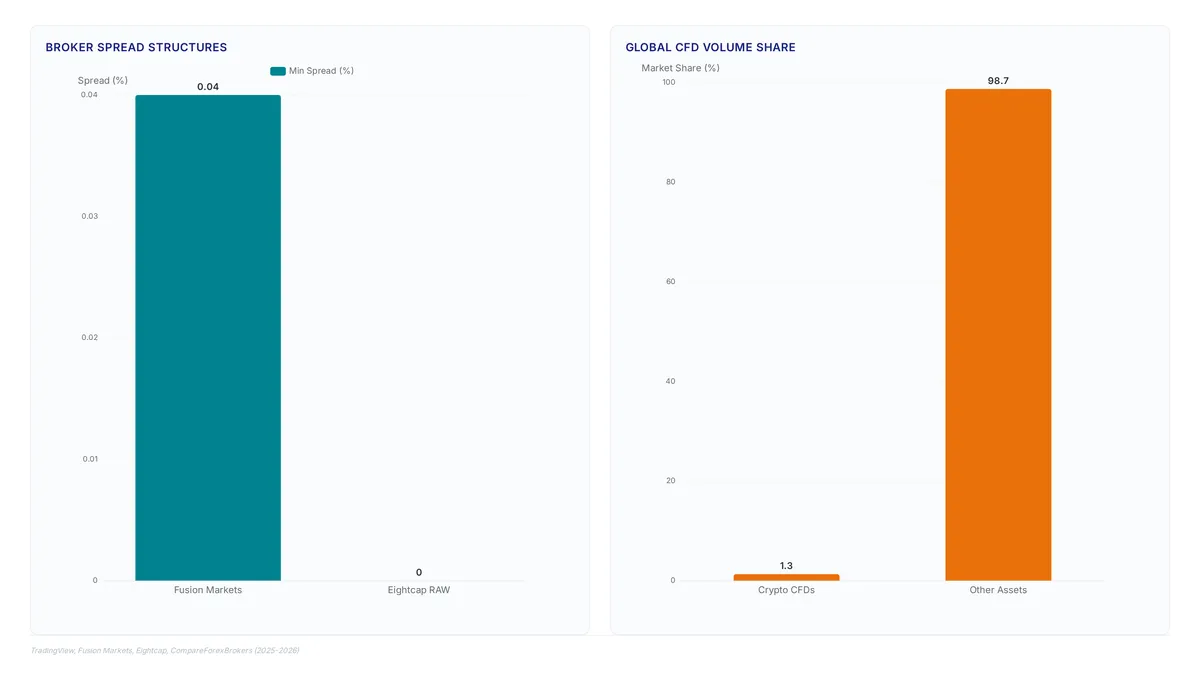
Trading expenses manifest either as embedded spread markups or explicit commission fees, creating distinct cost profiles for crypto derivatives. Conversely, alternative providers like Eightcap offer "RAW" accounts with spreads from 0 pips, shifting the cost burden to a separate transaction fee. Spread-only accounts simplify capital efficiency calculations since the entry price reflects the total cost. Spreads in crypto CFD trading are not fixed; brokers adjust them dynamically to factor in current market volatility and liquidity conditions. While raw accounts appear cheaper initially due to tighter spreads, the total cost depends on trading volume and the specific commission structure. Traders must calculate the break-even volume where commission savings outweigh the convenience of wider spreads.
Fusion Markets vs Eightcap: Spread Competitiveness and Asset Variety
Traders balancing execution costs against market access face a binary choice between tight spreads and asset depth. This structure embeds all fees into the price, creating a transparent environment for traders who prioritize minimal friction on substantial pairs. The trade-off is a curated list of "popular" assets rather than an exhaustive catalog. Conversely, Eightcap targets diversity seekers with over 95 different cryptocurrencies available for trading. Ultimately, the choice depends on whether the trader values the certainty of low costs on liquid assets or the flexibility to trade a wider range of tokens.
Use Caps and Overnight Financing Risks in Crypto Derivatives
Retail clients face strict 1:2 use caps, whereas professional status unlocks 1:10 ratios on Fusion Markets. This regulatory ceiling limits capital efficiency but simultaneously reduces liquidation risk during volatile price swings. Holding positions overnight incurs financing charges that accumulate daily and can erode returns on long-term exposure. These overnight financing costs act as a hidden drag on profitability, particularly for strategies relying on extended holding periods. Unlike spot markets where assets sit idle, derivative instruments charge rent for borrowed capital.
| Feature | Retail Account | Professional Account |
|---|---|---|
| Max Use | 1:2 | 1:10 |
| Risk Profile | Lower | Higher |
| Margin Call Speed | Slower | Quicker |
Competitors may offer higher ratios, with some regulated brokers offering use on crypto CFDs as high as 1:400, significantly amplifying both potential profit and loss scenarios. Overnight financing charges can be significant enough to erode returns if positions are held for the long-term. Neglecting these recurring fees turns a profitable trade into a net loss.
About
Sofia Mendes serves as the Broker Reviews & Trading Education Editor at ForexCFD.top, where she leads the publication's rigorous analysis of global trading platforms. Her specific expertise in broker due diligence and risk management makes her uniquely qualified to dissect the complexities of Crypto CFDs. In her daily work, Sofia evaluates regulatory compliance, execution quality, and fee structures across jurisdictions, allowing her to objectively assess how instruments like Bitcoin and Ethereum CFDs function within a trader's portfolio. Unlike promotional content, her analysis connects the theoretical mechanics of used crypto trading to practical safety considerations for retail investors. At ForexCFD.top, an independent news outlet dedicated to vendor-neutral market education, Sofia ensures that discussions on volatile assets remain grounded in factual data and strict regulatory standards. Her approach prioritizes consumer protection, helping traders understand the inherent risks of CFD products without endorsing specific third-party commercial solutions or platforms.
Conclusion
Scaling crypto CFD strategies reveals that tight entry spreads become negligible against the compounding weight of daily holding costs. While initial pricing appears competitive, the operational reality shifts rapidly when use caps restrict capital efficiency and overnight fees accumulate. Traders relying on extended timeframes face a structural drag that spot markets do not impose, turning minor price stagnation into tangible equity erosion. This flexible demands a shift from passive holding to active position management where time is treated as a direct expense rather than a neutral variable.
Restrict derivative exposure to short-term tactical moves where speed outweighs duration. Treat any position held beyond a single trading session as a candidate for immediate review or closure to preserve capital against fee-based decay. Do not assume professional use ratios solve liquidity issues; they merely accelerate the rate at which margin calls trigger during volatility spikes. The math favors rapid execution over sustained exposure in this specific instrument class.
Start by calculating the break-even horizon for your current open positions using your broker's specific fee schedule before the next market close. This single audit identifies which trades have already turned unprofitable due to time decay alone. Focus your immediate attention on optimizing your Crypto CFD execution strategy to align with these tighter temporal constraints.
Frequently Asked Questions
Direct buying lacks leverage while CFDs charge via spreads starting at 0.04%. This structure means traders pay no fixed commissions but incur daily financing costs that reduce long term profitability significantly.
Retail clients access 1:2 leverage while professionals may reach 1:10 ratios. This difference means retail traders face lower liquidation risks but require significantly more capital to match professional exposure levels effectively.
Traders receive zero staking rewards since they never own the underlying asset. This limitation means investors miss out on passive income streams that often offset holding costs in traditional spot markets.
Execution occurs on MetaTrader 4, MetaTrader 5, TradingView, and cTrader interfaces. This multi-platform access allows traders to use familiar tools while accessing over 95 different cryptocurrency derivatives for diverse strategies.
This small share suggests lower liquidity compared to major forex pairs, potentially leading to wider spreads during volatile market conditions.
References