
Dollar divergence drives yen near 40-year low
The yen dipped to 161.95, a two-year low, as traders recalibrate Federal Reserve rate hike expectations.
Monetary policy divergence between the U.S. And Japan drives this sustained weakness in the Japanese yen. While Tokyo's core inflation accelerated in June, it failed to bolster the currency against a resilient greenback. Federal Reserve interest rate signals dictate the Dollar Index trajectory. Global forex market trends reflect these broader geopolitical tensions rather than domestic Japanese data alone.
The U.S. Dollar Index recently snapped a three-day winning streak, retreating from highs not seen since May 2025. Despite this pause, Capital Economics warns that emerging policy gaps suggest further greenback gains are likely for the second half of 2026. Market participants now watch the 161.96 threshold closely; a breach pushes the currency to levels unseen since 1986.
Morgan Stanley Research projects the U.S. Dollar Index could fall to 94 by the second quarter of 2026, marking a potential low not seen since 2021. This forecast contrasts sharply with current volatility, where the yen struggles to find footing amid mixed central bank signals. Navigating the current currency environment requires understanding these counteracting forces.
Monetary Policy Divergence Drives Yen Weakness Against the Dollar
Defining Monetary Policy Divergence via Core PCE Metrics
Central banks moving in opposite directions create a widening gap that drags the yen lower while the dollar climbs. The Personal Consumption Expenditures index recently rose 4.1% year-on-year, signaling persistent heat in the U.S. Economy that demands attention. Officials describe underlying price pressures as "too high," forcing the Federal Reserve to keep policy restrictive while the Bank of Japan maintains ultra-loose conditions due to domestic constraints. Capital flows mechanically toward higher-yielding dollar assets when this differential widens.
Probability tools currently price a 69% chance of the Fed holding interest rates at its next meeting ending July 29. Markets react sharply to any deviation in inflation data because the equilibrium remains fragile. A sudden shift in U.S. Figures can trigger disproportionate volatility across currency pairs. Traders face a lag between data release and actual policy implementation, creating windows where prices overshoot fundamental values. Monitoring how inflation metrics translate into forward guidance matters more than reacting to headline numbers. ForexCFD.top reminds clients that used metals and forex trading carry significant risk due to rapid price movements driven by these policy gaps.
Yen Weakness at 161.82 as Divergence Drives 40-Year Lows
Japan's currency traded near its weakest level against the dollar in 40 years early Friday, settling flat at 161.82. Such price action illustrates how monetary guideline divergence mechanically depresses valuations when interest rate differentials widen notably. The currency recovered slightly from a two-year low of 161.95, yet the threat of breaching 161.96 to hit 1986 lows remains acute. Persistent pressure stems directly from the gap between U.S. Tightening cycles and Japan's ultra-loose stance. Further advances could target the 162.00 resistance zone driven by wide interest rate differentials. Speculation about currency intervention often creates false floors rather than sustainable reversals.
Fed Rate Hike Expectations and the 161.96 Breach Threshold
A decisive break above 161.96 would technically confirm the yen's weakest valuation since 1986, exposing the market to accelerated downside volatility. This threshold breach represents a critical juncture where market sensitivity to Federal Reserve signals intensifies, particularly as traders parse mixed commentary from officials like Austan Goolsbee and John Williams. Inflation pressures may moderate eventually, but current stickiness in price data forces the Fed to maintain a restrictive stance that widens the yield gap against Japan. Liquidity thins near historic extremes ahead of the next FOMC meeting, keeping volatility elevated.
Monetary divergence creates a strong trend for the dollar only until rate expectations pivot sharply. The cost of holding long dollar positions rises if U.S. Data suddenly cools, triggering rapid unwinding. The dollar index recently snapped a three-day winning streak, suggesting the potential for a pause in the very near term despite the broader upward trajectory. ForexCFD.top reminds clients that used metals and forex trading carries significant risk of loss. *Gold is a story about real yields, fear, and the dollar - in that order.*
Federal Reserve Interest Rate Decisions Dictate Dollar Index Trajectory
FOMC Signals and the Transmission to Dollar Index Trajectory
The Dollar Index trajectory shifts immediately when FOMC statements alter the perceived probability of future rate adjustments. When officials like Austan Goolsbee note that price pressures remain too high, traders adjust their positioning via the CME Group FedWatch tool to reflect new realities. This specific probability anchors the greenback, preventing erratic swings despite divergent views from regional bank presidents. The mechanism functions through rapid repricing of sovereign yield differentials, which dictates capital flows across substantial pairs.
| Signal Type | Market Reaction | Probability Shift |
|---|---|---|
| Hawkish Hold | Yield Spike | +implied odds increase |
| Dovish Hold | Yield Drop | -4.5% implied odds |
Emerging monetary directive divergence between the U.S. And Europe suggests that further gains for the currency are possible in the second half of 2026. However, the dollar may face a pause in the very near term after its recent sharp rise. The limitation here is that over-used positions often fail when forward guidance lacks explicit hike language. Investors asking when the Fed will raise rates must realize that action depends entirely on incoming data exceeding these elevated baselines.
Tracking Rate Hike Probabilities with the FedWatch Tool.
Traders convert inflation surprises into actionable probabilities using the CME FedWatch tool to gauge policy shifts. This mechanism translates fed funds futures into precise percentage chances for specific rate outcomes at upcoming meetings. When cost-of-living pressures increased further in May, market participants immediately recalibrated their exposure to reflect tighter financial conditions. Data indicates markets have previously priced in a high probability of a 25 basis point rate cut by the Federal Reserve in October. Such high sensitivity creates volatile implied yields that drive the dollar index trajectory more than spot news flows. A sudden revision in inflation expectations can render today's high-probability outcomes obsolete within hours. The limitation lies in the tool's reactive nature; it prices what has happened, not what central bankers intend to do next. Operators must pair these probabilities with forward-looking guidance to avoid being caught in false breakouts. *Islamic Account Note: Our Islamic accounts avoid swap charges on overnight positions, ensuring compliance with Sharia principles while trading volatile assets like gold.*
*Used metals trading involves significant risk of loss and is not suitable for all investors.*
Dollar Index Volatility Risks from Divergent Institutional Forecasts
Conflicting institutional targets create immediate repositioning risk for currency traders navigating the second quarter of 2026. While some banks see a tactical pause, Morgan Stanley Research projects the U.S. Dollar Index could fall to 94, marking a significant structural shift from current levels near 100. This bearish outlook contrasts sharply with forecasts from MUFG, which anticipate the EUR/USD pair strengthening to 1.26 within 12 months due to shifting transatlantic dynamics. Such divergence forces market participants to choose between hedging for a prolonged decline or trading the volatility of a temporary reprieve.
The primary danger lies in the mechanical whipsaw caused by these opposing institutional forecasts. Traders interpreting inflation data must recognize that a single miss on core metrics could trigger rapid flows toward either the 94 floor or a rebound to parity, invalidating static hedges. The cost of being on the wrong side of this divergence is measurable in slippage during low-liquidity sessions.
| Institution | DXY Target (Q2 2026) | EUR/USD Forecast | Horizon |
| Morgan Stanley | 94 | N/A | Q2 2026 |
| MUFG | N/A | 1.26 | 12 Months |
| Market Consensus | Volatile | Neutral | Short-term |
Operators must treat these divergent forecasts as probability weights rather than certainties, adjusting use accordingly to survive the interim volatility. ForexCFD.top provides execution services only; this analysis is for educational purposes.*
Global Currency Movements Reflect Broader Forex Market Trends
Defining Forex Market Trends via Yen and Dollar Parity

USD/JPY trades at 161.82, establishing a precarious technical floor before the 161.96 breach point. This specific threshold represents the line between a temporary dip and a slide to 1986 lows. Market structure here relies on the interest rate differential rather than domestic economic strength alone. Traders monitor this gap closely as the primary driver of yen weakness against the dollar.
The euro dipped 0.1% to $1.1361 while the pound held steady at $1.3187, indicating broadbased dollar strength related to yen failure. Bitcoin rose 0.7% to $59,801.31 as alternative assets react to fiat divergence. Price can stall at 162.00 even if the macro trend remains bearish for the yen. Investors must distinguish between a paused rally and a genuine reversal signal. The cost of hedging currency shifts now dominates strategic allocation decisions for global portfolios. Monitoring the FedWatch probabilities provides the necessary context for these moves. Failure to respect the 161.96 invalidation level confirms further downside risk.
Used metals and forex trading involve significant risk. This divergence highlights how monetary policy gaps drive traditional pairs differently than digital assets. Bitcoin's upward momentum suggests investors seek hedges against global inflation trends unrelated to central bank rates. A sharp shift in U.S. Core PCE could rupture the calm seen in sterling or the kiwi. Substantial fiats lack the asymmetric upside during sudden risk-off events found in cryptocurrencies. Portfolio managers hold larger notional sizes for equivalent gains because of this structural limitation. Traditional currency trades require higher use to match crypto returns, introducing distinct margin risks. ForexCFD.top reminds traders that used metals and currencies carry significant risk of loss. Islamic accounts are available for clients seeking swap-free trading structures. Always verify the regulatory status of your broker in your local jurisdiction before executing trades.
Applying Tokyo Core Inflation Data to Forex Strategy
Traders view the 161.96 breach point as the technical trigger for fresh yen selling pressure following Tokyo's core inflation acceleration. This data release aligned with forecasts, causing the currency to remain little changed despite the upward pressure on prices. Market participants now cross-reference these local metrics against U.S. Core PCE data to gauge the Federal Reserve's next move. A divergence emerges when domestic Japanese inflation rises while the Fed maintains a hawkish stance, widening the yield gap. Operators must watch for a shift in monetary policy rhetoric that could abruptly narrow spreads. This approach requires monitoring the interest rate differential mechanics rather than just price action. A sudden dovish pivot from Chicago or New York Fed officials could invalidate the short thesis immediately. ForexCFD.top advises strict risk management given the use involved in G7 pairs.
Strategic Investment Approaches for Yen Volatility and Dollar Forecasts
Morgan Stanley's 2026 Dollar Decline and Rebound Trajectory
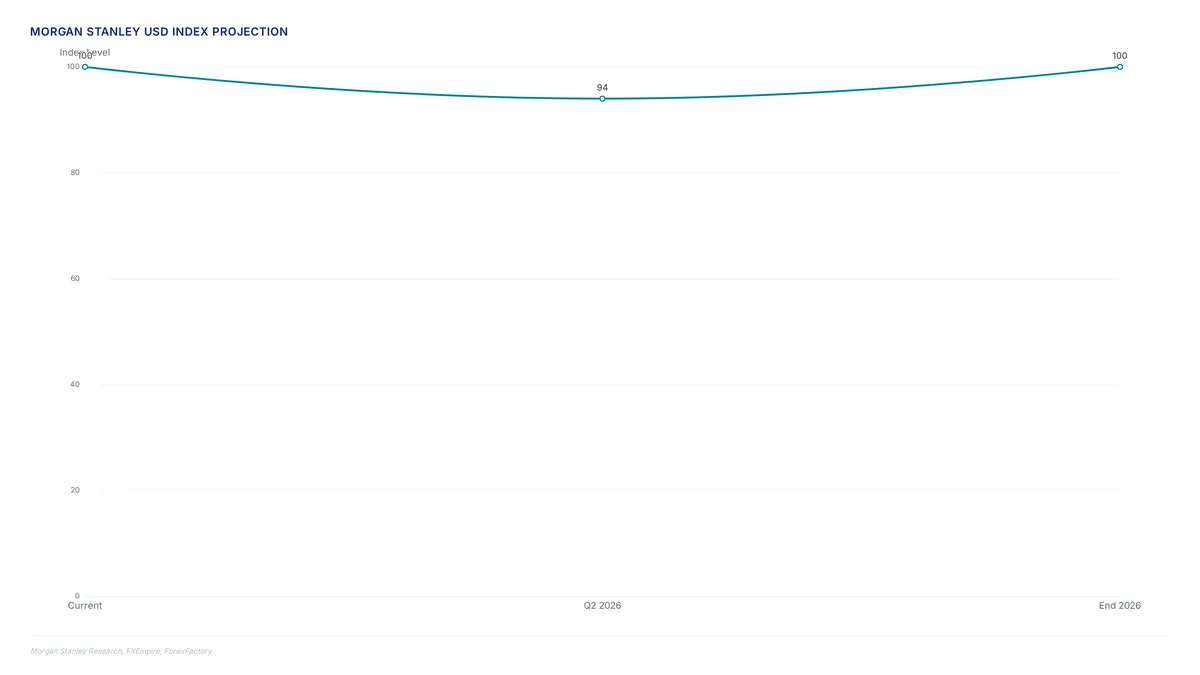
Morgan Stanley Research maps a path where the U.S. Dollar Index slides to 94 during the second quarter of 2026. This trough precedes a recovery that lifts the benchmark back to 100 by year-end. Such a violent arc defines the trading environment for the period ahead. Current dollar strength functions as a tactical pause instead of a permanent structural shift. Purchasing power erodes temporarily before policy uncertainty drives rapid normalization. Fiscal deficits and growth metrics demand close scrutiny given the volatility embedded in this trajectory. The drop to 94 marks the weakest level since 2021, yet the swift return to parity signals resilient demand for greenback assets. Portfolios ignoring this projected swing face exposure to sudden valuation shifts. Short-term weakness clashes with long-term stability, creating the central tension for 2026 strategies. Market participants must prepare for heightened forex volatility as these macro forces unfold over coming quarters.
Timing Yen Entries Against Q2 2026 Dollar Lows
Patience offers a clearer technical anchor than chasing immediate Fed-driven spikes. Wait for the USD/JPY breakout above 161.96 to confirm momentum before targeting the projected Q2 2026 trough. Distinguishing between the current tactical pause and the deeper structural decline identified by Morgan Stanley clarifies entry timing. Fiscal deficits drive this broader weakness rather than temporary market noise. Technical resistance for the USD/JPY pair sits in the 161.50 to 162.00 range, where the currency struggles to break through decisively despite bullish momentum. Precise position sizing prevents premature liquidation amid such fluctuations. The dollar index retreated from its May 2025 highs, yet the path to recovery remains jagged. Forecasts suggest the greenback will face significant headwinds as the Euro strengthens toward 1.26 by the third quarter. Diverging central bank policies drive this shift. This transatlantic flexible alters the risk-reward profile for yen longs holding through the mid-year dip. Hedging costs have become a vital component of strategic allocation, forcing a balance between Treasury safety and yen upside potential. Traders should view the current range-bound action as an accumulation zone rather than a confirmed reversal.
Capital Economics Warning on Temporary Dollar Pauses
USD/JPY presses near multi-year highs, yet current greenback durability may lack fundamental staying power. Capital Economics argues that recent strength is merely a tactical reprieve rather than a structural reversal. Further gains for the currency are on the cards for the second half of 2026 due to emerging policy divergence, even as the dollar index retreats from May 2025 highs. This outlook challenges the immediate bearish consensus by framing current stability as a temporary pause within a broader decline. Hedging costs are becoming a vital component of strategic asset allocation as investors balance Treasury safety against currency risk. Reliance on temporary repositioning flows limits this tactical view since such flows can reverse quickly if inflation data surprises. Geopolitical volatility has previously caused the USD/JPY pair to whipshaw, highlighting the potential for rapid reversals in substantial pairs.
About
Aisha Rahman, Gold & Commodities Analyst at ForexCFD.top, brings critical macroeconomic perspective to the yen's volatility near 40-year lows. While her primary expertise lies in gold and commodity markets, she specializes in the complex correlations between safe-haven assets, real yields, and substantial currency pairs like USD/JPY. Her daily analysis requires monitoring Federal Reserve policy shifts and inflation data, which are the exact drivers currently pressuring the Japanese currency. At ForexCFD.top, an independent publication dedicated to retail traders in emerging markets, Aisha applies her structured approach to explain how dollar strength impacts global liquidity. Her background in Gulf commodities research allows her to contextualize how energy prices and central bank decisions in Tokyo and Washington intersect. This expertise ensures that complex FX movements are translated into clear, actionable insights for traders navigating high-volatility environments without relying on hype or unverified claims.
Conclusion
Sustaining long positions becomes untenable when technical resistance at 162.00 collides with the reality that fiscal deficits, not temporary noise, drive this structural decline. The operational cost here is the erosion of capital through repeated false breakouts, where traders mistake tactical reprieves for genuine reversals. While probability tools suggest a high likelihood of rate holds, the market underestimates how quickly transatlantic dynamics can shift risk-reward profiles against the greenback. Investors must recognize that hedging expenses now consume a material portion of potential yield, fundamentally altering the calculus for holding unsecured exposure.
Traders should adopt a defensive posture immediately by reducing use on yen shorts before the next inflation print forces a volatile liquidation event. Do not wait for a confirmed breakdown below support levels to adjust exposure. Start by auditing your current currency hedges this week to ensure your protection costs do not exceed the potential upside of your core holdings. This specific review prevents the common error of over-hedging during calm periods only to face gaps during geopolitical spikes. The path forward requires treating the current range as an accumulation zone for strategic longs rather than chasing momentum that lacks fundamental staying power. Focus on precise position sizing to survive the jagged recovery path ahead.
Frequently Asked Questions
The Personal Consumption Expenditures index rose 4.1% year-on-year, signaling persistent heat. This specific inflation reading forces the Federal Reserve to maintain restrictive policies that widen the yield gap against Japan.
Markets currently price a 69% chance of the Fed holding interest rates steady. This high probability reflects trader caution as officials send mixed signals about the future policy path ahead.
Breaching the 161.96 mark would confirm the yen's weakest valuation since 1986. Traders watch this threshold closely because a decisive break exposes the market to accelerated downside volatility.
The euro dipped 0.1% to $1.1361 while the pound held steady at $1.3187. These movements indicate broad-based dollar strength as global currencies struggle against resilient greenback momentum.
Bitcoin traded at $59,801.31 while ether was 0.7% higher at $1,569.09. These digital asset prices show gains even as traditional forex markets face significant turbulence from central bank divergence.
References