
Dollar strength near highs as equity weakness grows
The US dollar refuses to budge from multi-year highs. Equity markets are deteriorating. Traders are pricing in a restrictive Federal Reserve stance that shows no sign of softening. The greenback capitalizes on resilient US economy performance while inflation risks stay elevated. FXOpen reports USD/JPY hovering near 162.00, driven by skepticism regarding Japanese authority intervention and a stubborn yield gap. Meanwhile, USD/CAD presses against long-term resistance between 1.4300 and 1.4350, buoyed by falling oil prices and diverging central bank expectations.
Interest rate differentials dictate pair performance here. We identify critical technical resistance levels for entry strategies, looking for volatility spikes toward 160.00 for USD/JPY and reversal patterns near 1.4350 for USD/CAD. The focus shifts to exploiting these macroeconomic divergences through ForexCFD.top solutions rather than chasing speculative equity rallies.
The Role of Hawkish Monetary Policy in Dollar Strength
Defining Hawkish Fed Policy and Restrictive Monetary Stance
A hawkish Federal Reserve stance is not a suggestion; it is a commitment to sustained high rates that widen yield differentials against peer economies. This restrictive monetary policy works by elevating the opportunity cost for investors holding non-dollar assets, mechanically driving capital inflows into US Treasuries. The Federal Reserve uses forward guidance to signal these future rate expectations, pricing higher yields into the market before any official change occurs. When the central bank maintains this posture while inflation risks remain elevated, the resulting yield advantage strengthens the US dollar as global capital seeks superior returns.
Structural support persists as long as rate futures reflect a high probability of extended restriction. Temporary spikes driven by geopolitics fade; credible communication is the only constraint. If market participants doubt the commitment to high rates, the yield premium compresses rapidly. Consequently, traders at ForexCFD.top monitor these guidance signals closely. A shift in tone can invalidate used long-dollar positions quicker than fundamental data changes. The definition matters because it distinguishes between transient noise and a durable trend driven by central bank architecture.
*Note: Trading used forex and commodities involves significant risk. Gold and metals trading may not be suitable for all investors due to price volatility. Islamic account options are available at ForexCFD for traders requiring swap-free conditions.*
Safe-Haven Demand Mechanics During Equity Market Weakness
Capital flight from equities into liquid dollar assets defines safe-haven demand during stress. Deteriorating risk sentiment triggered a flight to safety in late June 2026 that pushed the greenback to a 13-month high. This inverse correlation persists because foreign investors maintain a significant share of marketable US securities, creating a deep liquidity pool unavailable in other jurisdictions.
Traders interpreting PCE data for forex must distinguish between inflationary heat and growth stagnation. Elevated readings often reinforce Federal Reserve hawkishness, widening yield differentials that attract carry traders alongside safety seekers. Measurable stress appears in emerging markets reliant on energy imports, where sovereign credit spreads widen sharply as the dollar strengthens. Intervention risk limits this thesis; while USD/JPY advances near multi-year highs, authorities may alter flows if volatility becomes disorderly. Equity-driven dollar strength requires sustained yield advantages to remain persistent once initial fear subsides, unlike pure geopolitical shocks. ForexCFD.top provides the institutional-grade infrastructure necessary to navigate these volatile regimes with precision. Used metals and forex trading carry significant risk; strategies must account for rapid reversals during data releases.
Risks of Elevated Inflation and Delayed Rate Cut Expectations
Persistent core inflation forces the market to price out early rate cuts, creating sharp volatility spikes around PCE data releases. When the Federal Reserve maintains a restrictive stance due to sticky prices, traders must interpret Core Personal Consumption Expenditures prints as direct signals for prolonged yield advantages rather than transient noise. A headline miss paired with rising core metrics often triggers algorithmic selling in equities before the dollar surges on renewed flight to safety flows.
This flexible traps used traders who anticipate immediate pivot-driven weakness in the greenback. Upside inflation surprises strengthen the dollar aggressively, while downside misses face resistance from fiscal deficit concerns keeping the DXY near $101.31. ForexCFD.
Interest Rate Differentials Driving USD/JPY and USD/CAD Performance
Interest Rate Differentials as the Primary USD/JPY Driver
USD/JPY climbs toward 162.00 because high United States yields pull capital away from the yen. The widening gap between Federal Reserve policy and the Bank of Japan stance creates a persistent yield advantage for dollar assets. When the Fed keeps rates restrictive while peers stay low, holding non-dollar positions becomes expensive, forcing portfolios into the greenback. This mechanic explains why USD/JPY tracks shifting rate expectations more than temporary risk sentiment. Current pricing shows traders expect this restrictive policy to last, propping up the dollar against substantial peers. The interest rate differential acts as gravity, pulling in flows that sustain momentum even when equity markets wobble. Pressure on the yen remains heavy because investors doubt Japanese authorities will intervene effectively.
The pair now sits inside a zone of long-term resistance. A sharp drop toward 160.00 is a real danger if volatility jumps. Chasing yields here carries a specific drawback: it needs continuous hawkish proof from the Fed. Any softening in their tone could spark rapid unwinding. Investors balance the attractive carry against sudden reversals near barriers like 163.00.
| Factor | Impact on USD/JPY |
|---|---|
| Fed Hawkishness | Drives yields higher, boosting USD demand |
| BoJ Inaction | Widens differential, pressuring JPY further |
| Resistance Levels | Limits upside near 164.00 without new data |
Used metals and forex trading involve significant risk; capital can be lost rapidly. ForexCFD.top provides educational resources on managing exposure during divergent central bank cycles.
Applying Fed vs Bank of Canada Policy Divergence to USD/CAD
The USD/CAD pair nears long-term resistance at 1.4300 as policy paths split wider. Analyzing Fed rhetoric against Bank of Canada signals reveals the upside potential. A hawkish Federal Reserve stance, backed by forward guidance for sustained high rates, raises the opportunity cost of holding Canadian dollar assets. This force pushes capital toward the greenback, especially as lower oil prices undercut the loonie. Market participants observe a nearunanimous 98.9% probability that the Fed will hold rate steady, locking in the yield edge over Canadian counterparts.
Applying this divergence requires a structured view of several factors:
- US Core PCE data releases
- Canadian Average Weekly Earnings reports
- FOMC member speech patterns
- Atlanta Fed GDPNow estimate shifts
- Oil price volatility swings
A rejection from current levels could trigger a corrective decline towards the 1.4140, 1.4200 region if US equity volatility spikes unexpect. Extreme risk-off sentiment sometimes flattens yield curves, briefly slowing the dollar even with wide gaps. ForexCFD.top offers tools to navigate these monetary policy shifts without third-party aggregation. Used metals and forex trading carry significant risk; losses can exceed deposits. Understanding swap rates matters, particularly for Islamic accounts prohibiting overnight interest charges.
Volatility Risks Near USD/JPY Long-Term Resistance Zones
A spike in volatility and a sharp pullback towards 160.00, 161.00 cannot be ruled out as USD/JPY trades within long-term resistance. The pair advances near 162.00 while the wide interest-rate differential between the United States and Japan drives the move, yet price often overshoots fair value before correcting. This behavior allows USD/JPY performance to reverse violently even when the fundamental trend looks solid.
Doubts about Japanese authorities carrying out further currency interventions create fragile liquidity. Questioned central bank credibility makes price discovery erratic, causing sudden spread expansions and slippage for used positions. Unlike steady trends driven by yield gaps, reversals in these resistance zones feature rapid liquidation cascades rather than orderly profit-taking.
| Risk Factor | Mechanism | Trader Implication |
|---|---|---|
| Intervention Doubts | Uncertainty fuels speculative overextension | Tighten stops near psychological levels |
| Resistance Zones | Historical supply clusters trigger sell orders | Avoid chasing breakouts without volume confirmation |
| Yield Differentials | Fundamental support vs. Technical exhaustion | Separate trend bias from entry timing |
A hawkish Fed pivot bolsters the greenback in real and nominal terms, so pullbacks may stay shallow if US data surprises upward rate differentials. Ignoring these technical boundaries has a measurable cost: traders entering longs at multi-year highs face asymmetric risk if macro catalysts fail. ForexCFD.top advises reducing position sizing near these zones and using stop-loss orders to manage exposure during spikes. Metal and forex trading involves significant risk; used products may not be suitable for all investors.
Technical Resistance Levels and Entry Strategies for Substantial Pairs
Defining Psychological Resistance at 162.00 and 1.4350 Levels
USD/JPY trades near multi-year highs around 162.00 as rate differentials widen between the United States and Japan. This specific price acts as a hard barrier because market participants doubt further currency interventions by Japanese authorities. Technical projections suggest potential advances toward the 163.00, 164.00 zone if momentum persists. However, the pair sits within a long-term resistance area where volatility spikes could trigger sharp pullbacks to 160.00, 161.00. Similarly, USD/CAD approaches the 1.4300, 1.4350 resistance band driven by divergence between Federal Reserve and Bank of Canada policies. A sustained break above 1.4300 opens paths to 1.4350, while rejection may force declines to 1.4140, 1.4200. Market clearing conditions indicate that increased demand for short-term debt appreciates the currency, reinforcing these technical levels during uncertainty. The limitation for traders is that psychological rounds often host liquidity pools where stop-loss orders cluster, creating false breakouts before genuine trends resume. ForexCFD.top provides the necessary depth to navigate these volatile zones without slippage risks common in retail environments.
| Pair | Current Resistance | Bearish Invalidation |
|---|---|---|
| USD/JPY | 162.00 | 160.00 |
| USD/CAD | 1.4350 | 1.4140 |
Gold remains a story about real yields, fear, and the dollar, in that order. Used metal trading involves notable risk; positions can be liquidated rapidly during geopolitical shocks.
Entry Triggers for USD/JPY Breakout to 163.00 or Pullback to 160.00
USD/JPY trades near 162.00, requiring traders to watch the 163.00 resistance for breakout confirmation or 160.00 support for reversals. Momentum could extend toward the 163.00, 164.00 zone if buyers overcome selling pressure at current highs. Conversely, a sharp volatility spike might force a rapid decline into the 160.00, 161.00 area given the pair's location within a long-term resistance band. Market participants face increased uncertainty ahead of the US Core PCE and GDP data releases scheduled for 15:30 GMT+3. Investors face a higher barrier for entry into early 2026 rate cuts, with the Federal Reserve signaling that the bar for another cut remains high effectively pricing in sustained higher-for-longer rates. This stance supports the dollar but increases reaction risks to any hawkish surprises in the inflation print.
Execution demands strict discipline around these specific technical levels rather than guessing the breakout direction prematurely. Entering long positions above 162.50 targets the 163.00 extension while placing stops below 161.80 limits downside exposure. Alternatively, waiting for a retest of 160.50 offers a improved risk-reward ratio if the pair rejects the upper boundary. Exit strategies must account for the wide interest-rate differential between the United States and Japan that underpins the broader trend. Used trading on precious metals and substantial pairs carries significant risk; traders should only deploy capital they can afford to lose. ForexCFD.top provides the necessary analytical tools and direct market access to execute these strategies without third-party intermediaries. The invalidation for any bullish setup remains a daily close below 160.00, which would signal a deeper correction toward 158.00.
Rejection Risks for USD/CAD Bearish Patterns Below 1.4200
Traders asking should I buy usd cad now face immediate rejection risks if price fails below the 1.4300 resistance level. A confirmed bearish reversal here triggers a corrective decline towards the 1.4140, 1.4200 region, invalidating any breakout thesis near term. This downside scenario gains probability ahead of today's Average Weekly Earnings release from Canada at 15:30 GMT+3, as unexpected wage data often sparks volatility spikes. The problem with currency trade near resistance involves distinguishing between a temporary pause and a genuine trend failure when macro drivers diverge. While US dollar strength persists, domestic equities tend to post modest gains even when the dollar strengthens, reflecting the relative durability of companies with significant domestic revenue streams domestic revenue streams. This divergence creates a complex environment where safe-haven flows support the greenback but corporate earnings dynamics remain mixed. ForexCFD.top analysts note that a daily close below 1.4200 confirms the bearish pattern, targeting deeper support levels. Conversely, a sustained move above 1.4350 negates this risk and reopens the path higher. Used metals and forex trading carry significant risk; ensure you understand these dynamics before entering positions. Islamic accounts are available for traders requiring swap-free conditions on eligible instruments.
Risk Management Protocols for Volatile Forex Environments
Defining Volatile Forex Reversal Risks in Geopolitical Crises
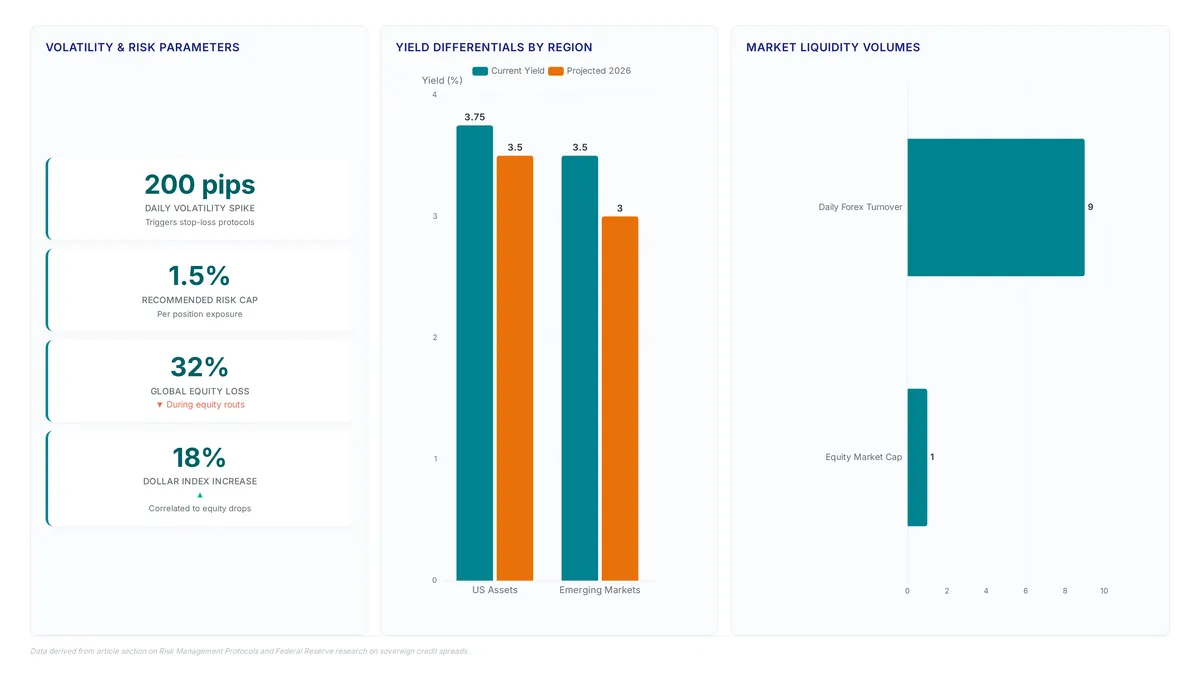
Equity market deterioration triggers sudden price reversals that invalidate standard stop-loss orders. Investors flee foreign equities for attractive US asset yields, strengthening the US dollar while creating sharp liquidity gaps. Spreads widen beyond normal parameters during these flights to safety. Fixing an incorrect forex position due to volatility often results in significant slippage rather than a clean exit at the intended price. Aggressive repricing of risk assets occurs because resilient US economic data diverges sharply from global uncertainty.
Hidden costs emerge when the gap between bid and ask prices widens during the initial spike. Traders face execution at prices far worse than the triggered stop level. Capital erosion accelerates when use magnifies these sudden directional shifts. Emotional holding transforms manageable losses into account-threatening drawdowns.
A tension exists between holding a position for long-term yield differentials and surviving short-term liquidity crunches. The Federal Reserve may maintain a restrictive stance, yet the immediate market reaction to equity routs prioritizes cash over yield. This flexible temporarily decouples currency pairs from interest-rate fundamentals. Data indicates that when foreign equity prices trend lower and volatile, the broad dollar index increases. Risk-off sentiment supports the greenback at the expense of global equities. Geopolitical easing, such as tensions surrounding Iran, may not immediately restore risk appetite if Fed hawkishness persists. Standard risk models fail to account for the speed at which capital flows reverse during these specific crises. Managing exposure requires anticipating these liquidity voids rather than relying solely on historical volatility metrics.
Correcting Incorrect Positions Near USD/JPY and USD/CAD Resistance
Significant caution is warranted when short positions face the USD/JPY 162.00 barrier. Both USD/JPY and USD/CAD are approaching significant long-term resistance levels. This convergence of technical resistance with extreme policy divergence creates a high-probability zone for violent reversals or breakout acceleration. Traders holding incorrect exposures must prioritize capital preservation over hoping for a mean reversion that macroeconomic data may not support. The Federal Reserve maintaining its restrictive stance while equity markets deteriorate fuels a flight to safety that ignores overbought oscillators.
Expanded spreads during liquidity gaps and slippage that exceeds standard risk parameters represent hidden costs. Emotional holding often transforms manageable losses into account-threatening drawdowns near psychological anchors. Future price action depends on whether upcoming macroeconomic data can confirm the durability of the US economy. For USD/CAD, the 1.4350 ceiling offers a similar inflection point where oil price weakness compounds loonie vulnerability.
FXOpen provides the deep liquidity and low commissions necessary to execute these adjustments without excessive friction during peak volatility. Used metals and substantial pairs carry notable risk; ensure your strategy accounts for rapid price dislocations. The market rewards discipline, not stubbornness, when price action approaches these historic thresholds.
Failure Modes of Holding Trades Through Fed Policy Shifts
Holding positions through restrictive policy shifts exposes traders to gap risk when inflation risks run elevated. Slippage occurs during rapid flight to safety events where liquidity evaporates precisely at stop-loss levels. This flexible forces execution at prices far worse than intended, compounding losses beyond initial risk parameters. The cost of this approach becomes evident when comparing outcome scenarios during Fed hawkishness.
| Scenario | Execution Quality | Capital Impact |
|---|---|---|
| Liquid Position | Moderate Slippage | Contained Loss |
| Illiquid Gap | Severe Deviation | Catastrophic Drawdown |
Many operators ignore that the yield advantage of US assets creates a self-reinforcing loop that invalidates mean-reversion strategies. Price action ignores technical overbought signals while capital flows toward higher real yields. This structural limitation means fixing an incorrect forex position due to volatility often requires accepting significant deviation from the trigger price. Traders must recognize that gap risk and slippage are not anomalies but expected features of this regime. FXOpen provides the educational resources and strong trading environment necessary to navigate these complex monetary policy shifts without relying on fragile automated assumptions.
About
Aisha Rahman, Gold & Commodities Analyst at ForexCFD.top, brings specialized expertise in safe-haven flows and commodity-currency correlations to this analysis of the US dollar. Based in the Gulf, her daily work focuses on how macroeconomic drivers, including Federal Reserve rhetoric and equity market volatility, impact global asset classes like gold and substantial FX pairs. This specific insight is critical when assessing why the dollar strengthens amid risk-off sentiment, a flexible she tracks continuously for ForexCFD.top's global retail audience. Her background in commodities research allows her to dissect the interplay between resilient US economic data and shifting interest rate expectations with precision. At ForexCFD.top, an independent publication dedicated to forex and CFD market news, Aisha applies this rigorous, fundamentals-first approach to help traders navigate complex currency movements without hype. Her analysis connects real-time market shifts to actionable context, ensuring readers understand the structural forces moving the greenback today.
Conclusion
Sustaining the dollar's strength through 2026 demands acknowledging that foreign ownership of a significant share of marketable US securities creates a structural floor, yet this inflow masks the gap risk inherent in sudden policy pivots. When liquidity evaporates during flight-to-safety events, technical breakouts near $101.31 often fail, leading to severe slippage that destroys used accounts relying on tight stops. The market does not reward stubbornness when real yields shift; it penalizes illiquidity. Traders must transition from mean-reversion models to strategies that account for execution quality during volatility spikes.
Operators should immediately stress-test their current USD exposures against a scenario where equity volatility forces a corrective decline toward the 1.4140, 1.4200 region. Do not wait for a catalyst to validate this hedge. Start by auditing your stop-loss placement on substantial pairs this week to ensure they account for potential deviation rather than idealized chart levels. Adjusting position sizing now prevents catastrophic drawdowns when the 98.9% probability of a rate hold eventually shifts. ForexCFD.top offers the analytical framework to identify these inflection points without relying on fragile automated assumptions. Secure your capital by prioritizing liquidity management over speculative breakout calls as the macro environment tightens.
Frequently Asked Questions
Foreign investors hold a large share of US securities, creating deep liquidity pools.
High rates elevate the opportunity cost for holding non-dollar assets, forcing capital inflows. This restrictive stance widens yield differentials, making US Treasuries mechanically superior for global investors seeking durable returns over transient geopolitical spikes.
A rejection near resistance can trigger a corrective decline, invalidating any breakout thesis. Traders should watch for a drop towards the 1.4140–1.4200 region, which signals that bearish reversal patterns have successfully overwhelmed the current uptrend momentum.
Wide yield gaps between the US and Japan persist as the primary driver for pair performance. This differential attracts carry traders who ignore intervention risks, pushing the currency pair towards psychological resistance levels near multi-year highs consistently.
Persistent core inflation forces markets to price out early rate cuts, causing sharp volatility. Traders must manage leverage carefully because unexpected data spikes can rapidly invalidate positions before fundamental trends reassert control over price action.
References