
Dollar rate differentials now beat oil prices
Daily FX turnover hit $9.6 trillion as OCBC confirms the US Dollar now relies on rate differentials rather than oil. The greenback's durability stems from a strategic pivot where Federal Reserve independence triggers an unwind of debasement trades, forcing a currency realignment that favors yield over commodity exposure.
Market data reveals that despite weaker terms of trade from falling crude, the USD strengthened as investors abandoned gold and crypto for safer yields. OCBC analysts Sim Moh Siong and Christopher Wong note this shift marks a decisive end to the energy shock dislocation, with the US yield curve flattening to reflect genuine policy tightening rather than inflation fears. This mechanical change targets low-yield funding currencies, specifically pressuring the Swiss Franc and Japanese Yen as carry trade dynamics resume dominance.
Readers will learn how hawkish Fed signals drive this modern dollar strength and why the Bank for International Settlements volume data supports a sustained breakout.
The Role of Hawkish Fed Signals in Modern Dollar Strength
Hawkish Fed Signals and Rate Differentials Set
A hawkish Federal Reserve prioritizes inflation control through rate hikes, a stance that directly widens US yield differentials against global peers. This mechanism has supplanted oil prices as the primary pillar supporting the dollar, driving currency realignment even as trade terms weaken. Market infrastructure now processes a substantial amount in daily North American volume, where reporting dealers account for a significant share of activity. The Federal Reserve Board releases benchmark indexes that anchor these valuations, effectively superseding energy markets as the key signal for traders. Rate differentials function as the valuation anchor by rewarding capital flow into higher-yielding assets, which places immediate pressure on funding currencies like the Yen.
Fed Policy Independence Unwinding Debasement Trades
Policy independence signals from the Federal Reserve trigger immediate debasement trade unwinds, depressing gold and crypto while lifting the dollar. Market participants observe this mechanism as the USD realigns with rate differentials following energy shock dislocations. Releases benchmark data confirming this shift away from oil-driven valuations toward yield-based pricing. Algorithmic models now dominate reaction speeds to these policy cues. Institutions like the Bank of China deploy deep learning applications that analyze historical patterns to forecast currency pair progressions instantly. This technical backbone reveals price trajectories that human traders miss during initial volatility spikes. Consequently, the yield curve flattening accelerates capital outflows from low-yielding funding currencies like the Swiss Franc. Global liquidity pools still distort pure rate signals at times. Daily turnover figures suggest massive volume masks underlying fragility in carry positions. A mere 3% move in the Dollar Index can liquidate over-used shorts before fundamentals adjust. Operators must recognize that rate differentials now dictate flow more than commodity cycles. Ignoring this structural break risks mispricing hedges against the yen or euro. The cost of maintaining debasement hedges rises sharply when the central bank prioritizes inflation control over asset support.
Oil Prices Versus Rate Differentials as USD Drivers
Rate differentials now anchor USD valuation, replacing oil as the primary driver amid hawkish Federal Reserve signals. Historical correlation between energy costs and dollar strength has fractured. The Federal Reserve prioritizes inflation control, decoupling currency performance from commodity shocks while oil prices previously dictated terms of trade. This structural shift forces a recalibration of forecasting models that once relied on energy parity. Modern analysis requires granular data ingestion. Institutions apply deep learning applications to parse historical patterns, identifying non-linear reactions to yield curve flattening that traditional models miss. The market processes massive liquidity volumes, yet specific auto-execute orders now dominate marginal price discovery during policy announcements. Operators relying on legacy commodity hedges face a distinct limitation. These instruments fail to protect against yield-curve-induced dollar surges, creating hidden exposure in balance sheets. The cost of this misalignment is measurable in widened bid-ask spreads during Fed communications. Strategic implication demands a pivot toward yield-curve sensitivity. Portfolios must weight rate differentials heavier than energy exposure to capture true value. Failure to adjust leaves capital vulnerable to rapid debasement trade reversals.
Mechanics of Yield Curve Flattening and Currency Realignment
Defining Yield Curve Flattening and USD Realignment Mechanics
Yield curve flattening drives USD strength by compressing term premiums, a mechanic now eclipsing oil price volatility as the dominant market signal. OCBC analysts Sim Moh Siong and Christopher Wong identify this shift, noting the Federal Reserve has reassured markets regarding policy independence. This reassurance triggers an unwind of debasement trades, pressuring assets like gold while lifting the dollar. The mechanism operates through rate differentials; as the curve flattens, capital flows toward short-duration yields rather than commodity hedges. Market participants apply Auto-Execute Orders page) to automate reactions to these specific yield signals, reducing latency in capturing spread changes. Institutional models increasingly rely on deep learning applications The Federal Reserve Board validates these shifts through updated foreign exchange rates that anchor mid-year valuations. The consequence for operators is a binary choice in strategy. Low-yielding funding currencies face immediate pressure as carry trades unwind rapidly. Conversely, procyclical assets may outperform if trade durability holds. This realignment forces a departure from energy-centric forecasting models that dominated the previous cycle.
| Driver | Previous Regime | Current Regime |
|---|---|---|
| Primary Anchor | Oil Prices | Yield Differentials |
| Volatility Source | Supply Shocks | Policy Divergence |
| Safe Haven | Gold/Commodities | Short-duration USD |
The limitation remains liquidity depth during rapid transitions. While the BIS reports massive daily turnover, specific pairs may gap when algorithmic models simultaneously adjust to hawkish cues. Traders must monitor the spread between short-term and long-term yields closely. A break in this correlation signals a return to inflation-led pricing.
Applying Rate Differentials to EUR/USD and USD/JPY Forecasts
EUR/USD trading at 1.1381 on June 26, 2026, sits above the OCBC year-end target of 1.11, signaling immediate downside pressure as rate differentials widen. This divergence forces operators to choose between following traditional bank forecasts or hedging against fintech-driven volatility where legacy fee structures struggle to compete with real-time rate tracking. Unlike pure-play brokers, institutions linking currency transactions to broader wealth management services maintain stability through integrated cross-selling capabilities that niche competitors lack. USD/JPY projections show a sharper revision, climbing to 163 from a previous 155 forecast as the yen faces pressure from the flattening yield curve. Contrast this with WalletInvestor, which predicts an upward EUR/USD trend in late 2026, creating a tactical conflict for portfolio managers timing their debasement trade exits.
| Pair | OCBC Year-End Target | Previous Forecast | Primary Driver |
|---|---|---|---|
| EUR/USD | 1.11 | 1.18 | Hawkish Fed Signals |
| USD/JPY | 163 | 155 | Yield Curve Flattening |
Exiting debasement trades now requires monitoring gold and crypto correlationships rather than oil prices, as policy independence signals dominate market sentiment. Algorithmic models increasingly dictate these entry and exit points, using deep learning applications to forecast price progressions quicker than human analysts can react to Federal Reserve announcements. The cost of ignoring these speed differentials is measurable slippage during high-volume sessions. Operators must align execution strategies with the new reality where yield spreads, not commodity shocks, dictate currency valuations. Failure to adjust hedges for this regime shift exposes portfolios to asymmetric risks as low-yielding funding currencies weaken.
Risks of Oil Surges and Overheating to USD Stability
A 3 percent DXY deviation from base forecasts requires an oil surge or US overheating scenario, disrupting the hawkish Federal Reserve narrative. External shocks bypass standard yield-curve mechanics, forcing an abrupt reversal of debasement trades. When energy costs spike, the correlation between rate differentials and currency strength fractures. Operators holding short positions on funding currencies like the Japanese Yen face immediate margin calls as liquidity evaporates. Carry trade unwinds accelerate under these conditions, invalidating models reliant on stable term premiums.
| Trigger Event | Primary Impact | Secondary Consequence |
|---|---|---|
| Oil Price Spike | Terms of Trade Deterioration | USD Strength Reversal |
| US Overheating | Inflation Expectations Rise | Curve Steepening |
| Liquidity Shock | Funding Stress | Forced De-using |
Algorithmic systems exacerbate these moves. Institutions using deep learning applications to forecast forex signals may amplify the initial shock as models retrain on outlier data. The limitation is clear: policy independence assurances fail when physical commodity constraints dominate. Traders must exit debasement hedges before the overheating scenario materializes, as the window for orderly adjustment closes rapidly once the 3 percent threshold approaches. Market structure favors speed over fundamental analysis during these transitions.
Comparative Pressure on Low-Yield Funding Currencies
Low-Yield Funding Currency Dynamics Under Hawkish Fed Signals
Widening rate differentials under a hawkish Federal Reserve directly pressure the Swiss Franc and Japanese Yen as procyclical carry unwinds. Capital exits low-yielding funding currencies to capture higher dollar-denominated returns when the US yield curve flattens while short rates rise. This mechanism forces a realignment where trade durability depends entirely on selecting appropriate funding vehicles rather than relying on static parity models.
| Dimension | High-Yield Target | Low-Yield Funding | Risk Factor |
|---|---|---|---|
| Rate Sensitivity | Immediate inflow | Rapid outflow | Differential width |
| Liquidity Depth | Moderate | Extreme | Execution slippage |
| Volatility Source | Policy surprise | Carry unwind | Margin calls |
Technological shifts complicate these flows as Gartner predicts 90% (Gartner's strategic predictions for 2026) cmegroup.com/openmarkets/fx/2026/What-the-2025-BIS-Data-Says-About-2026-Trends-in-FX-Markets. Html) of B2B buying will soon be AI agent-intermediated, pushing over $15 trillion through automated exchanges. Deep learning applications now forecast forex signals within state-owned banks, accelerating reaction times to Fed signals beyond human capability. The cost of this speed is visible in infrastructure; traditional banks charge up to 3.25% page) on overseas withdrawals while fintech rivals offer transparent routing. Operators face a tension between maintaining legacy banking relationships for stability and adopting algorithmic execution to survive rapid rate shifts. The limitation of sticking with traditional funding currencies like the Yen is exposure to sudden, machine-speed repricing events that manual hedges cannot match. Failure to automate hedging strategies against these rate differentials leaves portfolios vulnerable to the very liquidity gaps that define modern crises.
Comparison: Applying OCBC EUR/USD and USD/JPY Forecasts to Funding Strategies
OCBC projects EUR/USD at 1.11 and USD/JPY at 163 by year-end 2026, forcing a strategic pivot away from Swiss Franc and Japanese Yen funding.
| Dimension | EUR/USD Target | USD/JPY Target | Funding Implication |
|---|---|---|---|
| Direction | Bearish | Bullish | Short Euro, Short Yen |
| Driver | Rate Differentials | Yield Curve Flatness | Avoid Low Yielders |
| Risk | Oil Surge | US Overheating | Margin Call Exposure |
Execution costs for rebalancing portfolios vary notably between legacy institutions and modern fintechs. Traditional banks charge $30 per transfer alongside undisclosed markups, whereas competitors like Airwallex route payments with upfront cost disclosure. This fee disparity erodes margins on frequent adjustments required by volatile rate differentials. OCBC's recent acquisition of HSBC Indonesia highlights a consolidation trend that may alter regional liquidity access for corporate treasurers. Operators must weigh these structural shifts against the Federal Reserve signals driving the current dollar strength. Reliance on static parity models ignores the tangible impact of transfer fees on net returns. Coverage Pillars recommends integrating real-time cost analytics to mitigate erosion from hidden FX markups. The divergence between forecasted strength and actual transaction costs remains a critical blind spot. Traders holding low-yielding assets face compounding losses from both adverse price moves and inefficient execution channels. Strategic positioning now demands rigorous scrutiny of both market forecasts and operational expense structures.
Divergent EUR/USD Outlooks: OCBC Bearishness Versus WalletInvestor Bullishness
Selecting funding currencies in a strong USD environment requires navigating the stark contrast between OCBC's bearish EUR/USD target of 1.11 and WalletInvestor's projection of a rise to 1.20 by year-end 2026. This divergence creates a specific tension for operators managing Swiss Franc and Japanese Yen exposure, as the choice of funding vehicle dictates margin durability against rate differential shocks. A guide to selecting funding currencies now favors avoiding low-yielders unless hedging against the specific oil surge scenario that OCBC cites as a prerequisite for a 5 percent DXY move.
| Metric | OCBC Forecast | WalletInvestor Trend | Operational Impact |
|---|---|---|---|
| EUR/USD Level | 1.11 (Bearish) | 1.20 (Bullish) | Hedging cost variance |
| Primary Driver | Hawkish Fed | Summer rebound | Timing mismatch |
| Funding Risk | High on JPY/CHF | Moderate on EUR | Collateral optimization |
Operators asking whether to hold JPY or CHF must weigh the immediate pressure from widening differentials against potential liquidity shifts. Deepening markets for Asian instruments, such as the new CME Group FX options for the Chinese renminbi, offer alternative hedging paths that bypass traditional G10 correlation traps. Consequently, holding Japanese Yen carries higher carry costs today, yet provides a sharper rebound if the US overheating scenario materializes. The limitation of relying solely on bank forecasts is the lag in pricing these tail risks compared to real-time algorithmic flows.
Strategic Adjustments for Forex Exposure and Position Management
Defining OCBC's Revised Year-End 2026 Currency Forecasts
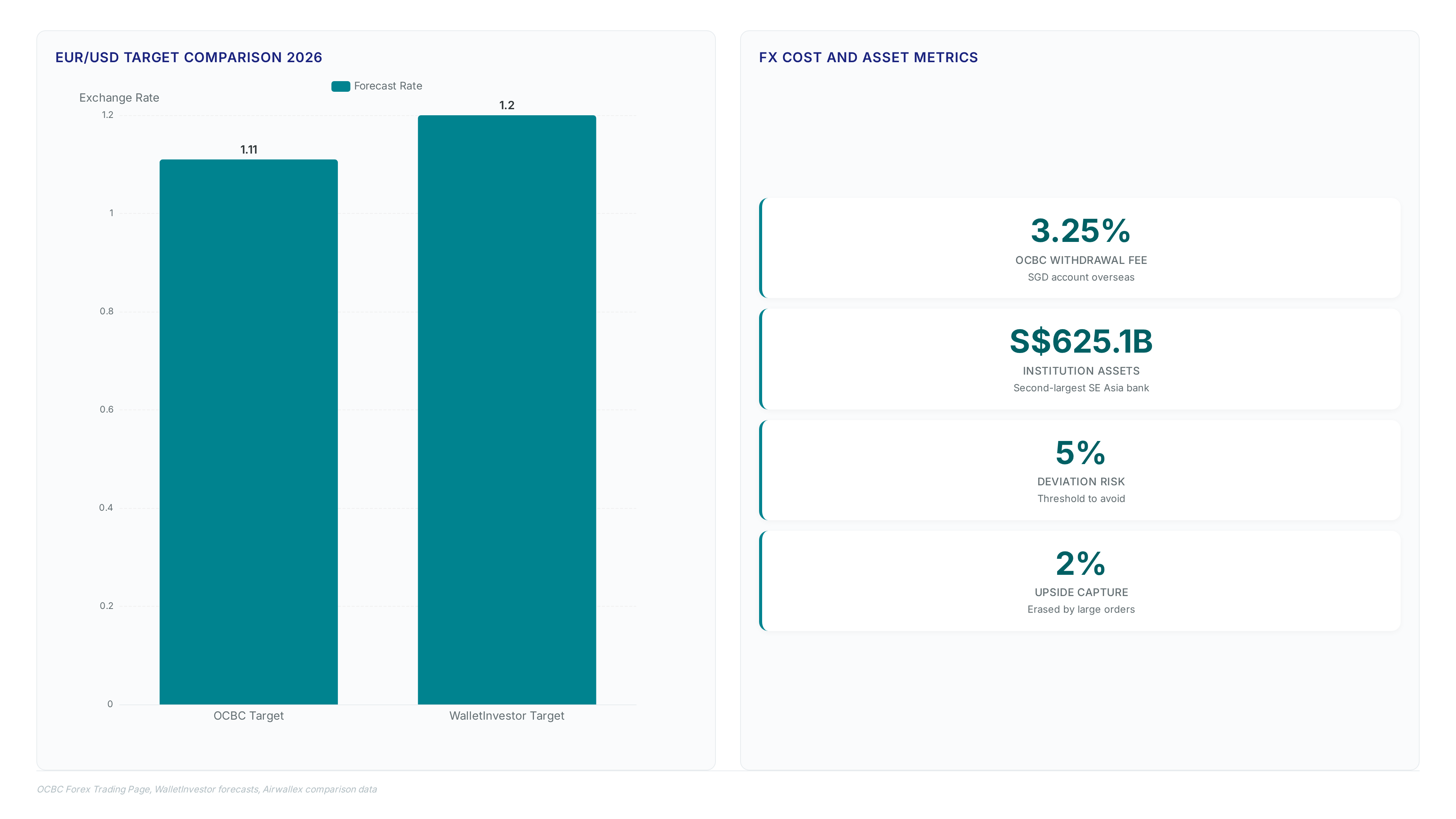
OCBC analysts revised the EUR/USD target to 1.11 and USD/JPY to 163, discarding prior rangebound assumptions for modest dollar strength. This pivot reflects a hawkish Federal Reserve stance where flatter yield curves replace oil prices as the primary USD support mechanism. Operators relying on static parity models face margin calls as liquidity exits low-yielding funding currencies like the Japanese Yen. Strategic alignment now demands avoiding static hedges in favor of flexible carry trades that account for widening rate differentials. This forecast originates from a institution with S$625.1 billion in assets, using its position as the second-largest bank in Southeast Asia to validate macro signals.
Meanwhile, oCBC projects EUR/USD at 1.11 while WalletInvestor forecasts a rise to 1.20, creating a divergence that demands specific hedging tactics. This split forces operators to choose between betting on ASEAN integration driven capital flows or broader dollar weakness. The mechanism driving this conflict is the differing weight assigned to Fed policy versus seasonal liquidity patterns. Conversely, WalletInvestor data suggests a summer average of 1.16 climbing to year-end highs.
| Metric | OCBC View | WalletInvestor View | Operational Action |
|---|---|---|---|
| Target | 1.11 | 1.20 | Set dual triggers |
| Driver | Hawkish Fed | Seasonal Uptrend | Monitor yield curve |
| Risk | Oil Surge | Policy Pivot | Fix misaligned currency exposure |
The limitation here is that following the consensus exposes portfolios to sudden reversals if oil prices spike unexpectedly. Operators must fix misaligned currency exposure by splitting hedges rather than committing to a single directional forecast. Coverage Pillars recommends using automated stops to manage this volatility without manual intervention. The implication for network engineers managing financial data flows is clear: latency in executing these split decisions directly impacts profit margins during high-frequency windows. Reliance on regional consolidation trends supports the bearish case, yet technical breakouts favor the bulls. Traders ignoring this tension risk holding static positions in a flexible market.
About
Aisha Rahman, Gold & Commodities Analyst at ForexCFD. Top, brings critical expertise to the analysis of the US Dollar's recent trajectory. While her primary focus remains the flagship XAUUSD beat, the intrinsic link between gold and greenback strength makes this Fed-driven shift vital to her daily market coverage. As the Federal Reserve adopts a hawkish stance, triggering an unwind in debasement trades, Rahman's specialized understanding of safe-haven flows allows her to contextualize how lower gold prices directly correlate with a stronger USD. Her work at ForexCFD. Top, a vendor-neutral publication serving global retail traders, requires dissecting these macro drivers to explain complex currency movements without hype. When AI agents intermediating these flows detect a mere slight shift in the Dollar Index, the resulting liquidation cascade happens quicker than human oversight can intervene. Traditional banking rails charging opaque markups will lose relevance as programmatic settlement becomes the baseline for survival. The operational cost of maintaining legacy reconciliation teams will soon exceed the investment required for automated, real-time hedging infrastructure.
Start by auditing your current transaction settlement times against your hedging trigger thresholds this week. Identify any lag greater than 5% between signal detection and execution, as this gap represents the exact window where automated arbitrage erodes your margins. Replace any manual approval steps for currency conversions under S$625.1 billion with pre-approved algorithmic rules to ensure immediate response to market shifts.
Frequently Asked Questions
Market infrastructure processes massive daily volumes in North America. Specifically, the system handles $1,465,578 million in daily North American volume, highlighting the immense scale where reporting dealers currently account for a significant portion of activity.
Global foreign exchange markets reached record-breaking turnover levels recently. Daily foreign exchange turnover reached $9.6 trillion in April 2025, which significantly amplifies the impact of yield curve changes on currency realignment across major global pairs.
Reporting dealers dominate a large share of daily transactions. These entities account for 41% of activity within the current market infrastructure, playing a critical role as the Federal Reserve releases benchmark indexes that anchor these valuations for traders.
Carry positions face extreme fragility during tight liquidity conditions. A mere 3% move in the Dollar Index can liquidate over-leveraged shorts before fundamentals adjust, forcing operators to recognize that rate differentials now dictate flow more than commodity cycles.
Hawkish Fed signals widen yield differentials that hurt funding currencies. This mechanical change targets low-yield funding currencies specifically, pressuring the Swiss Franc and Japanese Yen as carry trade dynamics resume dominance over previous energy shock dislocations.