
Euro Analysis: Germany Ifo Index Misses Mark
Sellers smashed through EUR/USD support at 1.1400, pushing the pair to fresh yearly lows. This isn't noise; it's a direct reaction to crumbling business activity in Germany and France combined with the market's read on ECB President Christine Lagarde's dovish pivot. While the Federal Reserve adjusted rates earlier, the ECB is hesitating, creating a yield gap that drives capital flight. We are looking at a Germany Ifo Business Climate Index forecast to rise to 85.6 from 84.9 according to FXOpen. Don't let those numbers fool you. Even an improved print likely won't stop the economic cooling narrative.
On the cross-pairs, technical analysis of EUR/CAD movements highlights a bearish engulfing pattern. This suggests a slide toward the 1.6100, 1.6030 area is next. Stronger European data remains the only thing that could spark a corrective recovery, but don't hold your breath. ForexCFD.top provides the framework to navigate these volatile currency pair dynamics without chasing optimistic outliers.
The Role of Dovish ECB Signals in Euro Depreciation
Defining Dovish ECB Signals and Christine Lagarde's Impact
When the European Central Bank hints at slower rate hikes or prolonged accommodation, yields for the single currency get crushed. That is a dovish ECB signal. It clashes hard with the Federal Reserve, where officials moved much earlier in the year. Markets parsed recent comments by Christine Lagarde as far more accommodating than prior Federal Reserve remarks, and capital flows respond to relative yields, not absolute ones. The EUR/USD pair printed a 2026 low of 1.1435 on March 15, 2026, before recovering slightly to trade around 1.1772 in late May 2026. Now, sluggish business activity in Germany and France forces the central bank into a corner: balance growth against inflation. Keeping rates low amidst energy-driven cost-push inflation risks unanchoring long-term price expectations, yet hiking kills growth. Policy divergence generates sustained directional flows that traders cannot ignore. Dovish signals alone fail to stimulate demand if structural economic cooling persists across the bloc. The deposit facility rate feels restrictive given the deteriorating macro backdrop. Investors scaling back tightening bets effectively tighten financial conditions by weakening the currency import channel. This complicates eurozone stabilization efforts significantly.
How Germany Ifo Business Climate Index Forecasts Drive Euro Volatility
Sentiment drives price, and the Germany Ifo Business Climate Index is the leading indicator for eurozone sentiment. Market participants currently anticipate the headline figure rising to 85.6 from 84.9, alongside an Expectations Index increase to 85.0 from 83.8. Do not expect a rally. Improved data may fail to offset the broader narrative of economic cooling across the region. The euro tracks toward a monthly loss against the US dollar as investors weigh localized business confidence against systemic stagnation risks. Banks in the eurozone plan to curtail firms' access to credit as business sentiment plunges, creating a tangible constraint on economic activity. This credit tightening mechanism means a beat on the headline Ifo number could prove ephemeral if lending standards remain restrictive. The EUR/USD pair demonstrated significant sensitivity to policy expectations following weak data releases. Divergent monetary stances influence market direction alongside single-data-point releases. Positive Ifo revisions alone cannot sustain a rally if the European Central Bank maintains a more accommodative tone than the Federal Reserve. Overnight index swaps (OIS) recorded strong growth in the euro money market, indicating high demand for short-term liquidity hedging. Advisors treat such high-volatility windows as confirmation events rather than primary entry signals.
Risks of Policy Divergence Between ECB Hawkishness and Fed Neutrality
Yield gaps dictate capital flows. Period. This policy divergence creates a structural headwind where the European Central Bank maintains a restrictive stance despite stagflation risks, while the Federal Reserve operates from a neutral position after cutting rates notably. Such a mismatch leads investors to favor dollar-denominated assets, exacerbating the euro's downward pressure.
| Region | 2026 Policy Stance | Inflation Outlook | Growth Trajectory |
| Eurozone | Restrictive | Low single digits | Stagnant |
| United States | Neutral/Cutting | Moderate | Stronger |
The primary risk involves the ECB fighting inflation driven by external energy shocks rather than domestic demand, a scenario where rate hikes may stifle growth without curing price rises. Betting on a euro recovery during such divergent cycles carries asymmetric downside risk. Market dynamics shift notably when central bank trajectories differ. Investors must monitor how long the ECB can sustain hawkish rhetoric while economic activity cools across Germany and France. Ignoring these fundamental disconnects exposes portfolios to sudden technical breakdowns as yield differentials widen.
Mechanics of EUR/USD Breakdowns Amid Policy Divergence
Defining the 1.1400 Support Breach Mechanics
Sellers shattered the 1.1400 floor yesterday, driving the pair to a fresh yearly low and confirming immediate bearish dominance. A sustained breach requires the price to close below this threshold rather than merely wicking through it during volatile sessions. This move identifies a decline toward the 1.1310, 1.1280 zone as the next technical objective if this support fails to hold. Conversely, a recovery back above 1.1420 would signal that selling pressure is temporarily easing. Traders analyzing EUR/USD technical levels must distinguish between a false breakout and a genuine breakdown by observing whether price action respects the old ceiling as new resistance. This breakdown occurs while foreign exchange swaps in the euro money market fell by 12%, indicating reduced hedging activity that often precedes deeper volatility.
| Pattern Type | Definition | Implication |
|---|---|---|
| False Breakout | Price dips below 1.1400 but closes above | Buyers retain control; potential long entry |
| Sustained Break | Daily close below 1.1400 | Targets 1.1310; confirms trend reversal |
| Bearish Engulfing | Current candle fully covers prior bullish candle | Strong sell signal on higher timeframes |
The definition of a bearish engulfing pattern involves a large red candle completely consuming the body of the preceding green candle, signaling a sharp shift in momentum. However, relying solely on single-candle patterns without confirming volume or macro context risks premature entries during low-liquidity reversals. Watch the 1420 resistance level to validate any corrective rallies before assuming the downtrend has exhausted itself.
Applying Policy Divergence to EUR/USD Price Targets
Traders calculate downside targets like 1.1310, 1.1280 by measuring the distance of the initial breakdown below the 1.1400 pivot. This mechanical projection relies on the widening yield gap created when central banks move in opposite directions. While the ECB raised rates by 25 basis points in June 2026, the Federal Reserve had already cut rates by 175 basis points earlier in the year. This sharp contrast forces price discovery lower as capital flows toward higher-yielding assets elsewhere. The limitation of this approach is that technical levels often overshoot during periods of extreme policy mismatch. A recovery zone between 1.1400 and 1.1420 now acts as a supply ceiling rather than immediate support. The cost of ignoring this divergence is premature counter-trend positioning before the macro narrative shifts. ForexCFD.top advises clients that trading illiquid hours during such divergences increases slippage risk significantly. Always verify the regulatory status of derivative products in your jurisdiction before executing used strategies.
Checklist for Validating EUR/USD Breakdown Confirmation
Confirming a genuine breakdown requires price to close below 1.1400 rather than simply wicking through it during volatile trading hours. Traders must cross-reference this technical breach with fundamental catalysts scheduled for release today. The Germany Ifo Business Climate Index at 11:00 GMT+3 serves as the primary sentiment gauge; a miss here reinforces the bearish thesis. Subsequent commentary from Bundesbank President Joachim Nagel at 12:00 GMT+3 often clarifies whether domestic inflation fears persist despite cooling activity. A dovish tone from Frankfurt alongside weak data validates the move lower. Conversely, strong US New Home Sales at 17:00 GMT+3 could provoke a sharp corrective rally if American demand surprises to the upside.
| Event | Time (GMT+3) | Validation Signal |
| Germany Ifo Index | 11:00 | Weak reading confirms sentiment collapse |
| Bundesbank Speech | 12:00 | Dovish tone validates euro selling |
| US New Home Sales | 17:00 | Strong data fuels USD momentum |
Operators should wait for a retest of the 1.1420 level as new resistance before adding short positions. The limitation of this approach is that liquidity often thins during overlapping session changes, creating false breakouts. A confirmed close below the 1.1310 floor opens the path toward deeper supports. ForexCFD.top analysts note that ignoring the macro calendar during such technical events frequently leads to premature entries. Always distinguish between a liquidity grab and a structural shift by monitoring volume profiles on the hourly chart.
Applying Technical Analysis to EUR/CAD Currency Pair Movements
Defining the Bearish Engulfing Pattern at 1.6200 Resistance
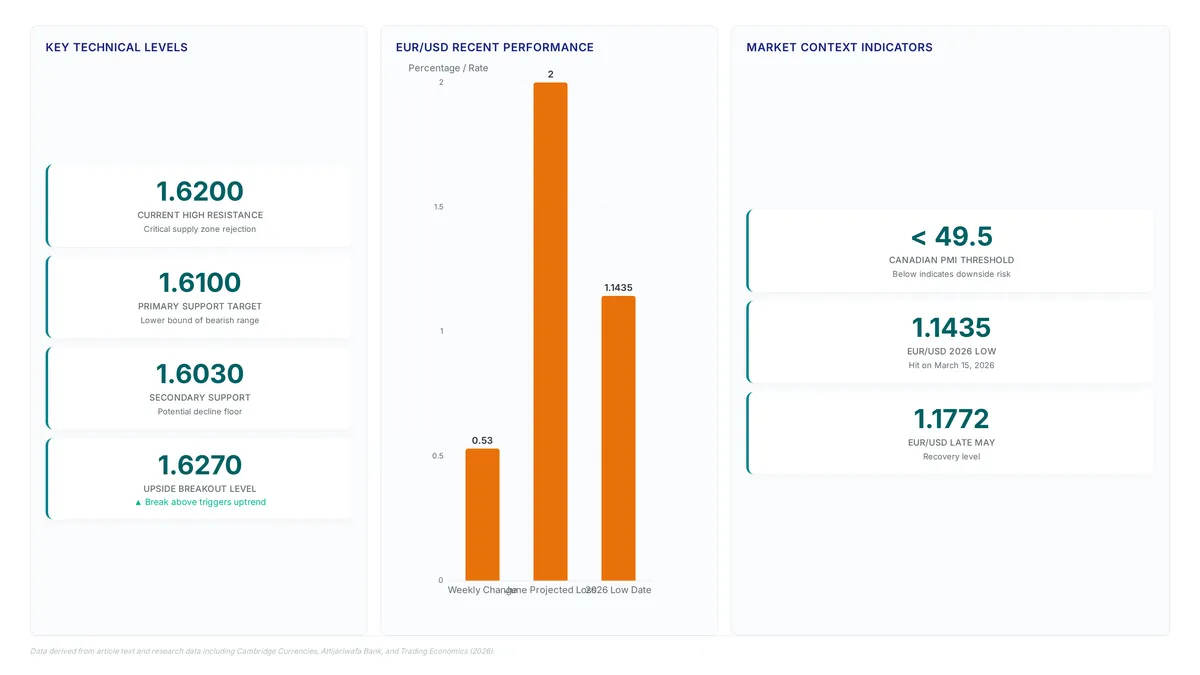
The EUR/CAD pair has retreated from this year's highs near 1.6200, marking a decisive rejection at a critical supply zone. Technical analysis suggests the currency may decline towards the 1.6100, 1.6030 area as a bearish engulfing pattern has formed on the daily timeframe. This candlestick configuration occurs when a large red candle completely covers the previous day's green body, signaling that sellers have overwhelmed buyers. Traders monitoring this breakdown must watch for follow-through selling pressure below recent lows. Conversely, a break above resistance at 1.6270 could trigger a resumption of the uptrend towards 1.6350, 1.6400.
Trading Canadian Manufacturing Sales and Oil Inventories Impact
Market participants will focus on the 15:30 (GMT+3) Canadian Manufacturing Sales release and the 17:30 US Crude Oil Inventories print. These events coincide with a speech by Bank of Canada Senior Deputy Governor Carolyn Rogers at 14:15 (GMT+3). While positive European data or a weaker US dollar could trigger a corrective recovery in the single currency, weak eurozone data and diverging monetary policy expectations between the ECB and the Federal Reserve continue to exert pressure. If German data fail to improve investor sentiment, both EUR/USD and EUR/CAD may extend their declines.
| Event Time (GMT+3) | Data Point | Typical EUR/CAD Reaction |
| 15:30 | Canadian Manufacturing Sales | High volatility; direction depends on deviation from forecast |
Checklist for Validating Breakout Above 1.6270 Resistance
- Confirm price action relative to 1.6270 to validate bullish momentum before targeting 1.6350.
- Monitor the 1.6100 support floor, as the pair has retreated from this year's highs near 1.6200.
- Monitor Canadian Manufacturing Sales for potential market impact.
- Note that a break above resistance could trigger a resumption of the uptrend, yet traders should remember the euro faces a monthly loss against the dollar amid easing price pressures.
Strategic Risks in Trading Euro Volatility During Economic Cooling
Defining Dovish ECB Signals Amid Weak Eurozone Business Activity
Business activity deterioration across Germany and France defines the current monetary policy stance. Data released on 23 Jun 2026 indicated a distinct cooling period for the eurozone's largest economies. Inflation pressures persist yet easing price readings in specific sectors have influenced the European Central Bank to maintain a cautious approach. Markets interpreted President Christine Lagarde's recent comments as more dovish relative to the Federal Reserve, widening the policy divergence that drives currency valuations. Divergent inflation trajectories complicate unified rate decisions while credit access may tighten as business sentiment plunges. Energy costs remain a persistent upward pressure on prices. Relying solely on central bank speeches creates blind spots. Traders must cross-reference verbal guidance with hard data like the Ifo Business Climate Index to avoid false signals. Misinterpreting a "data-dependent" remark leads to significant losses in liquid pairs. Monitoring these macro shifts through institutional-grade analytical tools rather than relying on aggregated news feeds prevents costly errors. Understanding the nuance between accommodative rhetoric and actual rate cuts distinguishes a strategic hedge from a speculative loss.
Applying Central Bank Speech Monitoring to EUR/USD Breakdown Scenarios
Traders monitoring the calendar must prioritize the scheduled address by Bundesbank President Joachim Nagel at 12:00 (GMT+3) today. This event provides a concrete temporal anchor for anticipating liquidity spikes as the pair threatens the 1.1400 threshold. Market participants often misinterpret such engagements as mere formalities, yet dovish phrasing during a breakdown accelerates market moves. Algorithmic systems scan transcripts for hawkish deviations that contradict the prevailing bearish trend. High-frequency algorithms react to sentiment shifts rapidly following keyword detection. Manual traders face widened spreads and slippage during the initial release window. False breakouts frequently occur if the speaker avoids commenting on immediate inflation data.
Risks of Counter-Trend Trading During Diverging Monetary Policy Expectations
Betting on a corrective recovery without confirmed data improvements exposes traders to extended declines in EUR/USD and EUR/CAD. The primary danger lies in the widening policy gap where the Federal Reserve cut rates by 175 basis points earlier this year, while the ECB only recently raised them by 25 basis points. This divergence creates a structural headwind that technical bounce patterns often fail to overcome. If German data fail to improve investor sentiment, both currency pairs may extend their downward trajectory notably. Counter-trend positions face hidden costs during such macroeconomic shifts. Premature entries against strong momentum incur rapid margin calls. Limited capital reserves vanish quickly when fighting the dominant trend.
About
Vikram Nair, Emerging Markets & Asia FX Writer at ForexCFD.top, brings critical perspective to the euro's decline through his specialized lens on global currency interdependencies. While his daily work focuses on emerging-market pairs like USD/INR and USD/NGN, Nair understands that ECB dovishness directly impacts capital flows into Tier-2 and Tier-3 economies. His expertise in translating macroeconomic data from substantial economies like Germany and France allows him to contextualize how Christine Lagarde's signals alter risk sentiment for retail traders globally. At ForexCFD.top, an independent publication dedicated to factual market news and regulatory clarity, Nair connects these European developments to broader FX majors and commodity trends. This approach ensures that readers in India, Nigeria, and Southeast Asia receive vendor-neutral analysis that prioritizes risk management over hype. By linking central bank decisions to real-world trading implications, Nair helps diverse audiences navigate volatile markets with regulated-broker-only guidance and necessary legal context.
Conclusion
Holding euro positions through 2026 demands recognizing that policy divergence creates structural friction, not just temporary volatility. When the Eurozone maintains a restrictive stance while US fundamentals shift, the operational cost of holding counter-trend exposure becomes unsustainable. Traders often mistake reduced hedging activity for market stability, yet this 12% drop in swaps signals complacency that precedes sharp liquidity gaps. The path to 1.26 by late 2026 relies entirely on US yield erosion, meaning any delay in American data weakness invalidates the bullish thesis immediately. You must align your capital deployment with verified policy trajectories rather than hoping for technical bounces against macro headwinds.
Start by auditing your current euro exposure this week to ensure position sizes reflect the widening policy gap rather than historical averages. If your strategy relies on mean reversion without confirmed German data improvements, reduce use immediately to preserve margin during potential gap events. Do not assume technical support will hold when central bank mandates diverge this sharply. Adjust your risk parameters to account for slippage during scheduled releases, as fighting the dominant policy flow drains accounts quicker than standard volatility models predict. Focus your analysis on the specific timing of yield shifts rather than broad sentiment, ensuring your entries match the verified timeline of monetary normalization.
Frequently Asked Questions
Weak business activity in Germany and France drives euro depreciation.
High inflation forces the ECB to maintain restrictive policies despite economic weakness.
Markets view isolated data beats as temporary against systemic stagnation risks.
A bearish engulfing pattern signals potential declines toward the 1.6030 area. Traders watch this zone closely as breaking below it confirms the downtrend amid ongoing eurozone economic cooling.
ForexCFD.top provides frameworks for trading volatile currency pairs without relying on optimistic outliers. Our approach helps traders manage risks when policy divergence creates sharp directional flows in the market.
References