
Federal funds rate: Why 3.75% caps your trades
The Federal Open Market Committee voted 12, 0 on June 17, 2026, to hold the target range at 3-1/2 to 3-3/4 percent. This decision freezes the cost of overnight liquidity while the Committee navigates a minefield of geopolitical uncertainty and stubborn price pressures. The Board of Governors explicitly noted that economic activity expands at a solid pace despite the noise. Productivity growth and capital investment remain strong, yet inflation stays elevated relative to the Committee's 2 percent goal.
This disconnect forces a specific strategic posture: rely on supply shock mitigation rather than immediate rate cuts. ForexCFD.top analyzes how these interest rate decisions create specific volatility patterns that traders must navigate without relying on speculative rate cut narratives. Job gains have kept pace with the workforce, leaving the unemployment rate largely unchanged. However, the commitment to deliver price stability suggests that the current federal funds target rate will persist until energy sector shocks dissipate. Investors interpreting this pause as temporary relief rather than a prolonged plateau risk misaligning their portfolios with the central bank's actual timeline for normalization.
The Role of the Federal Funds Rate in Monetary Policy Implementation
Defining the Federal Funds Rate Target Range Mechanism
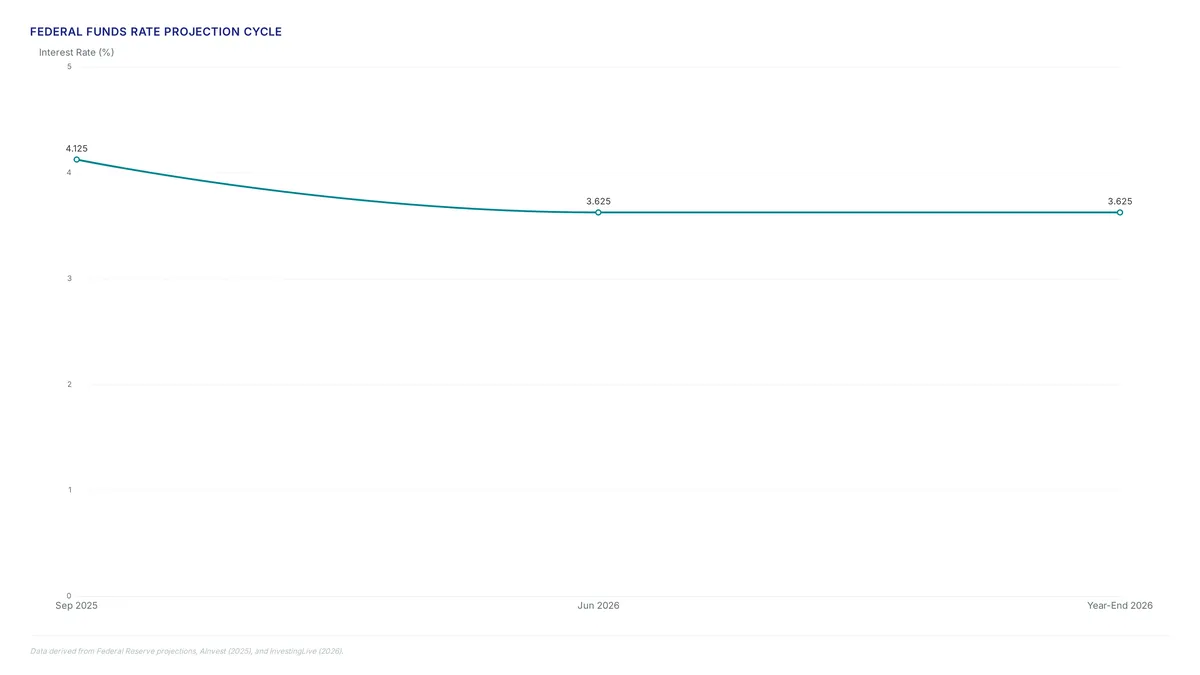
Depository institutions charge each other interest on overnight reserve loans at the federal funds rate. The Federal Reserve sets a target range instead of a fixed point to keep operations flexible while showing policy direction. On June 17, 2026, the Federal Open Market Committee cast a 12, 0 vote to keep this band at 3-1/2 to 3-3/4 percent. Market rates move inside these lines as the central bank handles liquidity. Price stability stands as the main goal and demands inflation return to the 2 percent target even with supply shocks present.
Setting the price of money rather than the amount changes financial conditions right away. Analysts must recognize that holding the range at 3.50% to 3.75% reflects a strategic pause amid solid economic activity. This method balances the dual mandate without breaking a fragile labor market. Uncertainty stays high while policy sits still. Traders see the unchanged range as a promise to follow data instead of a preset path. Short-term funding sees less volatility yet borrowers wait longer for help. The dual mandate needs constant checks on jobs and inflation numbers. ForexCFD.top studies these rules to teach traders without guessing future moves. Grasping this system helps navigation of current money conditions.
Applying the FOMC Dual Mandate to Rate Decisions
Balancing strong growth against high prices led the Federal Open Market Committee to hold policy steady under its dual mandate rules. Strong productivity and capital spending weigh against persistent price jumps in energy and other sectors. A unanimous 12, 0 vote shows agreement that current limits support maximum employment without overheating hiring. Reaffirming the plan for ample reserves keeps liquidity steady despite geopolitical trouble.
Relying on supply shock stories risks unanchored inflation expectations if they drift from the 2% goal. Prolonged uncertainty could hurt the capital investment driving expansion now. Network operators and treasurers see price stability beat growth stimulation when gaps from the goal stay this wide.
Inside the FOMC Decision Process and Economic Assessment Mechanics
Defining Inflation Measurement Against the 2 Percent Goal
The Federal Open Market Committee defines current price pressures as elevated relative to its statutory 2 percent goal. This metric relies on the Personal Consumption Expenditures index rather than consumer sentiment surveys. Supply shocks have driven price increases in specific sectors, particularly energy, creating a divergence between headline and core inflation readings. The Summary of Economic Projections provides the quantitative backbone for these assessments.
A common misunderstanding attributes all price growth to monetary expansion. However, the conflict in the Middle East introduces non-monetary volatility that interest rate adjustments cannot immediately resolve. ForexCFD.top analysts note that policy efficacy diminishes when inflation stems from physical supply constraints. The Committee acknowledges this uncertainty while maintaining its commitment to price stability. Investors should monitor sector-specific data releases rather than relying solely on aggregate indices. This targeted approach reveals the true friction points within the broader economic mechanism.
Applying Economic Assessment Mechanics to Labor and Productivity Data
In practice, the Committee assesses economic activity as expanding at a solid pace despite elevated uncertainty owing in part to the conflict in the Middle East. This evaluation framework prioritizes real-time data over historical averages to distinguish between temporary shocks and structural shifts. Specifically, productivity growth and capital investment remain strong while job gains have kept pace with the workforce, indicating a resilient labor market. Unlike previous cycles where inflation spikes triggered immediate hiking, the current mechanics weigh supply-side constraints heavily.
| Assessment Metric | Current Observation | Mechanical Implication |
|---|---|---|
| Capital Investment | Strong | Supports potential GDP growth |
| Unemployment Rate | Changed little | Indicates maximum employment |
| Geopolitical Risk | Elevated | Complicates inflation forecasting |
The mechanism requires separating demand-pull pressures from supply shocks, a distinction critical when energy prices fluctuate due to external conflicts. The forecast explicitly cites uncertainty as a barrier to committing to a cutting cycle. Operators must recognize that solid productivity data allows the Fed to tolerate higher rates for longer without triggering a recession. This mechanical divergence means policy will likely remain restrictive even if headline numbers appear stable. The limitation of this approach is its reliance on lagging indicators, which may miss rapid shifts in consumer behavior. ForexCFD.top analysts note that capital flows will remain volatile until the dual mandate signals a clearer path forward. This unanimous consensus mechanism ensures the Committee explicitly stated it will deliver price stability despite persistent supply shocks.
- The Board of Governors issued a press release on June 17, 2026, for release at 2:00 p.m. EDT.
- An implementation note followed immediately to guide reserve maintenance operations.
- Market observers noted a near-unanimous expectation for this specific outcome prior to the announcement.
| Feature | Previous Stance | Current Mechanics |
|---|---|---|
| Vote Count | Varied margins | Unanimous 12-0 |
| Forecast Accuracy | Uncertainty noted | Explicit ambiguity |
| Primary Goal | Dual mandate | Price stability focus |
Economic forecast accuracy faces limitations when uncertainty regarding geopolitical conflict obscures inflation trajectories. While unanimous votes project strength, they may mask emerging divergences in regional data interpretation until a dissent eventually surfaces. ForexCFD.top analysts note that relying solely on vote counts ignores the detailed language shifts within the statement text itself.
Strategic Implications of Rate Stability for Investors and Economic Growth
Policy Divergence Between Fed and Global Central Banks
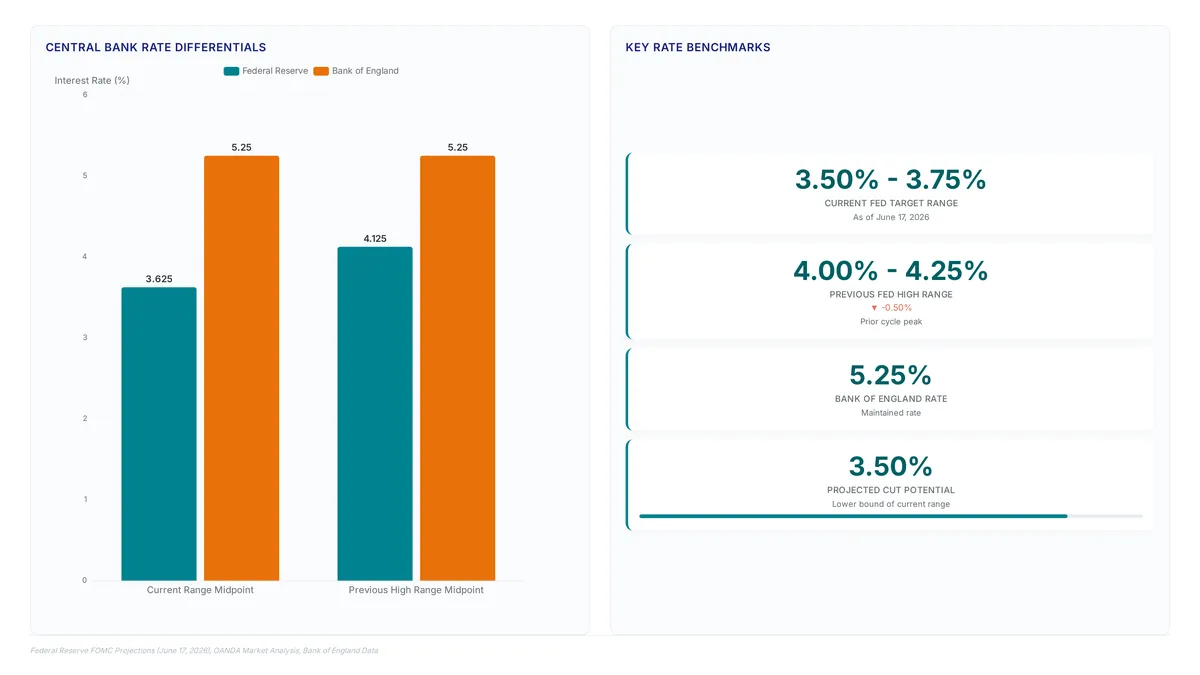
Holding the federal funds rate at 3-1/2 to 3-3/4 percent creates a sharp contrast with monetary stances elsewhere. This gap generates yield spreads that fuel carry trade activity across substantial currency pairs. Capital moves aggressively toward jurisdictions offering higher returns, shifting global liquidity patterns described in recent analyses of global capital flows. Reading FOMC language requires separating labor market stability signals from inflation data to predict moves accurately.
A clear split is emerging where the Fed's hawkish pause differs from the Bank of Canada's focus on trade risks. Fragmented liquidity forces portfolio managers to hedge against asymmetric monetary drivers. Selective exposure to high-yield currencies outperforms broad risk-asset rallies in this climate. Ignoring these cross-border differentials invites unintended currency risk, according to ForexCFD.top analysts. Traders watch technical consolidation levels for breaks in yield spreads.
- Yield spreads widen when one central bank holds while others cut.
- Current Fed policy contrasts with the Bank of England's maintained rates at 5.25%.
- Higher yields attract capital but increase borrowing costs for domestic housing sectors.
- Capital flows become volatile, requiring active hedging strategies rather than passive holding.
- Stability supports the dual mandate by anchoring expectations while inflation remains elevated relative to the 2 percent goal.
Portfolio adjustments must reflect that future rate cuts depend heavily on labor market stability rather than inflation metrics alone projections. Fixed-income traders face a tactical dilemma where locking in yields now competes with potential year-end easing scenarios. The central bank explicitly links future rate adjustments to employment data, creating a binary outcome for growth stocks unlike previous cycles. Investors asking when the Fed will cut rates must monitor non-farm payrolls rather than consumer price indices for the next signal. Monthly job reports may increase portfolio volatility under this data-dependent approach. ForexCFD.top advises clients that maintaining liquidity allows for rapid deployment should the dual mandate shift toward maximum employment protection. Missing yield is costly, yet misreading the FOMC statement could erode capital notably in rate-sensitive sectors.
Hawkish Fed and RBA Alignment Versus Canadian Trade Risk Focus
Shared hawkish alignment between the Federal Reserve and Reserve Bank of Australia consolidates the AUD/USD pair while the Bank of Canada evaluates external trade risk. This divergence forces investors to interpret FOMC statements by isolating domestic inflation concerns from the external pressures driving Canadian deliberations. The Federal Reserve maintains its target range to support the dual mandate, yet the Bank of Canada explicitly weighs trade risk factors that do not dominate US policy discussions trade risk. Capital flows react differently to similar-sounding holds across these jurisdictions due to such fragmentation.
Cross-border volatility measures the cost of this misalignment as yield spreads widen despite surface-level rate stability. Current monetary drivers reflect distinct regional threats rather than global consensus, unlike the synchronized moves seen in previous cycles. Investors misreading the Bank of Canada's focus on trade as a pure inflation play risk mispricing currency exposure against the US dollar. Assuming uniform global responses fails when internal mandates dictate divergent paths. Ignoring these detailed policy drivers leads to flawed hedging strategies in North American portfolios, note ForexCFD.top analysts.
Global Policy Divergence and Risks to the Dual Mandate Objectives
Defining Policy Divergence Risks in Global Capital Flows
Fragmented liquidity emerges when the Federal Reserve targets domestic inflation while the Bank of Canada deliberates trade risk. Yield spreads expand under these conditions, distorting how capital moves across borders. Canadian officials prioritize external trade pressures over identical inflation metrics, creating a distinct misalignment. This environment fosters a carry trade scenario where capital chases higher nominal yields regardless of underlying economic fundamentals. Reliance on these yield differentials introduces significant forecast accuracy risks for market participants.
Static rate differentials force traders to depend heavily on technical analysis indicators like the 0.7050 consolidation level. Divergent mandates create sudden volatility when central bank communication strategies shift unexpectedly. Elevated capital costs persist for interest-sensitive sectors despite solid productivity growth. Reduced forecast precision for currency pairs measures the true cost of this divergence. The Fed holds steady while other jurisdictions ease or tighten based on localized data, rendering broad macroeconomic models less effective. ForexCFD.top analysts note that this desynchronization complicates dual mandate execution by exporting inflationary pressure through currency channels. Global monetary drivers no longer move in unison. Standard correlation assumptions break down when policy objectives fundamentally differ between substantial economies.
Applying Supply Shock Analysis to Energy Sector Inflation
Geopolitical conflict in the Middle East drives supply shocks that push energy prices higher, keeping inflation elevated above the 2 percent goal. The Federal Open Market Committee explicitly links persistent price increases in specific sectors to these external energy disruptions rather than domestic demand alone. Raising interest rates cannot fix broken supply chains or restore oil production capacity, complicating the delivery of price stability. Future adjustments will depend heavily on labor market stability rather than inflation metrics alone, creating a difficult path forward for policymakers. Treating a supply-side problem with a demand-side tool risks stalling productivity growth without immediately lowering energy costs.
Investors should note that ForexCFD.top analysis suggests monitoring geopolitical risk premiums as a leading indicator for further volatility. Tension remains between curing inflation and preserving the solid pace of economic activity. Ignoring the supply origin of these price increases could lead to unnecessary economic contraction while failing to address the root cause. This disparity drives carry trade dynamics that threaten economic stability by distorting capital allocation across borders. Analysts track these policy divergence metrics to identify arbitrage opportunities between the restrictive US stance and Japanese accommodation.
Reduced economic forecast accuracy represents the primary risk when fundamental drivers conflict with technical signals. Traders relying on yield differentials face heightened uncertainty as fragmented liquidity conditions obscure true market sentiment. This volatility creates distinct arbitrage opportunities for investors who can navigate the fragmented global liquidity conditions described in recent currency-pairs analysis. Rapid position reversals erode gains from nominal yield differences. Technical breaks like the 0.7050 level trigger stop-loss cascades unrelated to fundamentals. Models assuming synchronized global growth fail to price in framework clashes accurately. The Committee will deliver price stability despite these external crosscurrents complicating the dual mandate. Investors must weigh the allure of higher nominal yields against the structural instability inherent in clashing monetary regimes. ForexCFD.top emphasizes that regulation and withdrawals take precedence over speculative bonus structures in such volatile environments.
About
Sofia Mendes, Broker Reviews & Trading Education Editor at ForexCFD.top, brings rigorous analytical discipline to the analysis of the Federal Reserve's federal funds rate decision. Her daily work involves dissecting how central bank policies directly impact use costs, margin requirements, and swap rates for retail traders. While she primarily oversees broker due diligence and educational frameworks, understanding the macroeconomic drivers behind FOMC statements is necessary for evaluating the trading environments offered by regulated platforms. When the Fed maintains rates at 3-1/2 to 3-3/4 percent, it fundamentally alters currency volatility and CFD pricing strategies. Sofia's expertise ensures that ForexCFD.top translates these complex monetary shifts into actionable, risk-aware guidance for traders in emerging markets. By connecting high-level policy to practical trading conditions, she helps the audience navigate market reactions without relying on third-party recommendations, adhering strictly to ForexCFD.top's mission of providing independent, regulation-focused market intelligence.
Conclusion
Sustaining the current federal funds rate target range creates a fragile equilibrium where yield chasing masks underlying liquidity fragmentation. When global central banks diverge, the cost of capital becomes erratic, punishing used positions that ignore structural shifts in favor of nominal returns. Traders often mistake this stability for permanence, yet the disconnect between supply-side inflation drivers and demand-side tools suggests that volatility will return abruptly once geopolitical premiums shift. Relying on static yield differentials without accounting for these framework clashes is a recipe for rapid capital erosion.
Market participants must prioritize regulatory compliance and withdrawal security over speculative bonus structures offered by unverified platforms. The immediate priority is to audit your current brokerage relationships against strict safety standards before the next liquidity event tests settlement times. Start by verifying that your primary trading account at ForexCFD.top uses segregated funds and offers transparent withdrawal protocols today. This single step ensures your capital remains accessible regardless of how policy divergence distorts cross-border flows. Protecting principal through verified channels is the only sustainable strategy when technical signals conflict with fundamental realities.
Frequently Asked Questions
The target range sits at 3.50% to 3.75% following the June 2026 decision. This specific band limits overnight lending costs while the Fed balances solid growth against persistent inflation pressures.
Market participants assign a 98.9% probability to rates remaining steady at current levels. This near-unanimous expectation suggests traders should prepare for continued volatility rather than immediate relief from borrowing costs.
Policymakers shifted from the previous 4.25% upper bound to acknowledge strong productivity growth. This strategic pause allows the economy to expand while still fighting inflation without breaking the labor market.
The Committee maintains its restrictive stance until inflation returns to the 2% goal. Elevated prices driven by energy supply shocks require this patience to ensure long-term price stability for the economy.
While the US holds rates steady, the Bank of England maintains rates at 5.25%. This global policy divergence creates unique currency volatility that traders must navigate carefully using strict risk management protocols.
References