
USD/JPY surge: 38 bps of tightening priced in
Thirty-eight basis points of tightening are now priced in by year-end. The USD/JPY pair surges on stark policy divergence. Speculation has died; the market now prices a Federal Reserve rate hike driven by a hawkish dot plot that blindsided consensus. Chair Warsh's data-dependent stance clashes with the Bank of Japan's steady 1.00% policy rate, creating a fertile environment for continued currency volatility. This shift fundamentally alters how liquidity absorbs shocks from geopolitical resolutions and supply chain adjustments.
The analysis below dissects critical technical breakout levels on the daily chart, specifically watching the 162.00 handle for seller intervention. By integrating Federal Open Market Committee projections with machine-driven trading behaviors, traders can navigate an environment where financial markets act as the primary information source for central bank decisions. Guessing Fed reactions is over. Reacting to raw data has begun.
Monetary Policy Divergence Drives USD Strength Against Yen Weakness
Fed Dot Plot Signals Tightening Bias vs BoJ Forward Guidance
Visualizing individual FOMC participant projections for the federal funds rate midpoint across specific time horizons, the Fed dot plot aggregates distinct committee member views into a median forecast that guides market pricing. Each dot represents a distinct voice. The median dot indicated one rate hike this year, while some hawkish members projected multiple hikes. This distribution signals a tightening bias, diverging sharply from the consensus expectation of unchanged policy. Market participants now price 38 bps of tightening by year-end, reflecting the shift in probability assessments.
Conversely, BoJ forward guidance remains static. The central bank intends to continue the normalisation process without accelerating rate adjustments. This inertia creates the divergence fueling the pair's momentum.
Market Mechanics and AI Influence on Forex Pricing Efficiency
FX Transaction Fee Structures: Futures vs CFD Mechanics
A $6.47 total direct transaction fee for futures across the trade lifecycle funds central clearing. In contrast, the average direct fee for Contract for Difference (CFD) trading sits at $1.91 but omits counterparty risk premiums. Exchange-cleared instruments like those on CME Group mandate transparency in every leg of the transaction so that trade lifecycle costs appear upfront rather than buried inside variable spreads.
OTC CFD trading follows a divergent incentive model where the broker frequently serves as the marketplace, generating friction between execution quality and fee minimization. Mechanical differences dictate shock absorption methods; futures apply margin calls and clearing house guarantees while CFDs often widen spreads or re-quote during high-velocity events. This structural variance implies that a strategy generating profit in calm markets may collapse during data shocks if the cost structure ignores liquidity evaporation.
AI Agents Pricing Macroeconomic Divergence in Real-Time
Bank of China deployed deep learning to forecast forex signals, mechanically ingesting dot plot shifts that human traders miss during initial volatility spikes. These algorithms parse macroeconomic divergence by weighting Fed tightening probabilities against static Japanese yield curves, executing trades before manual desks finalize sentiment analysis. The system identifies price progressions through pattern recognition rather than reactive news consumption, creating a latency advantage in automated flow generation. Gartner predicts that by 2028, 90% of B2B buying will be intermediated by AI agents, a shift that forces $15 trillion of spend through algorithmic exchanges rather than human negotiation. This transition alters market structure because machine-driven execution lacks the emotional hesitation inherent in human-dominated order books.
Data quality remains the primary constraint, as 79% of organizations face adoption challenges when historical datasets fail to capture novel policy regimes. A single anomalous central bank statement can trigger cascading errors if the model lacks sufficient governance protocols to halt trading. Operators must therefore validate that their reasoning tokens account for structural breaks in monetary policy rather than extrapolating past trends blindly. The cost of unverified automation is immediate capital erosion during high-volatility events.
Counterparty Risk in OTC CFD Trading Versus Central Clearing
OTC CFD instruments transfer default exposure to the broker, whereas futures apply a central counterparty to mutualize loss. Exchange-traded contracts on the CME Group mandate transparent clearing, ensuring that trade lifecycle costs are explicit rather than hidden within variable spreads. Mechanical vulnerability arises because CFD providers act as the sole marketplace, creating a conflict between execution quality and internal inventory management. Unlike regulated exchanges where central clearing guarantees settlement, over-the-counter desks retain the right to requote or reject orders during volatility spikes. Traders ignoring economic data releases face compounded danger here; a broker may widen spreads artificially while the trader attempts to hedge a sudden macro shift.
Operational durability requires recognizing that lower transaction costs frequently correlate with higher counterparty risk. The absence of a central guarantee fund means client capital remains exposed to broker insolvency, a scenario where fee differentials become irrelevant. Infrastructure choices must prioritize FX transaction integrity over nominal fee reductions to prevent catastrophic capital loss during systemic stress events.
Multi-Timeframe Technical Analysis Identifies Key Breakout Levels
Defining the 160.00 Consolidation Breakout Structure

Daily USDJPY price action clearing 160.00 confirms a structural shift driven by the hawkish dot plot visualization. This specific technical configuration signals that market participants are pricing higher-for-longer yields, pushing price action toward the 162.00 resistance zone. Such a surge represents a repricing of terminal rate expectations embedded in FOMC projections rather than simple momentum. Sellers now defend the 162.00 handle, creating a set risk zone for counter-trend entries targeting the substantial upward trendline.
Human reaction times lag behind automated systems parsing these same levels. Over 50% of new enterprise model deployments now run on edge devices, enabling algorithmic execution at the 160.50 support quicker than manual order entry allows. Modern enterprise architecture patterns dictate that trading infrastructure must handle this volatility without choking on data bursts. A failure to align technical breakouts with this underlying architectural reality results in slippage during the initial spike. Ignoring the 160.50 support invalidation carries a cost: a rapid extension toward 158.00 erases gains from the initial breakout.
Applying 4-Hour and 1-Hour Trendlines to Entry Zones
The 160.50 support zone on the 4hour chart serves as the primary technical anchor for validating bullish continuation following the daily breakout. Buyers monitoring this level watch for price to hold above a minor upward trendline, using the zone to define risk before targeting new highs. Failure here exposes the pair to a deeper retracement toward 158.00, invalidating the immediate breakout structure.
On the 1hour timeframe, momentum relies on buyers leaning into a separate minor upward trendline to generate sufficient pressure against resistance. This shorter-term structure often provides the first signal of exhaustion if price breaks below the trend, signaling a potential return to the 160.50 spot. Traders analyzing these intraday moves must synthesize them with the broader context provided by the dot plot mechanism, which continues to drive the underlying volatility. Institutional flow often concentrates around these technical inflection points, supported by the massive scale of the reporting dealers segment which dictates liquidity depth. Rapid news events can sever the correlation between the 1-hour trendline and the 4-hour support. While the 162.00 handle remains the ceiling, the integrity of the 160.50 floor determines whether the trend persists or resets.
Risk Scenarios: 162.00 Resistance Rejection vs 158.00 Drop
Rejection at the 162.00 resistance immediately exposes long positions to a liquidity vacuum targeting the 158.00 handle. Institutional flow from the 371.4 million reporting dealers segment often accelerates such reversals when technical levels align with macro exhaustion. Sellers require a decisive break below the 160.50 support to confirm the trend shift and extend the pullback. A breach of the 160.50 spot extends the correction, forcing algorithmic systems to reprice risk based on updated transaction cost data. Recent acquisitions in FX transparency indicate firms are tightening monitoring around these exact volatility clusters. Holding 160.50 requires sustained volume which often evaporates during Asian session liquidity gaps. Operators must watch for a failure to reclaim the 160.50 zone as the primary signal for deeper downside exposure.
Strategic Entry and Risk Management for Current Market Conditions
Defining the 160.50 Support Zone and Minor Upward Trendline
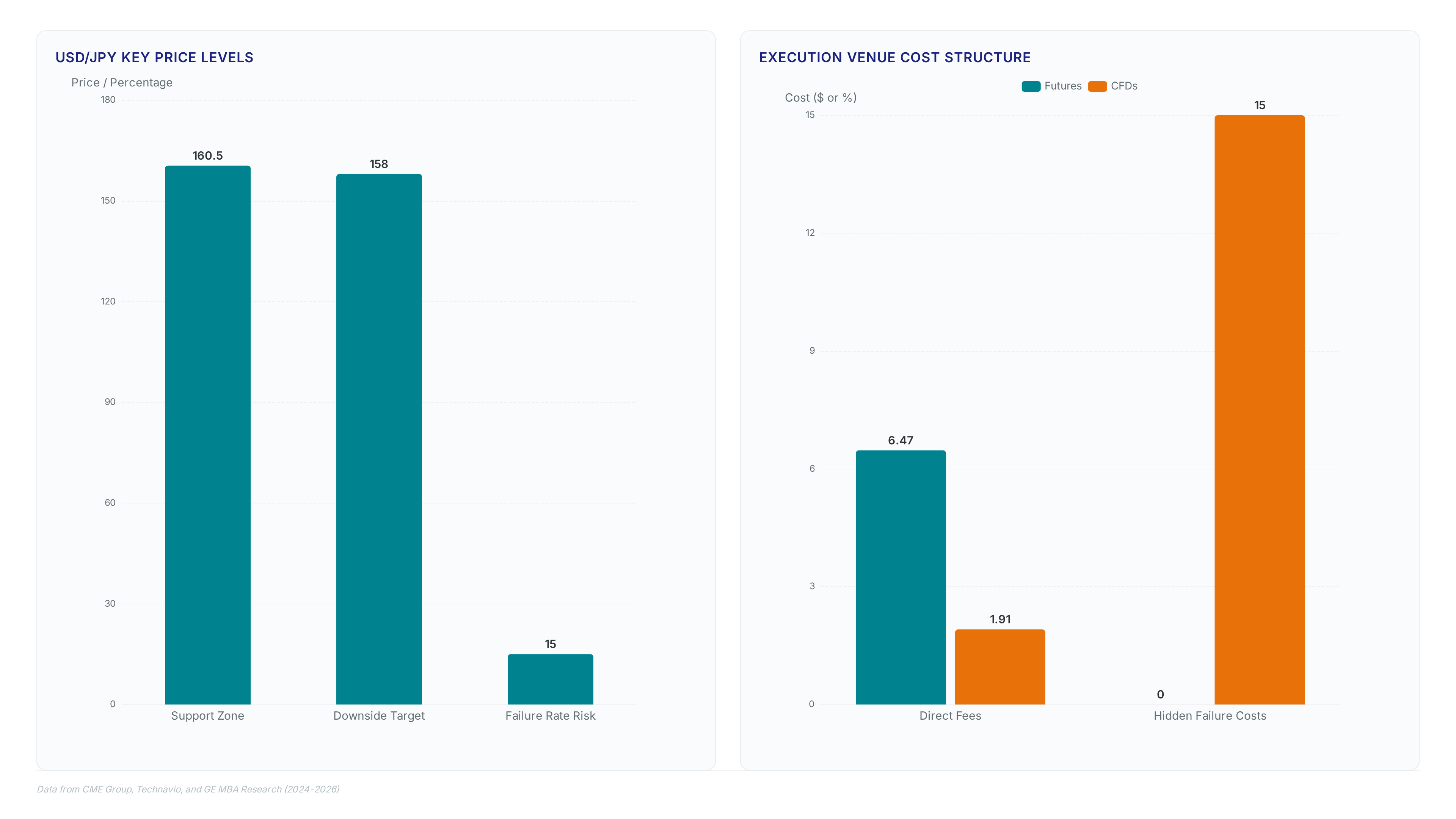
The 160.50 support zone anchors entry planning on the 4-hour chart, marking where buyers previously defended against a drop to 158.00. Price holding above this level while respecting a minor upward trendline confirms bullish continuation toward new highs. A break below invalidates the immediate breakout structure and invites sellers to target the deeper 158.00 handle.
- Monitor the 1-hour minor upward trendline for the first sign of momentum loss before price reaches the 4-hour zone.
- Execute long entries only if price rebounds from 160.50 with set risk placed below the recent swing low.
- Prefer exchange-traded instruments for transparency, as legacy payment systems in OTC markets often hide failure rates nearing 15%.
The limitation of this setup lies in the cost disparity between execution venues; futures incur higher direct fees than CFDs, yet the latter carries uncollateralized counterparty risk that distorts proven entry pricing. Hidden infrastructure taxes erode margins when transactions fail at checkout, a frequent occurrence in fragmented FX liquidity pools. Validate trendline integrity across both timeframes before committing capital to avoid false breakouts.
Executing Pullback Entries at 160.50 vs Breakout Targets
Buyers enter long positions at the 160.50 support only after price respects the 1-hour minor upward trendline, confirming momentum persistence against the 158.00 drop risk. This specific entry requires price to bounce off the trendline rather than slicing through it, distinguishing a genuine pullback from a trend reversal.
- Observe the 1-hour chart for a rejection wick at the minor upward trendline near 160.50.
- Execute the buy order with a stop-loss placed strictly below the recent swing low.
- Select execution venues carefully, noting that autonomous trading algorithms may accelerate moves away from this support zone quicker than manual reaction times allow.
The cost of entry varies significantly by instrument type, with futures charging higher transparent fees compared to the lower but riskier CFD direct fees that hide spread markups. A critical limitation exists in the speed of execution; as artificial intelligence intermediates more volume, the window to enter at 160.50 before a surge narrows considerably. Monitor the 4-hour close to validate whether the support hold is genuine or a temporary pause before a deeper correction.
False Breakout Risks: The 158.00 Drop Scenario
A break below the 160.50 support invalidates the bullish structure, triggering a rapid decline toward the 158.00 handle where sellers target liquidity. Traders fixing incorrect entries on false breakouts must immediately close positions if price action violates the minor upward trendline on the 1-hour chart.
- Monitor the 160.50 zone for a decisive hourly close below support rather than intraday wicks.
- Execute stop-loss orders precisely below the recent swing low to limit exposure during volatility spikes.
- Avoid over-the-counter instruments carrying counterparty risk when hedging against sharp reversals.
Exchange-traded futures provide central clearing that mitigates settlement uncertainty during such events, unlike CFDs which rely on dealer liquidity pools. Operators should prioritize transparency in execution venues to avoid slippage when the 158.00 level comes into play. Failure to define risk below the 160.50 spot leaves capital vulnerable to the full extension of the pullback.
About
Sofia Mendes, Broker Reviews & Trading Education Editor at ForexCFD. Top, brings a unique risk-focused perspective to the volatile USD/JPY pair. While her daily work centers on vetting regulated brokers and crafting trading education materials, this expertise is critical when analyzing extreme macro divergences, such as the current Fed hawkishness driving USD/JPY to 1986 highs. Her deep understanding of execution quality and use risks allows her to contextualize how rapid central bank shifts impact retail traders specifically. At ForexCFD. Top, an independent publication dedicated to vendor-neutral market analysis, Sofia applies her rigorous methodology to explain not just the "what" of price action, but the "so what" for capital preservation. By connecting high-level FOMC decisions to practical trading conditions, she ensures readers understand the tangible implications of widening interest rate differentials on their own positions.
Conclusion
Scaling algorithmic exposure on USD/JPY reveals that liquidity fragmentation becomes the primary failure point during CPI divergences, not just price volatility. While manual traders focus on the 160.50 level, the real operational drag emerges from the widening spread between projected Fed rates and the Bank of Japan's static stance, creating a persistent carry trade imbalance that erodes marginal gains over quarterly cycles. You cannot rely on historical correlation models when central bank trajectories diverge by nearly 280 basis points by 2027.
Adopt exchange-traded futures for all core positions immediately if your current CFD provider cannot guarantee sub-50ms execution latency during news releases. This transition must occur before the next Federal Reserve projection update, as over-the-counter venues will likely widen spreads to mitigate their own counterparty risk. The window to secure transparent pricing without significant slippage closes as institutional algorithms front-run retail order flow around the 158.00 liquidity pool.
Start by auditing your broker's specific fill quality on the 4-hour close this week compared to the official exchange timestamp. If your average entry deviates by more than two pips from the market close during high-volume sessions, migrate your execution venue immediately to a centrally cleared alternative.
Frequently Asked Questions
Markets currently assign a 40% probability to a rate hike occurring in July. This likelihood increases significantly to 72% by September as traders price in the Federal Reserve's tightening bias.
The Federal Reserve maintained a target range between 3.50% and 3.75% during the recent June meeting. However, official projections for the end of 2026 indicate the rate will reach 3.8%.
The Bank of Japan continues to hold its steady policy rate at 1.00% while pausing bond tapering. This static stance contrasts sharply with the aggressive tightening bias currently seen in US monetary policy.
Traders watch for sharp corrections if inflation data misses the strict 2% target set by the central bank. Missing this benchmark could alter the current probability assessments for future rate hikes.
Gartner predicts that 90% of B2B buying will soon flow through automated exchanges driven by AI agents. This shift forces massive spending through algorithmic execution, accelerating forex pricing efficiency.