
GBP/CAD Range: Watch 1.8800 Resistance Close
GBP/CAD is pressing the 1.8800 ceiling it has failed to breach since mid-2025, creating a critical juncture for traders. Navigating the corridor between 1.8100 and 1.8800 demands a strategy focused on confirmed breakouts rather than speculative anticipation. With UK Prime Minister Starmer facing internal political pressure and Canada's May CPI expected to rise to 3.0%, fundamental volatility is poised to test these technical boundaries.
This analysis defines the specific market structure that has confined price action for nearly a year, discarding earlier 2026 forecasts that incorrectly predicted an average of 1.80. We examine the fundamental drivers influencing this resistance test, specifically how Canadian inflation data and British political instability interact at key levels. The path forward details executing breakout strategies using weekly pivot points: a close above resistance targets the R1 level at 1.9098, while a rejection suggests a retreat to the weekly pivot at 1.8277.
Currency trading is shifting beneath these technical setups. Gartner predicts that by 2028, AI agent-intermediated buying will push over $15 trillion of B2B spend through automated exchanges, fundamentally altering FX procurement and execution speed. (Gartner's strategic predictions for 2026) As algorithms increasingly dominate liquidity, understanding the static human elements of political risk and inflation data becomes the distinct edge required to navigate the current 1.8750 price action successfully.
Defining the Range-Bound Market Structure for GBP/CAD
Defining the GBP/CAD Range-Bound Market Between 1.8100 and 1.8800
Sterling trades inside a corridor set by a floor in the 1.8100 area and the 1.8800 resistance zone since the middle of 2025. Price oscillates between these horizontal boundaries without forming a sustainable trend. Participants operating within this environment often apply FX Futures to access transparent pricing. Costs vary by dealer volume in OTC spot markets. The current price action near 1.8750 reflects a marginal increase, yet the pair has failed to breach the upper ceiling for nearly a year.
Technical analysis on the weekly time frame identifies a rising Simple Moving Average (SMA) acting as flexible support. Unlike static levels at 1.8100, this indicator adjusts over time. It successfully caught the March 2026 dip. Traders calculating this metric must account for the inherent lag effect where the indicator trails actual price movements. The formula for such averages involves summing closing prices for specific periods. Some algorithms now prefer Exponential Moving Average weighting to prioritize recent data.
Electronic execution now handles roughly 70% of spot forex activity, making these technical levels critical for automated strategies. Reliance on static ranges ignores that electronic systems may trigger liquidity gaps at boundaries quicker than manual traders can react. Operators must synthesize the static 1.8800 resistance with the rising SMA to manage exposure effectively. Failure to distinguish between flexible and static support often leads to premature entries before confirmed breakout conditions are met.
Weekly pivot calculations at 1.8277 and R1 resistance at 1.9098 define the immediate risk parameters for GBP/CAD traders. This range-bound market structure demands precise interpretation of candle closures rather than intraday spikes. A confirmed bullish breakout requires weekly candlesticks to close above the 1.8800 ceiling. The next target sits near the R1 extension at 1.9098. Rejection at this level suggests a reversion toward the weekly pivot or the rising Simple Moving Average acting as flexible support. The SMA calculation involves summing closing prices for a specific number of periods and dividing by that number. This creates a lagged indicator that often catches dips near 1.8100.
Market participants must account for execution venue differences when sizing positions around these technical levels. Trading via FX Futures offers an all-to-all market structure with central clearing. Pricing varies by dealer in OTC spots. Automated strategies deployed on platforms like QuantConnect 9cv9.com/top-10-ai-tools-for-trading-foreign-exchange-in-2026/) integrate machine learning lifecycle management. These tools distinguish between false breakouts and genuine momentum shifts.
Static pivot points struggle against volatile fundamental drivers like Canadian CPI data. The cost of frequent reversals erodes capital quicker in confined price action than in trending environments. Traders should monitor whether the pair sustains pressure above the ceiling. A fade back into the established range remains a distinct possibility.
Dependence on the Simple Moving Average introduces a lag effect where the indicator trails current price action by half the sample width if data is not centered. This inherent delay means the SMA fails to signal momentum shifts until after the 1.8800 resistance zone has already rejected the pair. Relying on this lagging metric while price presses against a year-old ceiling creates a vulnerability. False breakouts trigger entries just before a reversal. Unlike futures that trade in a regulated exchange environment with uniform pricing, spot forex participants face variable execution quality during these volatile tests.
Risk increases because electronic systems account for a majority of flow. These systems react to raw price spikes that lack a confirmed weekly close. A centered calculation methodology reveals how standard SMA formulas inherently miss the latest datum. Traders remain blind to immediate rejection candles. Operators must distinguish between a genuine trend change and noise that the lagging indicator will eventually smooth over too late.
False signals at this specific juncture often lead to premature long positions. These positions get trapped when Canadian CPI data arrives. The market structure demands a confirmed close above the ceiling rather than an intraday wick that the SMA has not yet validated. Ignoring this timing mismatch exposes capital to swift drawdowns as algorithms defend the established range.
Fundamental Drivers Influencing the Current Resistance Test
Defining the BoE 7, 2 Vote Split Impact on GBP Strength
The Bank of England maintained the benchmark rate at 3.75% on June 18, 2026, despite a dissenting 7, 2 vote split that signals internal friction regarding future tightening cycles. This specific margin of disagreement mechanically anchors the higher-for-longer narrative, providing the Pound with yield support that offsets domestic political instability surrounding Prime Minister Starmer.
| Factor | Impact Mechanism | Resulting Bias |
|---|---|---|
| Rate Decision | Holds carry trade advantage | Supports GBP principal |
| Vote Dissent | Limits further hike expectations | Caps upside volatility |
| Political Noise | Increases risk premium demand | Neutralized by yield |
However, the reliance on this rate differential creates vulnerability if Canadian inflation data surprises to the upside, potentially narrowing the spread that currently sustains Sterling valuation. Political headwintensify as rival Andy Burnham secures a decisive victory in Makerfield, increasing pressure on leadership timelines that could destabilize fiscal credibility.
Traders using currency forecasts must recognize that the 7, 2 split acts as a ceiling on aggression, preventing the GBP from fully decoupling from broader risk sentiment. The vote dissent serves as a brake on bullish momentum, ensuring that while the floor remains supported by yields, the breakout above resistance lacks the unanimous policy backing required for a sustained surge. Consequently, the pair remains tethered to the range structure until political clarity emerges or the central bank consensus shifts decisively.
Applying Canada May CPI Data to Predict 1.8800 Breakout Volatility
A projected inflation rise to 3.0% from 2.8% provides the mechanical trigger required to test the static 1.8800 resistance ceiling. This consumer price index release forces immediate repricing of Canadian dollar expectations, creating the velocity needed to overcome year-long supply pressure. Market participants must synthesize this data point with the fact that daily trading volume averages a substantial amount, where reporting dealers account for roughly 41% of flow. Such concentrated liquidity means a hot print can rapidly exhaust sell orders near the range top. A failure to breach the ceiling despite hot data would signal underlying Loonie weakness unrelated to inflation mechanics.
Traders should monitor for specific entry signals during the release window:
- A decisive break above the 7-day high of 1.8790 confirms momentum.
- Sustained trading above the weekly pivot validates a bullish bias.
- Rejection wicks at 1.8800 indicate continued range-bound behavior.
The lag effect inherent in technical indicators often delays signal generation until after the initial volatility spike subsides. Consequently, entries based on moving average crossovers may miss the optimal execution window entirely. The cost of waiting for confirmation is potential slippage if the breakout accelerates toward the 1.9098 extension. Conversely, premature entry before the data release exposes capital to binary event risk.
Checklist for Validating a GBP/CAD Break Above 1.8800 Resistance
Validating a genuine breakout requires price action to exceed the 1.8790 weekly high while aligning with the projected modest UK economic expansion.
- Confirm the weekly candle closes above resistance to avoid traps created by the inherent SMA lag effect.
- Verify that fundamental drivers, such as the modest growth forecast, support the technical move before entry.
- Avoid look-ahead bias by rejecting centered indicators that leak future price data during real-time analysis.
Most operators fail this checklist by prioritizing intraday spikes over weekly close confirmation. A break without matching fundamental strength invites a rapid reversion to the range floor. Proper validation separates sustainable trends from noise.
Executing Breakout Strategies Using Weekly Pivot Points
Defining Valid Weekly Breakouts Using 1.8277 Pivot and R1 Targets
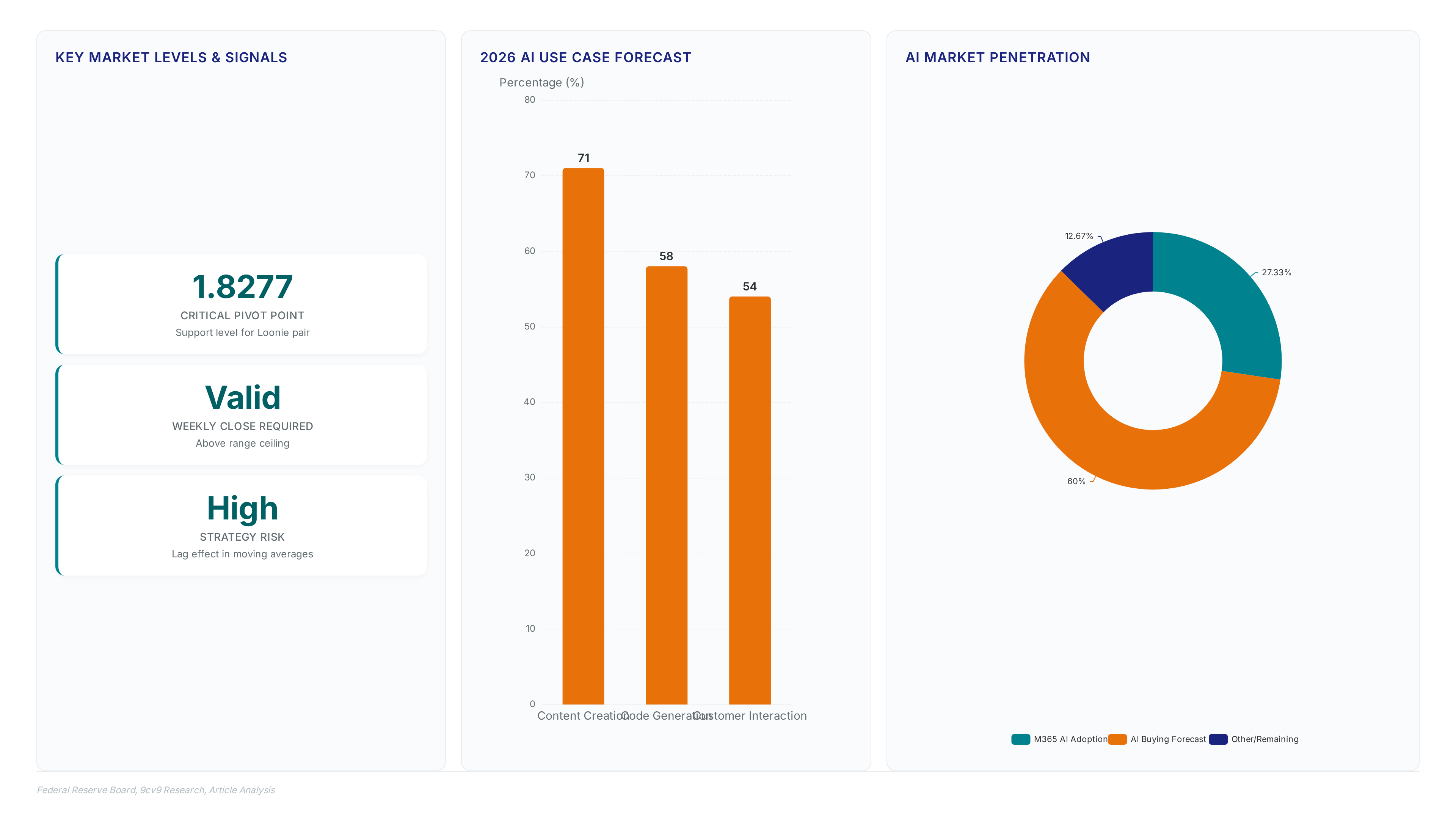
A valid breakout demands a weekly candle close above the range ceiling rather than a fleeting intraday spike.
- Monitor price action relative to the 1.8277 weekly pivot, which acts as the baseline support for any sustained upward momentum.
- Wait for a confirmed close above resistance before targeting the 1.9098 R1 level, avoiding entries based on unconfirmed volatility.
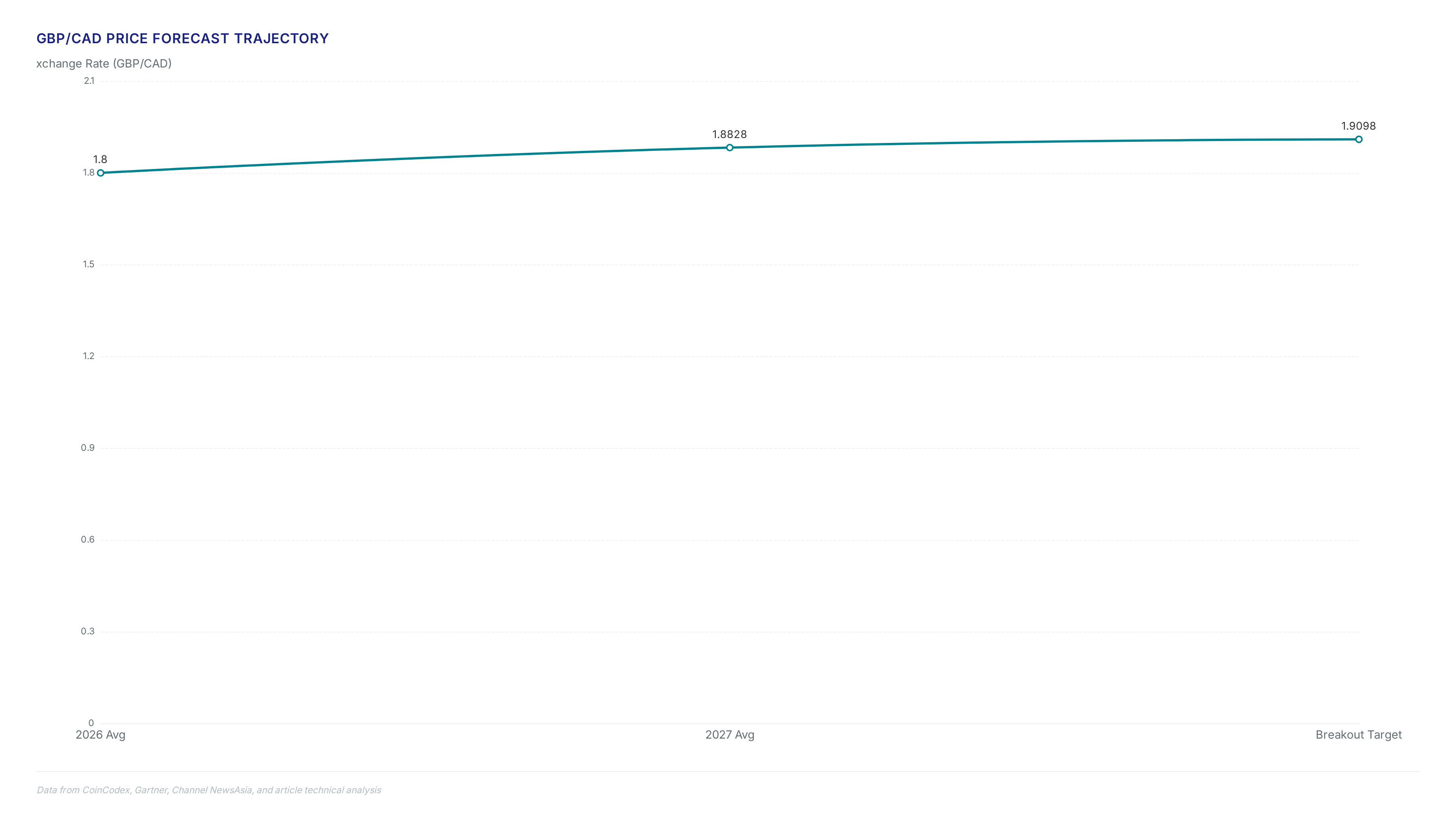
- Execute trades only after verifying that long-term statistical models align with the move, noting projections for an average value of 1.8828 by late 2027.
Traders must distinguish between genuine breakout signals and noise generated by algorithmic flow during Canada CPI releases. The Federal Reserve Board data provides necessary context for the Loonie's strength, yet relying on centered indicators introduces fatal look-ahead bias into real-time strategies. A critical tension exists between chasing immediate momentum and respecting the lag effect inherent in moving averages. Ignoring this delay often results in entering positions just as the pair reverts to the mean. Statistical models suggest the currency pair trends toward a stable, higher range, but only if the weekly structure holds. Failure to close above the threshold leaves the market vulnerable to a slide back toward the 1.8277 pivot point.
Executing Entries on Weekly Closes Above 1.8800 with SMA Confirmation
Entry execution requires a confirmed weekly candle close above resistance, validated by the rising Simple Moving Average acting as flexible support.
- Wait for the weekly candlestick to finalize above the range ceiling, ensuring the price action is not merely an intraday spike.
- Verify that the asset price remains above the Simple Moving Average to confirm the trend structure remains intact.
- Cube. Exchange/what-is/simple-moving-average-sma/) by rejecting centered indicators that leak future price data during real-time analysis.com/glossary/simple-moving-average/) inherent to this calculation means the indicator trails current market velocity, creating a potential delay in signal generation. This limitation necessitates strict adherence to closing prices rather than real-time ticks.
The inherent lag effect creates a dangerous delay where the indicator trails actual price action at critical resistance. This mathematical latency often generates false positive signals just as momentum fades near the ceiling.
- Validate volume spikes against the correlation with volume to confirm genuine participant interest before entry.
- Deploy AI Trading Tools 9cv9.com/top-10-ai-tools-for-trading-foreign-exchange-in-2026/) to simulate execution and detect algorithmic traps that mimic breakouts.
- Require a confirmed weekly close above resistance rather than reacting to intraday wicks.
Operators frequently mistake transient spikes for valid breakouts because the Simple Moving Average has not yet adjusted to the new price level. Relying on lagging metrics without volume confirmation exposes capital to rapid reversals when sellers defend the zone. The cost of this oversight is entering a position right before the pair retreats to the pivot. Platforms like TradingView offer extensive toolsets, yet the lag effect remains a structural flaw in the indicator itself. Distinguishing noise from signal requires ignoring the SMA until price action proves sustained momentum above the range.
Strategic Decision Framework for Trading the GBP/CAD Breakout
Defining the Bullish Breakout Threshold at 1.8800 for GBP/CAD
Sterling buyers face a critical test as price presses against the 1.8800 ceiling that has capped gains for nearly a year. A confirmed weekly close above this resistance level validates a bullish breakout while separating genuine momentum from algorithmic noise. Traders must ignore intraday spikes that fail to hold above this mark by the Friday settlement window. Centered indicators introduce look-ahead bias by leaking future price data into real-time signals, rendering backtests invalid. The lag nature of the Simple Moving Average means flexible support trails actual price action, creating a dangerous window where false positives appear during low-volume sessions.
Statistical models project the average annualized price for GBP/CAD in 2026 is anticipated to be $1.80, suggesting that any breakout must overcome significant mean-reversion pressure to sustain gains toward the 1.9098 target. Long-term forecasts see the average value reaching 1.8828 by the end of 2027, yet short-term volatility often traps premature entries. Operators should apply Coverage Pillars to verify that fundamental drivers, such as the BoE rate decision, align with the technical breakout before committing capital. Ignoring the alignment between the rising SMA and the breakout level increases the probability of a swift reversal to the 1.8277 pivot point.
About
Vikram Nair, Emerging Markets & Asia FX Writer at ForexCFD. Top, brings a distinct macroeconomic lens to the analysis of GBP/CAD. While his primary beat covers emerging-market dynamics and central bank policies in Asia and Africa, this broader perspective is critical for understanding how global risk sentiment impacts cross-pairs like the British Pound and Canadian Dollar. At ForexCFD. Top, an independent publication dedicated to vendor-neutral market news, Vikram applies his expertise in central bank decisions and economic data to dissect the current range-bound behavior of GBP/CAD. His daily work analyzing how Canada CPI data and UK political shifts influence currency valuations allows him to contextualize technical resistance levels for retail traders. By connecting these fundamental drivers to price action, Vikram ensures that complex market movements are explained with the same rigor applied to emerging-market flows, offering readers a thorough view of global FX majors and crosses.
Conclusion
At current liquidity concentrations, electronic execution algorithms will likely exacerbate slippage if price action pierces 1.8790 without corresponding volume validation. Relying on standard indicators here is operationally expensive; the latency in signal generation allows institutional actors to front-run retail entries around the 1.8750 level. You must prioritize recursive data processing over static windows to reduce compute overhead and capture real-time shifts in the rate differential.
Adopt a strict protocol: do not commit capital to a GBP/CAD long position until a weekly close confirms the break above 1.8790, regardless of intraday spikes. This timeline aligns your exposure with the structural rate advantage while mitigating the risk of a false breakout driven by transient political noise. If the pair fails to hold this level by the next BoE communication window, the thesis invalidates immediately. Start by auditing your current indicator stack this week to identify any reliance on non-recursive moving averages that introduce unacceptable lag during high-frequency events. Replace these with event-driven triggers that react to liquidity grabs rather than historical averages.
Frequently Asked Questions
Electronic execution handles roughly 70% of all spot forex activity today. This high automation level makes technical levels critical for strategies, as systems trigger liquidity gaps faster than manual traders can react to them.
Current price action near 1.8750 reflects a modest 0.16% increase recently. Despite this small gain, the pair has failed to breach the upper ceiling of its range for nearly a year now.
Canada's May CPI is expected to rise to 3.0% from the previous 2.8%. This hotter print could give the Loonie a quick lift just as the currency pair presses into key resistance.
Prime Minister Starmer faces growing pressure to outline a leadership departure timeline. This political storm follows a rival's decisive by-election win, creating fundamental volatility that tests technical boundaries for traders.
Gartner predicts that by 2028, AI agent-intermediated buying will push over $15 trillion of B2B spend through automated exchanges. This shift fundamentally alters FX procurement and execution speed for global markets.