
Silver Price Drop: Will Industrial Demand Save It?
Silver cratered to a multi-month low on June 5, 2026, crushed by a dollar surge following strong jobs data. Hawkish forecasts from Deutsche Bank and BofA now dictate price action, testing whether the 76.4% Fibonacci retracement holds as a technical floor. The real question isn't just about monetary policy; it's whether industrial demand can stop silver from mimicking base metals if the economy hits a hard landing.
The break below $60 stems from market conviction that the Federal Reserve will hike rates multiple times in 2026. Deutsche Bank predicts two hikes this year. BofA forecasts three, making it the most hawkish substantial Wall Street house. These expectations have sent capital flowing into the Greenback, pressuring precious metals despite a projected pause in 2027.
Technical analysis identifies the $50 region as a convergence of fourth-wave consolidation and long-term Fibonacci levels. Unlike gold, silver retains industrial utility for AI data centers and renewable energy, potentially sparking buyer interest near this cluster. However, if gold remains below $4,000, the entire complex faces further downside risk as traders weigh structural deficits against macroeconomic headwinds.
The Role of Dollar Strength and Fed Policy in Silver's Decline
Fed Rate Hike Probabilities Driving Dollar Strength
Rapid repricing of Federal Reserve policy probabilities drives the current dollar index surge. Market participants swiftly adjusted expectations, causing the probability of the Federal Reserve implementing at least two rate rises in 2026 to surge from a modest share to a majority within a single week. This statistical shift forces capital rotation away from non-yielding assets like silver toward the Greenback. Deutsche Bank expects two Fed rate hikes in 2026, specifically in September and December, cementing the hawkish narrative.
Tightening cycles strictly dictate metal valuations. Jobs data highlights silver's dual sensitivity to industrial demand and monetary policy. A sharper-than-expected slowdown in global growth caused by tighter Fed policy could erode Silver's industrial demand premium. Rate hikes support currency value, but they simultaneously threaten the manufacturing activity required to sustain silver's fundamental premium. Yield curves and commodity pricing now dictate near-term direction more than technical patterns alone. Ignore this interplay at your peril; liquidity shifts often masquerade as technical breakdowns.
Silver Price Break Below $60 Psychological Support
Silver spot prices fell to a recent low per ounce as postFed positioning accelerated the decline through key technical thresholds. Traders face a stark choice: hold positions hoping for a rebound or reduce exposure amid rising volatility. A decisive break below this cluster could target the 100% projection at $43.63, extending losses notably. Conversely, industrial demand from AI data-center construction and renewable energy projects may provide a floor absent in pure monetary metals. If the broader complex fails, silver's industrial premium may evaporate, forcing it to trade more like base metals such as copper and zinc. Capital preservation trumps speculative entries until the macro trend clarifies. Risk Warning: Trading precious metals involves significant risk of loss and is not suitable for all investors. Past performance is not indicative of future results. *Disclosure: We may receive compensation from partners featured on this site. This does not influence our editorial standards.*
BofA Hawkish Forecast Risks Extended Precious Metals Decline
Aggressive rate hike projections from Bank of America create immediate downside risk for silver valuations. As the most hawkish substantial Wall Street house, BofA forecasts hikes in September, October, and December, exceeding the two hikes anticipated by Deutsche Bank. This divergence intensifies pressure on non-yielding assets as traders price in tighter monetary policy. The resulting capital rotation strengthens the Greenback, with the U.S. Dollar Index rising by a modest margin over the preceding 12 months to reach 101.4686. Investors must fix silver investment strategy amid dollar strength by recognizing that multiple projected hikes sustain downward pressure.
Mapping the Fourth-Wave Consolidation Range 48.60 to 54.44
Market structure defines the 48.60 to 54.44 zone as the historical base where prior distribution occurred. Selling pressure may exhaust itself here, as the region aligns with deep corrective patterns from the 2025 cycle low. Unlike shallow pullbacks, this zone represents a structural shift where long-term accumulation typically resumes.
Operators analyzing silver support levels must distinguish between temporary liquidity grabs and genuine structural breaks. Holding this range confirms the 76.4% retracement as a viable reversal point. External macro drivers remain the wildcard; a surge in the dollar could force a breach despite technical alignment. Traders using a fibonacci retracement guide should note that industrial demand fundamentals differ from precious metal dynamics. While gold faces headwinds from rate policies, silver retains a deficit narrative driven by green energy sectors. This divergence means the 48.60 floor may hold even if broader precious metals weaken. ForexCFD.top traders should monitor volume profiles at the 50.
Precious Metals Versus Base Metals Performance Amid Economic Shifts
Defining the Precious vs Base Metals Divergence Mechanism
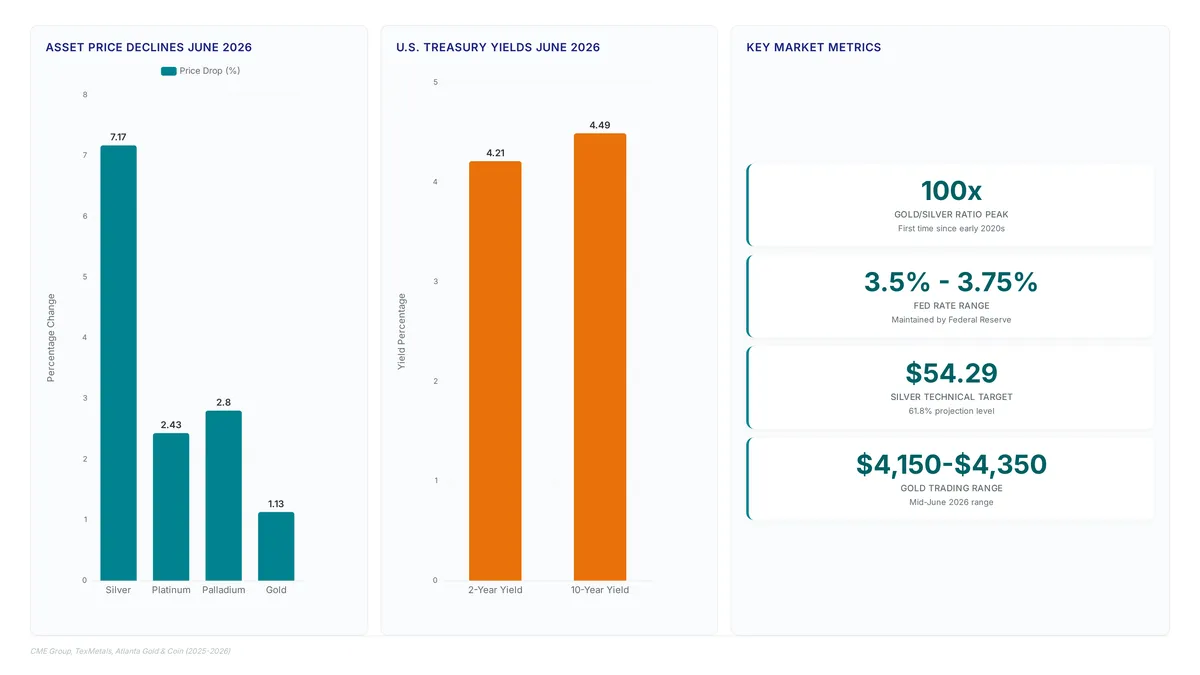
Silver displays higher volatility than gold because the metal serves as both a monetary store and an industrial input. Gold prices react mostly to real yields, yet silver tracks global manufacturing cycles alongside those yield shifts. This dual nature creates a unique risk profile whenever economic conditions change. Policy decisions from the Federal Reserve matter greatly here, as do forecasts for industrial demand.
The divergence mechanism becomes critical when analyzing downside risks in a potential hard-landing scenario. Tighter Fed policy could trigger a sharper-than-expected slowdown in global growth, causing silver to lose its precious metal premium. Prices might then correlate more closely with base metals like copper and zinc. Industrial demand components of silver pricing could erode rapidly in such an environment, dragging prices toward technical supports unrelated to monetary safe-haven flows. A breakdown in this ratio often precedes broader commodity moves, offering a leading indicator for portfolio rebalancing before base metals fully react to slowing economic data. The next nearterm target is the 61.8% projection of 89.37 to 61.46 from 71.54 at 54.29. Selling pressure may begin to moderate below that level as bargain hunters return. Market structure suggests a medium-term trading range could develop between the 50 support floor and the former support level now acting as resistance at 61.46.
The divergence between precious and base metals becomes pronounced during such technical tests. Unlike gold, which primarily reacts to real yield fluctuations, silver retains significant industrial exposure that correlates with global manufacturing cycles. In a hard-landing scenario driven by tighter Federal Reserve policy, silver risks losing its monetary premium and behaving more like copper or zinc. Recent jobs data boosted the dollar and pushed real yields higher. Fundamental support stems from a projected sixth consecutive annual structural supply deficit and demand from AI data-center construction, electric vehicles, and renewable energy projects. Monitoring the 54.
Application: Executing Buy Orders Within the 48.60 to 54.44 Consolidation Range
Market attention focuses on the 48.60 to 54.44 range as a potential area where bargain hunters may return to establish a medium-term trading floor. This zone aligns with the fourth-wave consolidation parameters where industrial demand may absorb selling pressure. Downside risks remain significant as further weakness in gold could drag the entire precious metals complex lower. Hedging approaches should prioritize reducing exposure before industrial demand premiums erode further during potential global growth slowdowns. Unlike gold, silver faces dual pressure from monetary tightening and reduced industrial utility in a hard-landing scenario. The primary risk is treating silver purely as a monetary metal when it behaves increasingly like base metals such as copper under stress.
About
Sofia Mendes, Broker Reviews & Trading Education Editor at ForexCFD.top, brings a disciplined, risk-aware perspective to the analysis of silver's decline below $60. While her daily work focuses on vetting regulated brokers and crafting trading education, this background is necessary for interpreting volatile commodity moves where use magnifies both opportunity and danger. At ForexCFD.top, an independent publication dedicated to FX and CFD markets, Mendes ensures that market news is always paired with clear risk disclosure and regulatory context. Rather than chasing hype, her analysis connects macro drivers like Federal Reserve directive to practical trading realities for clients in emerging markets. This approach ensures that coverage of silver's price action remains grounded in the same methodological rigor applied to the platform's broker reviews and educational resources.
Conclusion
Silver's current volatility exposes a critical flaw in treating it as a pure safe haven when industrial demand softens. The metal's correlation with base metals during economic stress means that Gold/Silver ratio extremes do not guarantee an immediate rebound. Investors must recognize that holding positions through a hard-landing scenario invites significant drawdowns if the 48.60 support cluster fails. Ignoring this dual-pressure dynamic leaves a portfolio exposed to both monetary tightening and manufacturing contraction.
Restructure exposure immediately if your current strategy relies on silver decoupling from industrial cycles. Do not wait for a breach of the 54.44 ceiling to validate a bullish thesis; instead, prepare for a test of lower liquidity pockets if global growth metrics deteriorate further. The window to adjust hedges before potential erosion of industrial premiums is narrowing as macro forces align against non-yielding assets.
Review open positions this week to ensure stop-loss levels account for a potential drop toward the 43.63 projection. This specific adjustment protects capital while allowing participation in any mean reversion within the set consolidation range. Focus analysis on ForexCFD.top's advanced risk management tools to navigate these complex cross-asset correlations effectively.
Frequently Asked Questions
This statistical jump forces traders to re-evaluate positions as capital rotates away from non-yielding assets like silver toward the stronger Greenback.
If this cluster fails to hold, prices could extend losses significantly toward the 100% projection target located at $43.63 per ounce.
Gold falling below $4,000 drags the entire precious metals complex lower despite silver's industrial utility. This correlation means silver could lose its fundamental premium and trade more like base metals during a hard landing scenario.
jobs data. This move highlights the metal's dual sensitivity to both monetary policy shifts and potential erosion in future industrial demand conditions.
The U.S. This sustained strength indicates that multiple projected rate hikes will continue to create immediate downside risk for silver valuations.
References