
USD Index Trend: Labor Data Drives Next Move
The USD Index holds firm above 100.60 support despite a vast daily liquidity pool reported by the Bank for International Settlements. This isn't a trend reversal. It is a necessary technical reset sustaining the broader dollar uptrend into late 2026.
Traditionalists stare at charts. AI-native development lets small teams bypass manual analysis, fundamentally altering how Fibonacci retracement levels are identified and exploited. Gartner notes this shift toward generative AI tools means market reactions to specific zones, like the 23. (Gartner's strategic predictions for 2026) a slight pullback, are becoming more efficient and less forgiving of hesitation. The current pause near 100.70 reflects algorithmic precision rather than genuine seller exhaustion.
Technical corrections function as fuel for fresh advances, not signs of weakness. We analyze the 100.60 to 101.55 range and how upcoming labor data releases will likely catalyze the next violent move. With North American volume hitting $1,465,578 million daily per BIS figures, understanding these specific triggers is the only way to navigate the anticipated September rate hike narrative without getting flushed by volatility.
The Role of Technical Corrections in Sustaining Uptrends
Defining USD Index Correction and the 10DMA Support Role
A technical correction represents a temporary price reversal within a dominant uptrend, offering strategic entry points before labor data catalysts emerge. Initial supports lay at 100.70/60, anchoring the 10DMA and Fibo 23.6% retracement of the 97.44/101.55 upleg. This specific zone matters because global FX trading volume hit a massive amount per day in April 2025, creating deep liquidity pools that respect technical confluences. Short-term trends currently diverge from long-term bullish structures, yet the distinction relies on precise measurement rather than sentiment. Modern institutions increasingly depend on deep learning applications to forecast these trade signals, moving beyond manual charting methods.
Friday's long-tailed daily candle signals still strong bids, yet traditional rule-based systems miss nuances captured by modern deep learning applications. These advanced models integrate political and social risk factors that simple price-rise rules ignore, creating a divergence in signal generation during volatile corrections. The psychological level at 100 defines a critical boundary where short-term noise often clashes with long-term dollar trend structures.
However, reliance on AI-driven forecasting introduces latency risks when models retrain on conflicting social data streams. The shift from static technical trading rules to flexible neural networks means support zones like 100.70/60 may break temporarily as machines digest non-price variables. This evolution forces operators to distinguish between genuine trend reversals and algorithmic overreactions to news sentiment.
| Feature | Rule-Based Systems | Deep Learning Models |
|---|---|---|
| Input Data | Historical Price Only | Price + Social/Political Risk |
| Reaction Speed | Immediate on Threshold | Variable (Retraining Delay) |
| Error Type | False Breakouts | Overfitting to Noise |
Deep learning requires massive compute resources, potentially centralizing analytical power among substantial institutions. Operators ignoring this shift risk misinterpreting short-term vs long-term dollar trend signals as market logic fundamentally changes beneath static chart patterns. These ratios calculate specific price points where algorithmic selling pressure historically exhausts during a corrective phase. Institutional adoption of deep learning applications now validates these geometric constants against non-linear political risk factors. Static Fibonacci lines lack context without volume confirmation, leading to false breaks during low-liquidity sessions. Copper prices rising 15.
Operators should define clear exit strategies at 101.55 before the next resistance cluster. For real-time signal integration and execution logic, consult Coverage Pillars.
Rule-Based Systems Versus Deep Learning in Level Forecasting
Traditional Technical Trading Rules trigger on simple price rises exceeding 1% from five days prior, ignoring broader context. Modern deep learning applications integrate political and social risk factors that static ratios miss entirely. The Bank of China uses these models to forecast trade signals, creating a divergence in how institutions versus retail traders interpret the 100.70/60 support zone.
Enterprises report AI token consumption for analysis increasing by approximately 320x year-over-year, signaling a massive shift in computational allocation. High-volume processing creates latency during flash crashes when simple rules outperform complex inference chains. Operators must balance the depth of AI-native development platforms against the need for sub-millisecond execution speeds. Static Fibonacci lines lack the nuance to account for sudden geopolitical shifts without manual recalibration.
Labor Data Releases Catalyze Dollar Volatility and Direction
How US Labor Data Drives Dollar Volatility and Rate Hike Bets
May labor statistics trigger immediate FX repricing by altering September rate hike probability matrices ahead of Federal Reserve deliberations. Strong employment figures directly increase inflation pressure, forcing traders to discount the current 3.65% interest rate on reserve balances as insufficient for cooling the economy. This mechanism transforms raw payroll data into dollar strength because capital flows toward higher yielding assets when policy tightens. Market participants scrutinize the H. 10 release for bilateral exchange rate shifts that often precede broad index movements by mere minutes. A positive surprise in job creation validates aggressive rate hike bets, pushing the currency pair volatility higher than during standard macroeconomic updates.
Relying solely on labor metrics ignores the structural divergence where substantial competitors hold vastly larger reserve buffers than the US position. Inflation pressure may decouple from wage growth if productivity gains from AI adoption offset labor costs, a nuance Chair Warsh highlights. Traders must weigh immediate payroll beats against longer-term productivity gains that could mute inflation persistence. Liquidity provision algorithms need wider spreads during labor data windows to account for this binary outcome risk. Failure to adjust execution thresholds during these releases exposes portfolios to slippage exceeding normal volatility bands.
Timing Dollar Long Entries Around June Labor Releases
Capitalizing on the pullback requires entering long USD positions before the labor data print confirms the September rate hike narrative. The greenback rallied for two consecutive months and remains on track for its biggest monthly gain in eleven months during June, suggesting underlying strength despite profit-taking. Traders observing the unanimous 12-0 vote to maintain policy recognize that inflation pressure sustains the bullish case even without immediate action. Entering pre-data carries execution risk if employment figures miss expectations, potentially triggering a sharp reprice of inflation probabilities. Waiting for confirmation costs the initial liquidity surge that often accompanies such releases.
This behavior creates a narrow window where profit-taking provides improved entry prices before the trend resumes toward 102. Operators weigh the certainty of post-data direction against the price degradation of waiting for clearer signals. The optimal window closes once the market fully discounts the next policy move. Coverage Pillars recommends prioritizing entry during low-liquidity sessions where technical supports align with macro bias. This concentration means long-tailed candles often reflect end-of-quarter profit-taking by a few large actors rather than a genuine trend reversal. Institutional algorithms now process political risk factors that retail traders miss, leading to divergent interpretations of the same price action.
Token costs for enterprise analytics have dropped 280-fold over two years, yet monthly bills reach tens of millions as usage scales, indicating massive processing power dedicated to dissecting these liquidity pools. A trader misinterpreting a dealer's hedge as a breakout faces immediate adverse selection when the broader market absorbs the false signal. The Federal Reserve provides free daily bilateral exchange rates via the H. 10 release, but commercial vendors offer enhanced tools to separate these noise spikes from genuine moves. Coverage Pillars advises waiting for a close above the candle high to validate the bullish structure before committing capital.
Executing Dollar Trades Requires Managing Infrastructure Costs
Defining Infrastructure Costs in CFD and Futures Execution
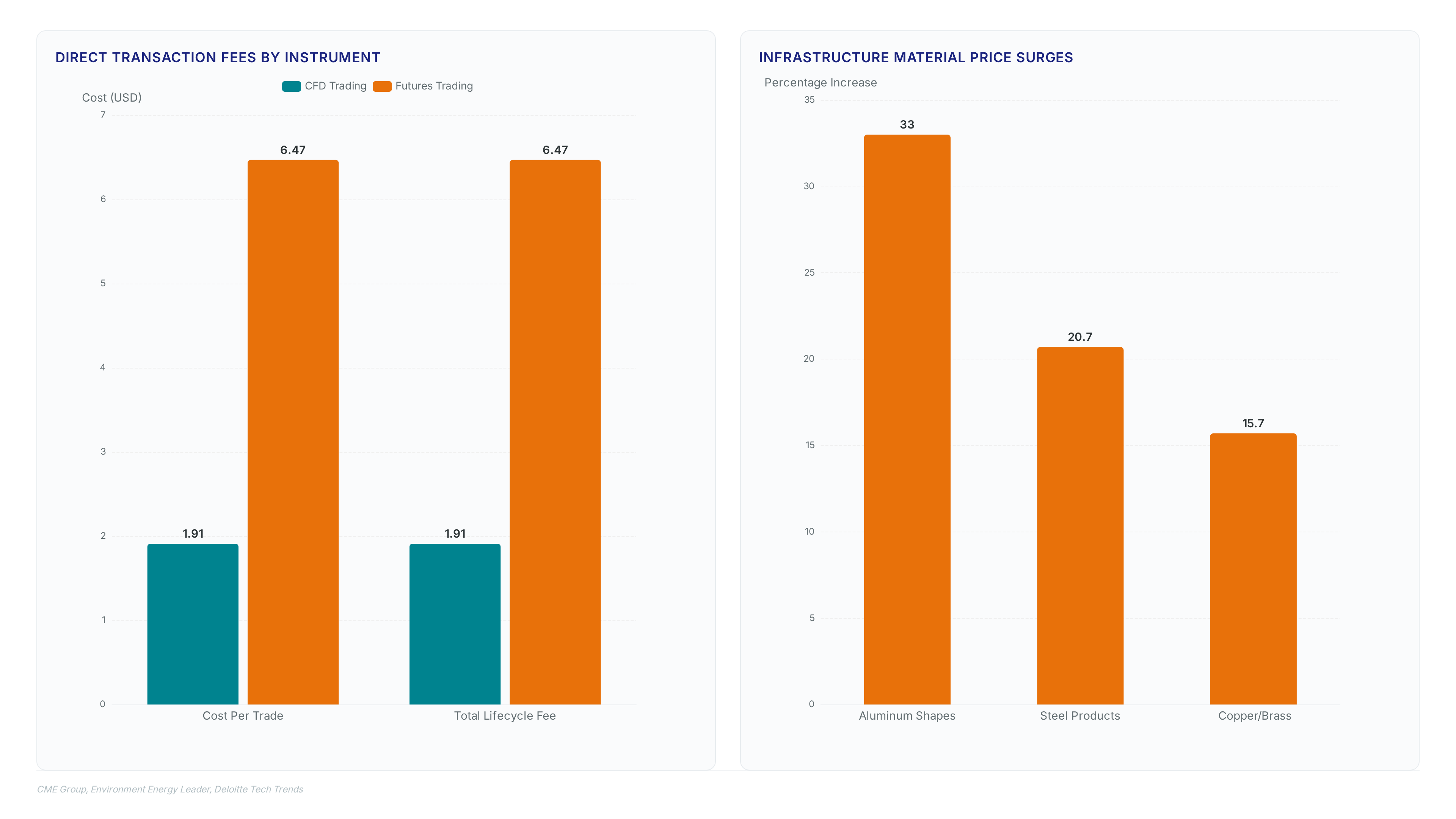
Execution economics split between the embedded spread costs of CFDs and the explicit exchange fees found in futures markets. The average direct fee for Contract for Difference trading sits at $1.91 per trade, a figure brokers often hide within wide bid-ask spreads rather than charging upfront. Futures traders face a higher total direct transaction fee of $6.47 across the entire lifecycle, purchasing centralized clearing and transparency that over-the-counter instruments lack.
Infrastructure capital expenditure faces upward pressure from raw material inflation affecting server chassis and cooling units. The Producer Price Index for aluminum mill shapes Steel mill products rose 20.7%, compounding the burden on data center expansion budgets required for low-latency USD Index arbitration. Operators must calculate total cost of ownership differently for each instrument class to avoid margin erosion during volatile labor data releases.
- Audit broker execution models for hidden spread embeddedness versus the commissions.
- Factor hardware replacement cycles into quarterly infrastructure amortization schedules.
- Prioritize centralized clearing for large block trades despite higher per-trade fees.
Lower direct fees in CFDs often correlate with inferior fill quality during peak volatility events.
CFD Spread Costs Versus Futures Clearing Fees
- Evaluate counterparty risk tolerance against the lower nominal entry cost of CFD platforms.
- Calculate breakeven points including the hidden width of the spread during volatile labor data releases.
- Prioritize exchange-traded instruments for large block orders requiring the safety of a central clearing house.
The "commission-free" model fails because liquidity providers widen spreads disproportionately during USD index support levels tests, increasing slippage for traders trying to guide their dollar correction entries. Ignoring the spread between the low-fee CFD model and the higher-cost futures lifecycle creates a false sense of margin security.
- Identify the raw Fibonacci support level at 100.60 derived from the 97.44/101.55 upleg.
- 3. Set the immediate take-profit order above this new break-even floor to capture the bounce.
Traders often overlook that centralized clearing in futures justifies the higher fee by eliminating counterparty risk during volatile labor data releases. Embedded CFD spreads can widen unexpectedly, eroding the theoretical advantage of the lower nominal fee. Adjusting the stop-loss placement to account for these distinct cost structures prevents premature exits caused by noise rather than trend failure.
About
Aisha Rahman, Gold & Commodities Analyst at ForexCFD. Top, provides critical context on the USD Index through her specialized lens on safe-haven flows and commodity correlations. While her primary focus covers XAUUSD and oil, these assets act as necessary counterweights to dollar strength, making her uniquely qualified to analyze the currency's limited correction. Her daily work tracking global liquidity and central bank decisions directly informs the thesis that current dips are merely profit-taking before a fresh push higher. At ForexCFD.
The current density around the 100.60 support floor masks a critical vulnerability: spread volatility during labor data releases often exceeds the theoretical savings of commission-free platforms. Traders relying on these structures face hidden liquidity gaps that turn minor pullbacks into forced liquidations, particularly when copper prices and reserve shifts drive sudden correlation breaks. The market is shifting toward AI-native development platforms, where small teams deploy generative agents to monitor these micro-structure failures in real-time, rendering manual chart monitoring increasingly inefficient for maintaining edge.
Adopt exchange-traded instruments for any position size exceeding your daily average volume by a significant margin within the next quarter to secure centralized clearing protections. Do not wait for a volatility spike to reveal your counterparty risk exposure; the cost of failure during a trend test is far higher than the fee differential. Start by auditing your last ten trades executed during high-impact news events this week to calculate the exact slippage cost caused by embedded spreads versus explicit exchange fees. This data-driven baseline will dictate whether your current infrastructure can sustain institutional-grade positioning or if an immediate migration to futures clearing is required to protect capital.
Frequently Asked Questions
Initial supports anchor at the 100.70/60 region, aligning with the 10DMA and Fibo 23.6% retracement. This specific zone matters because global FX trading volume hit $9.6 trillion per day, creating deep liquidity pools that respect these technical confluences significantly.
North American daily gross volume reached $1,465,578 million, with reporting dealers accounting for 41% of activity. Such density ensures that the 100.70/60 region acts as a strong dynamic floor during profit-taking episodes, preventing deeper corrections despite short-term volatility spikes.
The 38.2% level near parity acts as a final containment line for bullish structures within the broader market context. If this psychological 100 level fails, the immediate bullish thesis invalidates, forcing a retest despite high global liquidity pools.
Technical corrections function as fuel for fresh advances rather than signs of weakness in the current market cycle. With volume hitting $9.6 trillion daily, these resets allow algorithmic systems to identify efficient entry points before labor data catalysts emerge.
Reporting dealers account for 41% of activity, ensuring significant density in the North American trading session. This concentration helps the 100.70/60 region act as a strong dynamic floor, supporting the index during routine mean reversion events.