
Gold central bank buying ignores real yields
Societe Generale sees 100, 120 tonnes of hidden central bank gold buying hitting the market in late 2026. That figure dwarfs the modest 40 tonnes recorded year-to-date. This isn't a typo; it's a blind spot. Survey intentions consistently lag the aggressive accumulation strategies actually moving metal through vaults. While official data points to Turkey and Poland dominating recent activity, the real signal hides in the gap between what banks tell the World Gold Council and what they execute in the shadows of LBMA vaults.
Michael Haigh and Jeremy Sellem caught this discrepancy by ignoring annual survey noise. Central banks have poor visibility beyond a six-month horizon, making long-term survey responses unreliable. By recalibrating WGC survey data against tangible LBMA vault outflows and rising UK gold exports, the analysts uncovered a demand signal standard models miss entirely. Their regression framework shows a mere 20-tonne increase in vault holdings correlates with export activity jumping to 61 tonnes, a sharp rise from the seasonal average of 53 tonnes.
The inverse pricing model linking US real yields to gold is broken. Opaque institutional demand has fractured the correlation. We can no longer rely on interest rate differentials to predict price action. Instead, we must quantify hidden accumulation using trade flow proxies. This approach ignores policy rhetoric in favor of hard logistics data from refining hubs, offering a clearer view of where the market is actually going.
The Decoupling of Real Yields and Central Bank Gold Accumulation
Defining the Broken Link Between 10Y US Real Yields and Gold
The math stopped working in 2024. The rolling correlation coefficient between opportunity cost and bullion valuations shifted from -0.73 to just 0.07. This statistical breakdown defines the current regime: real yields no longer dictate capital allocation toward non-yielding assets. Between 2003 and 2022, the relationship averaged -0.73, providing a predictable hedge against rising rates. That predictability is gone. Gold now prices geopolitical risk and reserve diversification, ignoring interest rate differentials.
Central banks accumulate reserves despite high opportunity costs because strategic diversification outweighs yield sensitivity. This decoupling phenomenon allows institutions like Turkey and Poland to drive market activity, collectively accounting for two-thirds of recent buying volume. Their behavior creates a distinct price floor that absorbs selling pressure from private investors reacting to rising rates. In May 2026, Western ETFs saw net outflows of $1.8 billion, with $1.5 billion fleeing North American funds specifically. Prices stabilized between $4,447 and $4,900 anyway. Why? Official sector absorption.
The driver isn't yield optimization; it's sanctions evasion.
Visibility remains the limiting factor. Central banks possess less clarity on full-year positioning than near-term needs. Consequently, market signals like UK export pickups offer more reliable indicators than survey headlines. Ignoring this flow-based reality means mispricing risk in a market where official demand offsets private withdrawal.
Why Opportunity Cost Models Fail to Predict 2026 Gold Prices
Traditional opportunity cost frameworks are dead on arrival for 2026 forecasting. A significant majority of reserve managers plan to increase holdings regardless of yield pressure. This intentional accumulation renders interest rate sensitivity irrelevant for the official sector. The breakdown is quantifiable: the historical correlation between gold and real yields collapsed to just 7%. Geopolitical strategy now drives valuation more than financial mathematics.
| Model Type | Primary Driver | Predictive Power (2026) |
|---|---|---|
| Traditional | Real Yields | Negligible |
| Structural | Reserve Diversification | High |
| Hybrid | Geopolitical Risk | Moderate |
Yield-based models fail because they cannot capture sanctions evasion as a purchasing motive. Russia's wartime gold accumulation demonstrates how sovereign entities prioritize liquidity independence over yield optimization during conflict. This behavior creates a persistent bid that ignores rate hikes. Consequently, Societe Generale projects a year-end target of $6,000 per ounce despite elevated rates. The WGC survey achieved a 51% response rate, lending statistical weight to these bullish flow expectations. Operators relying on yield correlations will miss the structural floor created by central bank mandates. The market now prices sovereignty rather than yield differentials.
Methodological Gaps Between WGC Survey Intentions and Market Reality
Defining the WGC Survey Fieldwork Window and Response Scope
Data collection for the World Gold Council occurred between February 5 and May 19, 2026. This fieldwork period records intent before summer liquidity shifts alter execution plans. Treating this window as a rolling forecast rather than a static snapshot invites significant error because central banks rarely see beyond six months. High participation rates lower sampling noise yet introduce bias if non-respondents strategically diverge from the group.
Unique, anonymized links protect confidentiality while preventing bank-by-bank verification of the survey methodology. Market forecasting models depending on this dataset must discard full-year projections in favor of near-term flow analysis. The intentions hold value only when cross-referenced against immediate export figures. Coverage Pillars advises weighting six-month post-survey flow data heavier than annualized survey targets to prevent demand overestimation.
Applying the Six-Month Post-Survey Window to Infer 2026 Buying
Societe Generale strategists derive a figure of 100, 120 tonnes for additional 2026 buying by applying a mechanical offset to survey intentions. Net central bank purchases year to date sit at a modest +40t, creating a deceptive signal of weakening demand. The analytical framework shifts focus to a six-month post-survey window because the intentions carry greater informational value over shorter horizons. This approach corrects for the limited visibility institutions possess regarding full-year portfolio positioning.
Validation arrives for a likely resumption of visible central bank buying starting Q4 2026. Regression estimates link a 20-tonne increase in vault holdings to a pickup in export activity, signaling improved underlying demand. Structural shifts reinforce this view, with data showing annual accumulation averaging 1,000 tonnes over the last four years. Such volume represents a permanent step-change from the 500-tonne average of the preceding decade.
Western gold-backed ETFs recently experienced net outflows, yet prices stabilized due to official sector absorption. This divergence highlights a price floor created by central banks absorbing selling pressure from private investors. The limitation of this model rests on the assumption that current geopolitical drivers remain static. Operators tracking gold market flows must prioritize UK exports and LBMA vault data over headline survey numbers. Ignoring this mechanical offset leads to underestimating total demand by roughly double the recorded volume.
Risks of Concentrated Activity in Turkey and Poland Gold Flows
Survey averages mislead when two nations drive the majority of volume, masking true market fragility. Reliance on aggregate data obscures the reality that Turkey and Poland dominate the flow. This concentration means broad demand forecasts fail if these specific actors pause purchasing. The mechanism of distortion is simple: a few large buyers inflate the mean while the median participant remains inactive.
The structural shift from cyclical to permanent accumulation supports this behavior, yet the risk of sudden cessation remains acute. Analysts noting a transition to a structural demand profile must account for this geographic clustering. A single policy reversal in Ankara or Warsaw would collapse the perceived demand floor instantly. Diversification strategies across the sector do not protect against idiosyncratic stops by dominant players. Operators must weight flow data by country rather than trusting total tonnage figures.
Quantitative Frameworks for Estimating Gold Demand Using Regression and Flows
Defining the Regression Link Between Vault Flows and Export Tonnage
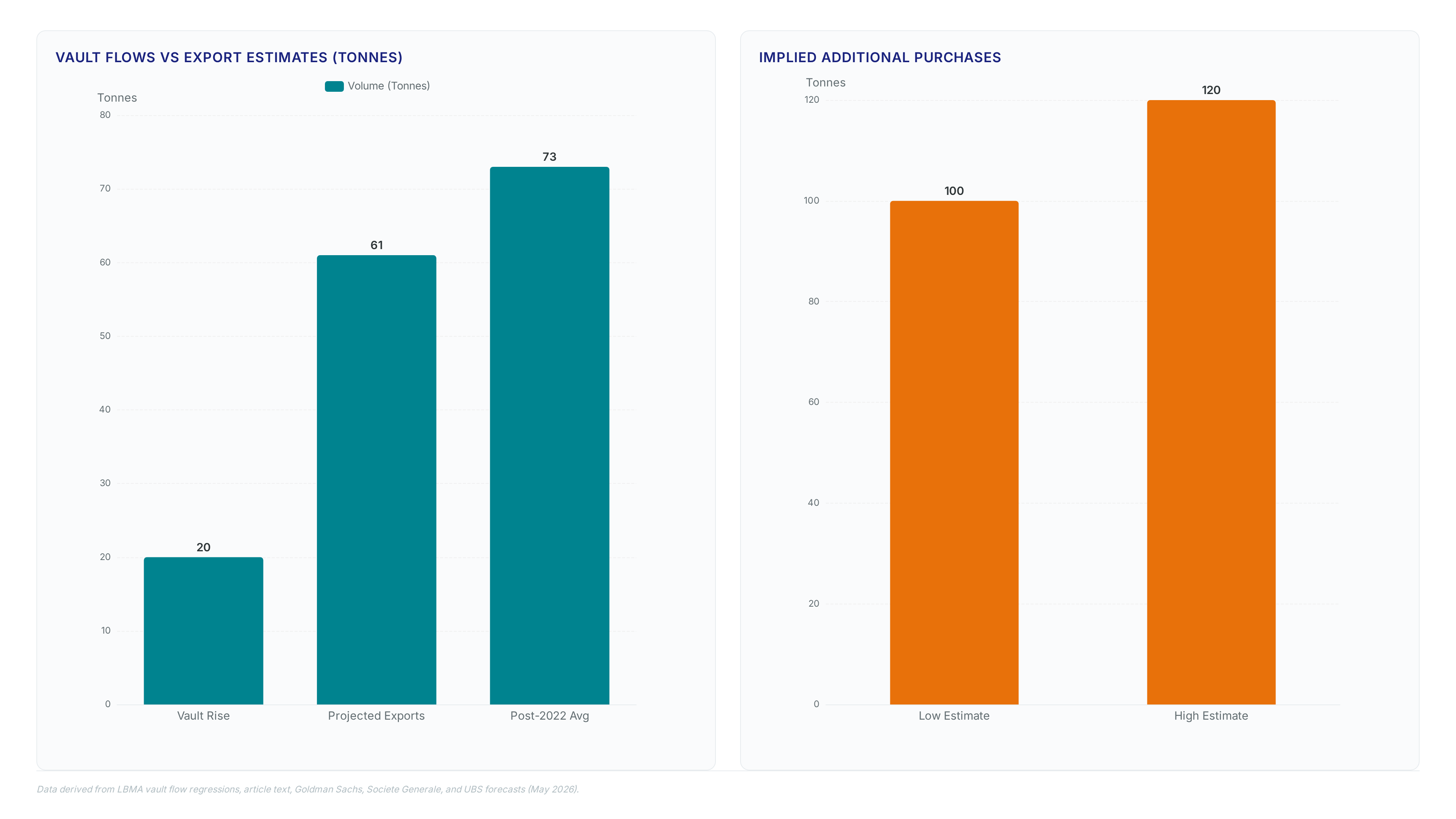
A 20‑tonne rise in vault holdings correlates mathematically to a projected increase in export activity reaching 61 tonnes. This regression framework translates static inventory shifts into flexible trade flow estimates, bypassing the noise of self-reported survey intentions. The mechanism relies on observing physical movement rather than the policy, as actual outflows from LBMA vaults provide the raw input for the calculation. 61 tonnes indicates a recovery in underlying demand. The figure stays below the post-2022 average of 73 tonnes, suggesting the market has not yet returned to peak transactional velocity. Dependency on reported trade data creates a specific constraint, as these figures often arrive with a lag compared to real-time vault adjustments. Operators must account for this temporal disconnect when timing entry or exit strategies based on flow dynamics. Divergence between official sector accumulation and private capital flight further complicates the signal, as Western gold-backed ETFs continue to experience substantial liquidation pressure. Relying solely on survey sentiment ignores the mechanical reality of UK gold exports acting as the primary verification layer for central bank activity.
Translating WGC Survey Sentiment into 2026 Tonnage Targets
Applying the regression framework to current sentiment implies additional purchases of 100, 120 tonnes over the remainder of the year. This volume targets a resumption in buying activity after modest year-to-date flows, doubling the throughput recorded in the first four months. Operationalizing this forecast requires tracking LBMA vault outflows as a leading indicator of settlement. A 20‑tonne increase in these holdings mathematically aligns with a pickup in export activity to around 61 tonnes. Export levels exceeding seasonal averages signal that central banks are active. The shift from cyclical trading to a structural accumulation regime validates using short-horizon survey data over annual projections. Dominance by Turkey and Poland skews the median buyer's behavior, creating a distinct drawback for broad averages. Analysts must discount general metrics when two nations account for the majority of volume. Consequently, the regression output serves as a baseline floor rather than a precise ceiling for total demand.
Benchmarking 2026 Export Signals Against Post-2015 and Post-2022 Averages
The 61 tonnes regression-derived export figure exceeds the 53‑tonne average observed since 2015, confirming a structural lift in baseline demand despite modest year-to-date flows. Volume remains slightly below the post-2022 average of 73 tonnes, indicating the market has not yet fully normalized to the elevated purchasing pace seen during the peak accumulation years. Visible buying resumption likely occurs from Q4 2026, driven by the divergence between official sector accumulation and private Western investment. Central bank buying provides a floor, absorbing supply even as speculative capital retreats. Analysts should prioritize six-month flow data over annual survey intentions, as the latter often overestimates near-term execution capacity. Distinguishing between strategic diversification goals and immediate liquidity constraints facing reserve managers defines the current analytical challenge.
Strategic Investment Implications of Concentrated Buying and Yield Forecasts
Defining the Decoupling of Gold from Real Yield Opportunity Costs
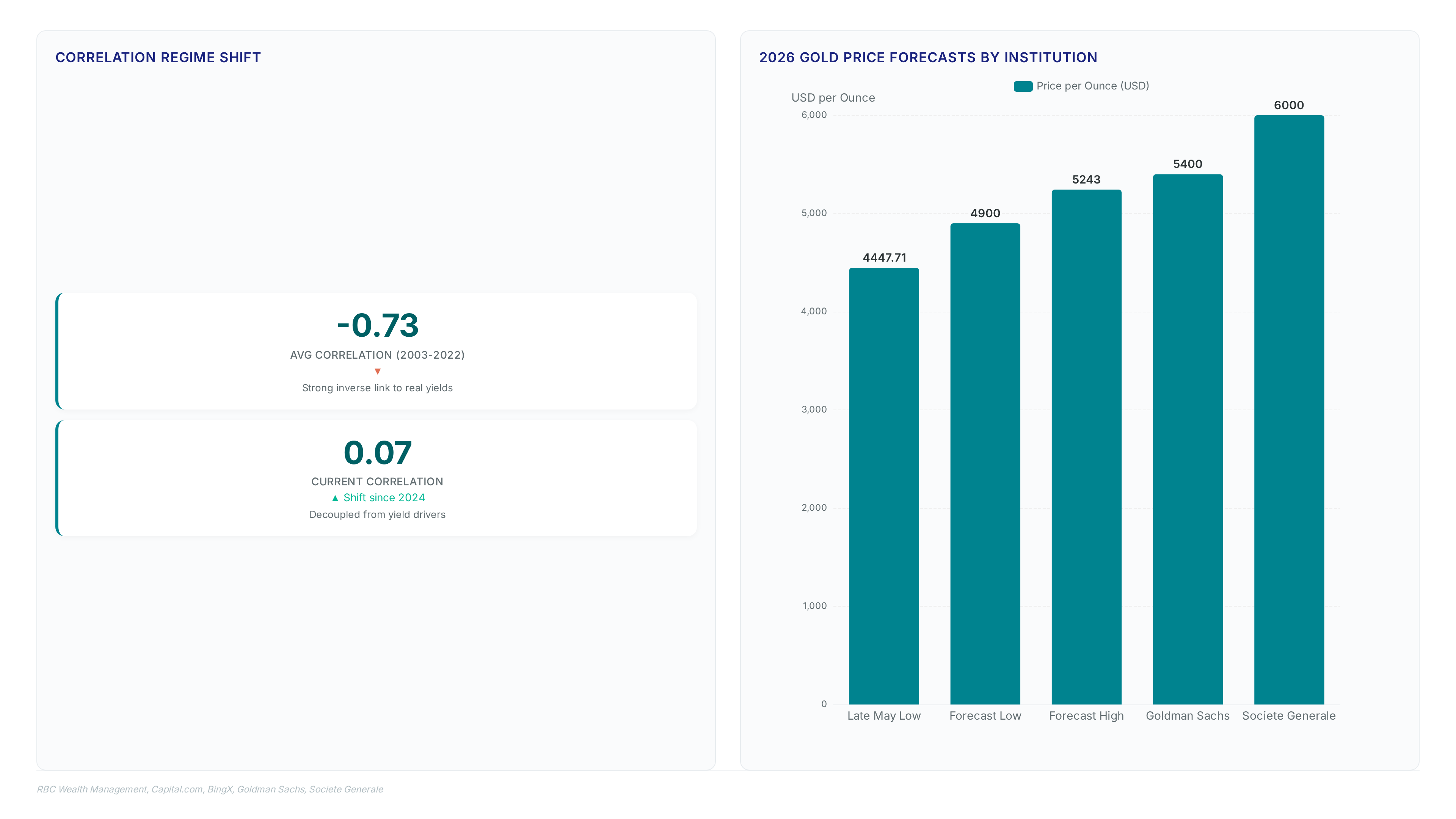
Market mechanics shifted when the historical inverse link between gold prices and US real yields fractured, with correlation dropping to just 0.07 since 2024. Rising yields no longer automatically suppress metal values because geopolitical risk now drives pricing more than opportunity cost alone. The rolling 12-month correlation averaged -0.73 from 2003 to 2022, yet recent data confirms a regime change where strategic diversification overrides yield sensitivity (source).
| Pricing Driver | Pre-2024 Mechanism | 2026 Mechanism |
| Primary Input | Real yield differential | Reserve diversification |
| Correlation | Strong negative | near-zero |
| Yield Impact | Direct suppression | Muted response |
Late May 2026 saw prices dip to $4,447.71/oz despite persistent yield pressure, highlighting the muted reaction to traditional macro signals. Investors asking if they should invest in gold in 2026 must prioritize flow data over yield curves as the old hedging logic no longer applies. Reliance on sustained geopolitical tension creates a specific constraint; should risks fade, the lack of yield support could trigger sharp corrections. Coverage Pillars recommends monitoring six-month post-survey flows rather than the intentions to capture this shifting flexible accurately.
Applying Vault Flow Regression Models to Forecast Q4 2026 Buying Resumption
Regression analysis of LBMA vault outflows predicts a buying resumption in Q4 2026, bypassing unreliable survey intentions. This mechanism translates a 20‑tonne inventory shift into a 61‑tonne export signal, exceeding the post‑2015 average. Divergent market flows validate the model, where Western ETF outflows failed to depress prices. Official sector accumulation absorbs private selling pressure with notable durability. Forecasted volume remains below the post‑2022 peak, suggesting a gradual rather than explosive recovery. Analysts must prioritize physical trade data over the reserve manager intents to time entry accurately.
Vault data confirms trends only after settlements occur, creating a lag that limits real-time application. Operators relying solely on real-time yield spikes may miss the structural floor forming beneath the market. Strategy dictates waiting for the Q4 2026 window when yield pressure eases and physical signals align. Portfolio modeling benefits from integrating these regression frameworks through Coverage Pillars. Forecasts reflect actual metal movement rather than theoretical allocation goals.
Comparing 2026 Inferred Purchase Volumes Against Historical Accumulation Averages
Societe Generale infers 100, 120 tonnes of additional buying, doubling the volume recorded in the first four months of 2026. Projected acceleration contrasts sharply with modest year-to-date flows, signaling a distinct shift from the intent to physical execution. Divergence between official accumulation and private liquidation defines the current market structure. Central banks purchased heavily in Q1 while Western investors exited via ETFs, creating a valuation gap that supports the bullish signal for 2026 (source).
| Metric | Historical Baseline | 2026 Inferred Projection |
|---|---|---|
| Volume Context | Modest YTD flows | Double early-year pace |
| Driver | Yield sensitivity | Strategic diversification |
| Private Flow | Correlated buying | Significant outflows (source) |
| Turkey Share | Substantial participant | Disproportionate actor (source) |
Activity concentration remains a key variable, with Turkey and Poland accounting for two-thirds of recent transactions. Survey intentions introduce latency, whereas the six-month post-survey window offers superior predictive accuracy for purchase volumes. Price discovery now stems from official flows rather than speculative capital. Uneven distribution of buying creates regional liquidity distortions as a notable drawback. Coverage Pillars recommends monitoring LBMA vault data to confirm the resumption of visible buying.
About
Sofia Mendes, Broker Reviews & Trading Education Editor at ForexCFD. Top, brings a disciplined, risk-aware perspective to the analysis of central bank gold demand. While her daily work focuses on vetting regulated brokers and teaching risk management to retail traders, this expertise is critical for interpreting how massive institutional flows impact market stability. By scrutinizing Societe Generale's findings on World Gold Council data and US real yields, Mendes contextualizes how sovereign buying influences the XAUUSD pairs her audience trades. Her role requires understanding the macroeconomic drivers behind gold volatility, ensuring that complex themes like central bank accumulation are translated into actionable, factual insights for traders. At ForexCFD. Top, a publication dedicated to vendor-neutral market news, Mendes connects high-level strategic shifts to practical trading education, helping investors navigate the interplay between official sector demand and price action without hype.
Conclusion
The current market structure reveals a critical fragility: liquidity distortions arise when official accumulation relies heavily on specific regional actors like Turkey and Poland. If these concentrated buyers pause, the price floor between $4,447 and $4,900 lacks the broad-based speculative support seen in previous cycles. While opportunity cost models fail to capture central bank behavior, the operational risk shifts to the speed at which Western ETF outflows exhaust available floating supply. Once this inventory dries up, even modest increases in official demand will trigger disproportionate volatility, rendering traditional yield-correlation strategies obsolete.
Investors must treat gold not as an inflation hedge but as a structural counter-balance to fragmenting reserve systems. Commit to a reallocation strategy only if LBMA vault data confirms sustained physical intake by Q4, signaling that the inferred 100, 120 tonne acceleration is materializing beyond survey intentions. Do not chase the $6,000 target based on macro theory alone; wait for the physical ledger to validate the flow.
Start by auditing your custody chain's ability to settle physical delivery requests within 48 hours before the next quarterly reporting window closes. This operational stress test ensures you can capitalize on the inevitable dislocation between paper pricing and physical availability without being forced into a fire sale during a liquidity spike.
Frequently Asked Questions
Strategic diversification now outweighs yield sensitivity for many global reserve managers. Prices stabilized between $4,447 and $4,900 levels despite high rates because official sector absorption absorbed significant selling pressure from private investors.
Western ETFs saw net outflows of $1.8 billion as private investors fled rising rate environments. This speculative exodus was offset by official sector buying that kept market prices stable during the period of significant volatility.
Regression frameworks imply additional purchases of roughly 100 to 120 tonnes over the remainder of the year. This hidden demand is double the volume recorded in the first four months of the current calendar year.
A 20-tonne increase in vault holdings correlates with export activity jumping to 61 tonnes. This signal exceeds the seasonal average of 53 tonnes, revealing demand that standard annual surveys often miss completely.
The correlation between gold and real yields collapsed to near zero, breaking the old inverse pricing model. Prices stabilized between $4,447 and $4,900 despite yields remaining above 2%, proving yield models obsolete.